Looking for things to do in Budapest? The city is two in one: Buda, on the right bank of the Danube, with Castle Hill and Fisherman’s Bastion, and Pest, flat and lively, with the Parliament, the grand boulevards and the old Jewish Quarter. Add thermal baths, bridges lit up at night and prices still lower than in Western Europe. This guide helps you choose what to do in Budapest, where to stay, when to go and how to plan a 3- to 5-day stay.
Our travel deals for Budapest
Affiliate links: we earn a commission, at no extra cost to you.
FlightsKiwi.comCompare flights and airline combinations to Budapest.
AirportsBudapest Ferenc Liszt (BUD), south-east of the cityLinked to the centre by the 100E express bus
Ideal length3 days, 4 to 5 days with the Danube Bend or Szentendre
Best timeMay-June and September; December for the Christmas markets
Time zone1 hour ahead of London, 6 hours ahead of New York
EntrySchengen area: no visa for up to 90 days for US citizens (tourism or business) and UK citizens (in any 180-day period) · travel.state.gov · GOV.UKPassport valid at least 3 months beyond your stay (US) or after leaving the Schengen area (UK)
CurrencyHungarian forint (HUF) · currenciesThe euro is not the official currency
Electricitycheck voltage and plug types before you go · plugs
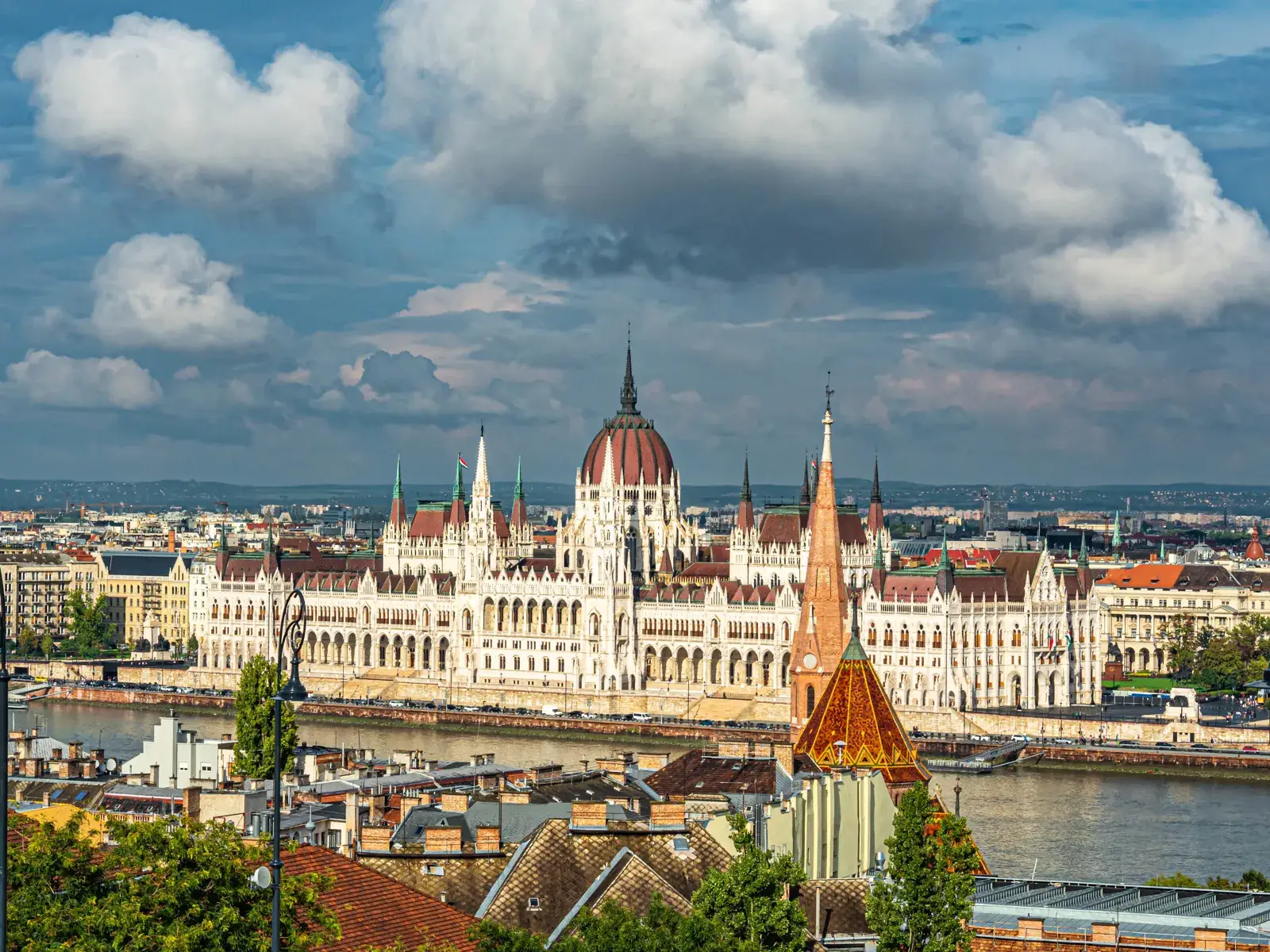
Aerial view of the Hungarian Parliament in Budapest
The Hungarian Parliament
With its neo-Gothic façade almost 270 m (886 ft) long beside the Danube, the Parliament is Budapest’s most photographed building. The interior can only be seen on a guided tour, available in several languages, and the Holy Crown of Hungary is on display. Slots sell out fast in high season: book online. For the best overall view, look at it from the Buda bank at dusk, when it is lit up.
The Shoes on the Danube Bank
A few minutes south of the Parliament, some sixty pairs of cast-iron shoes are fixed to the embankment. This memorial honours the Jews shot on the riverbank by Arrow Cross militiamen in 1944-1945. It is a place of remembrance: visit with respect.
Buda Castle Hill
On the right bank, Castle Hill (Várhegy) brings together the Royal Palace, home to the Hungarian National Gallery and the Budapest History Museum, Matthias Church with its glazed tile roof, and Fisherman’s Bastion, whose neo-Romanesque terraces look across to the Parliament and Pest. Go up by the funicular from the Chain Bridge, by bus or on foot via the steps. The medieval quarter, with its colourful houses, is easy to explore in half a day. Arrive early to enjoy the Bastion before the groups.
The Chain Bridge and the Danube banks
The first permanent bridge between Buda and Pest, the Chain Bridge (Széchenyi Lánchíd), guarded by its stone lions, has reopened after a long renovation. The riverside walk on the Pest side links the Parliament with Elisabeth Bridge. A boat cruise, by day or night, takes in all the riverside monuments in about an hour.
The thermal baths
Budapest sits on dozens of hot springs. The Széchenyi Baths, in City Park, are the best known: a large yellow neo-Baroque building and heated outdoor pools where people swim even in winter. The Rudas Baths, at the foot of Gellért Hill, keep an Ottoman pool under a dome, and Lukács is more popular with locals. The Art Nouveau Gellért Baths are famous for their decor: check they are open before you go. Bring a swimsuit, towel and sandals, and book online in high season.
The old Jewish Quarter and ruin bars
In District VII, the Dohány Street Synagogue is the largest in Europe. The visit includes the Jewish Museum, the memorial garden and the weeping willow memorial. The area is also home to the « ruin bars », set up in abandoned buildings: Szimpla Kert, the best known, can also be visited during the day. In the evening, Kazinczy Street and its neighbours are very lively, and noisy.
Andrássy Avenue, Heroes’ Square and City Park
A Unesco World Heritage Site, Andrássy Avenue links the centre with Heroes’ Square, flanked by the Museum of Fine Arts. It passes the Hungarian State Opera and the House of Terror, a museum devoted to the Nazi and communist regimes. Under the avenue runs metro line 1, one of the oldest on the continent. Beyond Heroes’ Square, City Park (Városliget) is home to Vajdahunyad Castle, the Széchenyi Baths and the House of Music.
St Stephen’s Basilica and the Great Market Hall
St Stephen’s Basilica, in the heart of Pest, offers a 360° view from its dome. South of pedestrian Váci Street, the Great Market Hall (Nagycsarnok), a 19th-century covered market, sells paprika, salami and fruit on the ground floor and Hungarian dishes upstairs. The souvenir stalls on the first floor are pricier than neighbourhood shops.
Gellért Hill and Margaret Island
Gellért Hill, covered in gardens, towers over the Danube. It is topped by the Liberty Statue and the Citadel, and offers one of the best views of the bridges at sunset. To the north, car-free Margaret Island is a large park with a musical fountain, pools and paths for running or cycling (bikes for hire).
Day trips from Budapest
Szentendre, a small artists’ town with Orthodox churches, is reached by suburban train (HÉV). The Danube Bend (Dunakanyar) can be explored in a day by car, bus or, in the warmer months, by boat: Visegrád fortress and Esztergom basilica, facing Slovakia. Lake Balaton, about two hours by road, draws swimmers in summer. Gödöllő, the former palace of Empress Elisabeth (Sisi), is under an hour by train.
Budapest neighbourhoods
District V (Belváros-Lipótváros): central Pest, between the Parliament, the basilica and Váci Street; convenient but more expensive
District VI (Terézváros): around Andrássy Avenue and the Opera, well connected
District VII (Erzsébetváros): the old Jewish Quarter, bars and restaurants, noisy at night
Districts VIII and IX: around the National Museum and the Great Market Hall, more residential and affordable
District I (Budavár): Castle Hill, very quiet at night but far from the nightlife
District XIII (Újlipótváros): residential, near Margaret Island
Itinerary: 3 to 5 days in Budapest
Day 1: Parliament (guided tour), the Shoes on the Danube Bank, St Stephen’s Basilica, then a Danube cruise in the evening
Day 2: Castle Hill, Matthias Church, Fisherman’s Bastion, down to the Chain Bridge, then the Rudas Baths or sunset on Gellért Hill
Day 3: Great Market Hall, the Great Synagogue and Jewish Quarter, Andrássy Avenue, Heroes’ Square and the Széchenyi Baths in the late afternoon
Day 4: day trip to Szentendre, or the Danube Bend (Visegrád, Esztergom)
Day 5: Margaret Island, the House of Terror or the Museum of Fine Arts, and an evening in a ruin bar
With only two days, combine Castle Hill and the Parliament on the first day, then the Jewish Quarter, Andrássy Avenue and a thermal bath on the second.
When to go to Budapest
The best time to visit Budapest is May to June and September: 23 to 27 °C (73 to 81 °F) in the afternoon, long evenings on terraces and pleasant outdoor baths. July and August are the hottest months (29 °C, or 84 °F, on average), with possible heatwaves and big crowds. December draws visitors for the Christmas markets, despite the dry cold. Budapest has a temperate climate with a continental edge: hot summers, cold winters around 0 °C (32 °F) at night, and moderate rain, more frequent from May to August, often as thunderstorms. For a weekend between two Central European capitals, our comparison Prague or Budapest sets climate, budget and atmosphere side by side.
The table uses normals for the Budapest city-centre station, established to World Meteorological Organization standards.
Month
Avg max
Avg min
Rain
Crowds
Prices
Verdict
January
4.7 °C (40 °F)
-1.2 °C (30 °F)
33 mm (1.3 in)
Low
Low
❌ Cold and grey, hot outdoor baths
February
7.1 °C (45 °F)
0.1 °C (32 °F)
30 mm (1.2 in)
Low
Low
⚠️ Cold but quiet, low prices
March
12.3 °C (54 °F)
3.9 °C (39 °F)
31 mm (1.2 in)
Low to moderate
Low → medium
⚠️ End of winter, changeable
April
18.8 °C (66 °F)
9.1 °C (48 °F)
33 mm (1.3 in)
Moderate (Easter)
Medium
✅ Mild spring, little rain
May
23.1 °C (74 °F)
12.8 °C (55 °F)
57 mm (2.2 in)
High
Medium → high
✅ Mild, terraces, gardens in bloom
June
26.8 °C (80 °F)
16.3 °C (61 °F)
60 mm (2.4 in)
High
High
✅ Long days, possible storms
July
28.8 °C (84 °F)
18.0 °C (64 °F)
54 mm (2.1 in)
Very high
High
⚠️ Hot, possible heatwaves
August
28.9 °C (84 °F)
17.7 °C (64 °F)
54 mm (2.1 in)
Very high
High
⚠️ Hot, festivals, crowds
September
23.1 °C (74 °F)
13.3 °C (56 °F)
46 mm (1.8 in)
Moderate to high
Medium
✅ The best compromise
October
17.2 °C (63 °F)
8.7 °C (48 °F)
44 mm (1.7 in)
Moderate
Medium
✅ Mild, autumn colours
November
10.6 °C (51 °F)
4.3 °C (40 °F)
46 mm (1.8 in)
Low
Low
⚠️ Grey, Christmas markets late in the month
December
5.1 °C (41 °F)
-0.2 °C (32 °F)
38 mm (1.5 in)
High (Christmas markets)
High over the holidays
⚠️ Cold, Christmas atmosphere
Temperatures and precipitation: World Meteorological Organization 1991-2020 climate normals for the Budapest-Belterület station (city centre, WMO no. 12840), published by NOAA (NCEI). Crowds and prices: estimate based on tourist seasons.
Spring (April-May): 19 to 23 °C (66 to 73 °F) in the afternoon; April is one of the driest months. Terraces reopen and parks bloom. Easter and May weekends are in high demand.
Summer (June-August): 27 to 29 °C (81 to 84 °F), very long evenings, outdoor baths and open-air bars. Heatwaves can push temperatures above 35 °C (95 °F), and late-afternoon storms are common. The Sziget festival, on a Danube island north of the city, is usually held in August, when accommodation prices soar.
Autumn (September-October): September stays warm (23 °C, or 73 °F) with fewer people; October is mild and colourful. It is grape harvest season in the nearby wine regions.
Winter (December-February): 5 to 7 °C (41 to 45 °F) in the afternoon, frost at night, possible snow. Steaming outdoor baths are at their most atmospheric. The Christmas markets, notably on Vörösmarty Square and in front of the basilica, usually open in mid- or late November.
Plan
Best time
City break and sights
April to June, September-October
Thermal baths
All year; winter for steaming outdoor pools
Christmas markets
Late November to December
Danube cruise, Danube Bend
May to September
Low budget, few crowds
January to March, November
Sziget and Christmas market dates change every year: check them before booking.
Budapest remains cheaper than most Western European capitals, especially for transport and meals away from the tourist streets, but inflation has pushed prices up in recent years, particularly for baths and restaurants in the centre. Rough amounts per person per day, excluding flights:
Item
Budget
Comfort
Accommodation (shared double room)
about HUF 9,000 to 17,000
about HUF 24,000 to 48,000
Meals
about HUF 7,000 to 10,000
about HUF 13,000 to 22,000
Transport (metro, tram, bus)
about HUF 1,000 to 2,000
about HUF 2,000 to 4,000
Sights and baths
about HUF 4,000 to 7,000
about HUF 9,000 to 15,000
Total per day
roughly HUF 20,000 to 35,000 per person per day
roughly HUF 48,000 to 84,000 per person per day
Rough estimates converted at the ECB reference rate of 23 October 2026; they vary with the season and the forint exchange rate. Accommodation prices peak in summer, during Sziget and at the end of the year.
To keep costs down: have a lunchtime set menu (napi menü) in a neighbourhood restaurant, buy a multi-day transport pass, and enjoy the free views from Gellért Hill, Fisherman’s Bastion (lower terraces) and the embankments.
Getting around Budapest
From the airport: the 100E express bus links the airport with central Pest (Deák Ferenc tér) and needs a special ticket. The 200E bus connects with metro line M3 at Kőbánya-Kispest. For a taxi, use the official rank outside the terminal.
On foot: central Pest is walkable; Castle Hill involves a bit of a climb.
Metro, tram and bus: four metro lines, trams and buses. Tram 2, along the Danube on the Pest side, has views of Buda and the castle. Buy tickets from machines or the official app and validate them: according to the UK FCDO (GOV.UK, updated 23 September 2026), you must validate at the metro entrance or immediately after boarding a bus or tram, validate a new ticket each time you change line, keep it until the end of the journey and use a special ticket for night services; otherwise you could be fined.
Boats: public river shuttles run on the Danube; they are included in some passes.
Train: three main stations (Keleti, Nyugati, Déli) serve the country and neighbouring capitals, including Vienna.
Car: unnecessary in the city. Hungary has a no-alcohol driving policy: it is illegal to drink any alcohol and then drive (GOV.UK).
Budapest airport transfer: 100E bus, 200E bus and taxi
Budapest Ferenc Liszt airport has no metro or direct train to the centre: the public connection is by bus, either the 100E express (direct, special ticket) or the 200E (connecting with the metro).
100E express bus
Run by BKK, the 100E links the airport with Deák Ferenc tér. According to BKK’s official Airport Express page (checked 26 October 2026), you need a special « Airport shuttle bus single ticket » at HUF 2,500, which can be bought by bank card on board; holders of certain Budapest passes can buy a HUF 1,000 add-on ticket instead. Citizens of any country over 65 travel free. The ticket is valid for one trip on the 100E only.
200E bus + metro
The 200E links the airport with metro line M3 at Kőbánya-Kispest: useful at night or if you already have a pass. Check ticket validity and timetables on bkk.hu.
Official taxi
Use the official airport taxi rank outside the terminal exits; fares are metered.
Option
Where to catch it
Official fare
Source
100E bus
Terminal 2 stop
HUF 2,500 (special ticket)
bkk.hu
200E bus + metro M3
Terminal 2 stop
See bkk.hu
bkk.hu
Official taxi
Terminal exits
Meter
Budapest Airport
Booking a transfer in Budapest
A private transfer booked in advance (driver waiting on arrival, price fixed at booking) mainly makes sense for a late arrival, bulky luggage, families with young children or groups sharing the cost. Before booking, check what the price includes (tolls, luggage, waiting time if your flight is late), the exact meeting point in the terminal, the cancellation terms and the name of the company that actually provides the ride.
For a first visit, stay in Pest, in District V, VI or VII: you will be within walking distance of the main sights, restaurants and transport. District VII is ideal for going out but noisy at weekends; ask for a room facing the courtyard. Districts VIII and IX are quieter and often cheaper. On the Buda side, Castle Hill and the areas at the foot of Gellért Hill suit a quiet stay, with longer journeys for evenings out.
Many apartments are in large old buildings with inner courtyards, not always with a lift or air conditioning, which is useful in July and August. For summer, Sziget and the end-of-year holidays, book several months ahead.
Entry requirements, health and safety
US citizens: Hungary is in the Schengen area: you may enter for up to 90 days for tourism or business without a visa. Your passport should be valid at least three months beyond your stay, and you need sufficient proof of funds and a return ticket (U.S. Department of State, travel.state.gov, last updated April 23, 2026).
UK citizens: no visa for up to 90 days in any 180-day period as a tourist. Your passport must have been issued less than 10 years before the day you arrive and be valid at least 3 months after the day you plan to leave the Schengen area. The EU Entry/Exit System (EES) is being implemented: fingerprints and a photo may be taken at your first entry, free of charge (UK FCDO, GOV.UK, updated 23 September 2026).
ID: always carry your passport: you must show ID if the police ask, and a copy is not acceptable (GOV.UK).
Health: UK travellers need a GHIC or EHIC for medically necessary state healthcare (GOV.UK); whatever your nationality, take out travel insurance covering medical costs.
Theft and scams: bag-snatching and pickpocketing are common, especially in Budapest (GOV.UK). GOV.UK also reports that some bars, clubs and restaurants charge very high amounts, with tourists taken to cash machines to pay, and that some taxi drivers earn commissions for recommending them; drinks have been spiked, particularly in Budapest’s bars. Ask for the price list, check your bill and never leave your drink unattended.
Demonstrations: political demonstrations are held in Budapest, often on national holidays such as 15 March and 23 October (GOV.UK).
Money: use official cash machines, preferably inside banks, and never change money on the street (GOV.UK).
Money: cards are accepted almost everywhere. If a terminal offers to charge you in your home currency or euros, choose forints to avoid an unfavourable conversion. Withdraw cash from bank machines rather than independent ones.
Tipping: in restaurants, a tip of about 10% is common. Check the bill: a service charge (szervízdíj) is often already added.
Baths: bring a swimsuit, sandals and towel; some pools require a swimming cap.
Mobile data: check your home carrier’s roaming charges before you go.
Language: Hungarian is unlike any neighbouring language; English is widely spoken in the centre. « Jó napot » (hello) and « köszönöm » (thank you) are appreciated.
Who is Budapest for?
Couples: yes: an evening Danube cruise, illuminated bridges, sunset on Gellért Hill and thermal baths.
Culture and history: yes: the Parliament, Castle Hill, the Great Synagogue, the House of Terror, the Museum of Fine Arts.
Nightlife: yes: the ruin bars of District VII, very lively and noisy at night.
Budget travellers: fairly: roughly HUF 20,000 to 35,000 per person per day, cheaper than many Western European capitals for transport and meals, even if inflation has pushed prices up.
Short breaks: ideal: three days are enough for the essentials.
Winter: yes for the Christmas markets and steaming outdoor baths, despite the night frost.
Three days let you see the Parliament, Castle Hill and the Jewish Quarter and enjoy a thermal bath. Allow four to five days to add Szentendre or the Danube Bend.
What is the best time to visit Budapest?
May-June and September, with 23 to 27 °C (73 to 81 °F) in the afternoon according to the 1991-2020 normals for the city-centre station. December is popular for the Christmas markets, despite the cold.
Can you pay in euros in Budapest?
The official currency is the forint. Some tourist businesses accept euros, but often at a poor rate: pay in forints, by card or with cash withdrawn from a bank machine.
How do you get from the airport to central Budapest?
The 100E express bus links the airport with central Pest (Deák Ferenc tér) and costs HUF 2,500 for a special ticket, according to BKK. The 200E bus connects with the metro, and official taxis wait outside the terminal.
Which thermal baths should you choose in Budapest?
Széchenyi for its large outdoor pools and neo-Baroque decor, Rudas for its Ottoman pool and panoramic pool, Lukács for a more local atmosphere. Book online in high season.
Is Budapest safe?
Generally yes, but GOV.UK reports common pickpocketing and bag-snatching, overcharging in some bars and clubs, and drink spiking in Budapest’s bars: check your bill and keep an eye on your drink.
Our sources
Budapest climate normals: World Meteorological Organization 1991-2020 climate normals for the Budapest-Belterület station (city centre, WMO no. 12840), published by NOAA (NCEI)


 FlightsKiwi.comCompare flights and airline combinations to Budapest.Compare flights