What are the best things to do in Seoul in a few days? The city mixes Joseon dynasty palaces, lanes of traditional houses, markets open day and night and brand-new tower districts, all crossed by the Han River and ringed by mountains. The extensive subway, signposted in English, makes the city easy to get around. This guide helps you choose your neighborhoods, sights and day trips for a 3- to 6-day stay.
Safety note: the U.S. Department of State rates South Korea Level 1: Exercise Normal Precautions, while noting that tensions on the Korean Peninsula remain high. The UK FCDO (GOV.UK, updated 14 May 2026) points out that peace across the demilitarized zone (DMZ) is maintained under an armistice, with no formal peace treaty: if you take a DMZ tour from Seoul, exercise caution and follow local instructions.
Our travel deals for Seoul
Affiliate links: we earn a commission, at no extra cost to you.
FlightsKiwi.comCompare flights and airline combinations to Seoul.
AirportsIncheon (international, linked by the AREX train and buses) and Gimpo (closer, mostly domestic and regional flights)
Ideal length4 to 5 days, plus one or two day trips (Suwon, Incheon, Bukhansan mountains)
Best timeApril to early June and late September to early November
Time zoneUTC+9, no daylight saving time (14 hours ahead of New York and 9 hours ahead of London in winter); see time difference with South Korea
EntryUS and UK citizens: visa-free for short tourist stays, K-ETA exemption until 31 December 2026 (details below; travel.state.gov, GOV.UK)
CurrencySouth Korean won; cards accepted almost everywhere
Electricity220 V, 60 Hz, type C and F plugs (CIA World Factbook); US and UK travelers need an adapter, and US devices must accept 220 V
Budget estimateroughly KRW 90,000 to 150,000 per person per day on a tight budget, KRW 220,000 to 415,000 for comfort
Things to do in Seoul: the highlights
Gyeongbokgung Palace and Gwanghwamun
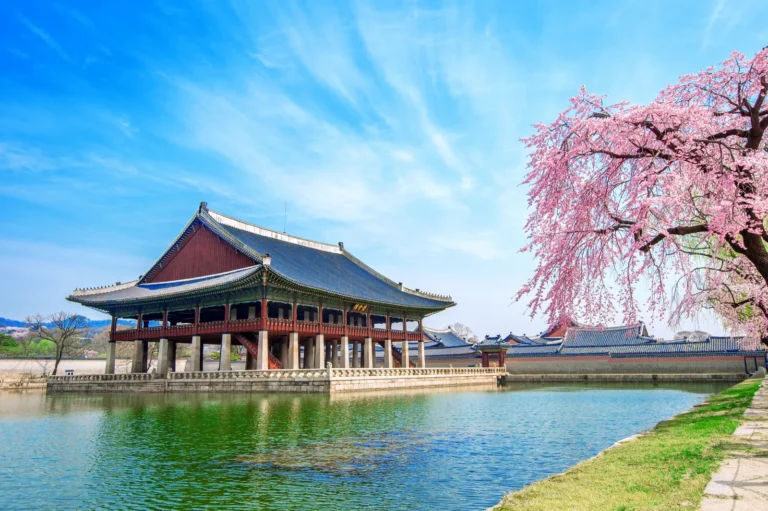
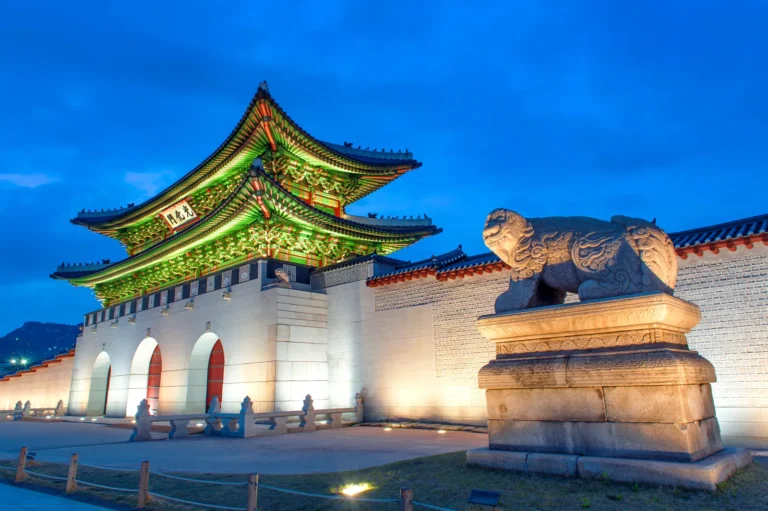
Gyeongbokgung is the largest of Seoul’s five royal palaces, built in the late 14th century at the start of the Joseon dynasty, then destroyed and rebuilt several times. You can see the throne hall, the Gyeonghoeru pavilion set on a pond and the changing of the guard at the main gate. Visitors wearing a hanbok, the traditional dress, generally get in free, and rental shops surround the palace. On site, the National Folk Museum shows Korean daily life. In front of the palace, Gwanghwamun Square has the statues of King Sejong and Admiral Yi Sun-sin.
Changdeokgung and its Secret Garden
Changdeokgung Palace, a UNESCO World Heritage Site, is admired for the way its buildings blend into the landscape. Its rear garden, Huwon or the « Secret Garden », with pavilions and ponds, can generally be visited only on guided tours at set times with limited places: book or arrive early. It is one of Seoul’s finest sights in autumn. Like the other palaces, Changdeokgung closes one day a week: check before you go.
Bukchon, Insadong and Ikseon-dong
Between Gyeongbokgung and Changdeokgung, the Bukchon neighborhood preserves hundreds of hanok, traditional tile-roofed houses. People live in them: the city has introduced visiting hours and restricted-access zones, so follow the signs and keep quiet. A few minutes away, Insadong is lined with galleries, craft shops and teahouses, and Ikseon-dong has cafés and restaurants set in old low houses.
Myeongdong, Namsan and N Seoul Tower
Myeongdong is the shopping and cosmetics district, very lively in the evening with its street-food stalls. To the south, you can climb Namsan hill on foot or by cable car to N Seoul Tower, with views over the whole city and the mountains. The path along the old city wall, on the slopes of Namsan, makes a lovely walk, especially in spring and autumn.
Markets: Gwangjang, Namdaemun and Dongdaemun
Gwangjang, one of the city’s oldest markets, is best known for its food counters: mung bean pancakes (bindaetteok), small rice rolls (gimbap) and noodles. Namdaemun, near the gate of the same name, sells everything. Further east, Dongdaemun is the fashion district, with malls open late and Dongdaemun Design Plaza, a curving building designed by architect Zaha Hadid.
Cheonggyecheon and the Han River
The Cheonggyecheon stream was uncovered again in the early 2000s: its walkway crosses the center for several kilometers, cool and below street level. To the south, the Han River is lined with parks where Seoulites picnic, cycle and meet in the evening, notably at Yeouido and Banpo, where a fountain lights up the bridge in season.
Hongdae, Itaewon and Gangnam
Hongdae, around Hongik University, is the student district of buskers, bars and clubs. Itaewon is more cosmopolitan, with many international restaurants. South of the river, Gangnam has office towers, shops and the COEX mall with its large library; nearby, Bongeunsa Buddhist temple offers a striking contrast. See our nightlife safety tips below.
Lotte World Tower and Seoul Sky
In Jamsil, in the southeast of the city, Lotte World Tower rises to 555 m (1,821 ft) with 123 floors: it is the tallest skyscraper in Korea. Its observatory, Seoul Sky, occupies floors 117 to 123. The tower, opened in 2017, connects directly to Jamsil station (subway lines 2 and 8) and the Lotte World Mall. Go on a clear day, late in the afternoon, to see the city by day and then lit up. Before you leave, our guide to the K-ETA covers entry formalities.
Museums and day trips from Seoul
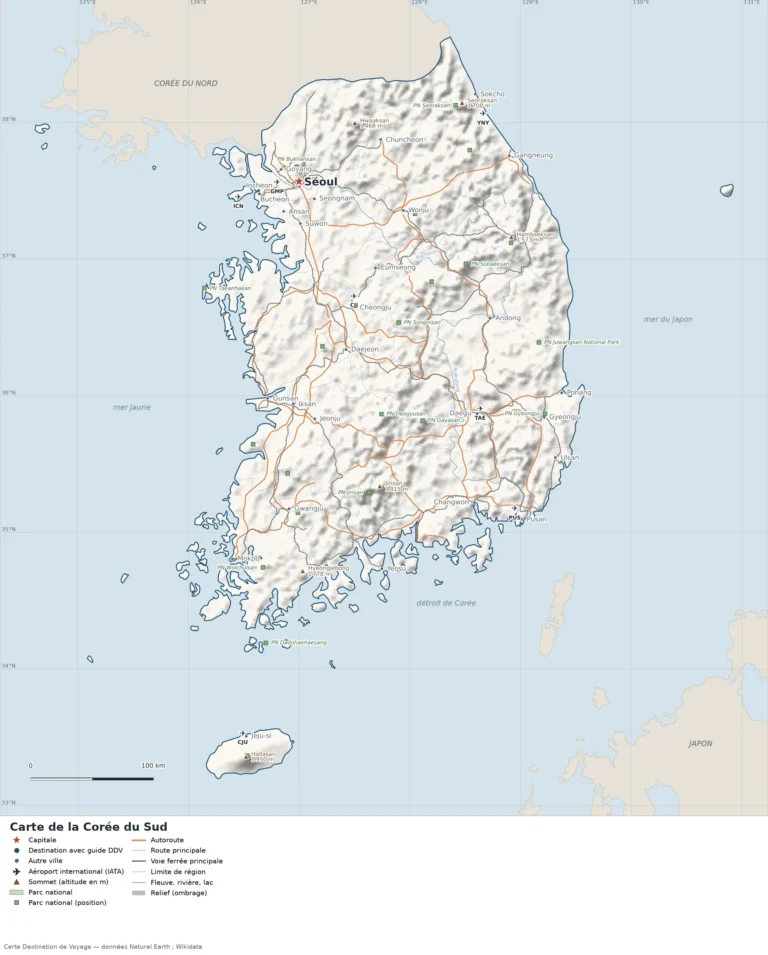
The National Museum of Korea, in Yongsan, presents the country’s history and art from prehistory to the Joseon dynasty; the nearby War Memorial of Korea covers the 1950-1953 conflict. To leave the city, Hwaseong Fortress in Suwon, a World Heritage Site, is reached by subway or train and explored on foot along its walls. Hikers will enjoy Bukhansan National Park, accessible by public transport. As for the DMZ, see the safety note at the top of this page.
Seoul neighborhoods
Myeongdong and the center (Jung-gu): very well connected, many hotels in all categories, ideal for a first visit
Jongno, Insadong and Bukchon: near the palaces, a more traditional feel, some hanok stays
Hongdae: young and lively, affordable accommodation, handy for the airport (AREX line)
Dongdaemun: moderate prices, late shopping, good subway connections
Gangnam: modern, business hotels, further from the palaces
Itaewon and Yongsan: international restaurants, near the National Museum
Itinerary: 3 to 6 days in Seoul
Day 1: Gyeongbokgung Palace and the National Folk Museum, Gwanghwamun Square, then a walk along Cheonggyecheon; Myeongdong in the evening
Day 2: Bukchon early in the morning, Changdeokgung Palace and its Secret Garden, Insadong and Ikseon-dong; dinner at Gwangjang market
Day 3: National Museum of Korea and the War Memorial, then Namsan and N Seoul Tower at sunset
Day 4: Gangnam, Bongeunsa temple and COEX, Lotte World Tower in Jamsil, then the Han River parks; evening in Hongdae
Day 5: Hwaseong Fortress in Suwon
Day 6: hiking in Bukhansan National Park or a day in Incheon
A weekend in Seoul: a 2-day plan
With only two days, stay in the historic north and the center, a few subway stops apart:
Saturday: Gyeongbokgung Palace at opening time, Gwanghwamun Square, then Bukchon and Insadong; dinner at Gwangjang market
Sunday: Changdeokgung Palace, a walk along Cheonggyecheon to Myeongdong, then Namsan and N Seoul Tower at sunset
At weekends, Bukchon, the palaces and Myeongdong are very busy: start early. To continue to Busan or Gyeongju, KTX high-speed trains leave mainly from Seoul and Yongsan stations. Our guide to Busan, Korea’s second city covers beaches, markets and temples.
Where to stay in Seoul
The key is to be a few minutes’ walk from a subway station, ideally on a line serving the center (lines 1 to 5) or the airport (AREX). Myeongdong and Jongno suit a first visit; Hongdae and Dongdaemun are more affordable; Gangnam suits business trips or stays focused on the south of the city.
Options range from hostels and small guesthouses to chain hotels and hanok converted into guesthouses, an experience worth a night or two. Rooms in mid-range hotels are often compact: check the stated size.
Getting around Seoul
Subway: the network covers the whole metropolitan area; stations, maps and announcements are in Korean and English, and lines are identified by a number and a color.
Transport card: the rechargeable T-money card is sold and topped up in convenience stores and stations. It works on the subway, buses and many taxis, with discounted transfers.
From Incheon Airport: the AREX train runs to Seoul Station (express or all-stop services); « limousine » buses serve the main districts and hotels.
Apps: Naver Map and KakaoMap are more accurate than the usual mapping apps for walking and transit directions.
Taxi: affordable for short trips; show the driver the address in Korean.
High-speed train: KTX trains link Seoul to Busan, Gyeongju and Gangneung.
When to go to Seoul
✓ Ideal~ Good, with caveats✕ AvoidAverage max. temperature · click a month to see where to go
✅ Best months: April, may, June, October, November
❌ Period to avoid: July, August
The best periods are April to early June and late September to early November: 18 to 27 °C (64 to 81 °F) in the afternoon according to KMA normals, with cherry blossoms in early April and autumn leaves in late October. Winter is very cold (−5.5 °C / 22 °F at night in January) but dry; July and August are hot and very wet. Month-by-month climate and events: see our article when to go to Seoul.
Budget for a trip to Seoul
Meals and transport are generally reasonably priced in Seoul, and accommodation remains affordable outside peak periods. Estimates per person per day, excluding flights, converted from euros at the European Central Bank rate of 23 October 2026:
Item
Tight budget
Comfort
Accommodation (per person, sharing a double room)
about KRW 37,000 to 67,000
about KRW 104,000 to 222,000
Meals
about KRW 30,000 to 52,000
about KRW 67,000 to 119,000
Transport in the city
about KRW 6,000 to 12,000
about KRW 15,000 to 30,000
Sights and activities
about KRW 7,000 to 22,000
about KRW 37,000 to 59,000
Total per day
roughly KRW 90,000 to 150,000
roughly KRW 220,000 to 415,000
Rough estimates, varying with the season and the won exchange rate.
To cut costs: have a set lunch in small neighborhood restaurants, eat at markets, and make the most of free or cheap sights (the Han riverbanks, Cheonggyecheon, the Namsan wall, the National Museum of Korea, whose permanent collections are free).
Entry requirements, health and safety
US citizens: according to the U.S. Department of State (travel.state.gov, last updated August 11, 2025), you need a valid US passport; a visa is required for employment, teaching English and stays longer than 90 days. The State Department page still mentions a K-ETA exemption that ran to December 31, 2024; a later notice from the Embassy of the Republic of Korea in the United States (overseas.mofa.go.kr, 29 December 2025) states that the temporary K-ETA exemption, which includes the USA, runs from January 1 to December 31, 2026.
UK citizens: according to the UK FCDO (GOV.UK, updated 14 May 2026), you can enter for up to 90 days for tourism with an onward or return ticket; your passport must expire after the date you leave. British nationals are temporarily exempt from K-ETA until 31 December 2026; if you apply anyway, use only the official K-ETA website, as other sites are generally scams. Without a K-ETA, fill in the arrival card on paper or online as a free e-Arrival card up to 72 hours before arrival.
Health: the UK FCDO advises checking the latest vaccine recommendations for South Korea, and the U.S. Department of State recommends keeping CDC-recommended vaccinations up to date. Western-style medical facilities are available in large cities, but not all staff speak English (U.S. Department of State).
Demonstrations: they are common, particularly near the U.S. Embassy and Seoul City Hall (U.S. Department of State). Under Korean law, it is illegal for foreign nationals to take part in political activities, including demonstrations (UK FCDO).
DMZ: exercise caution in the DMZ area and follow local instructions (UK FCDO).
Weather and alerts: heavy rain and flooding can occur in the June-August monsoon (U.S. Department of State), and the typhoon season normally runs from June to November (UK FCDO). The government’s Emergency Ready App explains the emergency alerts sent to your phone. Air pollution, including yellow dust, is common in spring.
Emergencies: 112 police, 119 ambulance and fire.
Practical tips for Seoul
Money: cards are accepted almost everywhere, even for small amounts; keep a few notes for markets and street stalls.
Internet: a data SIM or eSIM makes map and translation apps easier to use.
Etiquette: speak quietly on the subway, leave seats reserved for older people and pregnant women free, and take your shoes off in homes and some traditional restaurants.
Tipping: it is not customary in Korea.
Tax refund: purchases in shops displaying « Tax Free » may qualify for a tax refund, with your passport.
Language: English is understood in hotels and tourist sites, less so elsewhere; a translation app helps.
Seoul: which travelers is it for?
Our view by traveler profile, based on the details in this guide (places, budget, seasons).
Profile
Our view
Why
Couple
Good fit
N Seoul Tower at sunset, a night in a hanok, a walk along the Han River.
Family
Good fit
National Museum, palaces, Han River parks and an easy subway; long-haul flights for most visitors.
Tight budget
Good fit
Roughly KRW 90,000 to 150,000 a day; meals and transport generally affordable.
Culture
Excellent fit
Joseon dynasty palaces, Bukchon, the National Museum, Suwon fortress.
Three days let you see the palaces, Bukchon, Insadong, Myeongdong and Namsan. Allow five to six days to add the museums, Gangnam, Hongdae and a day trip to Suwon or the mountains.
Which neighborhood should you stay in in Seoul?
Myeongdong or Jongno for a first visit, near a subway station. Hongdae and Dongdaemun are more affordable; Gangnam suits you if your plans focus on the south of the river.
How do you get from Incheon Airport to central Seoul?
The AREX train links the airport to Seoul Station, with express and all-stop services. « Limousine » buses also serve the main districts and hotels.
Can you visit the DMZ from Seoul?
Tours exist. The UK FCDO notes that peace is maintained under an armistice with no formal peace treaty, and advises caution and following local instructions in the DMZ area. Check the latest travel advice and your insurance before booking.
What can you do in Seoul in a weekend?
On Saturday, Gyeongbokgung, Bukchon, Insadong and then Gwangjang market; on Sunday, Changdeokgung, Cheonggyecheon, Myeongdong and Namsan at sunset. Everything is doable by subway and on foot.
Is Seoul expensive?
Allow roughly KRW 90,000 to 150,000 per person per day on a tight budget, KRW 220,000 to 415,000 for comfort. Accommodation is the biggest expense; the subway and market food remain affordable.
Is Seoul safe?
The U.S. Department of State rates South Korea Level 1: Exercise Normal Precautions. Stay away from large demonstrations, which foreigners are not allowed to join, and keep an eye on your drink in nightlife areas.
U.S. Department of State, South Korea country information (travel.state.gov, last updated August 11, 2025) and South Korea travel advisory (Level 1), read on 26 October 2026
Embassy of the Republic of Korea in the United States, K-ETA exemption notice (29 December 2025)


 FlightsKiwi.comCompare flights and airline combinations to Seoul.Compare flights