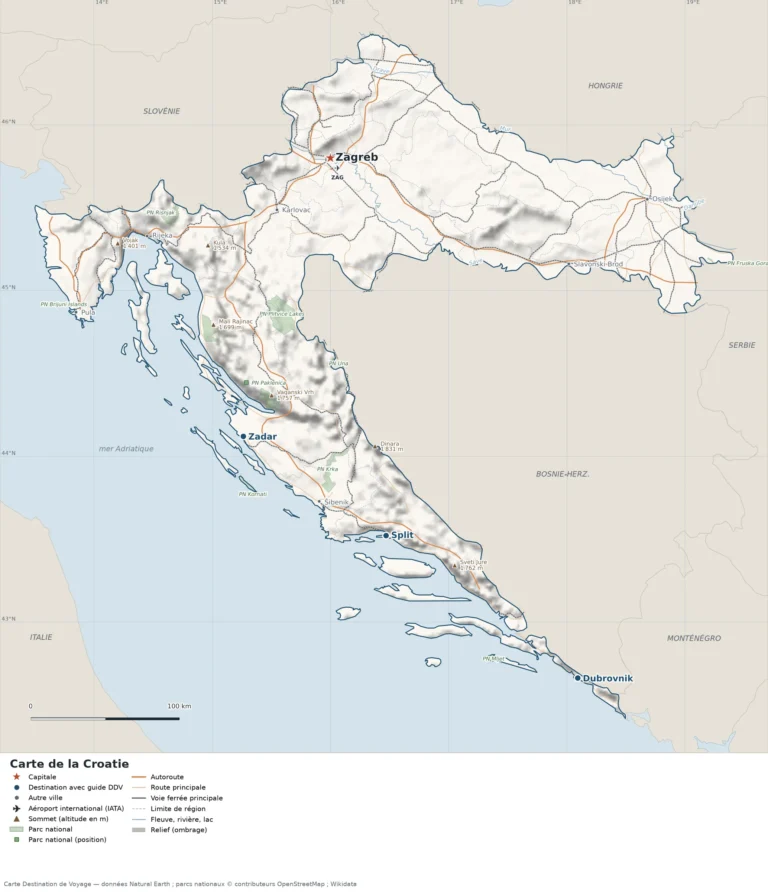
Dubrovnik sits on a rocky promontory in southern Dalmatia, a few kilometers from Bosnia and Herzegovina and Montenegro. Its old town, entirely enclosed by walls and a UNESCO World Heritage Site, can be walked in a few hours, but deserves two to three days with the nearby islands. To visit Dubrovnik, this guide helps you choose your sights, your neighborhood and your day trips, and avoid the busiest hours.
Our travel deals for Dubrovnik
Affiliate links: we earn a commission, at no extra cost to you.
FlightsKiwi.comCompare flights and airline combinations to Dubrovnik.
AirportsDubrovnik Airport (Čilipi), southeast of the city, linked to the center by shuttle bus, city bus and taxi
Ideal length2 to 3 days, plus 1 to 2 days of day trips
Best timeMay-June and September
Time zoneUTC+1, UTC+2 in summer (same as Paris and Berlin; one hour ahead of London, six hours ahead of New York)
EntryUS and UK citizens: no visa for up to 90 days in any 180-day period (Schengen area) (travel.state.gov, GOV.UK)
Currencyeuro
Budget estimateroughly €90 to €150 per person per day on a tight budget, €200 to €350 for comfort, more in July-August
Things to do in Dubrovnik: the highlights
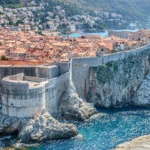
Walking the city walls
This is Dubrovnik’s main sight: a wall walk of about 2 km (1.2 mi) that circles the whole old town, with towers, bastions and constant views over the tiled roofs and the sea. There is an entry fee and the route runs one way. Allow 1 h 30 to 2 hours with breaks. In summer, start at opening time: there is little shade and the stone holds the heat. Bring water and a hat.
The Stradun and the old town
The Stradun (or Placa), the main limestone-paved street, crosses the old town from the Pile Gate to the Ploče Gate. Around it you will find Onofrio’s Great Fountain, the Franciscan monastery and its old pharmacy, St Blaise’s Church, Orlando’s Column, the Clock Tower and the Sponza Palace. The stepped lanes climbing on either side of the Stradun are quieter, even in summer.
Rector’s Palace and the cathedral
The Rector’s Palace, seat of government of the former Republic of Ragusa, now houses the city’s history museum. Next door, the Cathedral of the Assumption keeps a treasury of reliquaries. The Dominican monastery, near the Ploče Gate, has a cloister and a collection of religious art. A combined ticket often covers several city museums: ask on site.
Fort Lovrijenac
Perched on a rock outside the walls, west of the Pile Gate, Fort Lovrijenac offers one of the best views of the old town. It is used as a stage for Summer Festival performances. Its ticket is often combined with the walls ticket: check when you buy.
Mount Srđ and its cable car
A cable car runs from the old town to the top of Mount Srđ, at about 400 m (1,312 ft). The view takes in Dubrovnik, the Elaphiti Islands and the coast. Fort Imperial, at the summit, houses a museum about the 1991-1995 war. You can also walk up a zigzag path exposed to the sun: avoid it in the middle of the day in summer.
Lokrum island
About fifteen minutes by boat from the old port, Lokrum is a small wooded island and nature reserve, with a botanical garden, the ruins of a Benedictine monastery, rocky coves and a small salt lake, the « Dead Sea ». Boats run in season, from spring to autumn. You cannot stay overnight: make sure you catch the last boat back.
Beaches and Lapad
Dubrovnik has no large sandy beach. The closest to the old town are Banje, a pebble beach facing the walls, and the concrete-and-rock bathing spots at the foot of the cliffs. The Lapad peninsula, to the west, is full of hotels and coves, with a long seafront promenade. Water shoes are useful on pebbles and rocks.
Cavtat and the Elaphiti Islands
To the south, the small town of Cavtat, reachable by boat or bus, has a quiet harbor and walks around its peninsula. To the northwest, the Elaphiti Islands (Koločep, Lopud, Šipan) make a day trip by ferry or tour: car-free villages, paths through the pines and a sandy beach on Lopud. Further away, the Pelješac peninsula (wines, Ston oysters) and the Bay of Kotor in Montenegro are popular day trips.
What else to do in Dubrovnik
Follow the Game of Thrones filming locations: the old town stood in for King’s Landing from season 2
Step into the monasteries: the Franciscan monastery houses a pharmacy founded in 1317, one of the oldest in Europe still operating; the Dominican monastery is the old town’s other great convent
Go sea kayaking below the walls or out to Lokrum
Attend the Dubrovnik Summer Festival: theater and concerts in historic venues
Tip: the old town is packed when cruise ships arrive. Walk the walls and the Stradun early in the morning or late in the day.
Dubrovnik neighborhoods
Old town (Grad): the most convenient for sightseeing and evenings, but expensive, noisy in summer and car-free: you will carry your luggage up steps
Ploče: just east of the walls, views of the old town, close to Banje beach
Pile: to the west, the gateway to the old town and the hub of city buses
Lapad and Babin Kuk: hotel districts with sea access, quieter, 15-20 minutes by bus from the center
Gruž: ferry port and bus station, handy for day trips, less charming
Itinerary: 3 to 5 days in Dubrovnik
Day 1: city walls at opening time, the Stradun, Franciscan monastery, Rector’s Palace; sunset from Fort Lovrijenac or Mount Srđ
Day 2: morning on Lokrum, afternoon swim at Banje or Lapad, evening in the old town
Day 3: boat trip to the Elaphiti Islands, or a visit to Cavtat
Day 4: day trip to the Bay of Kotor in Montenegro (border crossing: bring your passport), or the Pelješac peninsula and Ston
Day 5: Mount Srđ cable car, the old town museums and the Ploče district
With only two days, focus on the walls, the old town and Lokrum. Dubrovnik combines easily with Split (several hours by road or ferry depending on the connection) and with Montenegro.
Dubrovnik airport transfer: shuttle, city bus, taxi and private transfer
Dubrovnik Airport is southeast of the city, and journey times grow in summer traffic. The old town is pedestrianized: whichever option you choose, you will finish on foot, often with steps.
The Platanus airport shuttle
According to the operator’s official site (platanus.hr, checked 26 October 2026), the shuttle leaves about 30 minutes after each flight arrival. It stops near the Ploče Gate, by the old town (about 30 minutes), then ends at Gruž bus station (about 35 minutes). Tickets cost €10 one way and €15 return; a one-way ticket is valid on any departure on the day of travel, a return ticket for 15 days. You can book online, buy at the booth near arrivals or at bus station ticket offices, by cash or card.
City buses and taxis
Libertas Dubrovnik city buses also serve the airport: check routes, timetables and fares on the Libertas website. Taxis wait outside the arrivals hall; ask for the fare before you set off and for a receipt at the end.
Option
Where to catch it
Official fare
Source
Platanus shuttle
Outside arrivals
€10 one way, €15 return
platanus.hr
Libertas city bus
Airport stop
See Libertas
libertasdubrovnik.hr
Taxi
Outside arrivals
Ask before setting off
—
Destination de Voyage calculation (based on Platanus fares): the €15 return is €5 cheaper per person than two one-way tickets, a saving of €20 for a family of four. If you are staying in Pile, Lapad or Babin Kuk, allow for a city bus connection from Ploče or Gruž.
Booking a transfer in Dubrovnik
A private transfer booked in advance (a driver waiting on arrival, a price fixed at booking) mainly makes sense for a late arrival, bulky luggage, a family with young children or a group sharing the cost. It also helps if you are staying in the old town, as a driver can drop you at the nearest gate. Before booking, check what the price includes (tolls, luggage, waiting time if your flight is late), the exact meeting point in the terminal, the cancellation terms and the name of the company that actually does the trip.
Where to stay in Dubrovnik
To enjoy the old town early in the morning and in the evening, when day visitors have left, stay inside the walls or just outside (Ploče, Pile). Options there are mostly apartments and small guesthouses in old houses, often reachable only by steps. Large hotels with pools and sea access are mainly in Lapad, Babin Kuk and Ploče.
Prices are among the highest in Croatia in summer. On a tight budget, look at Lapad, Gruž or Cavtat and plan for bus journeys. Check for air conditioning in summer and the exact access to the property if you have heavy luggage.
Getting around Dubrovnik
On foot: the old town is pedestrianized and entirely walkable, with plenty of steps.
City buses: the Libertas network links the Pile Gate with Lapad, Babin Kuk and Gruž; it is the easiest option from the hotel districts.
From the airport: shuttle buses serve the city; taxis and ride-hailing are also available.
Boat: boats to Lokrum from the old port, ferries to the Elaphiti Islands from Gruž, boats to Cavtat in season.
Car: pointless in town, where parking is scarce and expensive; useful for Pelješac or Montenegro. The land borders with Bosnia and Herzegovina and Montenegro, outside the Schengen area, still have police and customs checks (U.S. Department of State).
When to go to Dubrovnik
✓ Ideal~ Good, with caveats✕ AvoidAverage max. temperature · click a month to see where to go
The best periods are May to June and September: 21 to 25 °C (70 to 77 °F) in the afternoon and a pleasant sea from June, according to the Croatian meteorological service normals. July and August are the hottest months (over 28 °C / 82 °F) and the busiest; November is the wettest. Winter is mild but many places close. Month-by-month climate and events: see our article when to go to Dubrovnik.
Budget for a trip to Dubrovnik
Dubrovnik is the most expensive city in Croatia, especially for accommodation and restaurants in the old town. Estimates per person per day, excluding flights:
Item
Tight budget
Comfort
Accommodation (per person, sharing a double room)
about €40 to €70
about €100 to €200
Meals
about €30 to €45
about €60 to €100
Transport (buses, boats)
about €5 to €15
about €15 to €30
Sights (walls, cable car, Lokrum)
about €15 to €30
about €30 to €50
Total per day
roughly €90 to €150
roughly €200 to €350
Rough estimates, varying with the season. Prices peak in July-August and are much lower from November to March.
To cut costs: stay in Lapad or Gruž, have lunch outside the old town, buy supplies at Gruž market and use public ferries rather than organized tours for the Elaphiti Islands.
Entry requirements, health and safety
US citizens: according to the U.S. Department of State (travel.state.gov, last updated December 11, 2025), you do not need a visa for tourism or business stays of less than 90 days within a 180-day period. Your passport must have at least three months’ validity when you leave Croatia. You must register with the local police within three days of arrival; hotels and vacation rentals do it for you.
UK citizens: according to the UK FCDO (GOV.UK, updated 11 August 2026), you can travel to the Schengen area, including Croatia, without a visa for up to 90 days in any 180-day period. Your passport must have been issued less than 10 years before you arrive and be valid for at least 3 months after you plan to leave; you may need to show a return or onward ticket. The EU Entry/Exit System (EES) may require you to register your fingerprints and photo at the border.
Health: health risks include biting insects and ticks (UK FCDO). UK travelers need a GHIC or EHIC for medically necessary state healthcare, but there is always a charge for treatment, up to €530: take out travel insurance.
Safety: the U.S. Department of State rates Croatia Level 1: Exercise Normal Precautions. Pickpockets operate in tourist areas (UK FCDO); always carry your passport.
Wildfires: they are common in hot, dry summers. Intentionally causing a fire can be fined €2,000 to €20,000 or lead to prison, and you can be fined even for causing one unintentionally; call 112 if you are in immediate danger (UK FCDO).
Local rules: in some town centers, including Split and Dubrovnik, you can get on-the-spot fines for drinking alcohol in public spaces, walking through town shirtless or in swimwear, or climbing on monuments (UK FCDO, GOV.UK, updated 11 August 2026).
Earthquakes: they can be strong in Croatia (UK FCDO); learn the safety instructions where you stay.
Emergencies: 112 (ambulance, fire, police).
Practical tips for Dubrovnik
Timing: walk the walls and the Stradun early in the morning or late in the afternoon, when day visitors have gone.
Dress: walking through town shirtless or in swimwear can earn an on-the-spot fine (UK FCDO): cover up when you leave the beach.
Money: cards are widely accepted; keep a little cash for small shops and markets.
Mobile data: near the Montenegrin and Bosnian borders, your phone may connect to a non-EU network, which can be expensive: check your roaming plan or use an eSIM.
Shoes: the polished limestone of the Stradun is slippery, especially in the rain.
Our view by traveler profile, based on the details in this guide (places, budget, seasons).
Profile
Our view
Why
Couple
Excellent fit
Walls early in the morning, sunset from Lovrijenac or Mount Srđ, a day on Lokrum.
Family
With reservations
Car-free old town full of steps; Lapad and Babin Kuk, with sea access, are more practical.
Tight budget
With reservations
The most expensive city in Croatia: roughly €90 to €150 a day; stay in Lapad or Gruž.
Culture
Excellent fit
Walls, Rector’s Palace, monasteries, Game of Thrones locations.
Beach
With reservations
No large sandy beach: pebbles at Banje, rock bathing areas, coves in Lapad and on Lokrum.
Day trips
Good fit
Elaphiti Islands, Cavtat, Bay of Kotor in Montenegro.
Frequently asked questions
How many days do you need to visit Dubrovnik?
Two days are enough for the walls, the old town and Lokrum. Allow three to five days to add the Elaphiti Islands, Cavtat or a trip to Montenegro.
How do you get from the airport to central Dubrovnik?
The Platanus shuttle leaves about 30 minutes after each arrival and stops near the Ploče Gate, then at Gruž bus station (€10 one way according to the operator). Libertas city buses and taxis also serve the airport.
Are the city walls worth the price?
It is the most memorable visit in Dubrovnik: about 2 km (1.2 mi) of wall walk with constant views over the city and the sea. Go at opening time in summer to avoid the heat and crowds.
Can you visit Montenegro from Dubrovnik?
Yes, the Bay of Kotor makes a day trip by car or on a tour. The border, outside the Schengen area, has police and customs checks: bring your passport and expect waits in summer.
Is Dubrovnik safe?
Yes: the U.S. Department of State rates Croatia Level 1: Exercise Normal Precautions. Watch your belongings in summer crowds, where pickpockets operate.
What can you do in Dubrovnik in 2 days?
Day 1: walls at opening time, the Stradun, the Franciscan monastery and the Rector’s Palace, sunset on Mount Srđ. Day 2: Lokrum in the morning, a swim at Banje or Lapad in the afternoon, Fort Lovrijenac late in the day.
Can you see the Game of Thrones locations in Dubrovnik?
Yes: Dubrovnik’s old town stood in for King’s Landing from season 2. Its streets, walls and steps can be explored freely or on a themed guided tour.
U.S. Department of State, Croatia country information (travel.state.gov, last updated December 11, 2025) and Croatia travel advisory (Level 1), read on 26 October 2026


 FlightsKiwi.comCompare flights and airline combinations to Dubrovnik.Compare flights