Croatia’s second city, Split grew up inside the walls of a Roman palace: people live, dine and sleep among remains more than 1,700 years old. It is also the main port for the Dalmatian islands. If you want to visit Split, this guide helps you plan your stay: what to see, where to stay, which islands to choose and when to go.
Our travel deals for Split
Affiliate links: we earn a commission, at no extra cost to you.
FlightsKiwi.comCompare flights and airline combinations to Split.
Emperor Diocletian had this palace built around the turn of the 3rd and 4th centuries to retire to after his abdication. After the fall of the Empire, people from nearby Salona took refuge there and built their houses inside the walls. The result is unique: a living neighborhood of lanes, shops and homes within the walls of a Roman palace. Together with the historic center, it is a UNESCO World Heritage Site.
The Peristyle
This is the palace’s central courtyard, lined with columns and arches, in front of the former imperial vestibule. Today it serves as a square, a café terrace and a stage for summer performances. To see it without the crowds, come early in the morning.
St Domnius Cathedral and its bell tower
The cathedral occupies Diocletian’s former mausoleum, an octagonal building turned into a church in the Middle Ages and dedicated to St Domnius, a Christian martyr persecuted under the emperor. The Romanesque bell tower, climbed by a narrow staircase, gives a view over the old town roofs and the port. A combined ticket generally covers several parts of the complex, including the baptistery, a former temple of Jupiter.
The palace cellars
The vaulted halls beneath the former imperial apartments, known as the cellars or substructures, mirror the layout of the vanished upper floors. They are partly occupied by a craft market and partly visited with a ticket, and help you understand the palace’s original architecture.
The gates and the statue of Gregory of Nin
The palace had four gates: Bronze on the sea side, Golden, Silver and Iron. Near the Golden Gate, the monumental statue of Bishop Gregory of Nin, by sculptor Ivan Meštrović, is a meeting point; custom has it that you rub his big toe, polished by passers-by.
What else to see in Split
The Riva and the medieval old town
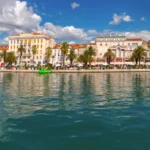
The Riva is the seafront promenade below the palace’s south facade, lined with palm trees and cafés. West of the palace, People’s Square (Pjaca) and the medieval lanes extend the old town. The fish market and the green market, near the palace, are busy in the morning.
Marjan hill
West of the city, this wooded hill is a protected park, with trails, viewpoints, small chapels and coves for swimming. The nearest viewpoint is reached on foot by steps from the Varoš neighborhood. The Meštrović Gallery, devoted to the sculptor, is at the foot of the hill.
Beaches in Split
Bačvice, the beach closest to the center, is a shallow fine-sand beach where people play picigin, a local ball game in the water. The coves of Marjan (Kašjuni, Bene) are more natural. Most beaches on the coast are pebbly: water shoes are useful.
Day trips from Split
Trogir: about 30 km (19 mi) west, this small island town with a medieval center on the World Heritage list deserves half a day. Get there by bus or, in season, by boat.
Salona: the ruins of the ancient Roman capital of the province of Dalmatia, a few kilometers northeast, with an amphitheater and early Christian basilicas.
Klis Fortress: perched on a pass above Split, it controlled the road inland. Wide views over the coast.
Krka National Park: its waterfalls and boardwalks make a day trip, about 1 h 30 by road. Swimming is no longer allowed.
Omiš and the Cetina canyon: about 25 km (16 mi) southeast, for rafting, canyoning or a simple walk.
Makarska Riviera: further south, long pebble beaches below the Biokovo massif.
Islands near Split
Split is the main port of central Dalmatia. Several islands are reached by ferry or catamaran, for a day or a few nights.
Brač
The closest island, opposite Split, is known for Zlatni Rat beach near Bol, a spit of pebbles that changes shape with the wind and currents. Its white stone was used to build many monuments. Car ferries arrive in Supetar; catamarans serve Bol in season.
Hvar
The busiest island on the coast: Hvar town, its fortress and square are very lively in summer, with a well-known nightlife. Stari Grad, the other port, is quieter; its farmland, still divided according to an ancient pattern, is a World Heritage Site. The Pakleni Islands, off Hvar, are reached by water taxi for swimming.
Vis
Further out and long closed to foreigners because of its military use, Vis is quieter and more authentic. From Komiža, boats go to the Blue Cave on the islet of Biševo, whose visit depends on sea conditions.
Šolta and Korčula
Šolta, very close, suits a quiet day. Korčula, further south, with its walled old town, is reached from Split by catamaran in season and makes a good stop on the way to Dubrovnik. If Korčula is your stepping stone south, see when to go to Dubrovnik to avoid the peak-summer crowds in the old town.
Getting around: ferries and catamarans from Split
Operators: the state operator Jadrolinija and private companies run the routes, far more frequent in summer.
Ferries or catamarans: ferries take cars and are cheaper; catamarans, faster, carry only passengers and are more affected by sea conditions.
Boarding: the quays are in front of the old town, a few minutes’ walk from the bus and train stations. The port is large: find your quay in advance.
Booking: in July-August, buy catamaran tickets in advance and arrive early if you are taking a car.
Off season: services are reduced from autumn to spring, and the bora or jugo winds can cause cancellations.
Organized trips: many agencies run boat days to Hvar, the Pakleni Islands or the Blue Cave, handy if you only have one day.
Itinerary ideas from Split
3 days: Split and Trogir
Day 1: Diocletian’s Palace, cathedral and bell tower, cellars, the Riva at sunset
Day 2: Marjan hill in the morning, Meštrović Gallery, Bačvice beach
Day 3: Trogir, or a day trip to Hvar or Brač
1 week: Split and the Dalmatian islands
Days 1 and 2: Split
Day 3: Trogir or Krka National Park
Days 4 and 5: Hvar (Hvar town, Stari Grad, Pakleni Islands)
Day 6: Brač and Zlatni Rat, or Vis
Day 7: back to Split for your flight, or a catamaran to Korčula then Dubrovnik
Split airport transfer: shuttle, bus 37, taxi and private transfer
Split Airport is in Kaštela, on the way to Trogir. In summer, allow plenty of time for the return journey, as traffic toward the airport can be heavy.
Official shuttle to the bus station
According to the operator Platanus (platanus.hr, checked 26 October 2026), the shuttle runs nonstop to Split’s main bus station, next to the train station and ferry port and about 5 minutes’ walk from the old town. Buses leave about 30 minutes after each flight arrival, from the first flight to the last, and the trip takes about 30 minutes, longer in summer traffic. Fares: €10 one way, €15 return, one suitcase included, free for children under 6. Tickets are sold online or at the booth in front of the bus (cash or card), not by the driver. Boarding is in parking zone P1, directly in front of the arrivals exit.
City buses 37 and 38
The operator Promet Split (promet-split.hr, checked 26 October 2026) lists line 37 Split – Airport – Trogir and line 38 Split – Kaštel Stari – Airport. Fares depend on the tariff zones published by Promet Split. These buses make many stops: they are mostly useful for Trogir or for accommodation along the Kaštela coast.
Taxi
Taxis wait near the main terminal. Ask for the price before setting off or check that the meter is running.
Option
Where to catch it
Official fare
Source
Platanus shuttle
Parking P1, in front of arrivals
€10 one way; €15 return
platanus.hr
Bus 37 (Split – Airport – Trogir)
Airport stop
By tariff zone
promet-split.hr
Taxi
Near the main terminal
Ask before setting off
—
Booking a private transfer in Split
A private transfer booked in advance is useful if you arrive late at night, travel as a family or with lots of luggage, or if your accommodation is far from bus and train lines. Before paying, check the total price (tolls, luggage, child seats, night supplement), the meeting point at the airport, flight tracking in case of delay, the waiting time included and the cancellation terms. Compare with the official fares in the table above: for one person traveling light, public transport is often enough. It is handy if you are staying in the car-free old town or going straight to a ferry: check the exact drop-off point.
Sources: Platanus (official shuttle) and Promet Split (bus lines), checked 26 October 2026.
Where to stay in Split
Neighborhood
Best for
Pros and cons
Inside the palace (old town)
First visit, short stay
Everything on foot; noisy at night, no car access, high prices
Varoš
Village feel, close to Marjan
Quiet lanes a few minutes from the center; lots of steps
Bačvice
Beach and nightlife
Beach on foot, close to the ferries; lively at night in summer
Meje and Marjan
Quiet and sea views
Residential, villas; 15-20 minutes’ walk from the center
Žnjan and the east of the city
Families, budget, car
More affordable, beaches; bus needed for the center
To catch an early ferry, accommodation near the port or Bačvice is the most convenient.
Options are mostly apartments and private rooms (apartmani, sobe), alongside hotels and hostels. In the old town, check for upper floors without an elevator and luggage access. In July-August, book several months ahead.
When to go to Split
The best period runs from late May to June and in September: it is warm, the sea is pleasant from June, ferries run regularly and crowds stay reasonable. July and August are the driest and sunniest months, but also the busiest and most expensive, with a risk of wildfires on the coast. From October to April, the city stays lively, but island services are reduced.
Month
High °C (°F)
Low °C (°F)
Rain mm (in)
Crowds
Prices
Verdict
January
10.7 (51)
5.9 (43)
73 (2.9)
Low
Low
⚠️ Mild but gray, islands quiet
February
11.5 (53)
6.0 (43)
64 (2.5)
Low
Low
⚠️ Cool, bora possible
March
14.5 (58)
8.5 (47)
58 (2.3)
Low
Low
⚠️ Early spring, cold sea
April
18.4 (65)
11.8 (53)
62 (2.4)
Medium (Easter)
Medium
✅ Mild, ideal for sightseeing
May
23.4 (74)
16.1 (61)
58 (2.3)
Medium
Medium
✅ Best compromise, St Domnius Day on the 7th
June
28.1 (83)
20.2 (68)
49 (1.9)
High
High
✅ Summer without the August crowds
July
31.0 (88)
22.8 (73)
25 (1.0)
Very high
Very high
⚠️ Heat, crowds, peak prices
August
30.9 (88)
22.9 (73)
32 (1.3)
Very high (15 Aug)
Very high
⚠️ Busiest, wildfire risk
September
25.4 (78)
18.4 (65)
82 (3.2)
High then medium
High then medium
✅ Warm sea, fewer crowds
October
20.5 (69)
14.7 (58)
80 (3.1)
Medium → low
Medium → low
✅ Mild for sightseeing, end of beach season
November
15.6 (60)
10.8 (51)
120 (4.7)
Low
Low
❌ Wettest month
December
11.8 (53)
7.2 (45)
99 (3.9)
Low
Low
⚠️ Wet and mild
Temperatures and precipitation: WMO 1991-2020 normals for the Split-Marjan station of the Croatian Meteorological and Hydrological Service (DHMZ), published by NOAA NCEI. Crowds and prices: estimate based on tourist seasons.
In summer, many performances take place during the Split Summer Festival, and St Domnius Day, honoring the city’s patron saint, is celebrated on 7 May. Comparison with Zagreb, Zadar and Dubrovnik and month-by-month advice: see our article when to go to Croatia.
Split: which travelers is it for?
Our view by profile, based on the information in this guide:
Profile
Our view
Why
Culture and history
✅ Ideal
Diocletian’s Palace, lived in for more than 1,700 years, with Trogir and Salona nearby.
Couple
✅ Yes
The Riva in the evening, Marjan hill, the islands of Brač, Hvar and Vis.
Family
✅ Yes
Bačvice, a shallow fine-sand beach near the center; Zlatni Rat on Brač.
Nightlife
✅ Yes
Hvar town, very lively in summer, is known for its nightlife.
Nature and adventure
✅ Yes
Rafting and canyoning on the Cetina, Krka National Park, Marjan trails.
Tight budget
⚠️ Possible
Split is not cheap in summer; late May-June and September are more reasonable.
Budget for a trip to Split
Split is not cheap in summer, especially for accommodation. Estimates per person per day, excluding flights:
Item
Tight budget
Comfort
Accommodation (per person, sharing a double room)
about €30 to €55
about €80 to €160
Meals
about €25 to €35 (bakeries, snacks, simple konobas)
about €50 to €75
Transport (buses, ferries)
about €10 to €20
about €25 to €50
Sights and trips
about €5 to €15
about €20 to €60
Total per day
roughly €70 to €125
roughly €175 to €345
Rough estimates. Prices drop significantly outside July-August; private boat trips to the islands raise the budget sharply.
Practical tips for Split
From the airport: a shuttle links the airport to the bus station, near the port; city buses and taxis also make the trip.
In the city: the center is walkable and the old town is pedestrianized. Parking is scarce and paid in summer: you do not need a car to visit Split.
Buses: the intercity network links Split to Trogir, Šibenik, Zadar, Makarska, Dubrovnik, Zagreb and Plitvice.
Dress in town: in Split you can get an on-the-spot fine for walking through town shirtless or in swimwear (UK FCDO). In churches, cover shoulders and knees.
Money: the euro. Cards are widely accepted, but keep cash for markets and some private rooms.
Mobile data: check your roaming plan or buy an eSIM before you go.
Entry requirements, health and safety
US citizens: according to the U.S. Department of State (travel.state.gov, last updated December 11, 2025), you do not need a visa for tourism or business stays of less than 90 days within a 180-day period. Your passport must have at least three months’ validity when you leave Croatia. You must register with the local police within three days of arrival; hotels and vacation rentals do it for you.
UK citizens: according to the UK FCDO (GOV.UK, updated 11 August 2026), you can travel to the Schengen area, including Croatia, without a visa for up to 90 days in any 180-day period. Your passport must have been issued less than 10 years before you arrive and be valid for at least 3 months after you plan to leave; you may need to show a return or onward ticket. The EU Entry/Exit System (EES) may require you to register your fingerprints and photo at the border.
Health: health risks include biting insects and ticks (UK FCDO). UK travelers need a GHIC or EHIC for medically necessary state healthcare, but there is always a charge for treatment, up to €530: take out travel insurance.
Safety: the U.S. Department of State rates Croatia Level 1: Exercise Normal Precautions. Pickpockets operate in tourist areas (UK FCDO); always carry your passport.
Wildfires: they are common in hot, dry summers. Intentionally causing a fire can be fined €2,000 to €20,000 or lead to prison, and you can be fined even for causing one unintentionally; call 112 if you are in immediate danger (UK FCDO).
Two days are enough for Diocletian’s Palace, the old town and Marjan hill. Allow four to five days to add Trogir and one or two islands (Hvar, Brač).
Do you have to pay to enter Diocletian’s Palace?
No, the palace is an open neighborhood where you can walk around freely. Only some parts require a ticket: the cathedral, the bell tower, the baptistery and part of the cellars.
Which island should you visit from Split?
Brač for Zlatni Rat beach and a short crossing, Hvar for the buzz and the Pakleni Islands, Vis for peace and quiet and the Blue Cave on Biševo.
Where can you swim in Split?
At Bačvice, a sandy beach close to the center, or in the more natural coves of Marjan hill. Most beaches in the region are pebbly.
When is the best time to visit Split?
Late May-June and September: pleasant heat, a swimmable sea, regular island connections and fewer crowds than in July-August.
Is Split worth visiting?
Yes: people live inside a Roman palace more than 1,700 years old, and it is the main port for the Dalmatian islands (Brač, Hvar, Vis). In July-August the old town is very busy: visit the palace early in the morning. To compare with the coast’s other big stop, see our Dubrovnik guide.
How much does a trip to Split cost?
Excluding flights, allow roughly €70 to €125 per person per day on a tight budget and €175 to €345 for comfort, based on a shared double room. Prices drop significantly outside July-August: see when to go to Croatia and our selection of where to go in September.
Our sources
U.S. Department of State, Croatia country information (travel.state.gov, last updated December 11, 2025) and Croatia travel advisory (Level 1), read on 26 October 2026
Promet Split, bus lines 37 and 38 (promet-split.hr), checked 26 October 2026
Climate normals: WMO 1991-2020 normals for the Split-Marjan station of the Croatian Meteorological and Hydrological Service (DHMZ), published by NOAA NCEI


 FlightsKiwi.comCompare flights and airline combinations to Split.Compare flights