⚠️ Safety first: this Rio de Janeiro travel guide starts with a warning. The U.S. Department of State notes that violent crime is high in most urban centers in Brazil, and the UK FCDO reports that the most common incidents affecting British nationals in Rio are thefts and pickpocketing around Copacabana and Ipanema beaches, Lapa and Santa Teresa. Both advise avoiding favelas, including on tours. Check the latest advice before you leave.
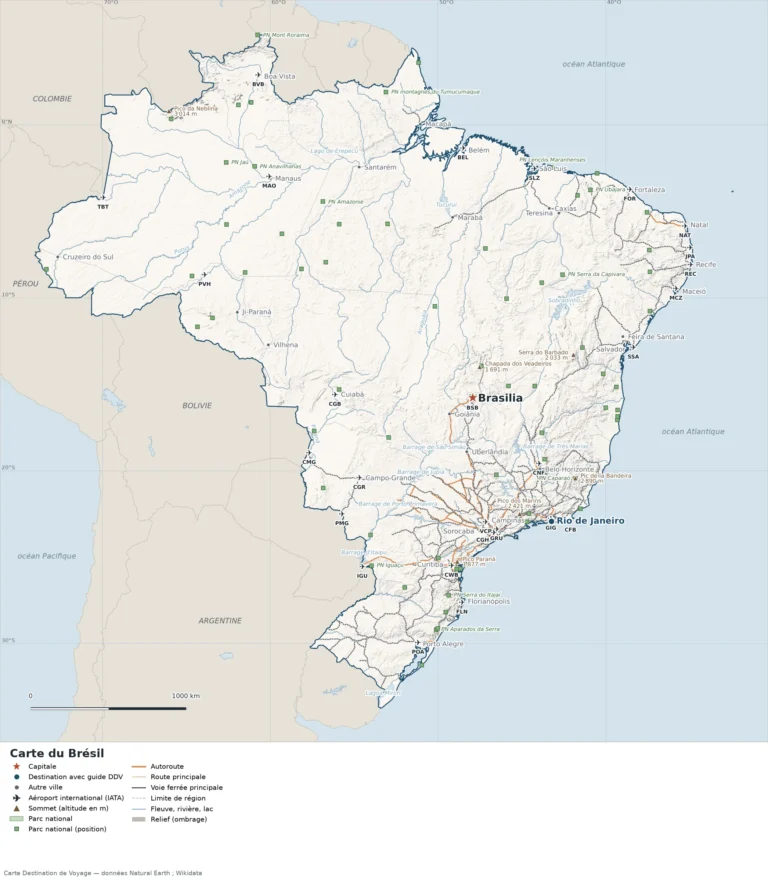
Planning a trip to Rio de Janeiro starts with understanding its geography: the city stretches between Guanabara Bay, the Atlantic and forest-covered hills. Christ the Redeemer looks down on the city from Corcovado, Sugarloaf Mountain closes the bay, and the beaches of Copacabana and Ipanema line the southern districts. Allow 4 to 5 days, and stay alert at all times. This guide helps you choose your sights, your neighborhood and your budget.
✅ Best months: April, may, June, July, August, September, October, November
The driest period runs from April to November, with 26 to 30 °C (79 to 86 °F) in the afternoon and less than 100 mm (3.9 in) of rain a month, according to INMET normals. December to March is the southern summer: over 30 °C (86 °F), frequent thunderstorms, New Year’s Eve (Réveillon) and Carnival, and the highest prices. The UK FCDO notes that flash floods and landslides are common in Rio de Janeiro, including in tourist areas, during heavy rain. Month-by-month climate and events: our article on the best time to visit Rio de Janeiro.
Things to do in Rio de Janeiro: the highlights
Corcovado and Christ the Redeemer
The statue of Christ the Redeemer, on top of Corcovado (about 700 m / 2,297 ft), looks out over the whole city, the bay and the beaches. You go up on the small rack railway from the Cosme Velho district, or by minibus. Stick to these organized options: the UK FCDO reports armed robberies of tourists on the Corcovado walking trail. Come early or on a clear day: clouds often hide the summit.
Sugarloaf Mountain
Two successive cable cars climb Morro da Urca and then the summit of Sugarloaf Mountain, at the entrance to Guanabara Bay. The view over Copacabana, Corcovado and the bay is especially beautiful in the late afternoon. The departure point is in the Urca district, at the foot of Praia Vermelha.
Copacabana, Ipanema and Leblon
Copacabana and its wave-patterned promenade, and the more residential Ipanema and Leblon, form the seafront of the Zona Sul. The beaches are lively every day and especially at weekends: street vendors, volleyball, kiosks. At the end of Ipanema, the Arpoador rock is a favorite sunset spot. Theft is common around Copacabana and Ipanema beaches (GOV.UK): take only the bare minimum, and do not go on city beaches after dark (U.S. Department of State).
The historic center (Centro)
The center preserves colonial churches, the Municipal Theater, the National Library, the elegant Confeitaria Colombo café and, in the redeveloped port area, the Museum of Tomorrow (Museu do Amanhã). Visit on weekdays during busy daytime hours, and avoid quiet or deserted streets in the evening and at weekends.
Santa Teresa and the Selarón Steps
Perched on a hill, Santa Teresa is a district of old houses, artists’ studios and small restaurants, served by a historic tram. Below, the Selarón Steps, covered in ceramic tiles, link Lapa and Santa Teresa. The UK FCDO lists Lapa and Santa Teresa among the places where thefts and pickpocketing most often affect visitors: come in the daytime, with no valuables on show.
The Botanical Garden and the lagoon
The Botanical Garden, founded in the early 19th century, has an avenue of imperial palms and many Atlantic Forest species. Nearby, the Rodrigo de Freitas lagoon is ringed by a cycling and walking path, with views of Corcovado.
Tijuca National Park
One of the largest urban forests in the world covers the city’s hills. Waterfalls, viewpoints and hiking trails (Pedra da Gávea, Pico da Tijuca) are best explored with a licensed guide: the U.S. Department of State advises increased caution when hiking in isolated areas, particularly near popular tourist spots in Rio de Janeiro.
Maracanã
The legendary stadium hosts matches of the city’s big clubs. Going to a game is a popular experience; stay alert in the crowd and do not linger around the stadium after the match.
Itinerary suggestions
4 to 5 days in Rio
Day 1: Copacabana, Arpoador at sunset, then Ipanema
Day 2: Corcovado in the morning, the Botanical Garden and Rodrigo de Freitas lagoon in the afternoon
Day 3: the historic center and the Museum of Tomorrow on a weekday, then Santa Teresa and the Selarón Steps in daylight
Day 4: Sugarloaf Mountain in the late afternoon, after a morning on the beach or a guided hike in the Tijuca forest
Day 5: day trip to Petrópolis or a free day in Leblon
10 days: Rio and the Costa Verde
Days 1 to 4: Rio de Janeiro
Days 5 to 7: Ilha Grande, a car-free island, and its trails to the beaches
Days 8 and 9: Paraty, a colonial town, and boat trips in the bay
Day 10: back to Rio and flight home
For a wider tour with Iguaçu Falls, Salvador or the Amazon, see our Brazil travel guide.
Budget for a stay in Rio
Rio is more expensive than the Brazilian average, especially in the Zona Sul and during the southern summer. Indicative amounts per person per day, excluding flights, converted from our euro estimates at the European Central Bank rate of 23 October 2026 (€1 = R$5.65) and rounded:
Item
Budget
Comfort
Accommodation (sharing a double room)
about R$140 to 250
about R$400 to 850
Meals
about R$110 to 170
about R$230 to 400
Transport (metro, ride-hailing)
about R$30 to 55
about R$85 to 140
Sightseeing (Corcovado, Sugarloaf, guides)
about R$55 to 115
about R$140 to 225
Total per day
about R$340 to 560
about R$850 to 1,580
Indicative estimates. Accommodation prices can double, or more, over New Year’s Eve and Carnival.
To save money: have a « prato feito » (set plate) or pay-by-weight lunch (« comida a quilo ») in neighborhood restaurants, enjoy the free beaches and viewpoints, and travel in May-June or August-September.
Getting around Rio
Metro: it links the Zona Sul (Ipanema, Copacabana, Botafogo) to the center and Maracanã. The UK FCDO reports theft and robbery on rail networks, including metros: avoid wearing expensive jewelry or using your phone on board.
Ride-hailing: apps such as Uber are widely available (GOV.UK). Be wary of drivers posing as app drivers, especially at airports, avoid drivers with few or low ratings and wait for your ride in a secure place (GOV.UK, U.S. Department of State).
Taxis: do not hail taxis in the street; use the authorized taxi booths at airports (GOV.UK). Registered taxis have red license plates and display company information and phone numbers (U.S. Department of State).
Buses: a wider network, but crime on public transportation occurs (U.S. Department of State).
Car: not recommended in the city. If you use GPS navigation, make sure the suggested route does not take you into a favela (GOV.UK). UK photocard licences can be used in Brazil (GOV.UK).
On foot: pedestrians do not have priority; cross with care.
Where to stay in Rio
Stay in the Zona Sul. Copacabana has the widest choice of hotels and the best value, with the metro nearby. Ipanema and Leblon are quieter and more expensive. Botafogo, on the metro, has many restaurants and lower prices. Barra da Tijuca, further west, is far from the main sights.
Choose accommodation with a safe for your passport and valuables, and book early for New Year’s Eve, Carnival and July.
Entry requirements, health and safety
US citizens: according to the U.S. Department of State (travel.state.gov, last updated August 6, 2026), a visa is required regardless of the purpose of travel: obtain a Brazilian visa or e-visa before you leave, and travel with a valid US passport.
UK citizens: according to the UK FCDO (GOV.UK, updated 29 September 2026), you can visit Brazil without a visa for up to 90 days for tourism. Your passport must be valid for at least 6 months after your arrival date; make sure it is stamped, or you may be fined when you leave.
Health: the UK FCDO lists yellow fever, dengue, chikungunya and Oropouche among the health risks; check vaccine recommendations at least 8 weeks before your trip. Yellow fever vaccination is not required for entry, but some countries (including Colombia and Bolivia) require proof from travelers who have recently been in Brazil (U.S. Department of State). Private hospitals require payment up front: insurance covering medical costs and evacuation is essential.
Safety: carry the bare minimum and a copy of your documents, leave your passport and jewelry in the safe, and never resist an attacker (U.S. Department of State). Express kidnappings, in which victims are driven to an ATM, can happen (GOV.UK).
Favelas: avoid them, including on organized tours (GOV.UK, U.S. Department of State).
Swimming: strong currents and riptides are a danger off some beaches; follow warning flags and lifeguards’ instructions (GOV.UK).
Emergencies: police 190, ambulance 192 (U.S. Department of State).
Practical tips for Rio
Money: card cloning and payment-machine scams are common, including with beach vendors: keep your card in sight and check the amount displayed (GOV.UK). Use ATMs inside a secure facility, such as an airport, hospital or bank, and avoid them in the early hours (U.S. Department of State).
Phone: avoid displaying your phone in the street (U.S. Department of State), a frequent cause of snatch theft. An eSIM or local SIM card avoids roaming charges.
Beach: take only what you need, and do not head to the beach with your luggage on your last day.
Etiquette: a few words of Portuguese (« obrigado » or « obrigada », « bom dia ») are appreciated; Brazil does not speak Spanish.
Rhythm: follow the city’s rhythm and avoid walking at night in deserted streets.
Who is Rio for?
Our verdict, profile by profile, based on the information in this guide:
Profile
Our verdict
City landscape lovers
Ideal: Corcovado, Sugarloaf, sunset at Arpoador and the Rodrigo de Freitas lagoon.
Beachgoers
Yes, with caution: Copacabana, Ipanema and Leblon, taking only the bare minimum and never at night.
Hikers
Yes, with a licensed guide: trails in Tijuca National Park (Pedra da Gávea, Pico da Tijuca).
Budget travelers
Yes: roughly R$340 to 560 per person per day, with « prato feito » and « comida a quilo » at lunchtime.
First big trip, families
Possible with preparation: crime is high; stay in the Zona Sul and follow the safety advice.
Four to five days let you see Corcovado, Sugarloaf, the beaches, the historic center and Santa Teresa. Add three to five days for Ilha Grande and Paraty.
Is Rio de Janeiro dangerous?
Crime is high: the U.S. Department of State notes high violent crime in most Brazilian cities, and the UK FCDO lists thefts around Copacabana, Ipanema, Lapa and Santa Teresa. Carry the bare minimum, keep your phone out of sight, use ride-hailing at night and avoid favelas.
Do you need a visa for Rio?
US citizens need a visa or e-visa obtained before travel (travel.state.gov). UK citizens can visit without a visa for up to 90 days, with a passport valid 6 months after arrival (GOV.UK).
How do you get to Christ the Redeemer?
By the small rack railway from Cosme Velho, or by minibus. Avoid the walking trail: the UK FCDO reports armed robberies of tourists on it.
Which neighborhood should you stay in?
In the Zona Sul: Copacabana for choice and price, Ipanema and Leblon for quiet, Botafogo for a tighter budget.
How much does a week in Rio de Janeiro cost?
Excluding flights, roughly R$340 to 560 per person per day on a budget, or about R$2,370 to 3,950 for 7 days, and R$850 to 1,580 per day in comfort (about R$5,930 to 11,070). Accommodation prices can double, or more, over New Year’s Eve and Carnival.
When is the best time to visit Rio de Janeiro?
April to November, the driest season, with 26 to 30 °C (79 to 86 °F) in the afternoon and lower prices. For the beach, New Year’s Eve and Carnival, aim for December to March, accepting heat and thunderstorms. The month-by-month details are on our page on the best time to visit Rio de Janeiro.
Our sources
U.S. Department of State, Brazil country information (travel.state.gov, last updated August 6, 2026), read on 26 October 2026
Climate normals: Brazil’s National Institute of Meteorology (INMET), Rio de Janeiro station: temperatures, 1981-2010 normals; precipitation, 1961-1990 normals (latest period published for this station)
European Central Bank: euro reference rates of 23 October 2026 (budget conversion)


 FlightsKiwi.comCompare flights and airline combinations to Rio de Janeiro.Compare flights