This Argentina travel guide in a nutshell: allow 10 to 12 days for the essentials (Buenos Aires, Iguazú, the Perito Moreno Glacier, El Chaltén) and three weeks to travel the country from north to south, with a budget of roughly US$55–90 per person per day on a budget trip (excluding flights). Argentina stretches from the Iguazú Falls, deep in subtropical forest, to the glaciers of Patagonia and Tierra del Fuego, by way of the Mendoza vineyards and the colorful mountains of the northwest. Distances are huge: a first trip means making choices. This guide brings together the essentials to plan your stay.
To locate cities, regions, terrain, national parks and airports, see our map of Argentina.
The seasons are reversed compared with the Northern Hemisphere. For a tour combining Buenos Aires, Iguazú and Patagonia, the best periods are October–November and March–April. Patagonia is mainly visited from November to March; the northwest (Salta, Jujuy) rather from April to November, in the dry season. The southern winter (June to August) suits skiing and the north of the country. All the details, month by month and with official normals from the Servicio Meteorológico Nacional, are in our article best time to visit Argentina.
What to see in Argentina: the highlights
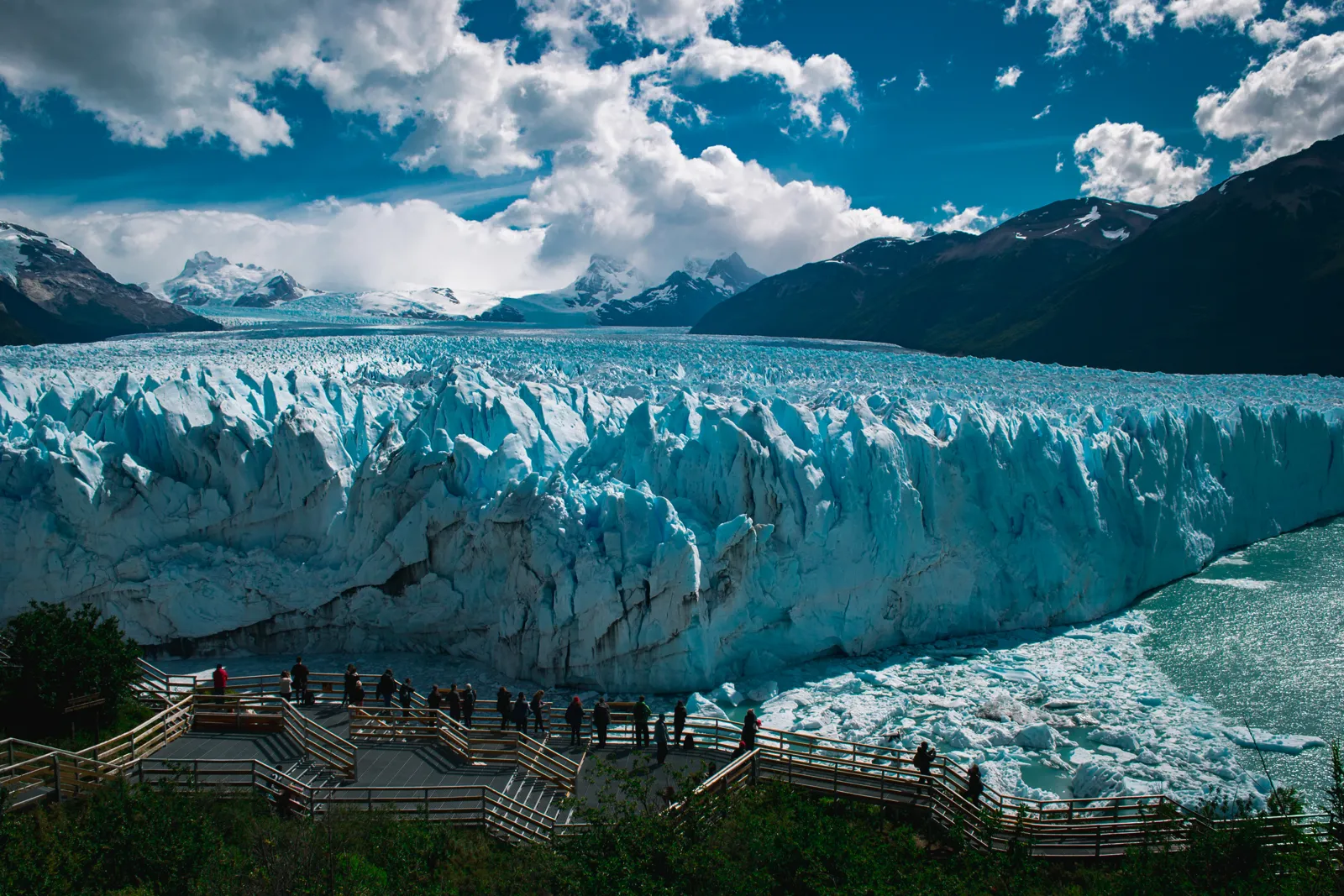
The Perito Moreno Glacier in Argentine Patagonia
Buenos Aires
The capital is best explored neighborhood by neighborhood: San Telmo and its Sunday market, Recoleta and its monumental cemetery, Palermo and its parks, Plaza de Mayo and the Casa Rosada, Puerto Madero on the waterfront. Allow three to four days for the museums, an evening of tango and a trip to the Tigre Delta. In La Boca, stay in the designated Caminito tourist area, where police patrols are visible, as the UK FCDO advises (GOV.UK, updated 7 May 2026).
Iguazú Falls
On the border with Brazil, the Iguazú Falls stretch for nearly three kilometers (about 2 mi) in the heart of a national park listed as a World Heritage Site. On the Argentine side, walkways lead above and to the foot of the falls, up to the Garganta del Diablo (the « Devil’s Throat »). The Brazilian side offers a panoramic view. Allow at least two days there, based in Puerto Iguazú.
Salta, Jujuy and the Quebrada de Humahuaca
The northwest is the land of colorful mountains, adobe villages and Andean culture. Salta, a colonial city, is the base for Cafayate and its high-altitude vineyards, the Salinas Grandes and the Quebrada de Humahuaca, a World Heritage valley, with the village of Purmamarca and its Hill of Seven Colors. A rental car is the best way to travel.
Mendoza and the wine route
At the foot of the Andes, Mendoza is the country’s main wine region, known for its Malbec. You can visit wineries in Luján de Cuyo, Maipú or the Uco Valley, and reach Aconcagua Provincial Park, home to the highest peak in the Americas, for a hike at its base. The UK FCDO advises particular caution in downtown Mendoza (GOV.UK, updated 7 May 2026).
Bariloche and the Lake District
San Carlos de Bariloche, on the shores of Lake Nahuel Huapi, is the gateway to the Andean Lake District: hikes, viewpoints such as Cerro Campanario, and the Seven Lakes Route to San Martín de los Andes. In winter, the Cerro Catedral resort draws skiers. Leave nothing in your rental car: according to the UK FCDO, thefts from unattended vehicles, especially hire cars, happen frequently in Bariloche (GOV.UK, updated 7 May 2026). If you are combining with the neighboring country, our page best time to visit Uruguay gives the normals month by month.
Valdés Peninsula
On the Atlantic coast, reached from Puerto Madryn, this World Heritage reserve is home to elephant seals, sea lions, Magellanic penguins and, in certain seasons, southern right whales. Viewing periods vary by species: check with local operators before setting your dates.
El Calafate and El Chaltén
El Calafate is the base for the Perito Moreno Glacier, in Los Glaciares National Park: walkways face its front, and boat trips or walks on the ice complete the visit. About three hours away by road, El Chaltén is Argentina’s hiking capital, with trails to Mount Fitz Roy and Cerro Torre.
Ushuaia and Tierra del Fuego
Ushuaia, on the Beagle Channel, is the country’s southernmost city. Boat trips go out to islands with sea lions and cormorants, there is hiking in Tierra del Fuego National Park, and it is the main departure port for cruises to Antarctica, roughly from November to March.
Things to do in Argentina: 10 experiences for a first trip
To sum up what to see and do in Argentina, here are the experiences described above, to choose according to the season and the length of your trip:
Explore the neighborhoods of Buenos Aires, from San Telmo to Palermo, and have a late dinner like the locals
See the Iguazú Falls from both the Argentine and the Brazilian side
Drive the road between Salta, Cafayate and the Quebrada de Humahuaca
Visit the Mendoza vineyards, ideally at harvest time
Tour the lakes around Bariloche
Watch the marine wildlife of the Valdés Peninsula
Get close to the Perito Moreno Glacier from El Calafate
Hike toward Fitz Roy from El Chaltén
Sail the Beagle Channel from Ushuaia
Try asado and mate, two everyday rituals
Itinerary ideas: how many days in Argentina?
Distances make domestic flights essential: from Buenos Aires, allow about 3 hours’ flying time to El Calafate and just under 2 hours to Iguazú or Salta. Across the Río de la Plata, Uruguay, its beaches and Colonia del Sacramento are often combined with Buenos Aires.
10 to 12 days: the essentials
Days 1 to 3: Buenos Aires
Days 4 and 5: Iguazú Falls (Argentine and Brazilian sides)
Days 6 to 8: El Calafate and the Perito Moreno Glacier
Days 9 to 11: El Chaltén, hikes toward Fitz Roy
Day 12: back to Buenos Aires
3 weeks: from north to south
Days 1 to 3: Buenos Aires and the Tigre Delta
Days 4 and 5: Iguazú Falls
Days 6 to 9: Salta, Cafayate and the Quebrada de Humahuaca by car
Days 10 to 12: Mendoza and the vineyards
Days 13 to 15: Bariloche and the Lake District
Days 16 to 19: El Calafate and El Chaltén
Days 20 and 21: Ushuaia and the Beagle Channel
Budget for a trip to Argentina
The cost of a trip to Argentina varies greatly with inflation and the exchange rate, which change quickly: the amounts below are orders of magnitude. Patagonia is noticeably more expensive than the rest of the country. Indicative amounts per person per day, excluding international flights (converted from our euro estimates at the ECB rate of 23 October 2026, €1 = US$1.12):
Item
Budget
Comfort
Accommodation (based on a shared double room)
roughly US$15–40 (hostel, hostal)
roughly US$65–145
Meals
roughly US$15–30
roughly US$40–65
Transport
roughly US$10–15 (long-distance bus)
roughly US$20–45 (car, taxis)
Activities and sightseeing
roughly US$10–20
roughly US$20–55
Total per day
roughly US$55–90
roughly US$145–280
Indicative estimates. Domestic flights, glacier excursions and Patagonian accommodation in high season push the bill up considerably.
To keep your budget under control, book domestic flights early, use comfortable night buses for medium-length journeys, and travel in the shoulder season in the south. The lunchtime « menú del día » is a good way to eat well at a reasonable price.
Who is Argentina for?
Our verdict by travel style, based on the information in this guide:
Nature and hiking: ideal: Iguazú Falls, the Perito Moreno Glacier, the Fitz Roy trails from El Chaltén.
Road trip: yes: the northwest by car from Salta to the Quebrada de Humahuaca, the Seven Lakes Route.
City and culture: yes: Buenos Aires, its neighborhoods, museums and tango evenings.
Wine and food: yes: Mendoza’s wineries, asado and mate.
Budget travelers: average: roughly US$55–90 per person per day, but Patagonia is much more expensive and inflation changes prices quickly.
Families: possible: distances require domestic flights; it is better to focus on two or three regions.
Getting around Argentina
Plane: essential to link distant regions (Buenos Aires, Iguazú, Salta, Mendoza, Bariloche, El Calafate, Ushuaia). Check the departure airport in Buenos Aires: domestic flights mostly leave from Aeroparque, in the city. The UK FCDO notes that flights from Argentina can be unreliable: check for delays or cancellations before going to the airport (GOV.UK, updated 7 May 2026).
Long-distance buses: a very dense network, with reclining seats (« semi-cama », « cama ») for overnight journeys. A good option between moderately distant cities.
Car: ideal in the northwest, Mendoza or the Lake District. According to the U.S. Department of State (travel.state.gov, last updated July 16, 2026), driving is more dangerous than in the United States, drivers can be aggressive and gas stations are often far apart. UK licence holders need the 1949 International Driving Permit plus their UK licence, and must get the IDP in the UK before travel (UK FCDO, GOV.UK, updated 7 May 2026); the U.S. Department of State says you need an Argentine or international driver’s license. Distances are long and some roads are unpaved.
In the city: subway (« subte ») and buses in Buenos Aires. If you hail a taxi in the street, only use a « radio taxi » with a visible logo on its doors (GOV.UK); from the airports, the U.S. Department of State recommends a pre-arranged ride or a flat-rate « remise » booked at the service counters.
Where to stay in Argentina
In Buenos Aires, Palermo and Recoleta are convenient and lively; San Telmo has more character but calls for more caution in the evening. In Iguazú, stay in Puerto Iguazú, the nearest town to the park on the Argentine side. In Salta, the historic center lets you do everything on foot. In Patagonia (El Calafate, El Chaltén, Ushuaia), supply is limited compared with demand in summer: book several months ahead.
Options include youth hostels, « hostales » and « hosterías » (small family-run hotels), « cabañas » (cabins, common in the Lake District and Patagonia), « estancias » (farms converted into accommodation) and hotels of every category.
Mistakes to avoid on a trip to Argentina
Underestimating distances: domestic flights are essential; in Buenos Aires, check whether your flight leaves from Aeroparque or the international airport.
Booking Patagonia late in summer: accommodation is limited in El Calafate, El Chaltén and Ushuaia.
Aiming for Patagonia in midwinter or the northwest in summer: the favorable seasons are opposite (see best time to visit Argentina).
Changing money in the street: the U.S. Department of State advises exchanging money only at banks, hotels and exchange houses with an actual storefront; you must show your passport.
Underestimating the roads: the U.S. Department of State describes driving as more dangerous than in the United States.
Leaving valuables in your rental car, especially in Bariloche (GOV.UK).
Traveling without health insurance: according to the U.S. Department of State, most care providers only accept cash payments.
Hailing any taxi in Buenos Aires: taxi scams are reported; use radio taxis or a pre-arranged ride.
Entry requirements for Argentina
US citizens
According to the U.S. Department of State (travel.state.gov, last updated July 16, 2026), you need a valid passport; private US citizens do not need a visa for visits of up to 90 days for tourism or business. Travelers with expired or damaged passports may be refused entry.
A parent traveling alone with a child under 18 who resides in Argentina must present a legalized permission letter (Autorización de Viaje) from the other parent on departure.
UK citizens
According to the UK FCDO (GOV.UK foreign travel advice, updated 7 May 2026), you can visit Argentina without a visa for tourism for up to 90 days; to extend for another 90 days, get advice from the Argentine Migration Office before your stay ends. Your passport must be valid for the proposed duration of your stay.
You must declare cash or travellers’ cheques worth more than US$10,000, and you may need a yellow fever certificate for onward travel to some other countries, due to the risk of yellow fever in Argentina (GOV.UK).
Entry requirements checked on 24 October 2026; check them again before you travel. For customs allowances on your return, check your home country’s rules (e.g. CBP in the US, HMRC in the UK).
Health and safety
Health: according to the U.S. Department of State, most care providers only accept cash payments and medical evacuation is extremely costly: insurance covering medical costs and evacuation is essential. The UK FCDO (GOV.UK, updated 7 May 2026) lists yellow fever, Zika and dengue among the health risks, as well as hantavirus and altitude sickness in parts of the country; check vaccine recommendations at least 8 weeks before your trip. The U.S. Department of State notes that mosquitoes carrying dengue are prevalent in the summer months (December–March) and recommends bringing DEET repellent. See a doctor or travel health clinic before departure.
Safety: street crime is a problem in most urban areas, including Buenos Aires, Rosario and Mendoza (U.S. Department of State). In Buenos Aires, the UK FCDO advises particular caution in Palermo, San Telmo, La Boca, Retiro, Florida Street and at the Retiro bus terminal; in La Boca, stay in the Caminito tourist area. Avoid « villas » (shanty towns), even in tourist zones (U.S. Department of State). Drinks can be spiked: never leave your drink unattended (GOV.UK). Watch out for the « mustard scam » and motorbike bag-snatchers. Emergency numbers: police 911 or 101, ambulance 107, fire 100 (GOV.UK).
Natural hazards and mountains: according to the UK FCDO, there is a risk of earthquakes, particularly in the provinces of Mendoza, San Juan, Salta and Jujuy; the Copahue volcano on the border with Chile erupts occasionally; flash floods can occur during heavy rain, including in Buenos Aires province. You will have to pay for most helicopter rescues, including on Aconcagua (GOV.UK). The U.S. Department of State strongly advises against hiking alone.
Practical tips for Argentina
Money: prices and exchange rates change quickly. According to the U.S. Department of State, foreign credit cards can benefit from a more favorable exchange rate for tourists under an Argentine Central Bank regulation (check with your card issuer); this does not apply to ATM withdrawals, and some US-issued cards do not work at certain ATMs. Never change money with street changers. Our currency converter helps you estimate your spending.
Internet: good network in cities, but no coverage over long stretches of road in Patagonia and the Andes. A local SIM card or an eSIM is useful for navigation and bookings.
Pace of life: Argentines eat late, rarely before 9 p.m. Many shops close in the early afternoon in provincial towns.
Etiquette: a few words of Spanish are much appreciated. People often greet each other with a kiss on the cheek, including between men among friends.
Tipping: in restaurants, around 10% is customary when service is not included.
Not for a short stay if you are a US or British citizen: US citizens can visit for up to 90 days for tourism or business without a visa (travel.state.gov), and British citizens for up to 90 days for tourism (GOV.UK). You need a valid passport. Checked on 24 October 2026; check the latest rules before you leave.
How much does a trip to Argentina cost?
Excluding international flights, allow roughly US$55–90 per person per day on a budget, and US$145–280 in comfort. These amounts vary greatly with inflation and the exchange rate, and Patagonia is more expensive than the rest of the country.
How long do you need to visit Argentina?
Two weeks lets you see Buenos Aires, the Iguazú Falls and Patagonia (El Calafate, El Chaltén). Three weeks or more are needed to add the northwest, Mendoza or the Lake District.
What is the best time to visit Argentina?
October–November and March–April for a full tour. Patagonia is best visited from November to March, the northwest from April to November.
Is Argentina safe to visit?
It can be visited without particular difficulty, but the U.S. Department of State and the UK FCDO report street crime in large cities, notably Buenos Aires, as well as drink spiking and scams. Usual precautions (keeping valuables out of sight, using radio taxis, never leaving your drink unattended) go a long way.
What should you see first in Argentina?
For a first trip: Buenos Aires, the Iguazú Falls, the Perito Moreno Glacier and El Chaltén. With more time, add the northwest (Salta, Quebrada de Humahuaca), Mendoza, Bariloche, the Valdés Peninsula or Ushuaia.
Can you combine Argentina with Brazil or Chile?
Yes. The Iguazú Falls can be visited from both sides of the Brazilian border, and Patagonia continues on the Chilean side. Check the entry requirements of each country on travel.state.gov or GOV.UK.
Visit Argentina, official tourism website (argentina.travel), « What plug is used in Argentina », published 3 June 2025: voltage, frequency and plug types
European Central Bank, euro reference rates of 23 October 2026: budget conversions
Servicio Meteorológico Nacional (SMN, Argentina’s national weather service): 1991–2020 normals for the Buenos Aires (Observatorio Central), Puerto Iguazú, Salta, Mendoza, San Carlos de Bariloche, El Calafate and Ushuaia stations
Discover our other destinations in Latin America, including our guides to Brazil, Chile, Patagonia’s neighbor, and Peru. Remember to take out travel insurance before you leave.
Transparency: this page contains affiliate links, labelled as such. If you book through them we may earn a commission at no extra cost to you; it does not influence our content or recommendations. How we fund the site.