This Chile travel guide in short: allow ten to twelve days for Santiago, Valparaíso and the Atacama, three weeks to add the lakes and Patagonia, and roughly US$60–100 per person per day on a budget trip (excluding flights). Chile stretches for more than 4,000 km (2,500 mi) between the Andes and the Pacific: the Atacama Desert in the north, vineyards and cities in the central valley, lakes and volcanoes in the south, then the glaciers and mountains of Patagonia, not forgetting Easter Island in the middle of the Pacific. A first trip means making choices. This guide brings together the essentials to plan your stay. For the glaciers and mountains of the far south, our Patagonia travel guide covers itineraries, access and practical tips.
To locate cities, regions, terrain, national parks and airports, see our map of Chile.
Chile at a glance
CapitalSantiago
LanguageSpanish (Rapa Nui is spoken on Easter Island)
The seasons are reversed compared with the Northern Hemisphere. For a tour combining the desert, Santiago and Patagonia, the best period runs from November to March, with October and April as shoulder months. Patagonia is mainly visited from November to March; the Atacama Desert all year round; the Lake District rather from December to March, when it rains least. The southern winter (June to August) suits skiing and the north. All the details, with official normals from the Dirección Meteorológica de Chile, are in our article best time to visit Chile. For the far south, on the Chilean or Argentine side, the best time to visit Patagonia has its own page.
What to see in Chile: the highlights
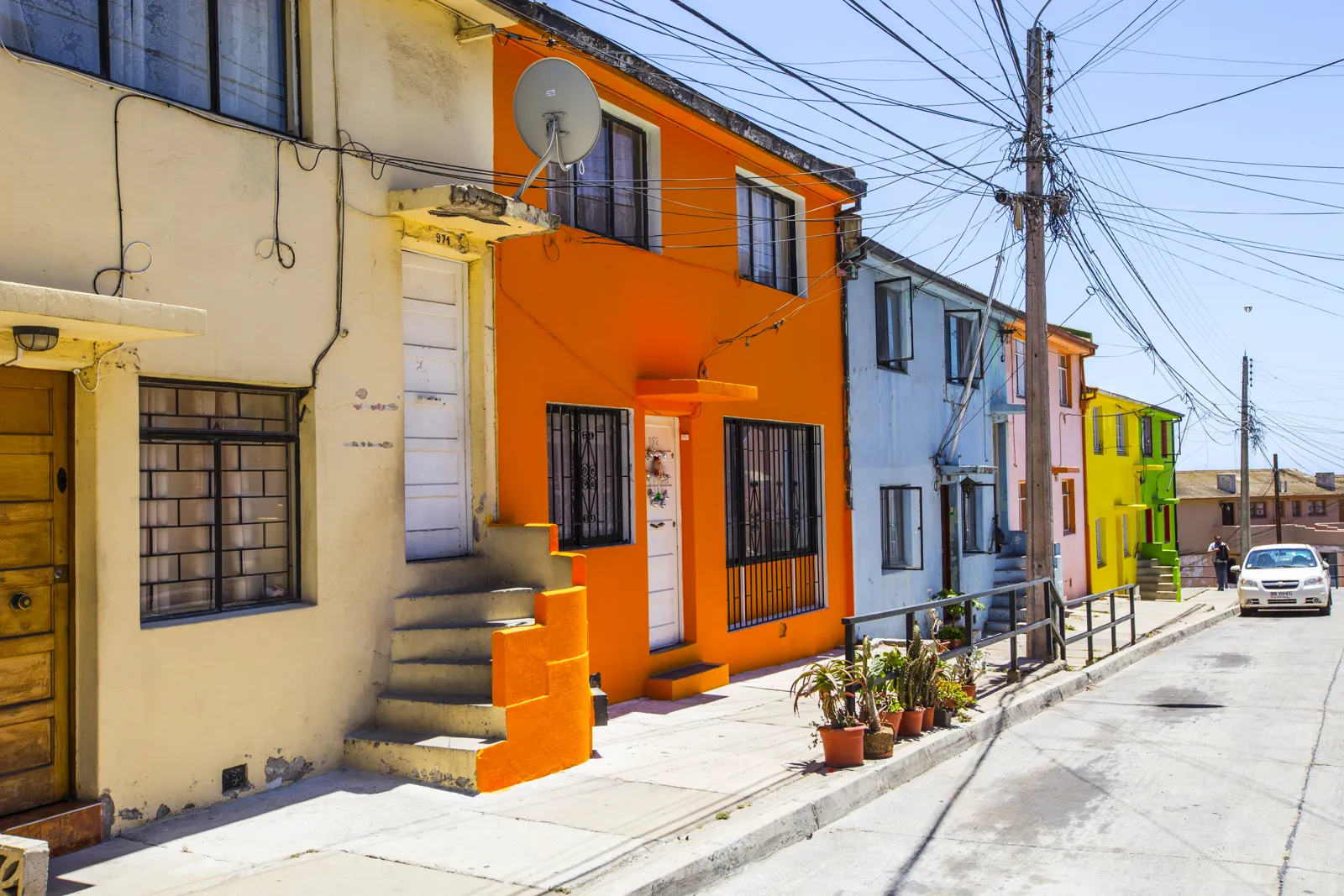
The colorful houses on the hills of Valparaíso, Chile
Santiago
The capital, backed by the Andes, can be explored in two or three days: the Plaza de Armas and the historic center, La Moneda palace, Cerro Santa Lucía, Cerro San Cristóbal and its cable car, the Lastarria and Bellavista neighborhoods, the Central Market. Santiago is also the base for visiting the wineries of the Maipo Valley. The U.S. Department of State advises significant caution when touring Cerro Santa Lucía, Cerro San Cristóbal, the Mercado Central, Plaza de Armas, Bellavista and Lastarria, where pickpocketing and muggings occur frequently (travel.state.gov, last updated July 2, 2026).
Valparaíso and the coast
About two hours from Santiago, Valparaíso stacks its colorful houses on some forty hills above the port. You get around on foot and by « ascensores », old funiculars, between Cerro Alegre and Cerro Concepción, in the heart of the historic center listed as a World Heritage Site. The neighboring resort of Viña del Mar is more modern. The UK FCDO reports frequent muggings in Santiago and Valparaíso, sometimes with weapons (GOV.UK, updated 9 October 2026): keep an eye on your belongings. On the Atlantic side of the Southern Cone, Uruguay, a calm and compact country is another destination to consider.
San Pedro de Atacama and the desert
A small adobe village at the foot of the volcanoes, San Pedro is the base for exploring the Atacama Desert: the Valley of the Moon, the altiplano lagoons, the Salar de Atacama and its flamingos, the El Tatio geysers at sunrise. You arrive by plane in Calama, then by bus or transfer. Several excursions go above 4,000 m (13,100 ft): allow a few days to acclimatize and bring very warm clothes for early-morning outings.
The Elqui Valley and the stars
East of La Serena, the Elqui Valley combines pisco vineyards, villages and exceptionally clear skies. Many tourist observatories offer stargazing evenings. It is an easy stop between Santiago and the north.
The wine valleys
Chile is a major wine country. The Casablanca (between Santiago and Valparaíso), Maipo (south of the capital) and Colchagua (around Santa Cruz) valleys are easy to visit on a tour or by car, with tastings at the wineries. The harvest takes place in late summer and the southern autumn.
Pucón, Puerto Varas and the Lake District
In the south, lakes and snow-capped volcanoes follow one after another. Pucón, on Lake Villarrica, is the capital of outdoor activities (hiking, hot springs, guided volcano ascent). Further south, Puerto Varas faces Osorno volcano, on the shore of Lake Llanquihue. According to the UK FCDO, Villarrica volcano, near Pucón, is active: follow local volcano monitoring advice and SENAPRED alerts (GOV.UK).
Chiloé Island
South of Puerto Montt, the Chiloé archipelago is known for its stilt houses (« palafitos ») in Castro and its wooden churches, several of which are World Heritage Sites. Green landscapes, fishing and island culture: allow two or three days, preferably in summer.
Torres del Paine and Patagonia
Torres del Paine National Park, north of Puerto Natales, is the country’s great hiking destination: the granite towers, turquoise lakes and Grey Glacier. The classic circuits (the multi-day « W ») require booking refuges or campsites well in advance. Punta Arenas, on the Strait of Magellan, gives access to penguin colonies. Further north, the Carretera Austral crosses forests, fjords and glaciers for hundreds of kilometers.
Easter Island (Rapa Nui)
More than 3,500 km (2,200 mi) from the mainland, the island is famous for its moai, the monumental statues erected by the Rapa Nui people, spread around the coast and in the Rano Raraku volcano quarry. Allow at least three to four days there. Access is by plane from Santiago; according to the UK FCDO, you must complete a Rapa Nui entry form, show a return ticket and a reservation registered with SERNATUR (or an invitation letter) (GOV.UK).
What to see and do in Chile: 8 experiences
Go up Cerro San Cristóbal and stroll through Lastarria and Bellavista, in Santiago
Ride the « ascensores » of Valparaíso between Cerro Alegre and Cerro Concepción
See the El Tatio geysers at sunrise and the Valley of the Moon near San Pedro de Atacama
Stargaze at an observatory in the Elqui Valley
Taste the wines of the Casablanca, Maipo or Colchagua valleys
Face the volcanoes of the Lake District, in Pucón or Puerto Varas
Hike the « W » in Torres del Paine (refuges or campsites to book)
Discover the moai of Easter Island, over at least three to four days
Itinerary ideas for Chile
Distances make domestic flights essential: from Santiago, it takes about 2 hours to fly to Calama and more than 3 hours to Punta Arenas; check flight times with the airlines.
10 to 12 days: desert, capital and coast
Days 1 to 3: Santiago and a day in the Maipo Valley
Day 4: Valparaíso
Days 5 to 8: San Pedro de Atacama (Valley of the Moon, lagoons, El Tatio geysers)
Days 9 to 11: Elqui Valley or wine valleys
Day 12: back to Santiago
3 weeks: from the desert to Patagonia
Days 1 to 3: Santiago and Valparaíso
Days 4 to 7: San Pedro de Atacama
Days 8 to 11: Lake District (Pucón, Puerto Varas)
Days 12 and 13: Chiloé Island
Days 14 to 19: Punta Arenas, Puerto Natales and Torres del Paine
Days 20 and 21: back to Santiago
Optional: 4 days on Easter Island
Budget for a trip to Chile
Chile is more expensive than most of its Andean neighbors. Patagonia and Easter Island are the most expensive regions, and the Atacama and domestic flights also weigh heavily. Indicative amounts per person per day, excluding international flights (converted from our euro estimates at the ECB rate of 23 October 2026, €1 = US$1.12):
Item
Budget
Comfort
Accommodation (based on a shared double room)
roughly US$20–40 (hostal, hostel)
roughly US$65–145
Meals
roughly US$15–30
roughly US$40–65
Transport
roughly US$11–17 (long-distance bus)
roughly US$30–45 (car, transfers)
Activities and sightseeing
roughly US$11–20
roughly US$30–55
Total per day
roughly US$60–100
roughly US$155–280
Indicative estimates. Domestic flights, Atacama excursions, Torres del Paine refuges and stays on Easter Island push the bill up considerably.
To keep your budget under control, book domestic flights early, use long-distance buses for medium-length journeys and cook from time to time in hostels. The set lunch (« menú del día » or « colación ») is a good option at midday.
Getting around Chile
Plane: essential for long distances (Calama, Punta Arenas, Puerto Montt, Easter Island), from Santiago.
Long-distance buses: a dense, comfortable network, with reclining seats for overnight journeys. Keep valuables with you rather than in the luggage hold, and be extremely wary of distractions at bus stations (GOV.UK); thefts are common on buses to and from Calama and San Pedro de Atacama, often by people posing as bus employees (U.S. Department of State).
Car: handy in the Lake District, on the Carretera Austral or around San Pedro. The UK FCDO reports an increase in criminals puncturing rental car tyres and stealing belongings, and thefts from cars at viewpoints and petrol stations: keep doors locked and nothing in sight. UK visitors can drive with a UK photocard licence for 3 months, carrying their passport and tourist card (GOV.UK, updated 9 October 2026); US visitors can drive with a valid US license for the duration of their tourist permit, though some rental insurance may require an international license (U.S. Department of State). No car insurance is available on Easter Island. Minefields lie near the borders with Peru and Bolivia in the north and Argentina in the south: stick to marked roads and trails.
In the city: the Santiago metro is efficient. Use ride-share apps or regulated taxis with orange or yellow plates; at Santiago airport, only book and pay for official taxis inside the terminal (GOV.UK, U.S. Department of State).
Where to stay in Chile
In Santiago, Providencia, Lastarria and Las Condes are convenient for a first visit; stay alert in the evening. In Valparaíso, Cerro Alegre and Cerro Concepción have most of the guesthouses and small hotels. In San Pedro de Atacama, options range from hostels to upscale lodges. In Patagonia, Puerto Natales is the base for Torres del Paine, with refuges and campsites in the park to book very early.
Options also include « cabañas » (cabins), common in the Lake District, and family-run « hostales ». Keep your valuables and passport in a hotel safe, and take care in hotel lobbies on arrival and departure (GOV.UK).
Mistakes to avoid in Chile
Trying to see everything in ten days: the country stretches over more than 4,000 km (2,500 mi); choose between north and south, or take domestic flights.
Aiming for Patagonia out of season: it is fully accessible only from November to March.
Booking Torres del Paine at the last minute: refuges and campsites on the « W » are booked in advance.
Leaving belongings visible in a rental car: the UK FCDO reports rental cars being targeted in cities and at viewpoints.
Taking an unofficial taxi at Santiago airport: overcharging scams are frequent; pay at the official booths in arrivals (GOV.UK).
Entry requirements for Chile
US citizens
According to the U.S. Department of State (travel.state.gov, last updated July 2, 2026), you do not need a visa for a tourist or business stay of 90 days or fewer. Your passport must be in good condition and valid for your stay. On arrival you receive a Tourist Card (Tarjeta de Turismo), valid up to 90 days and extendable for another 90 days for US$100 at the immigration office; you must return it on departure.
Minors leaving Chile without one or both parents need an original notarized authorization from the non-traveling parent(s) and an original apostilled birth certificate.
UK citizens
According to the UK FCDO (GOV.UK foreign travel advice, updated 9 October 2026), you can visit Chile for up to 90 days without a visa. Your passport should expire after the day you plan to leave Chile. Keep the tourist card (« tarjeta de turismo ») you receive on arrival and hand it back when you leave; a duplicate can be requested online from the PDI if lost.
Children traveling with only one parent, a guardian or alone need a written notarized authorization from the non-traveling parent(s) and an original birth certificate.
Easter Island: entry form, return ticket and a reservation registered with SERNATUR (or an invitation letter) are required.
Entry requirements checked on 24 October 2026; check them again before you travel. For customs allowances on your return, check your home country’s rules (e.g. CBP in the US, HMRC in the UK).
Health and safety
Health: the UK FCDO (GOV.UK, updated 9 October 2026) lists altitude sickness as a risk in parts of Chile and confirms dengue on Easter Island (not found on the mainland, according to the U.S. Department of State); hantavirus is present. Check vaccine recommendations at least 8 weeks before your trip. Private clinics are expensive and Easter Island has only one hospital, with serious cases flown to the mainland: insurance covering medical costs and evacuation is essential. The ozone layer is thin over parts of Chile: protect yourself from UV radiation (U.S. Department of State).
Safety: pickpocketing, muggings and thefts from vehicles are very common throughout Chile, especially in Santiago and Valparaíso (GOV.UK). Drinks have been spiked in bars in the Suecia and Bellavista areas of Santiago: keep your drink in sight. Avoid demonstrations, especially around 29 March, 1 May and 11 September. In the Araucanía Region, there is ongoing civil unrest, especially around Temuco, and a state of emergency in the provinces of Biobío, Arauco, Cautín and Malleco (GOV.UK). Drinking alcohol in public places is illegal. Emergency numbers: ambulance 131, fire 132, police 133.
Natural hazards: major earthquakes, tsunamis, wildfires, landslides and volcanic eruptions are risks (U.S. Department of State); follow SENAPRED alerts. Winter weather sometimes closes high Andean crossings to Argentina between June and September (GOV.UK). In the mountains, never hike alone, hire an experienced guide and register with park officials (U.S. Department of State); rescue services are good but you may have to pay (GOV.UK).
Practical tips for Chile
Money: cards are widely accepted in cities; keep cash for small villages, the Atacama and Patagonia, and Chilean pesos for highway tolls. Never let your card be charged out of your sight (U.S. Department of State), and be careful when leaving ATMs and exchange offices. Our currency converter helps you estimate your spending.
Internet: good network in cities, but no coverage over long stretches of Patagonia, the Carretera Austral and the desert. A local SIM card or an eSIM is useful for navigation.
Documents: always carry a printed copy of your passport photo page (GOV.UK) and keep the original in a safe place.
Etiquette: a few words of Spanish are much appreciated; Chilean Spanish is fast and full of local expressions. On Easter Island, do not touch the moai and respect the archaeological sites: you can be expelled for damaging national heritage (U.S. Department of State).
Tipping: in restaurants, around 10% is customary; it is often suggested directly on the bill.
Chile is often combined with its neighbors: see our guides to Argentina for Patagonia, Bolivia and Peru. Before you leave, read our travel insurance guide.
Who is Chile for?
Our verdict by profile, based on the information in this guide:
Hiking and nature: yes: Torres del Paine and the « W », the Lake District, the Carretera Austral, the Atacama Desert; Patagonia is visited from November to March.
Couples: yes: the Casablanca, Maipo or Colchagua wine valleys, stargazing in the Elqui Valley, Valparaíso.
Families: yes, with fewer stops: distances require domestic flights, and several Atacama excursions go above 4,000 m (13,100 ft).
Budget travelers: average: roughly US$60–100 a day on a budget trip; Chile is more expensive than its Andean neighbors, and Patagonia and Easter Island push the bill up.
Culture: yes: Valparaíso’s historic center, Chiloé’s wooden churches, the moai of Easter Island.
Short trip: no: the country stretches over more than 4,000 km; allow 10 to 12 days for the north and center, three weeks to add the south.
Read more
The reversed seasons, region by region, are detailed with normals from the Dirección Meteorológica de Chile on our page best time to visit Chile. Chile does not change its clocks on the same dates as the UK or the US: check the time difference with Chile before booking domestic flights. To continue into Argentine Patagonia, compare with the best time to visit Argentina.
Frequently asked questions
Do I need a visa for Chile?
Not for a stay of up to 90 days if you are a US or British citizen (travel.state.gov, GOV.UK). Your passport must be valid for your stay; keep the tourist card given on arrival and return it when you leave. Checked on 24 October 2026; check the latest rules before you leave.
How much does a trip to Chile cost?
Excluding international flights, allow roughly US$60–100 per person per day on a budget, and US$155–280 in comfort. Patagonia and Easter Island are noticeably more expensive than the rest of the country.
How long do you need to visit Chile?
Ten to twelve days lets you see Santiago, Valparaíso and the Atacama Desert. Allow three weeks to add the Lake District and Patagonia, and a few more days for Easter Island.
What is the best time to visit Chile?
From November to March for a full tour including Patagonia, with October and April as shoulder months. The Atacama Desert can be visited all year round.
Is Chile safe to visit?
It can be visited without particular difficulty, but the UK FCDO and the U.S. Department of State report common street crime and muggings, sometimes armed, in Santiago and Valparaíso, rental car thefts and taxi scams at Santiago airport. Natural hazards (earthquakes, volcanoes) also mean following local instructions.
What to see in Chile on a first trip?
Santiago and Valparaíso, then the Atacama Desert in the north. With three weeks, add the Lake District (Pucón, Puerto Varas), Chiloé and Torres del Paine in Patagonia; Easter Island needs a few more days.
Which itinerary for 2 weeks in Chile?
Combine Santiago and Valparaíso, the Atacama Desert, then the Lake District or Patagonia by plane. The south is fully accessible only from November to March.
Our sources
Entry, health and safety information read on 24 October 2026: U.S. Department of State, Chile country information (travel.state.gov, last updated July 2, 2026), and UK FCDO, foreign travel advice for Chile (GOV.UK, updated 9 October 2026)
Chile’s official tourism website (chile.travel), « Don’t go to Chile without knowing this: 5 essential tips », created 15 January 2026: voltage, frequency and plug types
European Central Bank, euro reference rates of 23 October 2026: budget conversions
Dirección Meteorológica de Chile (DMC, Chile’s weather service): 1991–2020 normals for Santiago (Quinta Normal), Calama, Valparaíso (Punta Ángeles), Puerto Montt (El Tepual), Punta Arenas and Easter Island (Mataveri)
Transparency: this page contains affiliate links, labelled as such. If you book through them we may earn a commission at no extra cost to you; it does not influence our content or recommendations. How we fund the site.