Uyuni salt flat, Lake Titicaca, colonial cities and Amazon rainforest: Bolivia is one of the most unspoiled countries in South America, and one of the most affordable. It is also a high-altitude country, where the pace of travel is set by acclimatization and unpredictable roads. This Bolivia travel guide helps you choose what to see, which itinerary to follow and what budget to plan.
To locate cities, regions, terrain, national parks and airports, see our map of Bolivia.
Bolivia at a glance
CapitalSucre (constitutional capital)La Paz is the seat of government
LanguagesSpanishQuechua, Aymara and Guaraní are among the official languages
Advised against: the UK FCDO advises against all but essential travel to the Chapare region of Cochabamba Department, including Villa Tunari and highway routes 4 and 24, due to gang-related violent crime linked to drugs (GOV.UK, updated 22 September 2026). The U.S. Department of State asks US citizens to contact the Embassy before traveling there (travel.state.gov, last updated May 7, 2026).
State of emergency and roadblocks: a state of emergency was declared on 21 June to restrict protests and blockades; roadblocks can appear without warning and strand travelers. Never try to cross a blockade (GOV.UK).
Fuel shortages: regular petrol and diesel shortages can disrupt intercity buses and long-distance road travel (GOV.UK).
Crime: the economic crisis has led to an increase in crime; petty crime is common in central La Paz, in tourist areas and on buses (GOV.UK). Beware of fake police officers and express kidnappings.
The situation can change quickly: check the latest advice before booking and during your trip.
When to go to Bolivia
The dry season, from May to October, is the best time for the Altiplano, Lake Titicaca, the Sur Lípez lagoons and trekking. To see the Uyuni salt flat as a mirror, aim instead for January to March, in the middle of the rainy season. June and July are the coldest months, with nights below freezing at altitude. All the details, with SENAMHI normals, are on our page best time to visit Bolivia.
What to see in Bolivia: the highlights
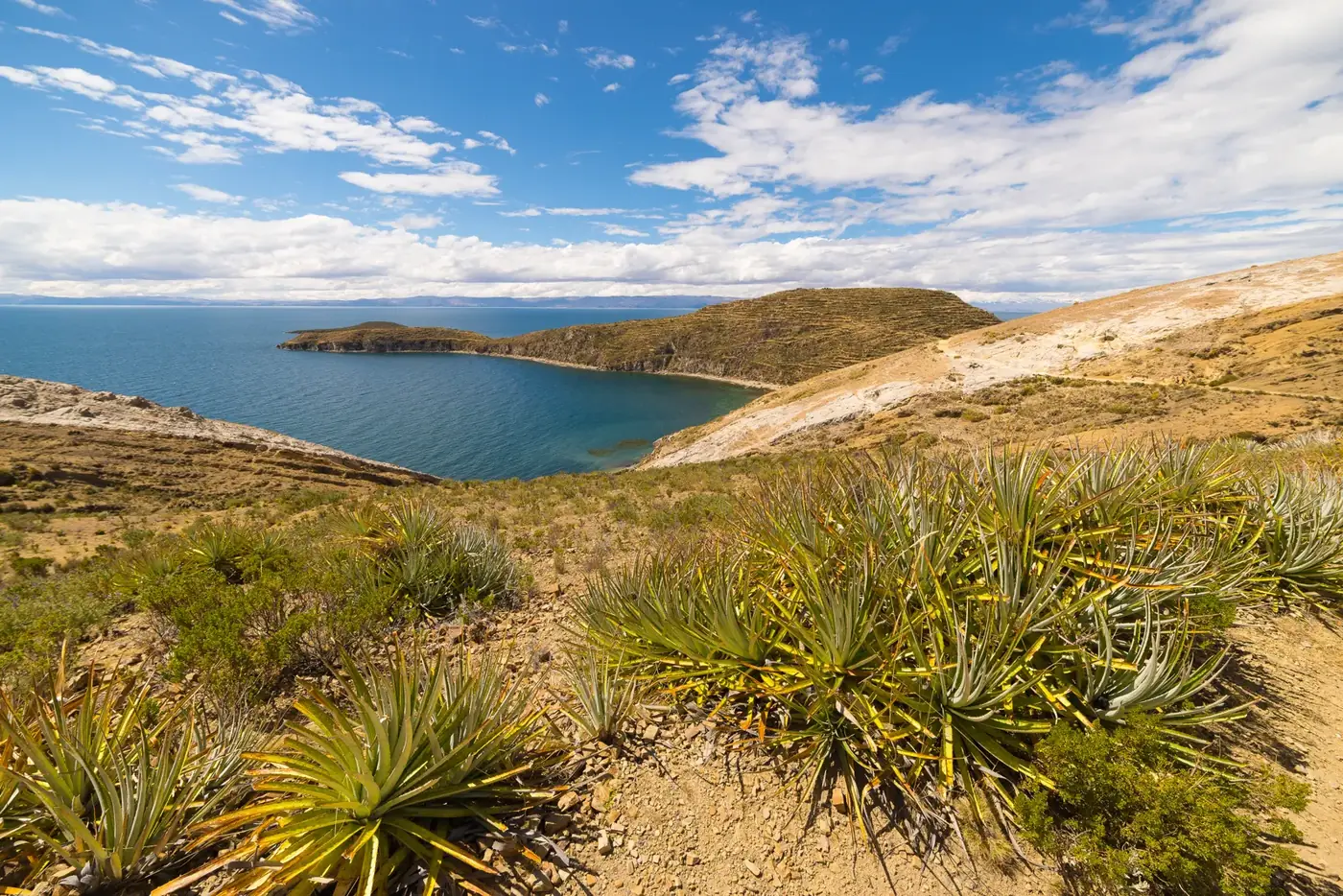
Isla del Sol on Lake Titicaca, Bolivia
La Paz and El Alto
Set in a bowl between 3,300 and 3,800 m (10,800 and 12,500 ft), at the foot of the Illimani massif, La Paz is a spectacular city. Its urban cable car network (Mi Teleférico) links the center with El Alto and offers striking views. Stroll through the Calle Jaén area, with its colonial houses, the Witches’ Market (Mercado de las Brujas) and Plaza Murillo. The Valley of the Moon, with its eroded formations, lies south of the city. The UK FCDO reports express kidnapping incidents around the Cementerio General and Sopocachi areas (GOV.UK): stay alert, especially after dark.
Lake Titicaca, Copacabana and Isla del Sol
Shared with Peru, Lake Titicaca lies at about 3,800 m (12,500 ft). Copacabana, a small lakeside pilgrimage town, is the base for Isla del Sol, the Incas’ sacred island with its terraced trails. Boats on the lake are often very basic: check that life jackets are provided (GOV.UK). For the Copacabana–La Paz journey, the UK FCDO recommends a direct bus, and the U.S. Department of State advises arriving in daylight and buying tickets at the bus terminal.
Tiwanaku
About 70 km (43 mi) from La Paz, the World Heritage site of Tiwanaku preserves the remains of a pre-Inca civilization: the Gate of the Sun, the semi-subterranean temple with its carved heads, the Akapana pyramid. A day trip from La Paz is enough.
The Uyuni salt flat and Sur Lípez
The world’s largest salt flat, the Salar de Uyuni covers more than 10,000 km² (3,900 sq mi) at about 3,650 m (12,000 ft). 4×4 tours, from one to four days, go via Incahuasi Island, covered in giant cacti, then on to Sur Lípez: Laguna Colorada and its flamingos, the Sol de Mañana geysers, Laguna Verde at the foot of the Licancabur volcano. Nights are spent in basic, cold refuges. Choose a reliable agency: according to the UK FCDO, there are no official minimum standards for tour operators, so get local advice and only use reputable companies (GOV.UK).
Potosí
At more than 4,000 m (13,100 ft), Potosí was one of the richest cities in the world thanks to the silver of the Cerro Rico. Its colonial center and the Casa de la Moneda (the former mint) bear witness to that era. Tours of the cooperative mines, still in operation, are physically demanding and expose you to dust and altitude: check the conditions before signing up.
Sucre
The constitutional capital, Sucre is a white city with a mild climate (21 to 23 °C, or 70 to 73 °F, in the afternoon all year round), listed as a World Heritage Site. Its convents, museums and the Casa de la Libertad, where independence was signed, can be explored on foot. Nearby, the Cal Orck’o site preserves thousands of dinosaur footprints. It is a good stop to catch your breath between stays at high altitude.
The Yungas and Coroico
Northeast of La Paz, the road drops more than 4,000 m (13,100 ft) to the subtropical valleys of the Yungas. The old road to Coroico, nicknamed the « Death Road », can be ridden downhill by mountain bike with an agency. The UK FCDO advises making sure the bikes are in good condition and that your guide carries safety equipment and a first-aid kit (GOV.UK).
Rurrenabaque and Madidi National Park
Reached by plane from La Paz, Rurrenabaque is the gateway to the Bolivian Amazon: the forest of Madidi National Park or the Yacuma pampas, where you watch caimans, capybaras and birds from a dugout canoe. Travel with a reputable agency. The UK FCDO reports an increase in robberies of people taking taxis in Santa Cruz, La Paz and Rurrenabaque, and rape and sexual assault incidents at clubs and hostels (GOV.UK).
Santa Cruz, Samaipata and the Jesuit missions
In the eastern lowlands, Santa Cruz is the country’s largest city and a frequent arrival point for international flights. It is a base for Samaipata and the pre-Inca site of El Fuerte, as well as the Jesuit missions of Chiquitos, wooden churches listed as World Heritage. Use radio taxis ordered by phone (GOV.UK).
Things to do in Bolivia: experiences not to miss
Cross the Uyuni salt flat and Sur Lípez on a 3-day 4×4 tour
Sail Lake Titicaca to Isla del Sol from Copacabana
Ride the La Paz cable cars over the city and El Alto
Visit the colonial cities of Sucre and Potosí
Head down to the Yungas and Coroico
Explore the Amazon from Rurrenabaque, in Madidi National Park
Itinerary ideas for Bolivia
10 days: the Altiplano essentials
Days 1–2: arrive in La Paz, acclimatize, cable cars and city center
Day 3: Tiwanaku
Days 4–5: Copacabana and Isla del Sol
Day 6: back to La Paz, flight or daytime bus to Uyuni
Days 7–9: 3-day Uyuni salt flat and Sur Lípez tour
Day 10: flight back to La Paz
2 weeks: Altiplano, colonial cities and the Amazon
Days 1–4: La Paz, Tiwanaku, Lake Titicaca
Days 5–7: Uyuni salt flat and Sur Lípez
Day 8: Potosí
Days 9–10: Sucre
Days 11–14: flight to La Paz then Rurrenabaque, a stay in the pampas or Madidi park, back to La Paz
Keep at least one spare day: roadblocks linked to social unrest and fuel shortages can disrupt travel (GOV.UK).
Budget for a trip to Bolivia
Indicative amounts per person per day, excluding international flights (converted from our euro estimates at the ECB rate of 23 October 2026, €1 = US$1.12):
Item (per person per day)
Budget
Comfort
Accommodation
roughly US$10–30 (hostel, small hotel)
roughly US$55–110 (boutique hotel)
Meals
roughly US$7–13 (set menu, markets)
roughly US$20–45
Transport
roughly US$5–15 (daytime bus, radio taxis)
roughly US$35–65 (domestic flights, driver)
Activities
roughly US$10–30 (entrance fees, group excursions)
roughly US$45–90 (private guide)
Indicative estimates excluding international flights. Uyuni–Sur Lípez tours and Amazon stays are sold as packages, whose price varies with length and level of comfort.
Bolivia is one of the cheapest destinations in South America. The main expenses are organized tours (salt flat, Amazon) and domestic flights, which save precious time. To convert your spending, use our currency converter.
Who is Bolivia for?
Our verdict by travel style, based on the information in this guide:
Adventure: ideal: the Uyuni salt flat and Sur Lípez by 4×4, the descent to the Yungas, the Amazon from Rurrenabaque.
Budget travelers: ideal: one of the cheapest destinations in South America, roughly US$35–50 a day excluding tours.
Culture: yes: Sucre and Potosí, the Tiwanaku site, the markets of La Paz, the Jesuit missions of Chiquitos.
Couples: yes: colonial houses turned into hotels in Sucre, Isla del Sol on Lake Titicaca.
Comfort: limited outside the cities: basic, cold refuges in Sur Lípez, roads sometimes blocked.
Families: demanding: altitude requires quiet days on arrival and 4×4 tours are long; Sucre, with its mild climate, offers a break.
Getting around Bolivia
Distances are long and roads often slow. Several options:
Domestic flights: link La Paz, Santa Cruz, Sucre, Cochabamba, Uyuni and Rurrenabaque; the fastest solution for long distances. The UK FCDO notes that many airports lack safety and rescue capability, especially outside the departmental capitals.
Buses: an extensive, cheap network. According to the UK FCDO (GOV.UK, updated 22 September 2026), accidents involving long-distance buses are common, many buses rarely have seatbelts, and some tourist-oriented companies have better safety standards: research your bus carefully. Theft of bags is a problem on overnight buses (U.S. Department of State); on night buses, keep documents and cards in a money belt.
Taxis: order a radio taxi by phone, check for the registration sticker and never get into a taxi already carrying other passengers (GOV.UK).
4×4 tours: essential for Sur Lípez, with a driver-guide.
Car: UK licence holders need a 1949 International Driving Permit plus their UK licence, obtained in the UK before travel (GOV.UK). The U.S. Department of State advises extreme caution: most roads are unpaved, four-wheel drive is recommended outside major cities, and the rainy season (November–March) makes travel difficult.
Roadblocks: check before every journey; never try to force a blockade.
Where to stay in Bolivia
In La Paz, the center (around Sagárnaga and Jaén streets) has most of the hotels and hostels, while the southern area (Sopocachi, Calacoto) is quieter and slightly lower, so easier on arrival. In Copacabana, accommodation lines the lake; on Isla del Sol, it is simple. In Uyuni, you spend the night before the tour in town; some hotels around the salt flat are built from salt blocks. In Sur Lípez, the refuges are basic and cold: bring a good sleeping bag. Sucre has many colonial houses turned into hotels. In the Amazon, lodges offer all-inclusive packages.
Entry requirements for Bolivia
US citizens
According to the U.S. Department of State (travel.state.gov, last updated May 7, 2026), US citizens do not need a visa to visit Bolivia for tourism and business. You need a passport with at least six months’ validity remaining, the address of your stay in Bolivia and an International Certificate of Yellow Fever Vaccination, especially if traveling to tropical areas of the country.
UK citizens
According to the UK FCDO (GOV.UK foreign travel advice, updated 22 September 2026), you can visit Bolivia for up to 90 days without a visa, within a one-year period; border officials issue 30-day stamps, but you can stay 90 days without a new stamp. Your passport should be valid for at least 6 months after arrival and have at least two blank pages.
You may need to show proof of accommodation for at least your first night. Make sure you get an entry stamp, or you will pay a fine when you leave; Bolivia no longer stamps passports on the Argentine border, but you must register your exit with Argentine immigration.
A yellow fever certificate is required if you arrive from a country listed as a transmission risk. Declare goods on Bolivia’s form 250.
Entry requirements checked on 24 October 2026; check them again before you travel. For customs allowances on your return, check your home country’s rules (e.g. CBP in the US, HMRC in the UK).
Health and safety
Altitude: altitude sickness is a risk in parts of Bolivia, including La Paz and the Uyuni salt flat (GOV.UK). Many trekking routes are at 16,000 ft (4,900 m) or higher; if you develop a severe headache, vomiting, shortness of breath at rest or unsteadiness, descend right away (U.S. Department of State). See a doctor before departure if you have a medical condition.
Health: the UK FCDO (GOV.UK, updated 22 September 2026) lists Oropouche virus disease and Zika among the health risks; check vaccine recommendations at least 8 weeks before your trip. Some medicines are in short supply: bring enough for your stay, with your prescription. You will need to pay up front for treatment, so insurance and access to funds are essential. Emergency medical care outside large cities is inadequate (U.S. Department of State).
Safety: petty crime is common (U.S. Department of State). Criminals impersonate police officers: never get into an unmarked police car; police cannot stop or search you in the street without a written order from a prosecutor (GOV.UK). Tourists, especially those traveling alone, are at risk of express kidnapping, notably at overland border crossings (GOV.UK). Avoid prison tours, which are illegal. Carry a copy of your passport photo page and entry stamp. Emergency numbers: ambulance 118, police 110, fire 119 (GOV.UK).
Drugs: carrying any amount of illegal drugs is treated as trafficking, with a minimum sentence of 8 years; all bags on departing international flights are searched (GOV.UK).
Practical tips for Bolivia
Money: bring cash for rural areas, Sur Lípez and small shops, where cards are rarely accepted. Withdraw money in the cities before tours. The UK FCDO notes an economic crisis and dollar shortage.
Acclimatization: plan at least two quiet days in La Paz before any exertion. For trekking, do not go alone: join an organized group or hire an experienced guide (U.S. Department of State).
Sun and cold: high-factor sunscreen, a hat, mountain sunglasses and warm clothes are essential on the Altiplano.
Internet: coverage is reasonable in cities but very weak around Uyuni and Sur Lípez: tell your family before a multi-day tour.
Language: Spanish is useful everywhere; English is rare outside tourist agencies and hotels.
Etiquette: always ask before photographing someone, especially women in traditional dress at markets.
Not for tourism if you are a US or British citizen. US citizens need a passport with at least six months’ validity, the address of their stay and a yellow fever certificate, especially for tropical areas (travel.state.gov); British citizens can stay up to 90 days in a one-year period, with a passport valid 6 months and two blank pages (GOV.UK). Checked on 24 October 2026; check the latest rules before you leave.
Is Bolivia dangerous?
The UK FCDO advises against all but essential travel to the Chapare region and reports increased crime linked to the economic crisis, fake police officers, express kidnappings, taxi robberies and frequent roadblocks during protests. Elsewhere, usual precautions (radio taxis, watching your belongings, avoiding demonstrations) go a long way.
How do you deal with altitude in Bolivia?
Plan two to three days of acclimatization in La Paz before any exertion, go up gradually, drink plenty and avoid alcohol. If you have a severe headache, vomiting or shortness of breath at rest, descend right away and seek medical attention.
How many days do you need in Bolivia?
Ten days lets you see La Paz, Lake Titicaca and the Uyuni salt flat. Two weeks leaves time to add Potosí, Sucre and a stay in the Amazon.
What currency is used in Bolivia?
The boliviano (BOB). Bring cash for rural areas and tours, where cards are rarely accepted.
What budget for 2 weeks in Bolivia?
Excluding international flights, allow roughly US$35–85 per person per day on a budget, or roughly US$480–1,210 for 14 days, and roughly US$155–315 per day in comfort (roughly US$2,190–4,390). The Uyuni–Sur Lípez tour and Amazon stays are sold as packages, to be added.
What should you see first in Bolivia?
The Uyuni salt flat and Sur Lípez, La Paz, Lake Titicaca and Isla del Sol, the Tiwanaku site, the colonial cities of Sucre and Potosí, then, with more time, the Yungas and the Amazon around Rurrenabaque.
Our sources
Entry, health and safety information read on 24 October 2026: U.S. Department of State, Bolivia country information (travel.state.gov, last updated May 7, 2026), and UK FCDO, foreign travel advice for Bolivia (GOV.UK, updated 22 September 2026)
European Central Bank, euro reference rates of 23 October 2026: budget conversions
Servicio Nacional de Meteorología e Hidrología de Bolivia (SENAMHI): climate normals for La Paz, Uyuni and Sucre
Transparency: this page contains affiliate links, labelled as such. If you book through them we may earn a commission at no extra cost to you; it does not influence our content or recommendations. How we fund the site.