Ghana: what the UK and US governments say before you go
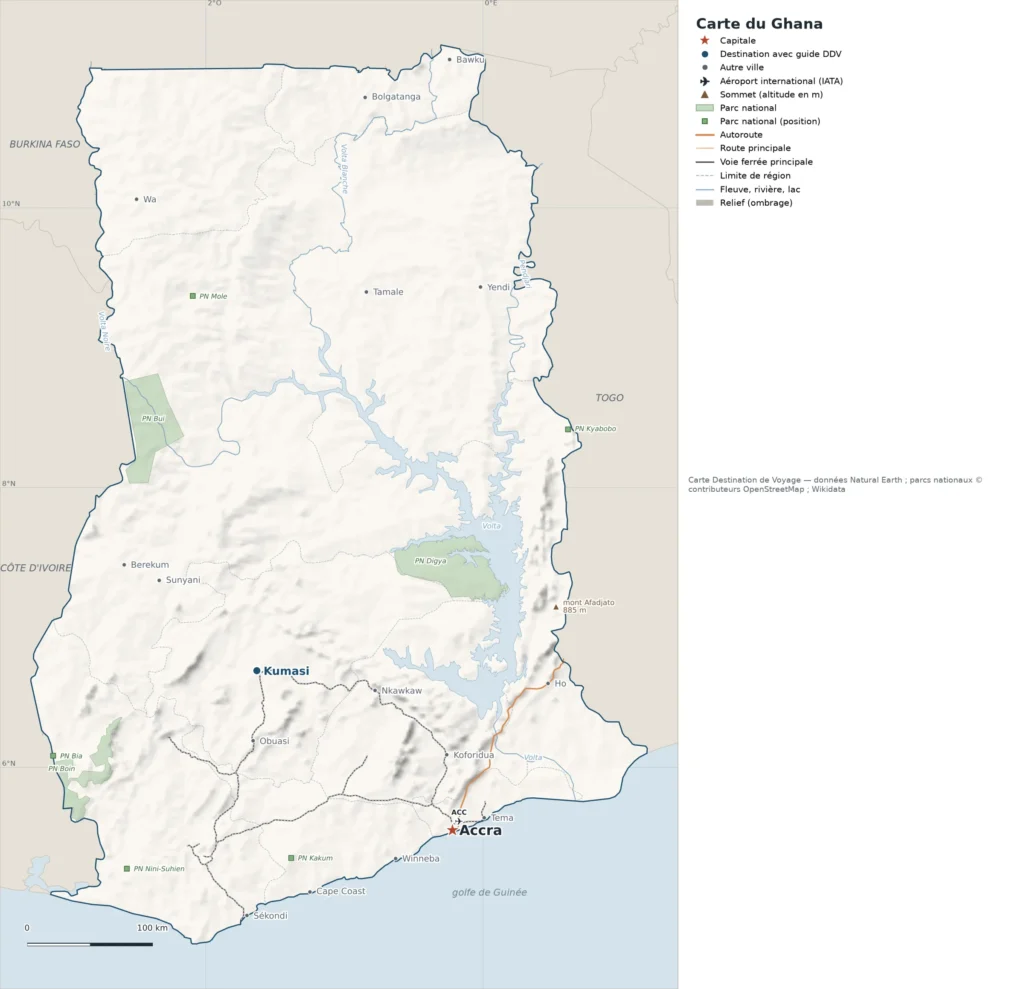
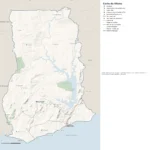
To locate cities, regions, terrain, national parks and airports, see our map of Ghana.
UK FCDO: advises against all but essential travel to the Bawku Municipal area in the Upper East region, because of the number of violent incidents (GOV.UK, updated 4 November 2026). It also reports a tribal conflict in the west of the Savannah Region, near the Côte d’Ivoire and Burkina Faso borders, and attacks on roads around Bawku, and warns that terrorist attacks cannot be ruled out, including in northern border areas.
U.S. Department of State: Level 2, Exercise Increased Caution (travel advisory dated July 6, 2026), because of crime, poor health infrastructure, violence against women and violence against lesbian and gay travelers. It adds a Reconsider Travel warning for the northern border in the Upper East Region, the Northeast Region, the Upper West Region and the areas west of the N12 highway in the Savannah Region, because of crime.
Our choice: this guide recommends no visit to the north of the country and focuses on the south.
A trip to Ghana is first of all about the south of the country: Accra, the coast of UNESCO-listed forts and castles linked to the slave trade, Kakum forest, and Kumasi, the heart of Ashanti country. Ghana is English-speaking, you need a visa before you travel, and both governments urge caution in the north, so this Ghana travel guide sticks to the southern regions, with information checked on 12 November 2026.
Ghana in figures (Destination de Voyage calculation)
Time difference: Ghana stays on GMT all year (UTC+0): the same as London in winter and 1 h behind in summer; 5 h ahead of New York in winter and 4 h in summer.
Driest month in Accra: January (9.5 mm / 0.4 in, 1 rainy day); wettest: June (175.5 mm / 6.9 in).
Warmest month: February (33.1 °C / 92 °F average high); coolest: August (28.3 °C / 83 °F).
Day–night gap: from 5.3 °C in July to 8.3 °C in January.
Day length: between 11 h 48 min (15 December) and 12 h 27 min (15 June): close to the equator, it varies by less than 40 minutes over the year.
Destination de Voyage calculation using the 1981–2010 normals of the Ghana Meteorological Agency (WMO) and the NOAA solar algorithm. Method: driest and warmest months read from the official Accra station normals shown below; day–night gap = average high minus average low.
Ghana at a glance
CapitalAccra
LanguageEnglish (official); Twi, Fante, Ewe, Ga and other languages are supported by the state, and Twi is widely spoken in the south
Currencythe Ghanaian cedi (GHS), issued by the Bank of Ghana · currency converter
Time zoneUTC+0 all year, no daylight saving · time differenceSame as London in winter, 1 h behind in summer; 5 h ahead of New York in winter, 4 h in summerLocal time now: –:–
AirportsKotoka International Airport (Accra) is the main gatewayCheck current routes with the airlines
EntryUK: visa required, applied for through the Ghana High Commission; US: see the Embassy of Ghana for visa details; yellow fever certificate required for both · travel.state.gov · GOV.UK
Electricitywe could not check plug types and voltage against an official source: check before you travel and bring a universal adapter
Safetynorthern areas to avoid (box above), extra care elsewhere
Our travel deals for Ghana
Affiliate links: we earn a commission, at no extra cost to you.
FlightsKiwi.comCompare flights and airline combinations to Ghana.
The best period for southern Ghana is November to February: Accra gets 9.5 to 32 mm (0.4 to 1.3 in) of rain per month, with 1 to 3 rainy days. June is the wettest month in Accra (175.5 mm / 6.9 in). The UK FCDO reports a rainy season from March to November in the northern regions and says heavy rain can also flood urban areas such as Accra and disrupt road travel and electricity (read 12 November 2026).
It is hot all year on the coast: 28 to 33 °C (82 to 91 °F) in the afternoon, 23 to 25 °C (73 to 77 °F) at night. August is a little cooler and relatively dry in Accra (22.2 mm / 0.9 in), a feature of the coast: in Kumasi, further inland, August stays wet.
Month
High °C (°F)
Low °C (°F)
Rain mm (in)
Rain days
Day–night gap (°C)
Sunrise / sunset on the 15th
Day length
January
32.4 (90)
24.1 (75)
10 (0.4)
1.0
8.3
06:15 / 18:05
11 h 50 min
February
33.1 (92)
25.0 (77)
14 (0.6)
1.0
8.1
06:16 / 18:13
11 h 57 min
March
33.0 (91)
25.1 (77)
55 (2.2)
4.0
7.9
06:07 / 18:12
12 h 05 min
April
32.7 (91)
25.1 (77)
82 (3.2)
5.0
7.6
05:53 / 18:08
12 h 14 min
May
31.6 (89)
24.4 (76)
148 (5.8)
8.0
7.2
05:46 / 18:08
12 h 22 min
June
29.7 (85)
23.6 (74)
176 (6.9)
10.0
6.1
05:47 / 18:14
12 h 27 min
July
28.4 (83)
23.1 (74)
65 (2.6)
5.0
5.3
05:54 / 18:19
12 h 25 min
August
28.3 (83)
22.7 (73)
22 (0.9)
4.0
5.6
05:56 / 18:14
12 h 18 min
September
29.5 (85)
23.1 (74)
47 (1.9)
5.0
6.4
05:51 / 18:00
12 h 09 min
October
31.0 (88)
23.5 (74)
64 (2.5)
6.0
7.5
05:46 / 17:46
12 h 00 min
November
32.0 (90)
24.2 (76)
32 (1.3)
3.0
7.8
05:49 / 17:41
11 h 52 min
December
32.1 (90)
24.3 (76)
25 (1.0)
1.0
7.8
06:01 / 17:49
11 h 48 min
Temperatures, rainfall and rainy days: 1981–2010 normals for Accra station, Ghana Meteorological Agency, published by the World Meteorological Organization (World Weather Information Service). Sunrise, sunset and day length: Destination de Voyage calculation using the NOAA solar algorithm (15th of each month, 2027).
For the coast and Accra: November to February, or August if you can only travel in summer.
For the forest (Kakum) and Kumasi: December to February, when the tracks are driest.
Avoid if possible: May and June, the two wettest months in Accra (148 and 175.5 mm / 5.8 and 6.9 in).
Where to go in Ghana: the highlights of the south
In short: the highlights of Ghana are Accra, the Cape Coast and Elmina castles (UNESCO), the Kakum canopy, the west coast and Kumasi with Lake Bosumtwi, all in the south of the country.
Accra
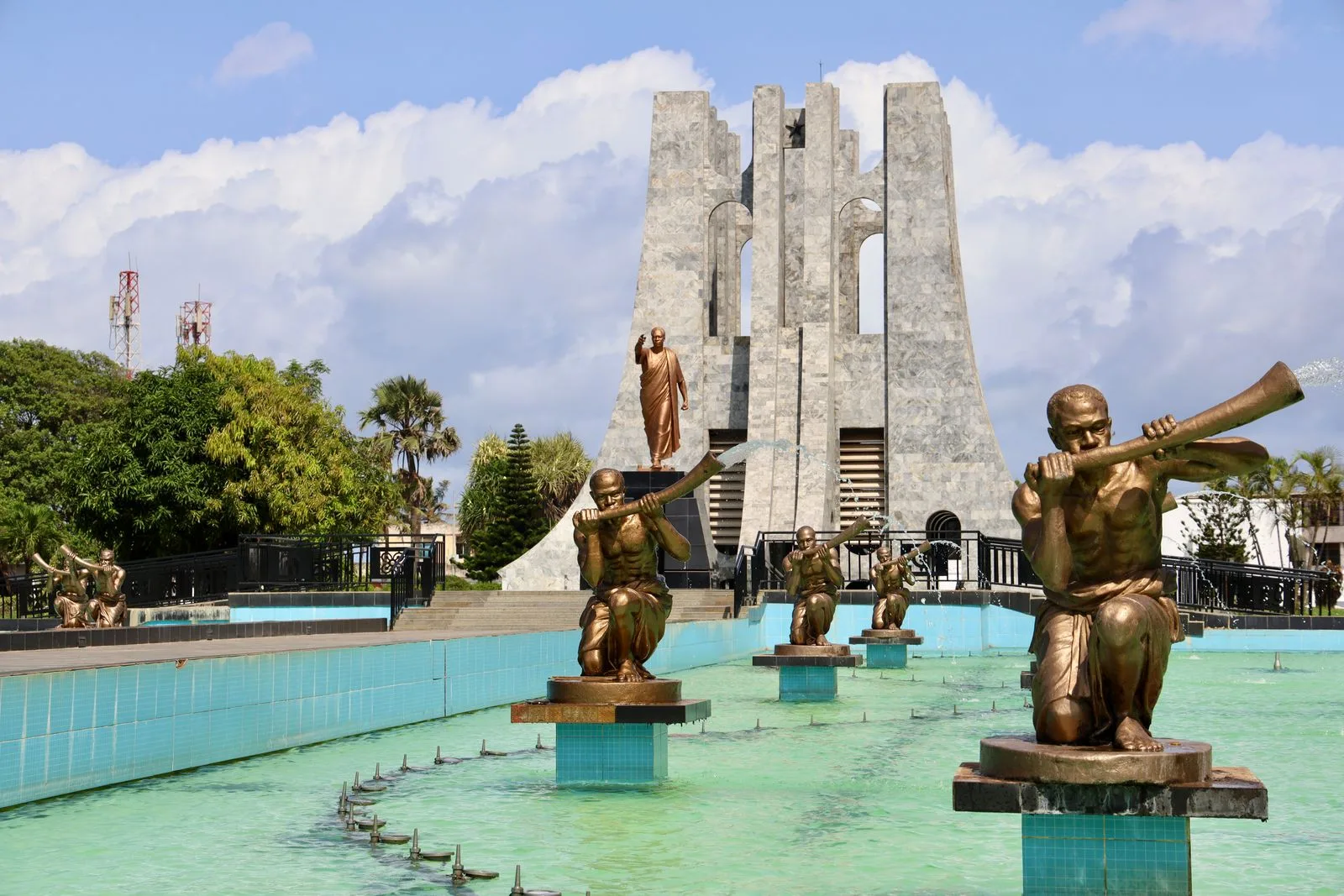
The capital mixes business districts, markets, city beaches and independence landmarks such as the Kwame Nkrumah mausoleum. The UK FCDO reports that street crime such as pickpocketing and bag-snatching is increasing in Accra, and recommends extra care after nightfall. See our Accra guide.
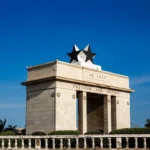
The Kwame Nkrumah mausoleum. Photo: Ana Kenk / Pexels
Cape Coast and Elmina
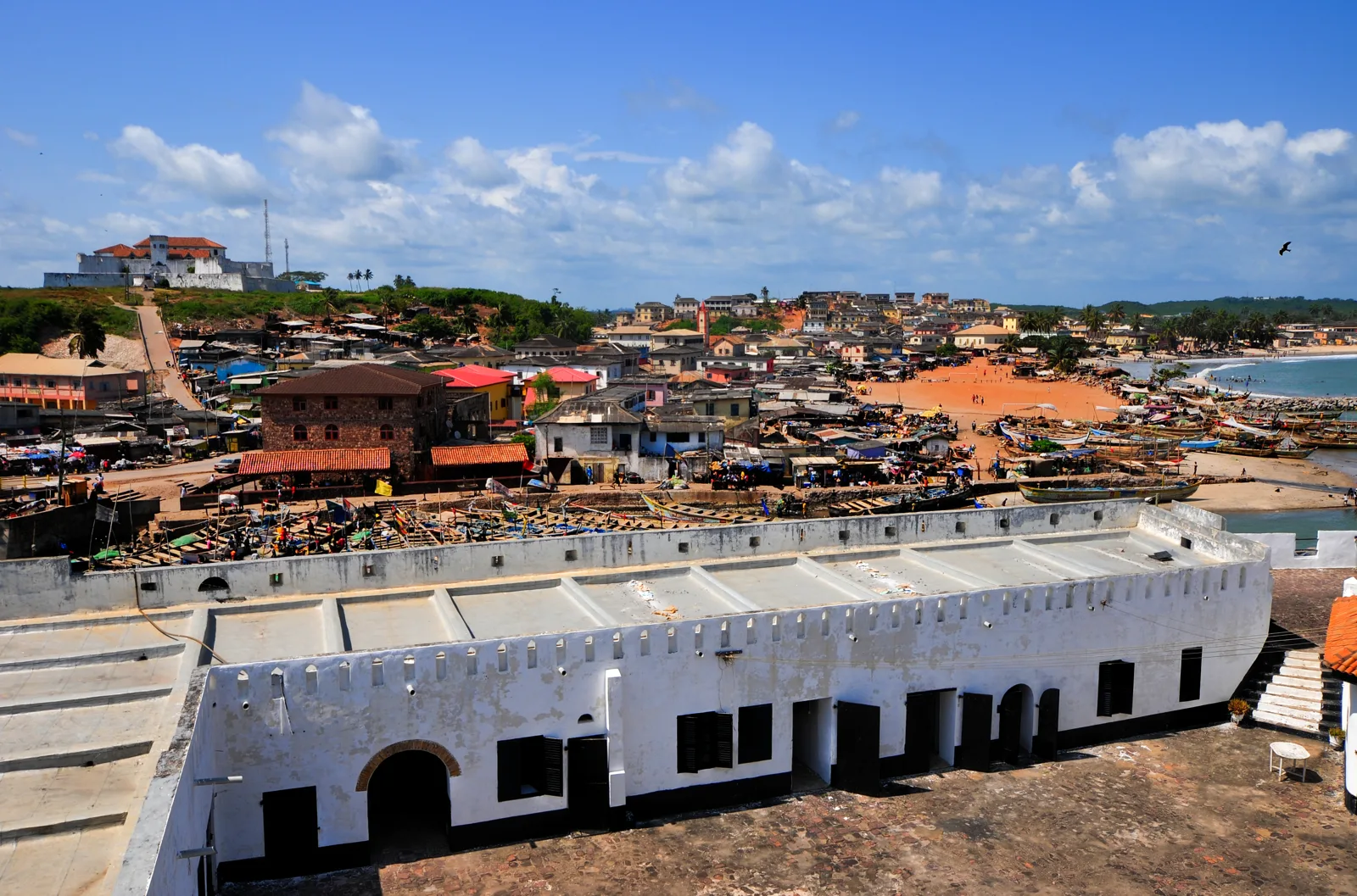
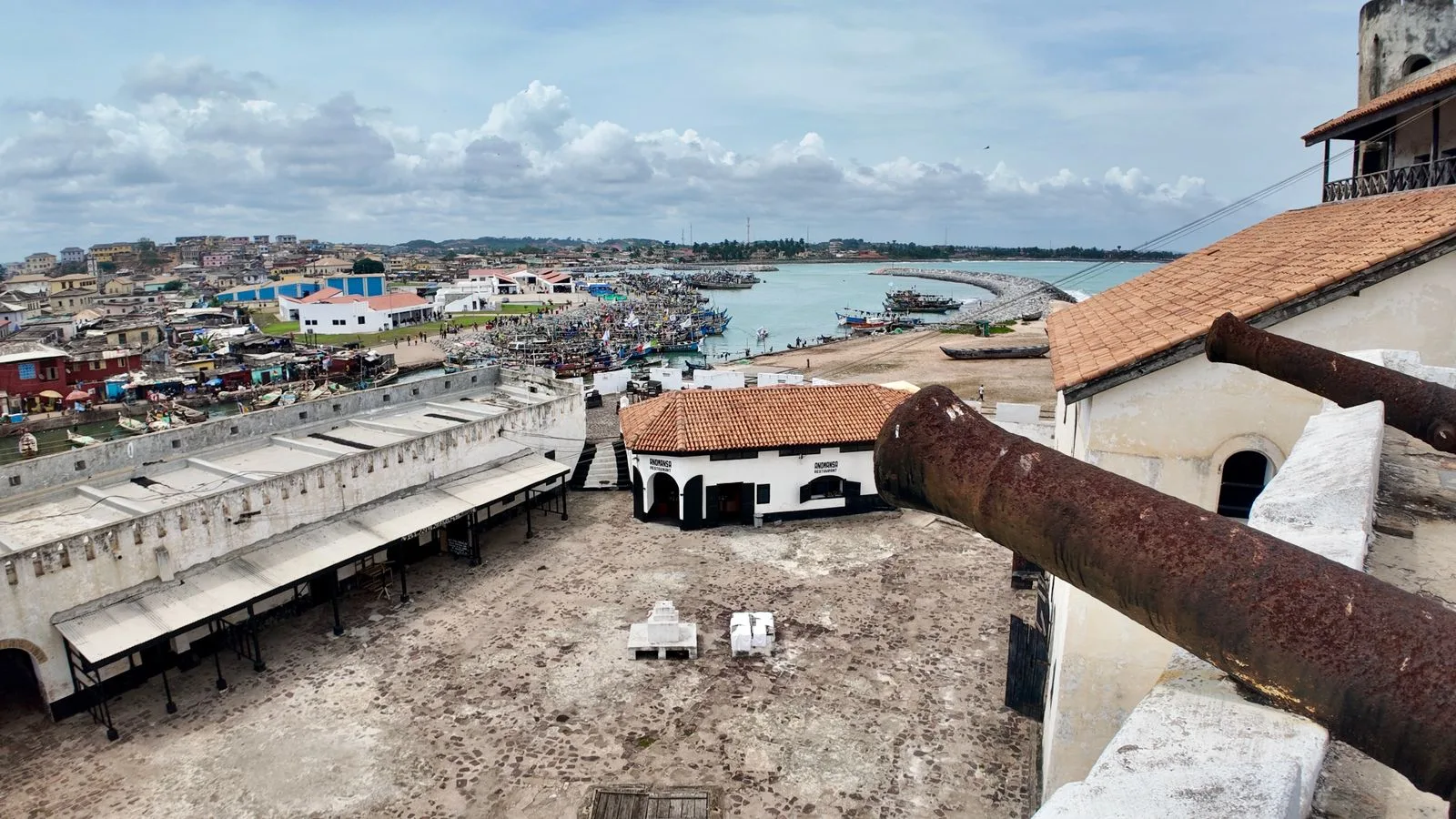
On the coast of the Central Region, the Cape Coast and Elmina castles are part of Ghana’s « forts and castles » inscribed on UNESCO’s World Heritage List in 1979. These former trading posts were at the center of the Atlantic slave trade: the guided tour of the dungeons is a powerful moment, to be approached like a memorial visit.
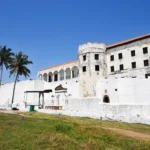
Elmina seen from the castle.
Kakum National Park
North of Cape Coast, this rainforest is known for its canopy walkway. Check opening hours and access conditions with the managing body before you go.
The west coast and Busua
Further west, the beaches around Busua and the coastal forts extend the Castle Coast. The FCDO says theft is the main problem on beaches, with isolated incidents of violent crime and sexual assault in areas popular with tourists: do not visit beaches alone. Both governments warn that swimming along the southern coast is dangerous because of rip tides and undertows.
Kumasi, the Ashanti capital
The country’s second city, Kumasi is the center of Ashanti culture: the Manhyia Palace, now a museum, and Kejetia market, described as the largest in West Africa. See our Kumasi guide.
Lake Bosumtwi
Southeast of Kumasi, this round lake fills a meteorite impact crater. It is a classic excursion from Kumasi.
What we do not currently recommend
Mole National Park, Tamale and the whole north are often included in tours. Given the UK FCDO warning for Bawku, its note on conflict in the Savannah Region and the State Department’s Reconsider Travel warning for the northern border regions, we do not recommend them for now, and we have not described the Volta Region because we found no official source to check it against. If you go for a specific reason, read the latest FCDO and State Department advice before you leave.
The coast’s forts and castles, and kente
The Ghanaian coast has the « Forts and Castles, Volta, Greater Accra, Central and Western Regions », inscribed on the UNESCO World Heritage List in 1979. Built by successive European powers, these trading posts served the gold trade and then the Atlantic slave trade. The most visited are the Elmina and Cape Coast castles, in the Central Region: their dungeons make them places of remembrance more than monuments.
Kente is the country’s other emblem: a hand-woven cloth of silk and cotton strips, historically worn by the Asante, Akan and Ewe. According to Asante oral tradition, it originated in Bonwire, in the Ashanti Region near Kumasi, and Ghana has had it recognized as a geographical indication to protect its origin. Mass-produced « kente-pattern » prints are not woven kente.
Landmark
What to know
Source
Forts and castles
World Heritage since 1979; Elmina and Cape Coast in the Central Region
UNESCO World Heritage Centre
Kente
Hand-woven cloth, silk and cotton; origin attributed to Bonwire (Ashanti); Ghanaian geographical indication
Wikipedia (EN), « Kente cloth »
Kumasi
Center of Ashanti culture (Manhyia Palace, Kejetia market)
Wikipedia (EN), « Kumasi »
Destination de Voyage summary, sources checked on 11 November 2026.
One week: Accra (2 nights); Cape Coast and Elmina (2 nights) with Kakum; return to Accra along the coast.
Two weeks: Accra; Cape Coast, Elmina and Kakum; west coast (Busua); Kumasi and Lake Bosumtwi; return to Accra.
Common rule: no travel after dark. The UK FCDO advises against traveling by road outside the main towns after dark, and the State Department says travel in darkness, particularly outside major cities, is dangerous.
Budget
We do not publish a budget range: we found no official source on prices for visitors. Plan for the visa fee (check the Ghana High Commission or Embassy of Ghana), health and evacuation insurance, and a vehicle with a driver or organized transport for the legs between towns.
Getting around Ghana
In short: in Ghana you travel by day, in a vehicle with a driver or on organized transport.
According to the US State Department, main roads in major cities are generally paved and well maintained, while secondary roads are mostly in poor condition, and many accidents occur on the highway from Accra to Cape Coast. The UK FCDO says street lighting is poor or non-existent, and warns of a heightened risk of attacks on vehicles after dark; for longer trips outside major cities, it advises traveling in daylight and in a convoy of at least two vehicles. Attacks on vehicles are increasing, and incidents have been reported in all types of taxis, including licensed taxis, minibuses (« tro tros ») and app-based taxi services. Use licensed taxis, check the driver’s ID, and avoid traveling alone in taxis after dark. At Kotoka airport, confirm the identity of any driver collecting you: impostors have robbed arriving travelers. You can drive with the 1949 international driving permit or a Ghanaian licence (FCDO).
Where to stay
Accra has many hotel districts. The FCDO reports burglaries in areas used by the international community (Airport Residential, Cantonments, Ridge, Kokrobite), especially over the Christmas period, and advises locking doors and windows and keeping valuables in a lockbox. It also reports media accounts of criminal kidnapping in Accra, Takoradi and Kumasi. On the coast, stay near the sites (Cape Coast, Elmina) to limit travel. In Kumasi, choose a hotel that is easy to reach by car.
Entry requirements for Ghana
US citizens
According to the U.S. Department of State (travel.state.gov, last updated July 9, 2026), proof of yellow fever vaccination is required on arrival for anyone over nine months of age. The page refers US citizens to the Embassy of Ghana website for the most current visa information and does not itself list the visa rules, fees or processing times.
Foreign nationals over six years old who have been physically present in Ghana for 90 days or more in a calendar year must register with the National Identification Authority (NIA) and obtain a non-citizen Ghana card.
UK citizens
According to the UK FCDO (GOV.UK foreign travel advice, updated 4 November 2026), your passport must be valid for at least 6 months after arrival, and you must have a visa.
To apply, complete the online visa application form on the Ghana High Commission website, pay online, upload your supporting documents (including a yellow fever certificate), then print the form and post it with hard copies as directed. Processing takes 10 to 15 days; an express service, in about 3 days, is available in person at the Ghana Premium Application Centre in London.
You must have a certificate proving yellow fever vaccination. Additional Ebola (Bundibugyo virus) screening is in place at Ghana’s entry points: international travelers must complete an online Ghana Health Declaration before travel and may face thermal screening and a travel history check.
You must declare all hard currency on arrival; you can bring in up to the cedi equivalent of 10,000 US dollars, and the authorities can confiscate the entire amount if you carry that value or more in foreign currency.
Check the Ghana High Commission or Embassy before you travel, as rules and fees change. Entry requirements checked on 12 November 2026. See also our entry requirements guide.
Health and safety
Health: the UK FCDO lists yellow fever, malaria and dengue among the health risks; check vaccine recommendations at least 8 weeks before your trip. The US State Department says mosquito-borne illnesses are a significant problem, recommends mosquito repellent, insecticide-treated nets and malaria chemoprophylaxis for all travelers, and says that in many areas tap water is not potable.
Care: medical facilities are poor outside towns, and serious cases need medical evacuation (FCDO); hospitals often require cash up front (State Department). Emergency numbers: 999 or 112 for an ambulance (FCDO); the State Department lists 211 for emergency services.
Crime: robbery, burglary and serious assault have become more common since 2021, sometimes with weapons (FCDO); carjacking, street mugging and rape occur, often at night and in remote places (State Department). Use the hotel safe, be alert at ATMs, and do not resist a robbery.
Laws: Same-sex sexual acts are criminalized (FCDO and State Department). Possession of illegal drugs, including cannabis, carries severe penalties. Wearing military clothing, including camouflage, is illegal, and photography near sensitive sites or the airport is illegal (FCDO).
Online scams: both governments warn about romance and financial scams, and a request for money from someone you met online should be treated with suspicion.
Practical tips for Ghana
Language: English is enough everywhere; a few words of Twi are appreciated in the south, especially in Kumasi.
Money: ATMs are common in large towns but may not be available in rural areas; many hotels and shops accept credit cards except Mastercard, which is not widely accepted (FCDO). Skimming is the main means of card fraud (State Department): keep your card in sight and check ATMs.
Internet: check your carrier’s roaming rates before you go. A local SIM or an eSIM is simpler (see our eSIM guide).
Dress and conduct: Ghana is conservative and deeply religious; dress modestly in public (FCDO). Public smoking is illegal (State Department).
At sea: piracy and armed robbery in the Gulf of Guinea continue to trend upwards (State Department): avoid pleasure sailing offshore.
Compare: for another country on the Gulf of Guinea, see our guide to Benin.
Common mistakes to avoid
Leaving without a visa: the UK FCDO says you must have one to visit Ghana, applied for in advance.
Forgetting the yellow fever vaccination certificate.
Taking an unofficial taxi or accepting help from a stranger at Accra airport.
Planning long legs that end after dark.
Swimming at beaches along the southern coast: both governments warn about rip tides and undertows.
Replying to a request for money received online: scams are frequent.
Verified practical information
Topic
Information
Source (consulted 11–12 November 2026)
Currency
Ghanaian cedi (GHS), issued by the Bank of Ghana
Bank of Ghana
Electricity
Not verified against an official source: check plug types and voltage before you travel
n/a
Languages
English official; Twi, Fante, Ewe, Ga and other languages supported by the state
Wikipedia (EN), « Ghana »
Health
Yellow fever certificate required on entry; malaria: transmission all year throughout the country (Institut Pasteur); chemoprophylaxis recommended for all travelers (US State Department)
UK FCDO; U.S. State Department; Institut Pasteur
Safety
UK FCDO: all but essential travel advised against in Bawku Municipality; State Department Level 2 with Reconsider Travel for northern border and some northern regions
UK FCDO (GOV.UK, 4 November 2026); U.S. Department of State (July 6, 2026)
Time
GMT all year (UTC+0)
Our time difference page
Destination de Voyage table, information checked on 12 November 2026.
Frequently asked questions
Is Ghana a safe country?
The UK FCDO advises against all but essential travel to Bawku Municipality and warns of crime and terrorism risks in the north; the US State Department rates Ghana Level 2, Exercise Increased Caution, with a Reconsider Travel warning for some northern regions. In the south, take care against street crime and avoid road travel after dark.
Do you need a visa for Ghana?
The UK FCDO says British citizens must have a visa, applied for through the Ghana High Commission before travel. The US State Department refers US citizens to the Embassy of Ghana for visa information. A yellow fever certificate is required for both.
What language is spoken in Ghana?
English is the official language. Twi is widely spoken in the south, along with Fante, Ewe, Ga and other languages.
What is the best time to visit Ghana?
November to February for the south: less than 35 mm (1.4 in) of rain per month in Accra (1981–2010 normals).
Can you visit Mole National Park?
We do not currently recommend it: it is in the north, where the UK FCDO and the US State Department have warnings. Check the latest official advice if you are considering it.
Where is Ghana?
In West Africa, on the Gulf of Guinea, between Côte d’Ivoire to the west, Burkina Faso to the north and Togo to the east.
What is the capital of Ghana?
Accra, on the Atlantic coast, the main air gateway to the country.
What is there to do in Ghana?
In the south: Accra, the UNESCO-listed Cape Coast and Elmina castles, the Kakum canopy walkway, the west coast beaches, Kumasi and Lake Bosumtwi.
Which country colonized Ghana?
The United Kingdom: the colony was called the Gold Coast and became independent in 1957 as Ghana, hence English as the official language.
What is the time difference with Ghana?
Ghana is on GMT all year: the same as London in winter and 1 h behind in summer; 5 h ahead of New York in winter and 4 h in summer.
Is there malaria in Ghana?
Yes. According to the Institut Pasteur, transmission occurs all year throughout the country, and the US State Department recommends chemoprophylaxis for all travelers. See a doctor before you go.
What currency is used in Ghana?
The Ghanaian cedi (GHS), issued by the Bank of Ghana.
U.S. Department of State, Ghana country information (travel.state.gov, last updated July 9, 2026) and Travel Advisory (Level 2, July 6, 2026), read on 12 November 2026
World Meteorological Organization, World Weather Information Service: 1981–2010 normals for Accra (Ghana Meteorological Agency)
Astronomical calculation by Destination de Voyage using the NOAA solar algorithm
Wikipedia (EN), « Ghana », « Accra », « Kumasi » and « Kente cloth »
Institut Pasteur, Ghana country sheet (in French), consulted 11 November 2026
Bank of Ghana (bog.gov.gh), consulted 11 November 2026
UNESCO World Heritage Centre: « Forts and Castles, Volta, Greater Accra, Central and Western Regions » (1979)


 FlightsKiwi.comCompare flights and airline combinations to Ghana.Compare flights