Burundi: what the UK and US governments say before you go
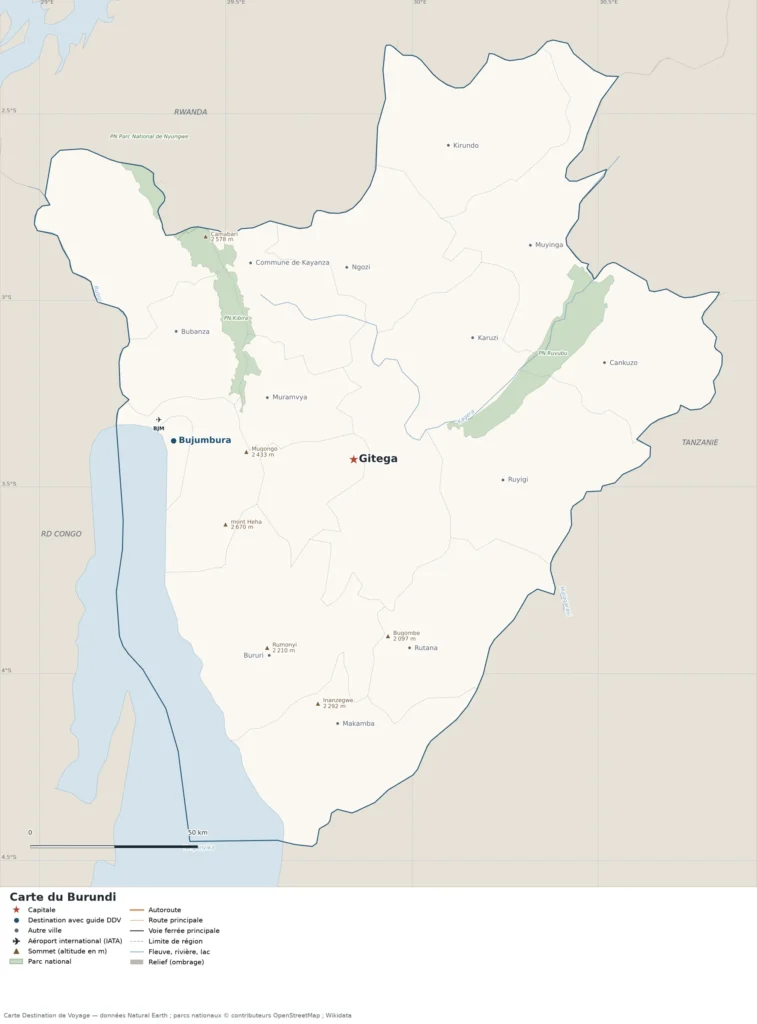
To locate cities, regions, terrain, national parks and airports, see our map of Burundi.
FCDO: advises against all travel (UK FCDO, GOV.UK, updated 21 May 2026) to the communes of Mugina, Cibitoke, Bukinyayana, Bubanza and Mpanda; to parts of Ntahangwa commune (the RN5 road north of Bujumbura airport towards Cibitoke, and the area west of the Rusizi River towards the DRC border, including Rusizi National Park); and to the RN6 and RN10 roads running west from Kayanza through Kibira National Park towards Cibitoke. The reasons given are the possible presence of a rebel group in Kibira and armed incursions from the Democratic Republic of the Congo (DRC).
State Department: Level 3, Reconsider Travel (travel advisory dated April 28, 2025). It lists as Do Not Travel areas the former Central Market on Chaussee Prince Louis Rwagasore in Bujumbura, Cibitoke and Bubanza provinces, and Kibira National Park.
Elsewhere: the FCDO says armed group activity along the Burundi–DRC border has increased and that the Rwandan land border is closed. The State Department says police and army checkpoints are common and that borders may close without notice.
A trip to Burundi is built around three ideas: a country of hills between Lake Tanganyika and the sources of the Nile, western and northern border areas to avoid, and no travel by road after dark. This Burundi travel guide only describes places outside the areas the UK FCDO advises against, with entry rules, climate and safety information checked on 12 November 2026.
A small landlocked country of 27,834 km² (10,747 sq mi) between Rwanda, Tanzania and the DRC, Burundi receives few visitors. Since the law of 4 February 2019 it has had two capitals: Gitega, the political capital in the center, and Bujumbura, the economic capital and largest city, on the shore of Lake Tanganyika.
Burundi at a glance
CapitalGitega (political); Bujumbura (economic, international airport)
LanguageKirundi, French and English are official languages; Kirundi is spoken by almost the whole population
Currencythe Burundian franc (BIF) · currency converterLargely a cash economy; both governments advise carrying US dollars in good condition (see Practical tips)
Time zoneUTC+2 all year, no daylight saving · time difference2 h ahead of London and 7 h ahead of New York in winter; 1 h and 6 h in summerLocal time now: –:–
AirportsMelchior Ndadaye International Airport (Bujumbura), the only international airport (FCDO)Check current routes with the airlines
EntryUS and UK: visa required, applied for online and issued on arrival ($90 for one month); yellow fever certificate required · travel.state.gov · GOV.UK
Central bankthe franc is issued by the Bank of the Republic of Burundi, which publishes exchange rates (consulted 11 November 2026)
Healththe Institut Pasteur says a yellow fever vaccination certificate is required on entry from 9 months of age and that malaria is transmitted all year throughout the country (country sheet consulted 11 November 2026); the US State Department recommends malaria chemoprophylaxis for all travelers
Burundi: key figures calculated by Destination de Voyage
Time difference: UTC+2 all year, i.e. 2 h ahead of London and 7 h ahead of New York in winter, 1 h and 6 h in summer.
Day length in Bujumbura: from 11 h 56 min (June–July) to 12 h 19 min (December), only 23 minutes of difference over the year because the city is close to the equator (Destination de Voyage calculation using the NOAA solar algorithm, 15th of each month, 2027).
Temperature range over the year: 24.8 °C (77 °F) on average in September, the warmest month, against 23.2 °C (74 °F) in July, the coolest, a gap of 1.6 °C (about 3 °F) (Destination de Voyage calculation from the 1961–1990 normals of Bujumbura station (IGEBU, published by the WMO), mean of highs and lows).
Driest month: July (3 mm / 0.1 in, 1 rainy day); wettest: March (118 mm / 4.6 in) (same source).
Our travel deals for Burundi
Affiliate links: we earn a commission, at no extra cost to you.
FlightsKiwi.comCompare flights and airline combinations to Burundi.
When is the best time to visit Burundi? From June to August, in the dry season. According to the Bujumbura normals, less than 15 mm (0.6 in) of rain falls per month in June, July and August, against 86 to 118 mm (3.4 to 4.6 in) per month from November to April. The UK FCDO says the rainy season runs from October to May and can cause flash floods, and that roads are frequently blocked or damaged by landslides after heavy rain; the US State Department says many roads become impassable in the main rainy season, from February to May (both read 12 November 2026). Temperatures hardly change: 29 to 31 °C (84 to 88 °F) in the afternoon all year on the shore of Lake Tanganyika.
The most favorable period is June to August, in the heart of the dry season: Bujumbura gets 8.9 mm (0.4 in) of rain in June, 2.7 mm (0.1 in) in July and 13.4 mm (0.5 in) in August. That is a strong argument for avoiding the wet months if you plan to travel by road in the provinces.
Temperatures vary little: 29 to 31 °C (84 to 88 °F) in the afternoon all year in Bujumbura, by the lake. The hills of the center, around Gitega, are cooler (no official normals for Gitega were used here). The table adds our own calculation: sunrise and sunset on the 15th of each month, almost constant this close to the equator.
Month
High °C (°F)
Low °C (°F)
Rain mm (in)
Rain days
Day–night gap (°C)
Sunrise / sunset on the 15th
Day length
January
29.1 (84)
19.2 (67)
100 (3.9)
16.0
9.9
06:02 / 18:20
12 h 18 min
February
29.7 (85)
19.3 (67)
86 (3.4)
19.0
10.4
06:10 / 18:23
12 h 13 min
March
29.3 (85)
19.3 (67)
118 (4.6)
18.0
10.0
06:07 / 18:15
12 h 08 min
April
29.2 (85)
19.6 (67)
112 (4.4)
18.0
9.6
06:01 / 18:03
12 h 02 min
May
29.9 (86)
19.1 (66)
57 (2.2)
10.0
10.8
06:00 / 17:57
11 h 58 min
June
29.9 (86)
17.6 (64)
9 (0.4)
2.0
12.3
06:05 / 18:00
11 h 56 min
July
29.2 (85)
17.2 (63)
3 (0.1)
1.0
12.0
06:10 / 18:06
11 h 57 min
August
30.0 (86)
17.4 (63)
13 (0.5)
2.0
12.6
06:07 / 18:07
12 h 00 min
September
30.9 (88)
18.6 (65)
33 (1.3)
8.0
12.3
05:55 / 18:00
12 h 05 min
October
30.1 (86)
19.1 (66)
59 (2.3)
15.0
11.0
05:43 / 17:53
12 h 11 min
November
29.1 (84)
19.1 (66)
97 (3.8)
19.0
10.0
05:38 / 17:55
12 h 16 min
December
28.9 (84)
19.1 (66)
100 (3.9)
19.0
9.8
05:47 / 18:07
12 h 19 min
Temperatures, rainfall and rainy days: 1961–1990 normals for Bujumbura station, Geographical Institute of Burundi (IGEBU), published by the World Meteorological Organization (World Weather Information Service). Sunrise, sunset and day length: Destination de Voyage calculation using the NOAA solar algorithm (15th of each month, 2027).
If you want to travel by road in the provinces (Gitega, source of the Nile, Karera): June to August, when roads suffer least from the rains.
If you can only go in the rainy season: keep journeys short, leave a time margin, and check road conditions before each trip, as the FCDO advises.
September is a transition month: 33 mm (1.3 in) over 8 rainy days on average in Bujumbura.
Best time by activity
Activity
Recommended period
Based on
Road trip in the provinces (Gitega, Gishora, source of the Nile, Karera)
June to August
dry season; roads often blocked or damaged by rain-related landslides (UK FCDO)
Bujumbura and Lake Tanganyika
all year, preferably June to August
highs of 29 to 31 °C (84 to 88 °F) all year; less than 15 mm (0.6 in) of rain per month in June–August
Ruvubu National Park
June to August
easier access in the dry season; check conditions with a local operator
Transition month
September
33 mm (1.3 in) over 8 rainy days on average in Bujumbura
Destination de Voyage summary based on the 1961–1990 normals for Bujumbura (IGEBU, WMO), UK FCDO and U.S. Department of State, read on 12 November 2026.
Where to go in Burundi: places outside the areas to avoid
What is there to see in Burundi? Bujumbura and Lake Tanganyika, Gitega and its National Museum, the Gishora drum sanctuary, the southernmost source of the Nile at Rutovu, the Karera Falls and Ruvubu National Park. None of these places lies in the areas the UK FCDO advises against, which cover the northwest (Bujumbura Province, Cibitoke, Bubanza) and the roads through Kibira National Park.
The selection below deliberately leaves out Kibira National Park, the Rusizi nature reserve (which runs along the Congolese border) and Cibitoke province, which are in or immediately next to the areas to avoid.
Bujumbura and Lake Tanganyika
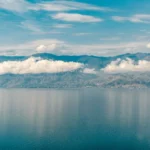
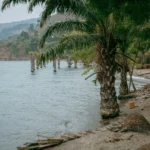
The economic capital and air gateway of the country, Bujumbura lies at the foot of the mountains, facing Lake Tanganyika. People come for the city and its markets. Crime levels are high and grenade attacks have occurred in the center, including a May 2024 attack at the former bus station (UK FCDO), and the FCDO advises against walking or using public transport after dark, even in the city center. It also advises against swimming in Lake Tanganyika because of wildlife and waterborne diseases. Everything is detailed in our Bujumbura guide.
Gitega, the political capital
In the center of the country, on the high plateaus, Gitega is home to the National Museum of Burundi, devoted to the history and traditions of the former kingdom. It is the most logical base for discovering the interior.
The Gishora drum sanctuary
Near Gitega, the Gishora sanctuary is linked to the royal drums. The ritual dance of the royal drum has been on UNESCO’s Intangible Cultural Heritage list since 2014. Ask locally about demonstration days.
The southernmost source of the Nile
In the south of the country, a pyramid at Rutovu marks the source regarded as the southernmost of the Nile. The site can be combined with the southern hills and Gitega.
The Karera Falls and the Germans’ Fault
In Rutana province, in the southeast, the Karera Falls drop in several steps through the vegetation. Not far away, the Nyakazu fault, known as the « Germans’ Fault », offers a wide view over the plain stretching toward Tanzania.
Ruvubu National Park
In the east, along the Ruvubu River, this park of savanna and gallery forest is the largest protected area in the country. Visitor facilities are limited: go through a local operator and check access conditions before leaving. The US State Department notes that no formal tourism infrastructure is in place and that tourists take part in activities at their own risk.
Regions and highlights at a glance
Region
Highlights
Government advice
Bujumbura and Lake Tanganyika
economic capital, markets, lakeside
high crime; avoid walking or public transport after dark (FCDO); do not swim in the lake (FCDO)
Center (Gitega)
political capital, National Museum, Gishora sanctuary
no specific FCDO warning; avoid road travel after dark
South (Rutovu)
southernmost source of the Nile
no specific FCDO warning; avoid road travel after dark
Southeast (Rutana)
Karera Falls, Nyakazu fault
no specific FCDO warning; avoid road travel after dark
East
Ruvubu National Park
no specific FCDO warning; limited tourism infrastructure (State Department)
Cibitoke and Bubanza provinces, Kibira National Park, RN5 north of the airport, RN6/RN10 through Kibira, Rusizi National Park
not recommended
FCDO: advises against all travel; State Department: Do Not Travel (Cibitoke, Bubanza, Kibira)
Destination de Voyage summary based on UK FCDO (GOV.UK, updated 21 May 2026) and U.S. Department of State (advisory dated April 28, 2025; country information last updated October 1, 2026), read on 12 November 2026.
The royal drums, UNESCO intangible heritage
Burundi has no World Heritage site, according to the UNESCO page consulted on 11 November 2026. Its best-known heritage is intangible: the ritual dance of the royal drum, inscribed in 2014 on the Representative List of the Intangible Cultural Heritage of Humanity. The Gishora sanctuary near Gitega is the most accessible place to understand its history; ask locally about demonstration days.
One week: Bujumbura (2 nights); Gitega and Gishora (2 nights); source of the Nile and return through the south; final nights in Bujumbura.
Ten days: same base, adding the Karera Falls, the Germans’ Fault and Ruvubu park, with each leg planned to arrive before dark.
Common rule: no stops in the provinces bordering the DRC, no road travel after dark, and fill the tank whenever you can, as both governments report severe and recurring fuel shortages.
Budget
We do not publish a budget range: we found no reliable official source on prices for visitors. Two items are certain, however: the visa, at $90 for one month according to the UK FCDO and the US State Department, and insurance that covers medical evacuation, which the State Department strongly recommends and the FCDO says may be needed (to Kenya or Rwanda). Also plan for a vehicle with a driver to get around the provinces.
Getting around Burundi
The UK FCDO advises against traveling by road outside Bujumbura after dark because of the security situation and road safety. Serious accidents are common, only a small number of roads are paved, and roads are frequently blocked or damaged by landslides; the US State Department adds that there is a general lack of lighting, signs and road shoulders, that fuel shortages can mean queues of hours or days, and that public transport is unregulated and generally unsafe. Roadblocks and document checks are common, and not always official: carry a copy of your passport and visa. If you drive, the FCDO says a UK photocard licence can be used for 6 months; the State Department says an international driving permit and third-party insurance are required. Burundi closed its land border with Rwanda on 11 January 2024; flights still link the two capitals (FCDO). The Tanzania border operates normally, although transport may be limited by fuel shortages, and the DRC border area is unstable (FCDO).
Where to stay
In Bujumbura and in the provinces, the FCDO recommends staying in hotels with good security and using hotel safes where possible. Choose hotels with guards and secure parking, and book your provincial stops in advance so you are not looking for a room at dusk. The US State Department notes that hotels may require non-resident foreigners to pay in US dollars.
Entry requirements for Burundi
US citizens
According to the U.S. Department of State (travel.state.gov, last updated October 1, 2026), you need a passport and a visa. A 30-day visa can be obtained on arrival at Bujumbura airport for $90, and can be extended in-country (renewal visas cost $70 per month). Those staying longer can apply for a three-month visa at the Burundian Embassy in Washington, DC.
Visa applicants should have a WHO card showing yellow fever vaccination. The State Department also recommends carrying copies of your passport and visa, and warns that travelers with more than one of any type of electronic device have had them confiscated on arrival.
UK citizens
According to the UK FCDO (GOV.UK foreign travel advice, updated 21 May 2026), your passport must be valid for at least 6 months after arrival and have one blank page, and you must have a visa.
You should apply online before you travel (the airport entry visa or transit visa application) and keep the validation certificate you receive, which you need to get your visa on arrival. A one-month visa costs $90, payable online or in cash on arrival, and is valid for single and multiple entries.
You must have a certificate proving yellow fever vaccination to enter Burundi.
Both governments describe the same procedure and fee. Rules can change: check the Burundi embassy website or your nearest Burundi embassy before you travel. Entry requirements checked on 12 November 2026. See also our entry requirements guide.
Health and safety
Health: the FCDO lists malaria, dengue, Zika, yellow fever and mpox among the health risks, and reports an ongoing cholera outbreak; check vaccine recommendations at least 8 weeks before your trip on TravelHealthPro. The US State Department recommends mosquito repellent, insecticide-treated nets and malaria chemoprophylaxis for all travelers, even on short stays, and says tap water is not potable. The FCDO also reports an Ebola Bundibugyo outbreak declared in the DRC’s Ituri province, which may mean heightened health screening at regional borders.
Care: outside Bujumbura there is a lack of adequate medical facilities, and evacuation to Kenya or Rwanda may be needed (FCDO). Hospitals often require cash up front and may refuse treatment otherwise (State Department). Emergency numbers: 112 (ambulance, fire, police) or the Red Cross on 109 (FCDO).
Safety: terrorist attacks cannot be ruled out, grenade attacks are common and crime levels are high (FCDO). Avoid large gatherings and demonstrations, and do not walk or use public transport after dark. Same-sex sexual acts are illegal, with penalties of 3 months to 2 years in prison (FCDO and State Department). Drug offenses carry severe penalties.
Practical tips for Burundi
Money: Burundi is largely a cash-based society. The FCDO advises taking US dollars dated after 2006 and says older or torn notes are often rejected; the State Department says most vendors and banks take only US bills in near-mint condition printed after 2009. Because the two governments give different dates, bring the newest notes you can. Outside Bujumbura, cards are rarely accepted and ATMs are few; ATMs dispense only Burundian francs. Exchange money only at reputable banks. Take care when withdrawing or exchanging cash, and not at night.
Internet: check your carrier’s roaming rates before you go. SIM cards can be bought locally, and you must show a copy of your ID or passport to register one (State Department). An eSIM is another option (see our eSIM guide).
Etiquette and photography: ask before photographing anyone. It is illegal to photograph government buildings, military installations and key infrastructure such as airports and border posts, including with a drone (State Department).
Electricity: we could not check the plug types and voltage against an official source, so check before you travel and bring a universal adapter. Power outages occur frequently (State Department).
Neighbors: the region is often combined with Tanzania; the land border with Rwanda is closed, and only flights link the two countries (FCDO).
Frequently asked questions
Is Burundi dangerous for tourists?
The UK FCDO advises against all travel to parts of Bujumbura Province, Cibitoke, Bubanza and the roads through Kibira National Park, and the US State Department rates Burundi Level 3, Reconsider Travel. Elsewhere, crime levels are high and the main rule is not to travel by road after dark.
Do you need a visa for Burundi?
Yes, for both US and UK citizens. You apply online and the visa is issued on arrival at the airport: $90 for one month according to the FCDO and the State Department.
What is the capital of Burundi?
Gitega has been the political capital since 2019; Bujumbura remains the economic capital and the city with the international airport.
What language is spoken in Burundi?
Kirundi, the official language spoken by almost the whole population, together with French and English, which are also official.
What is the best time to visit Burundi?
June to August, the dry season: less than 15 mm (0.6 in) of rain per month in Bujumbura (1961–1990 normals).
Where is Burundi?
In East Africa, in the Great Lakes region: this small landlocked country of 27,834 km² (10,747 sq mi) is surrounded by Rwanda, Tanzania and the DRC and lies on Lake Tanganyika.
What currency is used in Burundi?
The Burundian franc (BIF), issued by the Bank of the Republic of Burundi. Many transactions are in cash and visitors are advised to carry US dollars in good condition.
Is there malaria in Burundi?
Yes. According to the Institut Pasteur, transmission occurs all year throughout the country; the US State Department recommends malaria chemoprophylaxis for all travelers.
Is the yellow fever vaccine required for Burundi?
Yes: the UK FCDO says you must have a yellow fever vaccination certificate to enter, and the Institut Pasteur says it is required from the age of 9 months.
Are the drums of Burundi on the UNESCO list?
Yes: the ritual dance of the royal drum has been inscribed on UNESCO’s Intangible Cultural Heritage list since 2014.
What is the time difference with Burundi?
Burundi is on UTC+2 all year: 2 h ahead of London and 7 h ahead of New York in winter, 1 h and 6 h in summer.
U.S. Department of State, Burundi country information (travel.state.gov, last updated October 1, 2026) and Travel Advisory (Level 3, April 28, 2025), read on 12 November 2026
World Meteorological Organization, World Weather Information Service: 1961–1990 normals for Bujumbura (Geographical Institute of Burundi)
Astronomical calculation by Destination de Voyage using the NOAA solar algorithm
Wikipedia (EN) « Burundi » (law no. 1/04 of 4 February 2019 on capitals, official languages, currency)
UNESCO World Heritage Centre, Burundi page, consulted 11 November 2026


 FlightsKiwi.comCompare flights and airline combinations to Burundi.Compare flights