Rwanda means the mountain gorillas of Volcanoes National Park, the chimpanzees of Nyungwe Forest, the Akagera savanna and the shores of Lake Kivu, in a country smaller than Maryland. Rwanda focuses on carefully managed, often expensive nature tourism, and the UK FCDO describes crime levels as relatively low. This Rwanda travel guide brings together the essentials for planning your stay: what to see, itineraries, budget and entry requirements.
To locate cities, regions, terrain, national parks and airports, see our map of Rwanda.
Rwanda at a glance
CapitalKigali
LanguageKinyarwanda, English, French and SwahiliOfficial languages
The best period is June to September, during the long dry season: very little rain (10 mm (0.4 in) in July in Kigali), easier trails to the gorillas and better wildlife viewing in Akagera. December to February is a good alternative. The wettest months are March, April and November. Thanks to the altitude, it is mild all year (26 to 28 °C (79 to 82 °F) by day in Kigali), but cool on the volcanoes. All the details, month by month and with official climate data, are in our article best time to visit Rwanda.
What to see in Rwanda: the highlights
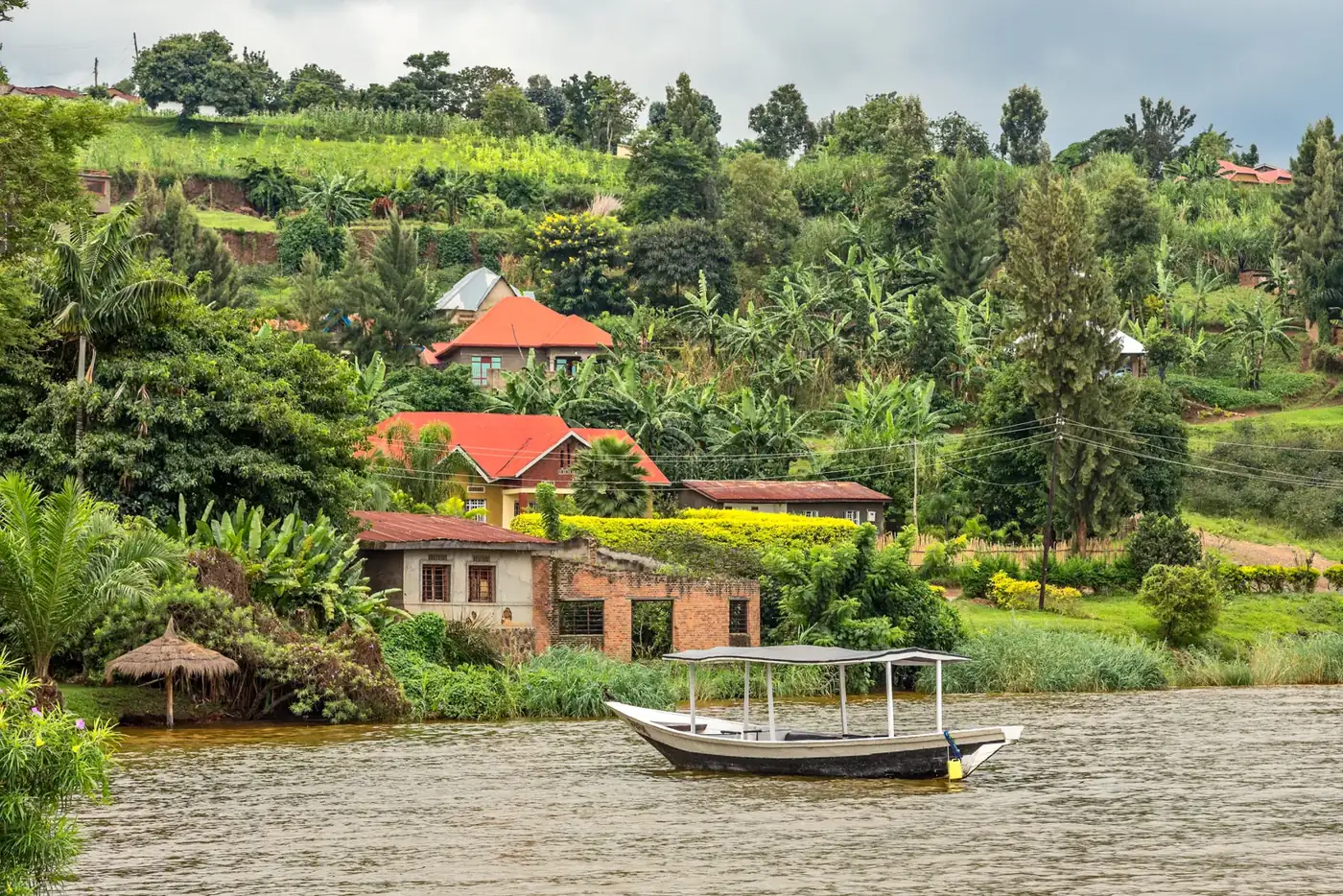
Boat moored on the shore of Lake Kivu, Rwanda
Volcanoes National Park and mountain gorillas
In the northwest, on the border with the DRC and Uganda, this park covers the Rwandan part of the Virunga Mountains. From the Kinigi headquarters, you set off to meet a family of mountain gorillas used to human presence: the walk takes from less than an hour to several hours depending on where the group is, and time with the gorillas is limited to about an hour. The park also offers golden monkey tracking, the climb up Bisoke volcano to its crater lake, and the hike to Dian Fossey’s grave. Places are limited and the permit is expensive: book early. The U.S. Department of State (travel.state.gov, last updated May 14, 2026) points out that tensions on the DRC border affect parts of the park, and that shells struck Rwandan territory there in 2022. If Volcanoes is fully booked, the neighboring country is another option: see the best time to visit Uganda to compare seasons.
Kigali
The capital, spread over hills, is clean, orderly and lively. The Kigali Genocide Memorial, where more than 250,000 victims are buried, is an essential visit to understand the country’s history. The Kimihurura and Kiyovu districts have many restaurants and cafés; Kimironko market and craft cooperatives showcase local crafts. Allow one or two days.
Nyungwe Forest
In the southwest, this national park protects one of the largest montane forests in East Africa. You track chimpanzees early in the morning, see several monkey species (colobus, guenons) and walk the canopy walkway. There are many trails. The park lies near the Burundi border: the UK FCDO (GOV.UK, updated 4 September 2026) reports that suspected militants fired on a bus on the Nyamagabe–Rusizi road in Nyungwe Forest in June 2023, killing two people. Obtain permits before entering the parks (U.S. Department of State).
Lake Kivu
In the west, this large lake framed by hills is ideal for resting between treks. Rubavu (Gisenyi) has beaches and a lakeside promenade; Karongi (Kibuye) is surrounded by islands you visit by boat. The Congo Nile Trail links these towns through the hills, on foot, by bike or by car. In the south, the UK FCDO advises against all but essential travel to the parts of Rusizi District within 10 km (6 mi) of the DRC border, including the Rwandan islands in Lake Kivu and Kamembe Airport.
Akagera National Park
In the east, along the Tanzanian border, Akagera is Rwanda’s only savanna park. After the reintroduction of lions and rhinos, it is once again home to Africa’s big mammals, as well as giraffes, zebras, hippos and very rich birdlife. Activities include game drives, boat trips on Lake Ihema and night drives with rangers. It can be visited on a day trip from Kigali, but a night there lets you enjoy the dawn. Follow all instructions from guides and trackers (U.S. Department of State).
Huye and the south
Once the country’s intellectual capital, Huye (formerly Butare) is home to the Ethnographic Museum, one of the richest in the region on Rwanda’s history and traditions. Nearby, Nyanza has the reconstructed royal palace of the Mwami, with its long-horned Inyambo cattle. A convenient stop on the way to Nyungwe.
Gishwati-Mukura National Park
Newer and less visited, this park in the west protects fragments of forest home to chimpanzees and golden monkeys. It combines well with Lake Kivu and suits travelers who want to get off the classic circuits.
Itinerary ideas for Rwanda
7 to 10 days: the essentials
Day 1: arrive in Kigali, Genocide Memorial
Days 2 to 4: Volcanoes National Park (gorillas, golden monkeys, Bisoke or Dian Fossey’s grave)
Days 5 and 6: Lake Kivu at Rubavu or Karongi
Days 7 and 8: Nyungwe Forest (chimpanzees, canopy walkway)
Days 9 and 10: back to Kigali via Huye and Nyanza, departure
2 weeks: the grand tour
Days 1 and 2: Kigali, memorial, markets and cooperatives
Days 3 and 4: Akagera National Park, game drive and boat trip
Days 5 to 8: Volcanoes National Park, gorillas, golden monkeys, Bisoke climb
Days 9 and 10: Rubavu, then the Congo Nile Trail to Karongi
Days 11 and 12: Nyungwe
Days 13 and 14: Huye, Nyanza and back to Kigali
Distances are short, but mountain roads are winding: allow several hours between Kigali and Nyungwe. Many roads outside larger towns are unlit after dark and driving standards are poor (UK FCDO); U.S. Embassy personnel are prohibited from driving outside cities after dark. Plan to arrive before nightfall.
Budget for a trip to Rwanda
Rwanda is not a cheap destination: primate permits and park fees make up a large part of the budget, and the gorilla permit is one of the most expensive in Africa. Outside these activities, everyday life (meals, local transport) remains affordable. Indicative amounts per person per day, based on two travelers, excluding international flights and gorilla permits (converted from our euro estimates at the ECB rate of 23 October 2026, €1 = US$1.12):
Item
Budget
Comfort
Accommodation
roughly US$20–55 (guesthouse, small hotel)
roughly US$170–450 and up (lodge near the parks)
Meals
roughly US$11–20 (local restaurants, buffets)
roughly US$35–65, or included in lodges
Transport
roughly US$11–30 (express buses between towns)
roughly US$65–135 (vehicle with driver shared by two)
Activities
roughly US$20–65 (park fees, guided walks)
roughly US$55–170 (chimpanzees, golden monkeys, safari)
Total per day
roughly US$65–110
roughly US$280–560 and up
Indicative estimates. The gorilla permit, on top, is set by the Rwanda Development Board: check the current price on the official website before booking.
To keep costs down, some travelers visit Akagera on a day trip, stay in Musanze rather than in the Kinigi lodges and travel in the rainy season, when some lodges lower their rates.
Who is Rwanda for?
Our verdicts by travel style, based on the information in this guide:
Wildlife and primates: ideal: mountain gorillas in Volcanoes National Park, chimpanzees in Nyungwe, a safari in Akagera.
Hiking: yes: Bisoke volcano, Dian Fossey’s grave, the Congo Nile Trail along Lake Kivu; the gorilla trek lasts from less than an hour to several hours.
History: yes: the Kigali Genocide Memorial and the Huye Ethnographic Museum help you understand the country.
Couples: yes: lodges near the parks and rest by Lake Kivu between treks.
Budget travelers: difficult: roughly US$65–110 per person per day excluding permits, but the gorilla permit is among the most expensive in Africa.
First trip to Africa: well suited: a compact country with relatively low crime levels according to the UK FCDO.
Getting around Rwanda
Vehicle with driver: the most common option for a tour, often arranged by an agency that also handles permits.
Express buses: companies link Kigali with the main towns (Musanze, Rubavu, Huye, Karongi). Cheap, but less practical for reaching the parks.
Car rental: possible. Roads from Kigali to the major towns are in good condition but can be damaged by landslides in the rainy season (UK FCDO, GOV.UK, updated 4 September 2026). UK drivers need the 1949 International Driving Permit plus their UK licence, obtained in the UK before travel; the U.S. Department of State states that an international driving permit and third-party insurance are required, and that phone use while driving is illegal without a hands-free device.
In town: use only official Kigali city buses and licensed taxis, and confirm the fare before departure; U.S. Embassy staff may not use motorcycle taxis or minibus taxis (U.S. Department of State).
In the parks: treks are done with a guide; stay on the trails and follow their instructions.
Where to stay in Rwanda
In Kigali, options range from guesthouses to international hotels, notably in Kiyovu, Kimihurura and Nyarutarama. Near Volcanoes National Park, the Kinigi lodges are closest to the trek starting points; Musanze has more affordable hotels about half an hour’s drive away. On Lake Kivu, Rubavu and Karongi have lakeside hotels. In Nyungwe and Akagera, accommodation is limited: a few lodges and camps, to be booked early in the dry season.
Entry requirements for Rwanda
US citizens
According to the U.S. Department of State (travel.state.gov, last updated May 14, 2026), you can get a 30-day tourist visa at the port of entry for $50 (single entry) or $70 (multiple entry), or a 30-day, 90-day or 10-year visa through the Rwandan Embassy in Washington. Cards are generally accepted at Kigali airport but not at some land borders: bring enough US dollars in cash. Your passport must be valid for six months after entry. To extend your visa, contact the immigration authorities within 15 days of arrival. A yellow fever card is required if you arrive from listed countries, and the U.S. Embassy recommends carrying proof of yellow fever vaccination anyway.
UK citizens
According to the UK FCDO (GOV.UK foreign travel advice, updated 4 September 2026), you must have a visa, but as a citizen of a Commonwealth country you can get a free 30-day visa on arrival; you can also apply to the Rwandan High Commission in London. Your passport must be valid for at least 6 months after arrival, with at least one blank page. A yellow fever certificate is required if you come from a country with a risk of transmission. The East African Tourist Visa (US$100, multiple entries over 90 days) also covers Kenya, Rwanda and Uganda (GOV.UK, Uganda travel advice, updated 8 October 2026).
Customs: plastic bags are banned and confiscated on arrival, vapes and e-cigarettes are banned, and drones must be declared on arrival (UK FCDO). Because of the Ebola outbreak in the DRC, health screening is in place at Kigali airport. Entry requirements checked on 24 October 2026.
Health and safety
Health: the U.S. Department of State lists malaria among prevalent diseases and states that chemoprophylaxis is recommended for all travelers, even for short stays; it also lists hepatitis A, typhoid and rabies, and advises against swimming in fresh water (schistosomiasis). The UK FCDO (GOV.UK, updated 4 September 2026) advises checking vaccine recommendations at least 8 weeks before your trip and, after the 2024 Marburg outbreak, wearing protective clothing in caves with fruit bats.
Medical care: only limited facilities are available, and serious cases may need air evacuation to Kenya or South Africa (UK FCDO). Providers require payment before treatment (U.S. Department of State): insurance covering medical evacuation is essential.
Safety: crime levels are relatively low, but there are burglaries, thefts, bag-snatching and muggings in Kigali (UK FCDO). Some unlit, unmarked military zones in Kigali are off limits. Near the DRC and Burundi borders, be aware of the risk of cross-border attacks; Burundi closed its border with Rwanda in January 2024.
Mountains: altitude sickness is a risk in parts of Rwanda (UK FCDO): check your fitness and equipment before hiking in the Virunga.
Emergencies: 112 (ambulance, police), 111 (fire), 113 for traffic accidents.
Practical tips for Rwanda
Money: US dollars can also be used, but most vendors and banks only accept bills printed after 2009, and bills smaller than $100 may be refused at exchange bureaus and hotels (U.S. Department of State). Keep Rwandan francs for small purchases outside the capital. Our currency converter helps you estimate your spending.
Documents: always carry a photocopy of your passport and visa and keep the originals in a secure place (U.S. Department of State); police may detain people without acceptable ID.
Internet and phone: an eSIM or a local SIM card is handy for staying reachable and using online maps.
Umuganda: on the last Saturday of each month, most services close from 7 to 11 am for the national community service day; Kigali also has car-free mornings on the first and third Sunday of the month (UK FCDO).
Etiquette: the 1994 genocide remains a sensitive subject; the week after Genocide Memorial Day on 7 April is an official week of mourning (UK FCDO). Laws on speech about the genocide are strictly enforced (U.S. Department of State). Photographing military sites, government buildings, airports and public monuments is prohibited.
Trekking gear: waterproof hiking boots, long trousers, gardening gloves against nettles and a rain jacket, whatever the season.
Allow 7 to 10 days for the essentials: Kigali, the gorillas of Volcanoes National Park, Lake Kivu and Nyungwe Forest. Two weeks let you add an Akagera safari, the Congo Nile Trail and the south (Huye, Nyanza). See our itinerary ideas above.
Do I need a visa for Rwanda?
Yes, but it is issued on arrival. British citizens get a free 30-day visa on arrival as Commonwealth citizens (GOV.UK, updated 4 September 2026); US citizens pay $50 for a 30-day single-entry visa at the port of entry (travel.state.gov, last updated May 14, 2026). Your passport must be valid for six months after entry. Checked on 24 October 2026.
Is Rwanda safe?
Crime levels are relatively low according to the UK FCDO, though bag-snatching and muggings occur in Kigali. The FCDO advises against all but essential travel to parts of Rusizi District near the DRC border, and both the UK and US advise caution near the DRC and Burundi borders. Avoid driving outside cities at night.
How much does a gorilla trek cost in Rwanda?
The permit, issued by the Rwanda Development Board, is one of the most expensive in Africa and is often the biggest item in the budget. Its price can change: check it on the official website when booking, several months ahead for high season.
Do I need malaria tablets for Rwanda?
Malaria is present in the country, and the U.S. Department of State states that chemoprophylaxis is recommended for all travelers, even for short stays. See your doctor or a travel clinic before leaving and use mosquito repellent and nets.
What is the best time to visit Rwanda?
The long dry season, from June to September, and July in particular. December to February is a good alternative. Gorillas can be seen all year round.
Our sources
Entry, health and safety information read on 24 October 2026: U.S. Department of State, Rwanda country information (travel.state.gov, last updated May 14, 2026), and UK FCDO, foreign travel advice for Rwanda (GOV.UK, updated 4 September 2026); East African Tourist Visa: UK FCDO, Uganda entry requirements (GOV.UK, updated 8 October 2026)
NOAA (World Meteorological Organization 1991–2020 climate normals) for Kigali (airport) and Gisenyi (airport, Lake Kivu)
European Central Bank, euro reference exchange rates of 23 October 2026 (budget conversion)
Transparency: this page contains affiliate links, labelled as such. If you book through them we may earn a commission at no extra cost to you; it does not influence our content or recommendations. How we fund the site.