Uganda is one of the few places in the world where you can see mountain gorillas in the wild. The country also combines savannas with lions and elephants, chimpanzee forests, the source of the Nile and a string of crater lakes. This Uganda travel guide helps you prepare your trip: what to see, which itinerary, what budget and which precautions to take.
To locate cities, regions, terrain, national parks and airports, see our map of Uganda.
⚠️ Safety: some areas call for particular caution. According to the UK FCDO (GOV.UK, updated 8 October 2026), terrorists are very likely to try to carry out attacks in Uganda, including in national parks; a series of attacks has hit western Uganda near the border with the Democratic Republic of the Congo (DRC), including the killing of two tourists and their driver in Queen Elizabeth National Park in October 2023. The FCDO advises particular caution in these areas, warns of ADF militants near the DRC border (especially around the Bwera crossing), and advises being extra cautious near the South Sudan border and in the Karamoja sub-region in the northeast, where cattle raids have caused deaths. In the national parks near the DRC and Rwanda, use reputable registered tour operators and check with the Uganda Wildlife Authority before you go. Check the latest advice on GOV.UK and travel.state.gov before you leave.
Uganda at a glance
CapitalKampala
LanguageEnglish and Swahili (official languages)Luganda is widely spoken in the center
Currencythe Ugandan shilling (UGX) · currenciesUS dollars often requested for permits
Time zoneUTC+3, no daylight saving3 h ahead of London and 8 h ahead of New York in winter
AirportsEntebbe International (EBB) · detailsCheck current routes with the airlines
EntryUS and UK: visa required, applied for online before travel; yellow fever card · travel.state.gov · GOV.UK
Electricitycheck voltage and plug types before you go · plugs
The best periods are the two dry seasons, December to February and June to August. Tracks are passable, the trails to the gorillas less slippery and animals easier to see on the savannas. April and May are the wettest months, with more than 250 mm (9.8 in) in Entebbe. Temperatures vary little: 25 to 28 °C (77 to 82 °F) in the afternoon near Lake Victoria, cooler at altitude. All the details, region by region, are in our page best time to visit Uganda.
What to see in Uganda: the highlights
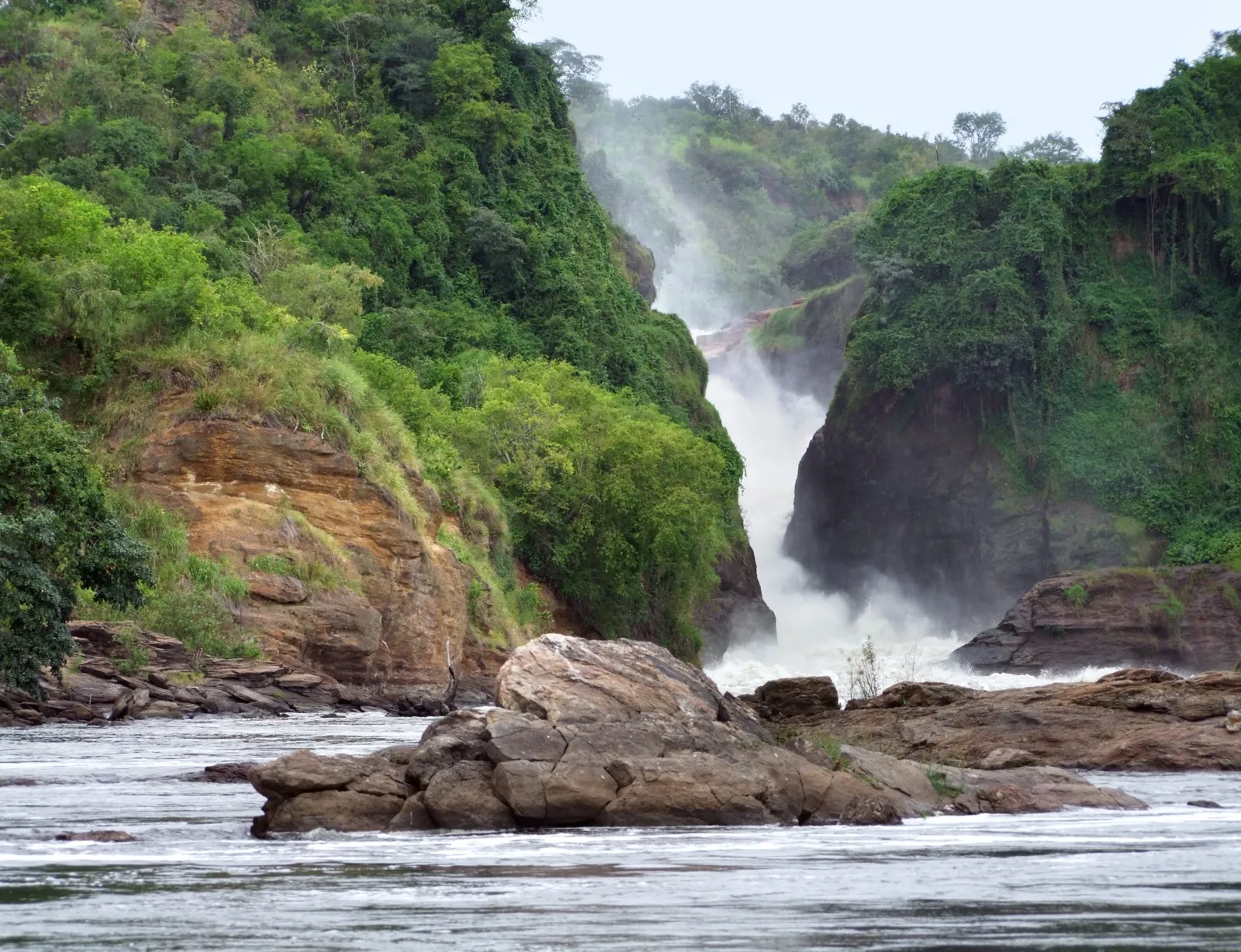
Murchison Falls on the Nile, Uganda
Bwindi Impenetrable Forest
A World Heritage Site, this montane forest in the southwest is home to a large share of the world’s mountain gorillas. Visits are made in small groups led by rangers, with a permit bought in advance. The walk can last from one to several hours on steep, muddy slopes. The park lies near the borders with the DRC and Rwanda: according to the UK FCDO, security personnel routinely accompany gorilla-tracking visits there, and you should avoid tours that cross into the DRC.
Murchison Falls National Park
The country’s largest park, in the northwest, is crossed by the Nile, which forces its way through a gorge a few meters wide. Game drives (elephants, giraffes, lions, buffalo) and river cruises to the foot of the falls, among hippos and crocodiles, are the main activities. Allow at least two nights.
Queen Elizabeth National Park
Between Lakes George and Edward, this savanna park is known for the cruise on the Kazinga Channel, where hippos, buffalo and birds gather, and for the Ishasha sector in the south, where lions climb trees. The Kyambura Gorge also offers chimpanzee tracking. The park borders the DRC, and both the UK FCDO and the U.S. Department of State report deadly terrorist attacks there: go with a reputable operator and follow local security advice.
Kibale and the Fort Portal crater lakes
Kibale Forest is the best place in the country to see chimpanzees, along with a dozen other primate species. Around Fort Portal, a series of crater lakes offers fine walks and quiet places to stay. It is a natural stop between Murchison Falls and Queen Elizabeth.
Lake Bunyonyi
Near Kabale, this lake with many islands, surrounded by terraced hills, is a place to rest after gorilla trekking. You get around by dugout canoe or boat, hike, and stay in simple lodges on the shore. Nights are cool.
Jinja and the source of the Nile
About 80 km (50 mi) east of Kampala, Jinja sits where the Nile leaves Lake Victoria. It is the base for rafting, kayaking and boat trips on the river. The UK FCDO notes that photographing military or official sites is forbidden, including Owen Falls Dam at the source of the Nile, and that accidents regularly happen on the Jinja–Kampala road.
Kampala and Entebbe
Kampala is a lively capital built on hills, with its markets, Namirembe Cathedral, the Kasubi Tombs of the Buganda kings (World Heritage) and the Namugongo Martyrs’ Shrine. Entebbe, quieter and on the lake, has the airport and a botanical garden; the nearby Mabamba swamp is known for the shoebill. In both cities, avoid walking after dark, do not carry large amounts of cash and use indoor ATMs (UK FCDO).
Lake Mburo and the Rwenzori
Lake Mburo, the savanna park closest to Kampala, is home to zebras, impalas and elands, and can also be explored on foot or by bike. In the west, the Rwenzori, the « Mountains of the Moon », rise above 5,000 meters (16,400 ft): a multi-day, very wet trek for experienced hikers, to be done with a guide.
Itinerary ideas for Uganda
10 days: gorillas, chimpanzees and savanna
Days 1–2: arrive in Entebbe, drive to Kibale via Fort Portal
Day 3: chimpanzee trek in Kibale, walk around the crater lakes
Days 4–5: Queen Elizabeth National Park, Kazinga Channel cruise, game drive
Day 6: through the Ishasha sector, arrive in Bwindi
Day 7: gorilla trek
Days 8–9: rest at Lake Bunyonyi
Day 10: back to Entebbe (a long day on the road, or a domestic flight)
2 weeks: the grand tour of Uganda
Days 1–2: Entebbe, Mabamba swamp, Kampala
Days 3–5: Ziwa Rhino Sanctuary, then Murchison Falls National Park (game drive, cruise to the falls)
Days 6–7: Fort Portal and Kibale Forest (chimpanzees)
Days 8–9: Queen Elizabeth National Park (Kazinga, Ishasha)
Days 10–11: Bwindi (gorilla trek)
Days 12–13: Lake Bunyonyi, then Lake Mburo
Day 14: back to Entebbe
Distances are long and roads sometimes poor: you often need 5 to 8 hours between two parks. The UK FCDO advises avoiding travel outside the main towns after dark, except on the Kampala–Entebbe airport road. If your time is limited, domestic flights serve several airstrips near the parks.
Who is Uganda for?
Our verdicts by traveler profile, based on the information in this guide:
Profile
Our verdict
Why
Wildlife and nature
✅ Ideal
Mountain gorillas in Bwindi, chimpanzees in Kibale, the savannas of Murchison Falls and Queen Elizabeth.
Adventure
✅ Yes
Rafting and kayaking on the Nile at Jinja, the Rwenzori trek for seasoned hikers.
Couples
✅ Yes
Lodges in the parks, a rest stop at Lake Bunyonyi, crater lakes around Fort Portal.
Families
⚠️ Possible
Long days on the road (often 5 to 8 hours between parks), steep walks for the gorillas, a yellow fever card required for all travelers.
Budget travelers
⚠️ Possible
Roughly US$55–90 per person per day on a budget, excluding gorilla permits; a 4×4 with driver-guide can be shared.
Beach
❌ No
A landlocked country: the lakes take the place of the sea.
Budget for a trip to Uganda
Indicative amounts per person per day, converted from our euro estimates at the ECB rate of 23 October 2026 (€1 = US$1.12):
Item (per person per day)
Budget
Comfort
Accommodation
Roughly US$17–45 (guesthouse, camping, bandas)
Roughly US$110–335 (full-board lodge)
Meals
Roughly US$9–17
Roughly US$35–65 (often included in lodges)
Transport
Roughly US$17–35 (bus, shared vehicle)
Roughly US$90–170 (4×4 with driver-guide, shared)
Activities
Park entry fees in US dollars, varying by park
Cruises, chimpanzee treks, private guides
Indicative total excluding permits
Roughly US$55–90
Roughly US$200–390
Indicative estimates excluding international flights. The gorilla permit comes on top: it costs several hundred dollars per person; check the price with the Uganda Wildlife Authority.
The biggest expense is often transport: most travelers hire a 4×4 with a driver-guide, sharing the cost. Park fees, cruises and permits are generally paid in US dollars.
Getting around Uganda
4×4 with driver-guide: the most common option for a tour of the parks. The driver knows the tracks and the park rules. The U.S. Department of State (travel.state.gov, last updated December 11, 2025) encourages the use of four-wheel-drive vehicles, as rural roads are poor and accidents frequent.
Car rental: possible, but driving standards are poor and the accident rate is high; avoid driving outside main towns after dark (UK FCDO, GOV.UK, updated 8 October 2026). You can drive with a UK licence for up to 3 months. Speeding is illegal and enforced by police.
Domestic flights: small airlines link Entebbe or Kajjansi with airstrips near Murchison Falls, Kibale, Queen Elizabeth, Bwindi and Kidepo.
Public transport: buses and minibuses exist, but the UK FCDO reports serious long-distance bus accidents and robberies of overnight buses, and advises avoiding matatus (minibus taxis).
Boda-boda (motorbike taxis): very common in towns, but the UK FCDO advises avoiding them (accidents, sometimes violent muggings), and U.S. Mission staff are prohibited from using them.
Ferries: ferry accidents on Lake Albert and Lake Victoria have killed many passengers; use a reputable company and do not board an overloaded boat (UK FCDO).
Where to stay in Uganda
In the parks, options range from campsites and bandas (small huts) run by the Uganda Wildlife Authority to upscale full-board lodges. Around Bwindi, choose your accommodation according to the sector where you got your permit (Buhoma, Ruhija, Rushaga or Nkuringo): driving between sectors takes several hours. In Kampala and Entebbe, mid-range hotels are plentiful; in Entebbe, staying near the airport is convenient for the first and last nights. At Lake Bunyonyi and Fort Portal, lakeside lodges are more affordable.
Entry requirements for Uganda
US citizens
According to the U.S. Department of State (travel.state.gov, last updated December 11, 2025), US citizens must apply for and obtain a visa online before travel on the Government of Uganda’s electronic visa system; travelers who tried to enter without it have been refused boarding or entry. All travelers must have a valid yellow fever immunization card. The immigration officer at the port of entry sets the length of stay (generally two weeks to three months for tourists), and overstays are fined about $30 per day. Some airlines ask to see the physical credit card used to buy the ticket at check-in.
UK citizens
According to the UK FCDO (GOV.UK foreign travel advice, updated 8 October 2026), you must have a visa and apply for it online. The immigration authorities email you a letter of authorization with a barcode: print it and show it on arrival, where border officials issue the visa. You can also apply online for the East African Tourist Visa, which costs US$100 and allows multiple entries into Kenya, Rwanda and Uganda over 90 days. Your passport must be valid for at least 6 months after arrival. Check vaccine entry requirements on TravelHealthPro. Beware of unofficial visa websites.
Entry requirements checked on 24 October 2026. The border with the DRC was closed in May because of Ebola, with limited exceptions (UK FCDO).
Health and safety
Health risks: according to the UK FCDO (GOV.UK, updated 8 October 2026), health risks include Ebola, malaria, yellow fever, mpox and Marburg virus disease; check vaccine recommendations at least 8 weeks before your trip. The WHO declared the Uganda Ebola outbreak over on 27 August 2026, but the outbreak in the DRC continues. The U.S. Department of State also lists meningitis, typhoid, hepatitis B and schistosomiasis. See a doctor about malaria prevention and protect yourself from mosquitoes.
Water: drink only boiled or bottled water and avoid ice (UK FCDO).
Medical care: facilities are limited, especially outside Kampala, and an air ambulance may be needed for serious cases (UK FCDO). Insurance covering medical costs and evacuation is essential.
Safety: terrorist attacks are very likely; avoid large gatherings and demonstrations. Muggings involving boda-bodas, and drugging of food and drink in bars and on public transport, have been reported (UK FCDO).
Local laws: same-sex sexual activity is illegal; the 2023 Anti-Homosexuality Act provides for life imprisonment and, in some cases, the death penalty (UK FCDO, U.S. Department of State). It is also illegal to wear military-style or camouflage clothing, to smoke in public places, and e-cigarettes and shisha are banned.
Emergencies: 999 (ambulance, fire, police).
Practical tips for Uganda
Money: according to the U.S. Department of State, US dollar notes printed before 2006 cannot be exchanged or used, and notes under $100 may get a less favorable rate. ATMs are available, but many only work for customers of specific Ugandan banks. Our currency converter helps you estimate amounts.
Internet: a local SIM card or an eSIM keeps you connected. The U.S. Department of State recommends a communication plan (phone, email, even a satellite phone) for remote areas.
Everyday safety: carry a copy of your passport’s photo page, as officials may ask for ID (UK FCDO); do not show valuables and avoid walking after dark.
Cleaning day: on the last Saturday of each month, from 7 to 10 am, businesses close and non-essential movement is banned; tourists are exempt but may have to explain themselves to police (UK FCDO).
Etiquette: ask before photographing someone, and dress modestly outside the lodges.
With the gorillas: follow the rangers’ instructions (distance, limited viewing time, no visit if you are ill).
Yes. US and British citizens must apply online before travel (travel.state.gov, last updated December 11, 2025; GOV.UK, updated 8 October 2026). The East African Tourist Visa (US$100) covers Kenya, Rwanda and Uganda. A yellow fever card is required for all travelers according to the U.S. Department of State. Checked on 24 October 2026.
How much does a trip to Uganda cost?
Excluding international flights and gorilla permits, allow roughly US$55–90 per person per day on a budget and US$200–390 in lodges with a driver-guide. The gorilla permit alone costs several hundred dollars.
How many days do you need in Uganda?
Ten days let you combine chimpanzees, a safari in Queen Elizabeth and gorillas in Bwindi. Two weeks leave time to add Murchison Falls and limit long days on the road.
Can I drive in Uganda with a UK licence?
Yes, for up to 3 months according to the UK FCDO; beyond that you need a Ugandan licence or a 1949 International Driving Permit obtained in the UK. Road travel is hazardous: most visitors hire a 4×4 with a driver-guide, and night driving outside towns should be avoided.
Is Uganda safe?
The UK FCDO considers terrorist attacks very likely, particularly in the west near the DRC border, where tourists were killed in Queen Elizabeth National Park in 2023, and advises extra caution near the South Sudan border and in Karamoja. Elsewhere, travel with a reputable operator, avoid night journeys and follow official advice.
Our sources
Entry, health and safety information read on 24 October 2026: U.S. Department of State, Uganda country information (travel.state.gov, last updated December 11, 2025), and UK FCDO, foreign travel advice for Uganda (GOV.UK, updated 8 October 2026)
World Meteorological Organization (WMO), climate normals for Entebbe, Kampala, Gulu and Kasese
European Central Bank, euro reference exchange rates of 23 October 2026 (budget conversion)
To combine or compare: our guides to Rwanda, Kenya and Tanzania, and all our destinations in Africa.
Transparency: this page contains affiliate links, labelled as such. If you book through them we may earn a commission at no extra cost to you; it does not influence our content or recommendations. How we fund the site.