South Africa brings together big cities, some of the most accessible safaris on the continent, vineyards, two oceans and mountains. Its road network lets you travel independently in a rental car, but safety requires real preparation. This South Africa travel guide covers the essentials for planning your trip: what to see, which itinerary to follow, budget and safety.
To locate cities, regions, terrain, national parks and airports, see our map of South Africa.
Safety: according to the UK FCDO (GOV.UK, updated 8 July 2026), there is a high crime rate in South Africa; most violent crime occurs in townships, informal settlements and other high-density areas, as well as some city centres and isolated areas, and the threat is higher after dark. Criminals have followed travellers from OR Tambo airport in Johannesburg to their destination to rob them, and violent attacks have increased on the roads to and from Cape Town airport. The U.S. Department of State (travel.state.gov, last updated August 11, 2025) also describes crime rates as very high, including in and around Kruger National Park. Check the latest advice before you leave.
South Africa at a glance
CapitalsPretoria(executive), Cape Town (legislative) and Bloemfontein (judicial)
Languages12 official languages, including English, Afrikaans, Zulu and XhosaEnglish is used throughout the tourism sector
Time zoneUTC+2, no daylight saving · details2 h ahead of London and 7 h ahead of New York in winter
AirportsJohannesburg OR Tambo (JNB), Cape Town (CPT), Durban King Shaka (DUR)Check current routes with the airlines
EntryUK: visa-free up to 90 days; US: check with the South African embassy; passport valid 30 days after departure, 2 blank pages · travel.state.gov · GOV.UK
Electricitycheck plug types before you travel · plugs
It all depends on your itinerary. Cape Town and its region have a Mediterranean climate: the best period runs from November to March, the dry and sunny season, while the southern winter (June to August) is cool and rainy there. In Kruger National Park it is the other way round: the dry season, from May to September, is best for wildlife viewing. To combine both, aim for April–May or September–October. The end-of-year holidays, which coincide with the South African summer school holidays, are the most expensive period. All the details, month by month with official climate normals, are in our article best time to visit South Africa.
What to see in South Africa: the highlights
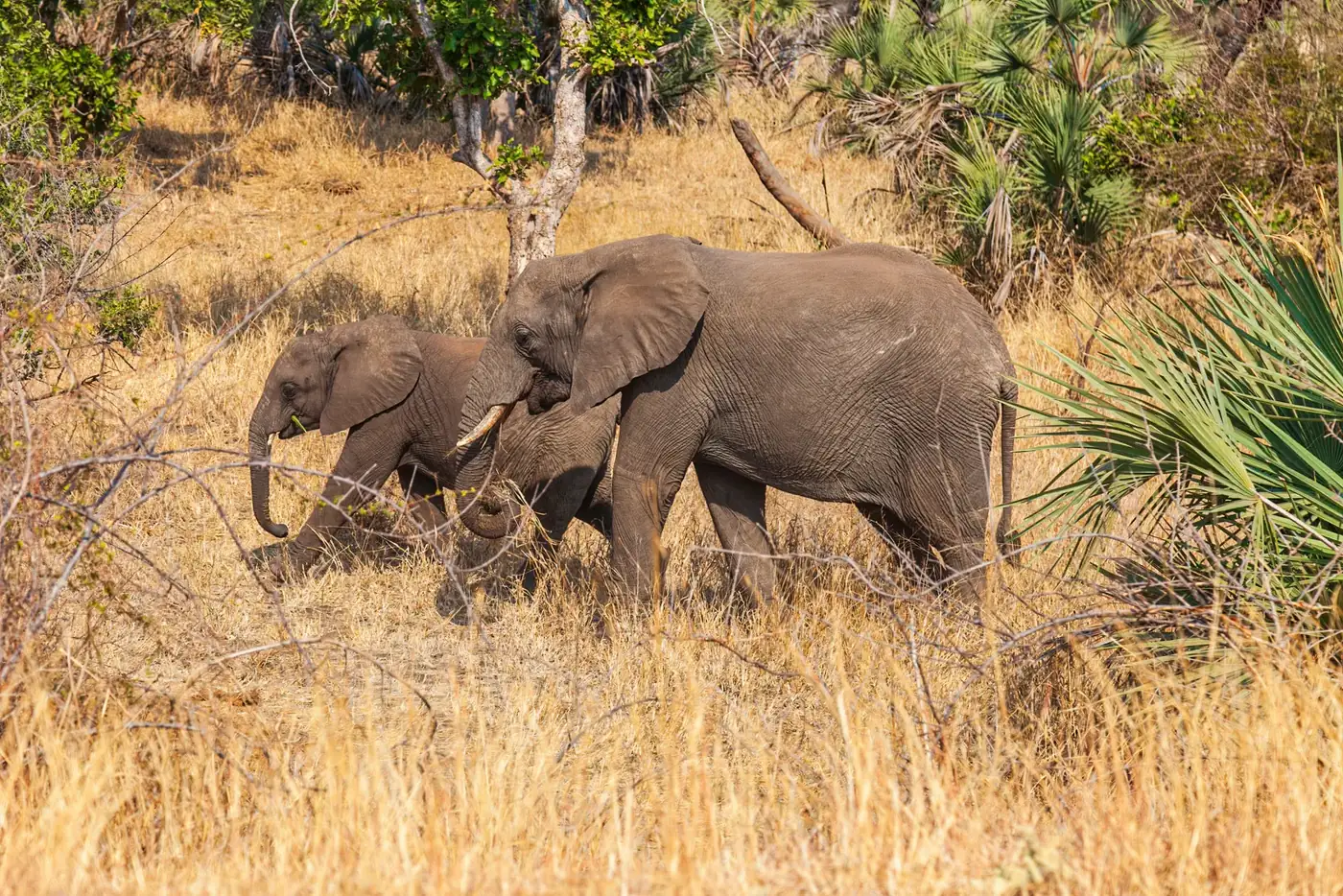
Elephant and calf in Kruger National Park, South Africa
Cape Town
The city is dominated by Table Mountain, reached by cable car or on foot along several trails. The UK FCDO (GOV.UK, updated 8 July 2026) reports recent violent attacks on hikers in Table Mountain National Park, including on Lion’s Head and Signal Hill, and advises hiking in groups of 4 or more. Allow at least three days for the V&A Waterfront, Kirstenbosch botanical garden, the colourful Bo-Kaap district, Zeitz MOCAA (contemporary African art) and the view from Signal Hill. The ferry to Robben Island, where Nelson Mandela was imprisoned for 18 years, leaves from the Waterfront: book ahead.
The Cape Peninsula
A day’s drive takes you along the coast to the Cape of Good Hope and Cape Point, in Table Mountain National Park. On the way: the scenic Chapman’s Peak Drive, the fishing harbour of Hout Bay, the African penguin colony at Boulders Beach near Simon’s Town, and Muizenberg beach. Many people drown every year due to strong sea currents, according to the UK FCDO (GOV.UK, updated 8 July 2026): only swim between the red and yellow flags. Our guide to Cape Town, from Table Mountain to the peninsula covers these places in detail.
The Cape Winelands (Stellenbosch, Franschhoek, Paarl)
Less than an hour from Cape Town, these valleys are home to hundreds of wine estates, often set in Cape Dutch-style homesteads. Tastings take place on the estate, often with a meal. To avoid driving after tastings, tourist shuttles link several estates, such as the Franschhoek Wine Tram. The UK FCDO advises not to walk around after dark anywhere in the country (GOV.UK, updated 8 July 2026).
Hermanus and the south coast
About 1 h 30 by road east of Cape Town, Hermanus is known for land-based watching of southern right whales during the southern winter and spring. Further east, Cape Agulhas marks the southernmost point of the African continent, at the conventional meeting point of the Atlantic and Indian oceans.
The Garden Route
This coastal route of about 200 km (124 mi), from Mossel Bay to the Storms River, alternates lagoons, forests and beaches: Knysna and its lagoon, Plettenberg Bay, and the Tsitsikamma section of Garden Route National Park with its suspension bridge and coastal trail. It is often combined with Oudtshoorn, in the Little Karoo, known for the Cango Caves and ostrich farms.
Kruger National Park
The country’s most famous national park stretches about 350 km (217 mi) from north to south along the border with Mozambique. Africa’s Big Five (elephant, lion, leopard, buffalo and rhino) are all present. You can explore it on your own in your own car, on a network of tarred roads and gravel tracks, or join the guided drives run by the rest camps. The south of the park (Skukuza and Lower Sabie areas) is the busiest. The private reserves on the western edge (such as Sabi Sands) offer guided safaris in open vehicles, at a higher cost. Gate and camp opening times are strict: check with SANParks. According to the UK FCDO (GOV.UK, updated 8 July 2026), SANParks advises against using the Numbi gate after a violent attack killed a tourist, and you can fly directly to the park from Johannesburg, Cape Town and Durban.
The Panorama Route (Mpumalanga)
On the edge of the escarpment, west of Kruger, this road links the viewpoints of the Blyde River Canyon, the Three Rondavels, God’s Window and Bourke’s Luck Potholes. It can be done in a day, often on the way between Johannesburg and the park.
For a safari, our Kruger National Park page covers entry fees, quotas, safety and malaria.
Johannesburg and Soweto
The country’s largest city is often the arrival point for international flights. The Apartheid Museum and Constitution Hill help you understand the country’s recent history. For townships such as Soweto, the UK FCDO advises going only with a responsible and reliable tour guide (GOV.UK, updated 8 July 2026); the Mandela House and the Hector Pieterson Museum are the classic stops.
KwaZulu-Natal: Durban, the Drakensberg and iSimangaliso
Durban has warm beaches all year round, strong Indian and Zulu influences and a cuisine known for its curries. To the north, Hluhluwe-Imfolozi Park lets you see the Big Five, and iSimangaliso Wetland Park combines lakes, mangroves and beaches. To the west, the Drakensberg range, a World Heritage Site, is one of the country’s great hiking regions.
Itinerary ideas for South Africa (10 days, 2 weeks)
10 days: Cape Town and the Garden Route
Days 1 to 4: Cape Town (Table Mountain, Waterfront, Bo-Kaap, Robben Island, Kirstenbosch) and a day on the peninsula
Day 5: Stellenbosch or Franschhoek winelands
Day 6: Hermanus (whales from about June to November), then drive east
Day 7: Oudtshoorn (Cango Caves)
Days 8 to 10: Knysna, Plettenberg Bay and Tsitsikamma, flying back from George or Port Elizabeth (Gqeberha)
2 weeks: Cape Town, the Garden Route and a safari
Days 1 to 4: Cape Town and the peninsula
Day 5: winelands
Days 6 to 9: Hermanus and the Garden Route to Tsitsikamma
Day 10: domestic flight to Johannesburg or Kruger Mpumalanga International Airport (Nelspruit)
Day 11: Panorama Route (Blyde River Canyon, God’s Window)
Days 12 to 14: safari in Kruger National Park, staying in the park’s rest camps or a private reserve
With three weeks, add KwaZulu-Natal (Drakensberg, Hluhluwe-Imfolozi, Durban) or, around Johannesburg, a day at the Apartheid Museum and a guided visit to Soweto.
Budget for a trip to South Africa
Once there, South Africa remains affordable, especially for food and wine. The biggest costs are car rental, fuel and private-reserve safaris. Indicative amounts per person per day, excluding international flights (converted from our euro estimates at roughly €1 = R18.6, ECB rate of 23 October 2026):
Indicative estimates, varying with the season and the rand exchange rate. A private-reserve safari, full board with guided activities, costs considerably more.
National parks run by SANParks charge foreign visitors a daily conservation fee on top of accommodation. For several days in different parks, compare with the annual Wild Card offered by SANParks.
Getting around South Africa
Rental car: the most common option for the Garden Route and Kruger. Traffic drives on the left. The U.S. Department of State (U.S. Department of State, travel.state.gov, last updated August 11, 2025) advises avoiding driving outside metropolitan areas at night and driving with doors locked and windows closed; the UK FCDO (UK FCDO, GOV.UK, updated 8 July 2026) advises not leaving valuables in the car and warns that GPS navigation may direct you through less secure areas. Licences: a valid US state licence is valid for stays of less than six months and an International Driving Permit is not required (travel.state.gov); a UK photocard licence can be used for up to 12 months, while paper licence holders need the 1968 IDP before travel (GOV.UK). Rental companies may have stricter requirements.
Plane: domestic flights quickly link Cape Town, Johannesburg, Durban, George, Port Elizabeth (Gqeberha) and Kruger Mpumalanga International Airport, saving long days on the road.
Train: the Gautrain express links OR Tambo Airport with Johannesburg (Sandton) and Pretoria; the UK FCDO lists it among the safer, more reliable options, but advises not walking to or from Gautrain stations after dark (UK FCDO, GOV.UK, updated 8 July 2026).
In cities: use internationally recognised e-hailing apps where bookings are confirmed through the app, or reputable dispatched taxis. Both the UK FCDO and the U.S. Department of State warn against minibus taxis.
Long-distance buses: several companies link the major cities, but the UK FCDO lists long-distance public coach and train services among transport with a greater risk of theft and unreliable service (GOV.UK, updated 8 July 2026); avoid bus stations at night.
Where to stay in South Africa
In Cape Town, the most practical areas for visitors are the V&A Waterfront, Green Point and Sea Point on the seafront, Camps Bay below the Twelve Apostles, or around Gardens. Avoid staying near Long Street if you come back late. On the Garden Route, Knysna and Plettenberg Bay have the widest choice. In Johannesburg, Sandton and Rosebank are the areas most used by travellers, and a hotel near the airport is a good idea if you arrive at night.
In Kruger National Park, SANParks rest camps offer bungalows, safari tents and campsites at reasonable prices; they are fenced and close at night. Lodges in the neighbouring private reserves offer a high level of comfort, with guided safaris included. Everywhere, there is a wide choice of privately run guesthouses and B&Bs.
Entry requirements, health and safety
US citizens: according to the U.S. Department of State (travel.state.gov, last updated August 11, 2025), South Africa strictly enforces its entry rules and the South African embassy provides the most current visa information: check with it before you travel. Your passport must be valid for 30 days after you leave South Africa and have 2 consecutive completely blank visa pages on arrival (endorsement pages do not count).
UK citizens: according to the UK FCDO (GOV.UK foreign travel advice, updated 8 July 2026), you can visit South Africa without a visa for up to 90 days for tourism or business. Your passport must have an expiry date at least 30 days after the date you leave South Africa and at least 2 blank pages. Do not overstay your entry stamp.
All travellers: special requirements apply to children aged 17 and under, and to unaccompanied children: see the South African Department of Home Affairs (GOV.UK; travel.state.gov). A yellow fever vaccination certificate is required if you arrive from a country listed as a transmission risk (GOV.UK; travel.state.gov). Since 1 July 2026, all travellers entering or leaving South Africa must submit an online traveller declaration before travelling, and cash above R25,000 per person, or other currencies worth more than US$10,000, must be declared (GOV.UK). Entry requirements checked on 24 October 2026; check them again before you travel.
Health: according to the UK FCDO (UK FCDO, GOV.UK, updated 8 July 2026), check vaccine recommendations at least 8 weeks before your trip (TravelHealthPro); health risks include malaria, chikungunya, cholera and mpox, and altitude sickness is a risk in parts of the country, including Johannesburg. The U.S. Department of State also lists malaria, hepatitis A and typhoid among common diseases, and notes that tap water is not safe to drink in many areas. Ask a doctor or travel clinic whether antimalarials are advised for your itinerary, notably the Kruger area. Private medical care is of a very high standard but expensive (GOV.UK): take insurance covering medical costs and repatriation.
Safety: crime rates are very high (travel.state.gov). The UK FCDO (UK FCDO, GOV.UK, updated 8 July 2026) advises not displaying valuables, not walking around after dark, using safe and reliable transport, being careful in and around airports and using main roads to and from them, and visiting townships only with a reliable guide; it notes that resisting a robbery can lead to a violent response. The U.S. Department of State warns that ATM and card skimming are common, and the UK FCDO advises changing large sums only in banks or secure shopping malls.
Sea and nature: many people drown every year due to strong currents: swim between the red and yellow flags and follow lifeguards’ instructions (GOV.UK). Watch out for sharks (travel.state.gov). Never hike alone (travel.state.gov); the UK FCDO advises groups of 4 or more in Table Mountain National Park.
Practical tips for South Africa
Money: cards are widely accepted. Keep a small amount of cash, withdrawn from an ATM in a shopping mall or bank branch. Do not hand over your card: vendors bring a card reader to you, and card skimming is common (travel.state.gov). Our currency converter helps you estimate your spending.
Internet: the mobile network covers cities and main roads well, less so some parts of the parks. A local SIM or an eSIM is handy for navigation and ride-hailing apps.
Water: parts of the country have had water shortages; follow the advice of local authorities if restrictions apply, including any bans on drinking tap water (GOV.UK, updated 8 July 2026).
Tipping: customary in restaurants (around 10%), for safari guides and for car guards, who watch parked cars for a small coin.
In the parks: stay in your vehicle outside designated areas, respect speed limits and gate closing times.
Power cuts: according to the UK FCDO (GOV.UK, updated 8 July 2026), planned power cuts (“loadshedding”) have fallen significantly but can still happen; check the Eskom website or loadshedding apps and carry a power bank. During load shedding, traffic lights stop working (travel.state.gov).
Who is South Africa for?
Our verdict by traveller profile, based on the information in this guide (places, budget, seasons).
Profile
Our verdict
Why
Couples
Very well suited
Cape Winelands, Garden Route, safari lodges.
Families
Suited
Fenced SANParks camps in Kruger, beaches; high crime levels call for strict precautions.
Budget travellers
Suited
Roughly R1,100–1,700 per person per day with a shared car and SANParks camps, excluding private-reserve safaris.
Safari and nature
Very well suited
Kruger National Park, Hluhluwe-Imfolozi, whales at Hermanus, the Drakensberg.
Culture and history
Suited
Apartheid Museum, Constitution Hill, Robben Island.
Road trip
Very well suited
Garden Route and the Mpumalanga Panorama Route.
Frequently asked questions
Do I need a visa for South Africa?
UK citizens can visit without a visa for up to 90 days for tourism (GOV.UK, updated 8 July 2026). US citizens should check the current rules with the South African embassy, as advised by travel.state.gov. Your passport must be valid for 30 days after you leave and have 2 blank pages. Checked on 24 October 2026; check the latest rules before you leave. Our guide South Africa visa and entry requirements covers these rules in detail.
Is South Africa dangerous for tourists?
Crime rates are very high, according to both the U.S. Department of State and the UK FCDO. Strict precautions reduce the risk: arranged airport transfers, no walking around after dark, no driving outside cities at night, visiting townships only with a reliable guide and not displaying valuables.
How many days do you need in South Africa?
Ten days lets you discover Cape Town and the Garden Route. With two weeks, you can add a three-day safari in Kruger, taking a domestic flight. Three weeks leaves time to add KwaZulu-Natal.
Do I need malaria tablets for Kruger National Park?
Malaria is listed as a health risk in South Africa by both the UK FCDO and the U.S. Department of State. Prevention relies on protection against mosquito bites and, depending on your itinerary, preventive medication: see a doctor or travel health clinic before you leave.
What is the best time to visit South Africa?
November to March for Cape Town, May to September for safaris. To combine both, April–May and September–October are the best compromises.
What can you see in South Africa in 2 weeks?
Two weeks lets you combine Cape Town and its peninsula, the winelands, Hermanus and the Garden Route to Tsitsikamma, then a domestic flight to the north-east for the Panorama Route (Blyde River Canyon) and three days of safari in Kruger National Park. The day-by-day plan is in our itineraries above.
European Central Bank: euro reference exchange rates of 23 October 2026 (budget conversion)
South African Weather Service, climate normals (Cape Town, George, Johannesburg, Durban and Skukuza stations), via the World Meteorological Organization (NOAA archive) for the 1991–2020 normals
To extend or compare, see our guides to neighbouring Namibia and Botswana, Mozambique for beaches, or Kenya for another great safari. Discover our other destinations in Africa.
Transparency: this page contains affiliate links, labelled as such. If you book through them we may earn a commission at no extra cost to you; it does not influence our content or recommendations. How we fund the site.