Namibia means the Namib Desert and its red dunes, a fog-bound Atlantic coast, Etosha National Park and vast, almost empty spaces. The country is mainly explored by car, on roads and gravel tracks that are well maintained but very long. This Namibia travel guide brings together the essentials: what to see, itineraries, budget and tips for planning your trip.
To locate cities, regions, terrain, national parks and airports, see our map of Namibia.
Namibia at a glance
CapitalWindhoek
LanguageEnglish (official language)Afrikaans, German and several African languages, including Oshiwambo, are also widely spoken
Currencythe Namibian dollar · currencies(NAD), pegged to the South African rand, which is also legal tender
Time zoneUTC+2, no daylight saving2 h ahead of London and 7 h ahead of New York in winter
AirportsWindhoek Hosea Kutako (WDH), Walvis Bay (WVB) · detailsCheck current routes with the airlines
EntryUS and UK: visa required since 1 April 2025 (online or on arrival) · travel.state.gov · GOV.UK
Electricitycheck voltage and plug types before you go · plugs
The best period is May to October, during the dry season: there is almost no rain, the tracks are in good condition and Etosha’s animals gather around the waterholes, especially from July to October. Days are mild from June to August, but nights are cold inland. From November to April, the rainy season brings thunderstorms in the north and center, green landscapes and fewer visitors. On the coast, Swakopmund is cool and often foggy all year. All the details, month by month and with official climate data, are in our article best time to visit Namibia.
What to see in Namibia: the highlights
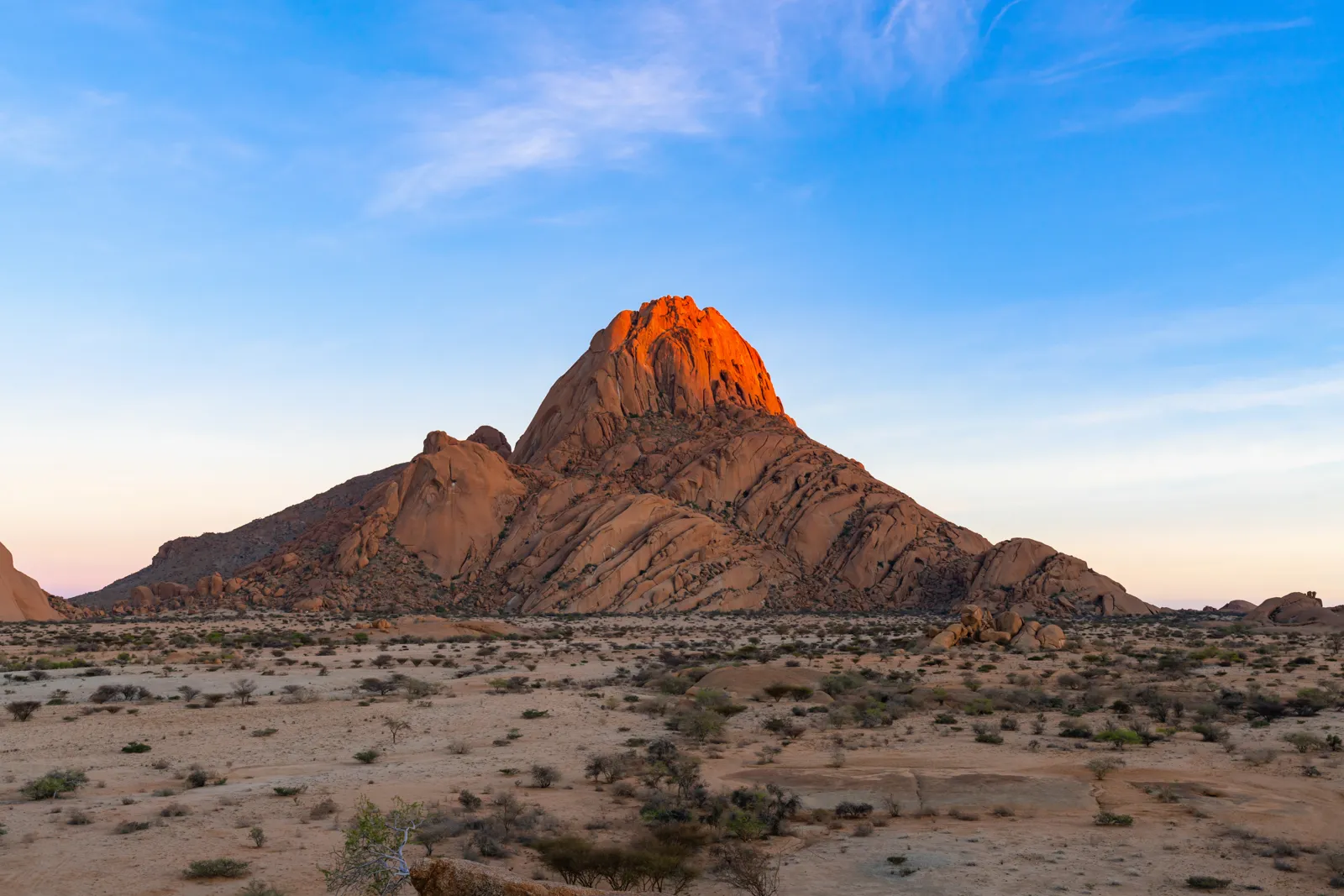
The track leading to the granite peaks of Spitzkoppe, Namibia
Sossusvlei, Deadvlei and the Namib Desert
This is the country’s most famous image: red dunes among the highest in the world, in Namib-Naukluft National Park. You enter through the Sesriem gate, then a road leads to the dunes, including Dune 45 near the road. The last kilometers to Sossusvlei are on sand: by 4×4 with experience, or by shuttle. Next door, Deadvlei is a white clay pan dotted with dead acacias, framed by tall dunes such as Big Daddy. Arrive when the gate opens for the morning light and the cool, and bring plenty of water.
Etosha National Park
Built around a vast salt pan, Etosha is the country’s great wildlife reserve: elephants, lions, giraffes, zebras, rhinos and many antelopes. You explore the park in your own vehicle on a network of roads and tracks linking the waterholes. The Okaukuejo, Halali and Namutoni camps have floodlit waterholes where you can watch animals at night. Gates open and close with the sun: respect the times and never get out of your vehicle outside authorized areas. Allow at least two or three nights.
Swakopmund and Walvis Bay
On the Atlantic coast, Swakopmund has kept German colonial-era architecture and serves as a base for activities: boat trips on the Walvis Bay lagoon (seals, dolphins, flamingos), 4×4 excursions through the dunes to Sandwich Harbour, sandboarding or scenic flights. The climate is cool and often foggy, a real change after the desert. The UK FCDO advises checking that your travel insurance covers activities such as quad biking, dune boarding or ballooning.
Damaraland and Twyfelfontein
Between the coast and Etosha, Damaraland is a region of mountains and rocky plateaus. The Twyfelfontein site, a UNESCO World Heritage Site, has thousands of rock engravings. The region is also known for its desert-adapted elephants, best seen with a local guide. The Brandberg, the country’s highest peak, lies to the south.
The Skeleton Coast and Cape Cross
North of Swakopmund, the Skeleton Coast takes its name from the shipwrecks and whale bones along it. Raw landscapes, fog, wind: it is a road like no other. At Cape Cross, a large colony of Cape fur seals can be seen from a boardwalk (a strong smell is guaranteed).
Fish River Canyon
In the south, Fish River Canyon is one of the largest canyons in Africa. The Hobas viewpoints offer the best-known views. The multi-day hike along the canyon floor is only open in the cool season, by reservation. The Ai-Ais hot springs are at the southern end.
Lüderitz and Kolmanskop
A small port town on the Atlantic, Lüderitz is known for its German-style houses. Nearby, Kolmanskop is a former diamond-mining town invaded by sand; check visiting conditions locally. Access to the diamond area that stretches to the south (the Sperrgebiet) is restricted, but Lüderitz itself is freely accessible.
The Kalahari
In the east and southeast, Namibia shares the Kalahari with Botswana and South Africa. This red-sand semi-desert, dotted with grasses and camel thorn acacias, is less spectacular than the Namib but greener and quieter; Mariental and Gobabis are its main towns on the Namibian side. The San, a hunter-gatherer people, have lived there for millennia: to learn about their culture, go through a guide or a community initiative.
Kaokoland and the Zambezi Region
For a second trip or a longer tour: Kaokoland, in the northwest, is a remote region home notably to the Himba, with the Epupa Falls on the Kunene River. In the northeast, the Zambezi Region (Caprivi) offers rivers and forests, very different from the rest of the country, and parks such as Bwabwata. The U.S. Department of State advises driving the Trans-Caprivi Highway between Rundu and Katima Mulilo only in daylight. Both regions need careful preparation and, for Kaokoland, real off-road experience.
Itinerary ideas for Namibia
10 days: the essentials (desert, coast, Etosha)
Day 1: arrive in Windhoek, pick up the vehicle, night in town
Days 2 and 3: drive to Sesriem, sunrise at Sossusvlei and Deadvlei
Days 4 and 5: Swakopmund, boat or 4×4 trip at Walvis Bay
Day 6: Damaraland, Twyfelfontein
Days 7 to 9: Etosha, from west (Okaukuejo) to east (Namutoni)
Day 10: back to Windhoek
2 to 3 weeks: the full loop
Days 1 to 3: Windhoek, then the south: Keetmanshoop and Fish River Canyon
Days 4 and 5: Lüderitz and Kolmanskop
Days 6 to 8: Sossusvlei, Deadvlei and the Naukluft Mountains
Days 9 and 10: Swakopmund and Walvis Bay
Days 11 and 12: Cape Cross, Damaraland
Days 13 to 16: Etosha
Days 17 and 18: Waterberg Plateau, then back to Windhoek
Distances are great: between two stops, you often cover 300 to 400 km (185 to 250 mi), much of it on gravel. Avoid planning more than one driving day per sightseeing day, and never drive at night outside towns.
Budget for a trip to Namibia
Namibia is not a cheap destination: renting a suitable vehicle and staying in remote areas are expensive. Camping, very well equipped throughout the country, does however cut costs considerably. Indicative amounts per person per day, based on two travelers, excluding international flights (converted from our euro estimates at the ECB rate of 23 October 2026, €1 = US$1.12):
Indicative estimates, varying by season, type of vehicle and number of travelers. Prices are highest from July to October and over the holidays.
National park fees (Etosha, Namib-Naukluft) come on top. Also check the rental car insurance excess, often high: read the contract carefully, especially for tires, windscreen and underbody. The UK FCDO (GOV.UK, updated 10 December 2025) notes that most policies will not cover accidents that do not involve other vehicles or animals, and the U.S. Department of State adds that many rental agencies void insurance if an accident occurs while speeding.
Who is Namibia for?
Our verdicts by travel style, based on the information in this guide:
Self-drive road trip: ideal: well-maintained roads and tracks, well-equipped campsites, 4x4s with rooftop tents.
Wildlife: yes: Etosha in your own vehicle with its floodlit waterholes, the Cape Cross seals, the desert elephants of Damaraland.
Couples: yes: remote lodges and guest farms, the Sossusvlei dunes at sunrise.
Families: possible: stages are very long; Swakopmund (boat trips, sandboarding) offers a break between desert and parks.
Budget travelers: moderate: roughly US$80–155 per person per day camping, with vehicle rental the main cost.
Off-road beginners: avoid Kaokoland, which needs real experience; the classic loop remains accessible.
Getting around Namibia
Rental car: the most common way to visit the country. Traffic drives on the left (U.S. Department of State, travel.state.gov, last updated May 28, 2026). A 4×4 is not compulsory on main roads, but recommended as soon as you leave the tarmac, and essential in Kaokoland or for the last kilometers to Sossusvlei.
Licence: UK drivers need their valid UK photocard licence (UK FCDO, GOV.UK, updated 10 December 2025). US drivers may use their US licence for up to 90 days or get an International Driving Permit from AAA or AATA before leaving (U.S. Department of State).
Gravel roads: do not exceed 80 km/h (50 mph) on gravel, according to both the UK FCDO and the U.S. Department of State; tourists are often involved in single-vehicle rollovers and punctures are common. The UK FCDO advises carrying two spare tires and plenty of water.
At night: avoid driving outside towns after dark, as wildlife and livestock are serious hazards (UK FCDO, U.S. Department of State). Plan your stages to arrive before sunset.
Fuel and equipment: fuel availability can be sporadic and roadside assistance outside Windhoek is unreliable (U.S. Department of State): fill up whenever you can and carry water, extra fuel, spare tires and an offline map or GPS.
Rules: using a phone while driving is illegal and seat belts are required for all occupants (U.S. Department of State). Police checkpoints are common outside main cities: keep your passport, licence and rental contract to hand.
Organized tours: self-drive packages with pre-booked accommodation, small-group guided tours or safaris with a driver-guide let you avoid driving.
Plane: domestic flights and air taxis link some regions, an expensive but quick option.
Where to stay in Namibia
The country offers three main types of accommodation. Campsites, often with private pitches, washrooms and a water point, are plentiful and suited to 4x4s with rooftop tents. Lodges and guest farms, often isolated, generally offer half board, as there are no restaurants nearby. Finally, the camps inside the parks, run by the state-owned Namibia Wildlife Resorts in Etosha and near Sossusvlei, are in high demand.
In Etosha, staying inside the park lets you enjoy the floodlit waterholes in the evening and be on the tracks as soon as the gates open. Near Sossusvlei, accommodation inside the Sesriem gate lets you reach the dunes earlier in the morning. In Windhoek and Swakopmund, choose a place with secure parking. In high season, everything is booked several months ahead. In campsites, baboons can be bold and aggressive: keep food and belongings in secure containers (U.S. Department of State).
Entry requirements for Namibia
US citizens
According to the U.S. Department of State (travel.state.gov, last updated May 28, 2026), since April 1, 2025 US tourists need a visa. Apply in advance through Namibia’s online visa on arrival portal and bring a hard copy of the approval; visas can also be bought on arrival in Windhoek or Walvis Bay and at large border crossings. Be ready to show proof of accommodation, sufficient funds, your itinerary and travel or medical insurance. Your passport must be valid for at least six months beyond your planned departure, with at least three completely blank pages. A yellow fever card is required if you travel from a yellow fever endemic country.
UK citizens
According to the UK FCDO (GOV.UK foreign travel advice, updated 10 December 2025), you need a visa from 1 April 2025, either on arrival at a port of entry or as an e-visa applied for online before travel. The fee is 1,600 Namibian dollars for travelers over 11 (800 for children aged 6 to 11, free under 6). Your passport must be valid for at least 6 months after arrival, with at least 3 blank pages. Check the date and length of stay on your entry stamp: overstaying or an incorrect stamp can lead to detention, arrest or a fine. A yellow fever certificate is required if you come from a country with a risk of transmission.
Children: both sources require a full (unabridged) birth certificate showing both parents, plus the other parent’s consent (affidavit or notarized consent) if a child travels with only one parent. Work and volunteering are not covered by the visa on arrival. Entry requirements checked on 24 October 2026.
Health and safety
Health: the U.S. Department of State lists malaria among prevalent diseases and states that chemoprophylaxis is recommended for all travelers, even for short stays; see a doctor or travel clinic. The UK FCDO (GOV.UK, updated 10 December 2025) advises checking vaccine recommendations at least 8 weeks before your trip and carrying plenty of drinking water in the hot, dry climate. In many areas tap water is not drinkable (U.S. Department of State).
Medical care: there are good medical facilities in Windhoek, but private hospitals may insist on payment before treatment, even if you are insured (UK FCDO). Insurance covering medical evacuation is strongly recommended.
Crime: muggers often target tourists in Windhoek, sometimes violently and in busy areas; gangs sometimes try to enter vehicles at intersections, and theft from vehicles at service stations is common (UK FCDO). Do not hail taxis in the street in Windhoek: ask your hotel for a reputable company. Avoid walking alone after dark.
Wildlife: keep a safe distance and follow your guides’ instructions: lions, elephants, hippos and other animals have killed people in the region (U.S. Department of State).
Emergencies: 10111, 999 or 112 (UK FCDO); ambulance 211111 in Windhoek or 10111 elsewhere.
Practical tips for Namibia
Money: credit cards are generally accepted, and the South African rand is legal tender alongside the Namibian dollar (U.S. Department of State). Card skimming has occurred at some hotels and lodges: keep your card in sight when paying (UK FCDO) and inspect ATMs before use. Keep some cash for small purchases. Our currency converter helps you estimate your spending.
Internet and phone: you can buy a local SIM card and use a compatible phone (U.S. Department of State); a local SIM or an eSIM is useful for maps. For excursions in remote areas, the U.S. Department of State advises carrying a satellite phone and leaving your itinerary with your hotel.
Etiquette: always ask before photographing someone. It is illegal to photograph government buildings, military installations, ports, stations, airports or border areas (U.S. Department of State). To meet the Himba, go through a guide or a community initiative rather than an improvised visit.
Souvenirs: buy diamonds only from licensed retailers, and never buy ivory or rhino horn: penalties are severe (U.S. Department of State, UK FCDO).
Tipping: customary for guides, lodge staff and fuel attendants who fill up and clean your windscreen.
Climate: even in the southern summer, bring warm clothes for desert nights and a windbreaker for the coast. Protect yourself from the sun, very strong on the high plateaus, and drink plenty when visiting the dunes.
Read more
To choose your dates, see the best time to visit Namibia. The Kalahari is shared with its neighbors: our South Africa guide helps you plan a combined trip via Johannesburg.
Frequently asked questions
Do I need a visa for Namibia?
Yes. Since 1 April 2025, US and British tourists need a visa, which can be obtained online before travel or on arrival (travel.state.gov, last updated May 28, 2026; GOV.UK, updated 10 December 2025). The UK FCDO gives a fee of 1,600 Namibian dollars per adult. Your passport must be valid 6 months beyond your stay and have three blank pages. Checked on 24 October 2026.
Do you need a 4×4 in Namibia?
It is not compulsory on paved roads and the main gravel roads in the dry season, but it is strongly recommended: gravel tracks make up a large part of the network, and a 4×4 is essential for the last kilometers to Sossusvlei and for Kaokoland.
How much does a two-week trip to Namibia cost?
Excluding international flights, allow roughly US$80–155 per person per day camping with a vehicle shared by two, and US$225–450 in lodges. The rental vehicle is the biggest expense.
What is the best time to visit Namibia?
The dry season, from May to October. July to October is ideal for Etosha, May to September for the desert and hiking. Nights are cold from June to August.
Is Namibia safe?
According to the U.S. Department of State, road accidents, particularly on gravel roads, are the most serious threat to visitors. Muggings and thefts from vehicles occur in Windhoek (UK FCDO). Drive slowly on gravel, never at night outside towns, and take malaria prevention advice for the north.
How many days do you need in Namibia?
Allow at least 10 days for the essentials (Sossusvlei, Swakopmund, Damaraland, Etosha), with a lot of driving. Two to three weeks let you add the south (Fish River Canyon, Lüderitz) without stringing together long drives.
Our sources
Entry, health and safety information read on 24 October 2026: U.S. Department of State, Namibia country information (travel.state.gov, last updated May 28, 2026), and UK FCDO, foreign travel advice for Namibia (GOV.UK, updated 10 December 2025)
Namibia Meteorological Service (Ministry of Works and Transport), « Tabulation of Climate Statistics for Selected Stations in Namibia »: long-term normals for Windhoek, Walvis Bay, Keetmanshoop, Grootfontein, Ondangwa, Rundu, Katima Mulilo and Gobabis
European Central Bank, euro reference exchange rates of 23 October 2026 (budget conversion)
Transparency: this page contains affiliate links, labelled as such. If you book through them we may earn a commission at no extra cost to you; it does not influence our content or recommendations. How we fund the site.