Botswana means the Okavango Delta, the elephants of Chobe, the Makgadikgadi salt pans and the vast Kalahari. The country has chosen low-volume, mostly high-end tourism, which makes it a renowned but expensive safari destination. This Botswana travel guide covers the essentials for planning your trip, on an organized safari or a self-drive tour: what to see, itineraries, budget and entry requirements.
To locate cities, regions, terrain, national parks and airports, see our map of Botswana.
Botswana at a glance
CapitalGaborone
LanguageEnglish (official language) and Setswana (national language)
The best period is May to October, during the dry season: there is hardly any rain, wildlife gathers around water, and the Okavango Delta is in flood, which makes mokoro trips possible. June to September is the ideal window; October is very hot. Nights are cold in June and July. From November to April, the green season brings thunderstorms, newborn animals, lower prices and the big herds in the Kalahari and Makgadikgadi. All the details, month by month and with official climate data, are in our article best time to visit Botswana.
What to see in Botswana: the highlights
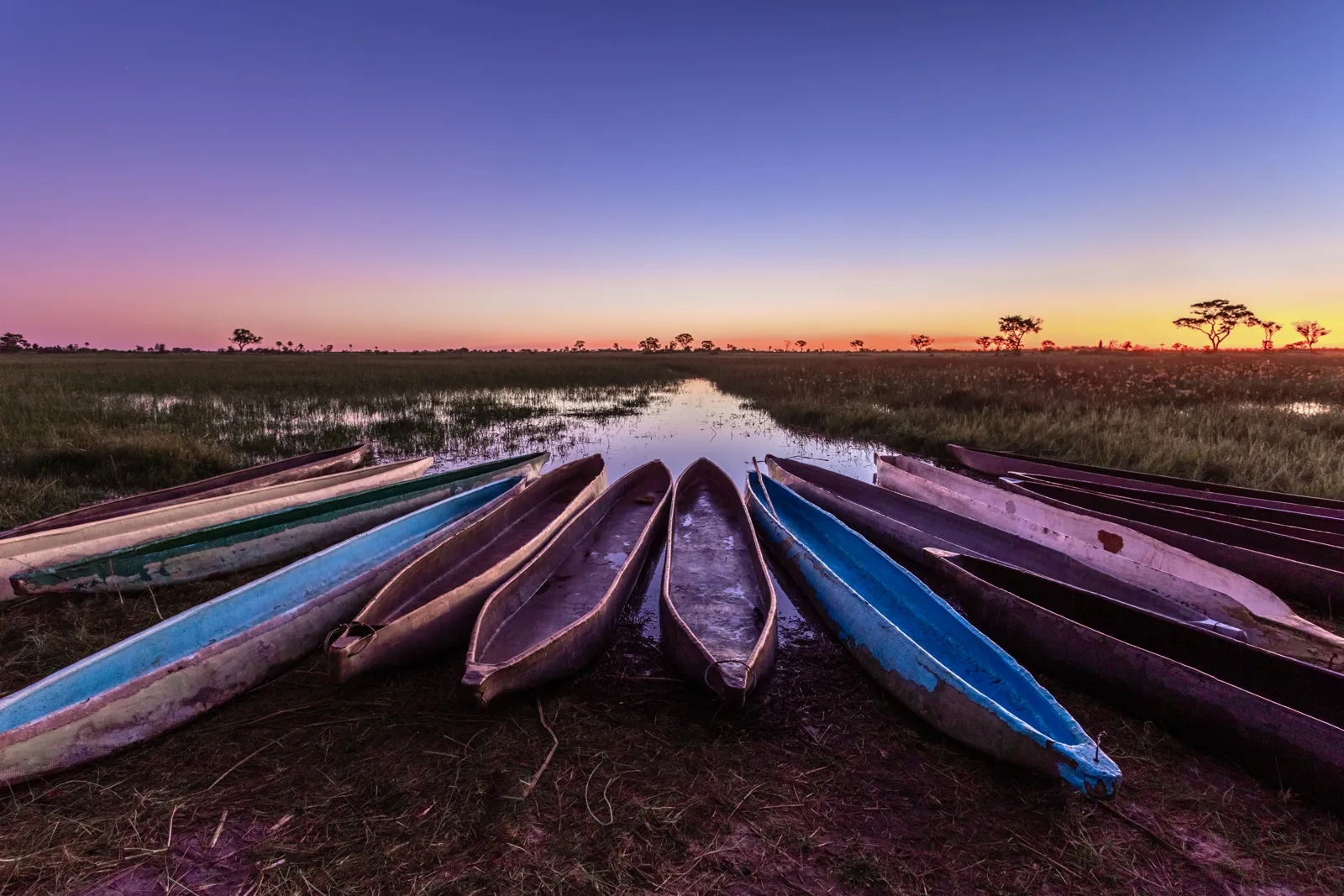
Traditional mokoros on the bank of the Okavango Delta at sunset
The Okavango Delta
This inland delta, a UNESCO World Heritage Site, is formed by the Okavango River, which fans out into the Kalahari instead of reaching the sea. Channels, lagoons, wooded islands and floodplains are home to elephants, hippos, lions, lechwe and abundant birdlife. You explore it by mokoro, the traditional dugout canoe poled by a guide, by boat, on foot with a licensed guide or on a scenic flight. Most camps in the heart of the delta can only be reached by light aircraft from Maun; day trips or multi-day mokoro excursions from Maun are also available at more moderate prices.
Moremi Game Reserve
In the eastern part of the delta, Moremi combines wetlands and dry land, making it one of the best places in the country to see wildlife, including African wild dogs. Unlike the heart of the delta, the reserve can be reached by 4×4 on tracks from Maun, with public campsites such as Third Bridge and Xakanaxa that need to be booked well in advance. Tracks can be flooded depending on the water levels.
Chobe National Park and Kasane
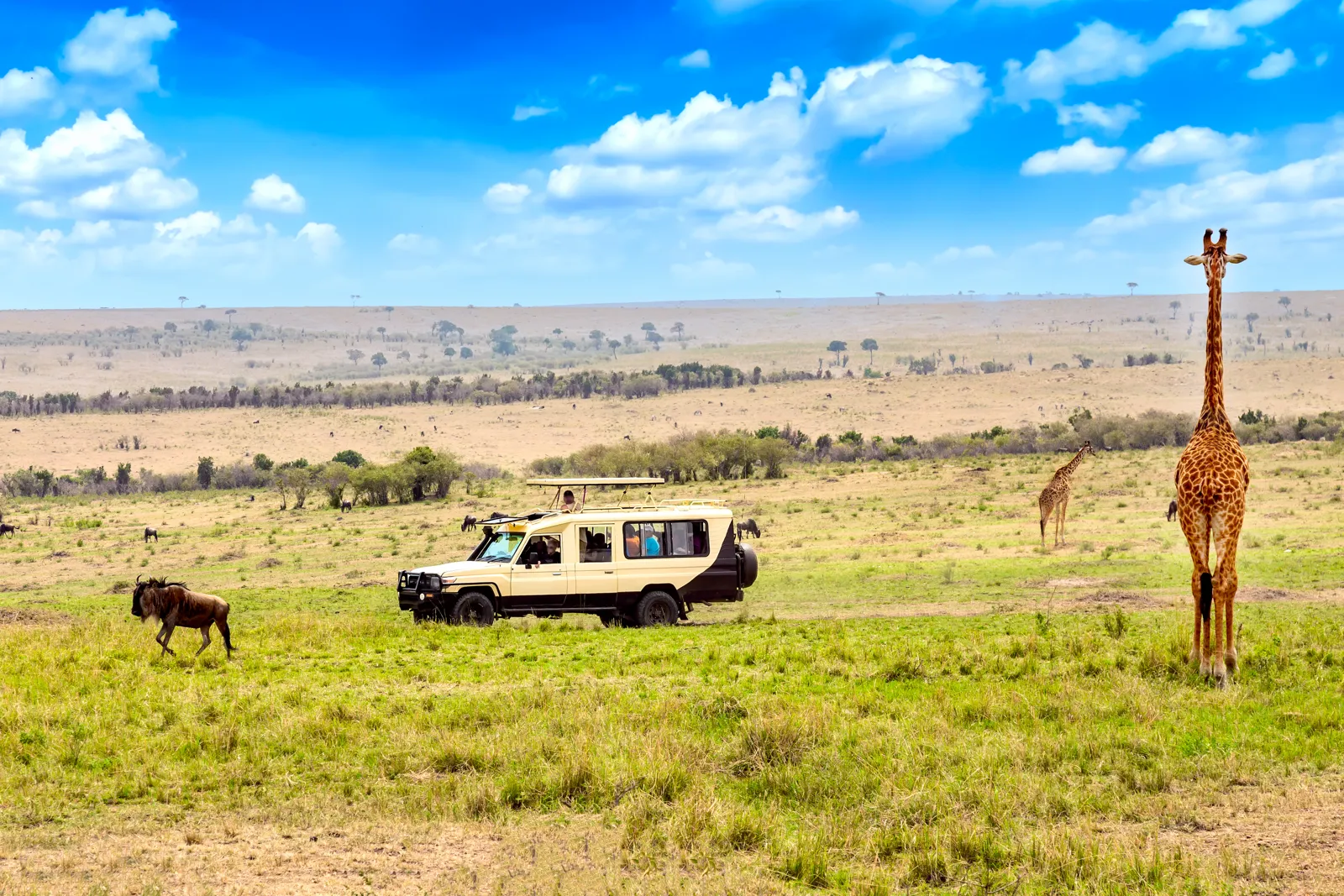
In the northeast, Chobe is known for its very large elephant populations. Its most accessible section, the Chobe Riverfront, runs along the river a few minutes from Kasane: game drives in the morning and boat cruises in the afternoon bring you close to animals coming down to drink. Further south, the more remote Savuti and Linyanti areas require a 4×4 and experience, or a fly-in safari.
The Makgadikgadi Pans and Nxai Pan
These ancient dried-up lakes form one of the largest salt pan systems in the world. In the dry season, the flat white horizon offers striking landscapes and starry nights; in the rainy season, the grass grows back and draws zebras and wildebeest. Nxai Pan National Park is known for its baobabs, including the group known as Baines’ Baobabs. Meerkats used to human presence can be seen with some guides. Crossing the pans requires a guide or solid experience: vehicles get stuck easily after rain.
The Central Kalahari Game Reserve
One of the largest reserves in Africa: semi-desert savanna, fossil valleys such as Deception Valley, black-maned lions, oryx and springbok. Infrastructure is minimal: campsites without water, sand tracks and very long distances. Visit fully self-sufficient, preferably in convoy, or on an organized safari. The best time is the rainy season, when wildlife gathers on the grasslands.
The Tsodilo Hills
In the northwest, these UNESCO-listed hills hold several thousand rock paintings, at a site sacred to local communities. Access is by road from Shakawe, at the northwestern tip of the delta, often combined with the “Panhandle”, the upstream part of the Okavango.
Khama Rhino Sanctuary
Near Serowe, in the east of the country, this community-run sanctuary protects white and black rhinos. It is a convenient stop on the road between the south (Gaborone, the South African border) and the north, with campsites and chalets, and guided drives to approach the rhinos.
Victoria Falls, nearby
Kasane is only about 80 km (50 mi) from Victoria Falls, on the border between Zimbabwe and Zambia. Many travelers combine them with Chobe in one or two days. This means crossing a border: check the entry requirements of the country concerned in advance on travel.state.gov or GOV.UK.
Itinerary ideas for Botswana
8 to 10 days: the safari essentials
Day 1: arrive in Maun
Days 2 to 4: Okavango Delta (fly-in camp, or a multi-day mokoro trip from Maun)
Days 5 and 6: Moremi Game Reserve
Days 7 to 9: Kasane, Chobe Riverfront, river cruise
Day 10: trip to Victoria Falls or depart from Kasane
2 to 3 weeks: a 4×4 self-drive loop
Days 1 and 2: arrive in Maun, preparation and shopping
Days 3 to 5: Moremi (Third Bridge and Xakanaxa campsites)
Days 6 to 8: Savuti, in Chobe National Park
Days 9 to 11: Kasane and the Chobe Riverfront
Days 12 to 14: Nxai Pan and the Makgadikgadi Pans
Days 15 and 16: back to Maun, scenic flight over the delta
Days 17 to 19: mokoro in the delta or the Central Kalahari (with experience and full self-sufficiency)
On deep sand tracks, average speeds often drop below 30 km/h (19 mph): do not plan overly long stages. According to the UK FCDO (GOV.UK, updated 1 June 2026), in very remote areas you should travel in convoy or with a satellite phone in case of breakdown, and take extra care when driving after dark because of stray wildlife and livestock.
Budget for a trip to Botswana
Botswana is one of the most expensive safari destinations in Africa, because of its high-end, low-density tourism policy. A self-drive camping trip is the cheapest option, but requires experience. Indicative amounts per person per day, based on two travelers, excluding international flights (converted from our euro estimates into US dollars at the ECB rate of 23 October 2026, €1 = US$1.12):
Item
Self-drive camping
Comfort (lodges and camps)
Accommodation
roughly US$22–56 (campsite pitch, sometimes more in the parks)
roughly US$280–1,120 and up (all-inclusive camp in the delta)
Meals
roughly US$17–28 (groceries and cooking at camp)
usually included in safari camps
Vehicle and fuel
roughly US$67–112 (equipped 4×4 shared by two)
included, or light-aircraft transfers extra
Park fees and activities
roughly US$22–56 (entry fees, mokoro, cruise)
usually included
Total per day
roughly US$110–200
roughly US$450 and well beyond
Indicative estimates, varying widely by season, region and camp standard. Prices are highest from July to October; the green season is much cheaper.
In between, mobile camping safaris with a guide and crew, and lodges on the edge of the parks around Maun and Kasane, keep costs down while avoiding the driving. Light-aircraft flights to the delta are often charged separately and limit the weight and type of luggage (soft bags).
Who is Botswana for?
Our verdicts by traveler profile, based on the places, conditions and budget ranges in this guide:
Safari and wildlife: ideal: the Okavango Delta by mokoro, Moremi’s wild dogs, Chobe’s elephants, the big herds of Makgadikgadi in the green season.
4×4 adventure: yes, for experienced drivers: deep sand tracks, water crossings, unfenced campsites. The UK FCDO advises travelling in convoy or with a satellite phone in very remote areas.
Couples: a very good choice for a special trip: tented camps in the delta, reached by light aircraft, with deliberately limited capacity.
Families: possible on an organized safari or in the lodges of Maun and Kasane, which are easier to organize; unfenced park campsites and long tracks are not well suited to young children.
Budget travelers: no: it is one of the most expensive safari destinations in Africa. Self-drive camping (roughly US$110–200 per person per day) and the green season bring the bill down.
Culture: as a complement: the UNESCO-listed rock paintings of the Tsodilo Hills.
Getting around Botswana
Organized safari: the simplest option, especially for the delta, which is mainly reached by light aircraft. Camps organize the activities (vehicle, boat, mokoro, walks).
4×4 self-drive: possible, with an equipped 4×4 (rooftop tent, extra fuel tanks). Traffic drives on the left (U.S. Department of State). Deep sand, water crossings and isolation call for real off-road experience.
Driving licence: according to the UK FCDO (GOV.UK, updated 1 June 2026), you can drive with a UK photocard licence for up to 90 days; holders of an old paper licence may need a photocard licence or the 1949 International Driving Permit, and car hire companies may require an IDP. According to the U.S. Department of State (travel.state.gov, last updated June 25, 2026), a valid international driver’s license and the vehicle registration documents are required and must be carried at all times.
Precautions: the UK FCDO advises arranging transport and accommodation in advance in remote areas, taking emergency supplies including water and fuel, and travelling in convoy or with a satellite phone in very remote areas. The rainy season (November to March) brings a risk of flash floods that can make roads unsafe and close border crossings at short notice (GOV.UK).
At night: take extra care: stray wildlife and livestock make driving outside major towns dangerous, especially after dark (GOV.UK). The U.S. Department of State notes that fatal accidents are frequent, especially at weekends and on end-of-month paydays.
Plane: domestic flights link Gaborone, Maun and Kasane; light aircraft serve the delta camps.
In the parks: never get out of your vehicle without permission. According to the UK FCDO, dangerous animals may roam on open highways, inside or outside reserves: always follow park regulations and wardens’ advice.
Where to stay in Botswana
Safari camps in the delta, Moremi, Linyanti or Savuti, often luxury tented camps, offer all-inclusive packages with guided activities; their capacity is deliberately limited. The more affordable lodges and hotels in Maun and Kasane serve as bases for day trips. The public campsites in the national parks, often unfenced, welcome self-drive travelers: animals can wander freely through the camp, night and day.
In high season, from July to October, book camps and park campsites several months ahead: without a booking, you may be refused access to some campsites.
Entry requirements for Botswana
US citizens: according to the U.S. Department of State (travel.state.gov, last updated June 25, 2026), you can stay up to 90 days in total within a 12-month period without a visa. The length of each stay is recorded on the entry stamp and may be less than 90 days. Your passport must have at least six months of validity remaining. Travelers with a temporary passport need a visa, which cannot be obtained on arrival.
UK citizens: according to the UK FCDO (GOV.UK foreign travel advice, updated 1 June 2026), you can visit for up to 90 days without a visa. Your passport must have an expiry date at least 6 months after your arrival and at least 3 blank pages. Make sure your passport is stamped on entry.
Children: both sources require a certified copy of the child’s full (unabridged) birth certificate and a consent form or affidavit signed by any parent not travelling. If you transit through South Africa, its own rules for minors also apply (U.S. Department of State).
Yellow fever: a vaccination certificate is required if you arrive from a country with a risk of yellow fever transmission (travel.state.gov and GOV.UK).
Cash: declare cash, foreign or local, worth BWP 10,000 or more (GOV.UK). Customs: check your home country’s allowances (e.g. CBP in the US, HMRC in the UK). Entry requirements checked on 24 October 2026; check them again before you travel.
Health and safety
Malaria: according to the U.S. Department of State (travel.state.gov, last updated June 25, 2026), malaria is present only in the north of the country, where the main parks are, and preventive medication is recommended for some areas, even for short stays. The UK FCDO (GOV.UK, updated 1 June 2026) notes that malaria was reported in April 2025 to have spread to areas where it is not usually present. See a doctor or travel health clinic at least 8 weeks before your trip.
Other risks: schistosomiasis and tick-borne diseases if you camp or walk in the bush; do not touch dead animals, as anthrax occasionally occurs in wildlife (GOV.UK). Avoid tap water and ice made from it (U.S. Department of State).
Healthcare and insurance: care is usually good in major towns but limited in rural areas, and serious cases may require evacuation to South Africa; private hospitals require payment up front (GOV.UK). Both governments strongly recommend insurance covering medical evacuation.
Safety: according to the UK FCDO, attacks on tourists are rare, but violent crime is increasing in Gaborone, Francistown and Maun, and there have been isolated break-ins at lodges in the Chobe area. Keep doors locked and windows closed while driving, keep valuables out of sight and do not pick up hitchhikers. The U.S. Department of State also reports crime in game parks and remote areas.
Swimming: do not bathe in rivers and lakes: you could be attacked by wild animals and risk water-borne diseases (GOV.UK).
Water and power: in times of drought, water may be rationed, and power outages can last several hours (U.S. Department of State). Keep a water reserve.
Wildlife products: it is illegal to buy, sell or remove protected animal products without a permit; ivory and rhino horn may never be taken out of the country, and penalties can reach five years in prison (U.S. Department of State, GOV.UK).
Emergencies: police 999, fire 998; for an ambulance, GOV.UK gives 997 and the U.S. Department of State gives 992 (MRI).
Practical tips for Botswana
Money: the currency is the pula (BWP). Carry some cash for campsites, park fees and tips, and check payment options with your camps and operators. Estimate your spending with our currency converter.
Internet and phone: expect no mobile coverage in many remote areas and parks; luxury camps sometimes offer limited connectivity. A local SIM or eSIM is useful in town, and a satellite phone is advised for very remote self-drive trips (GOV.UK).
Luggage: on light-aircraft flights to the camps, luggage weight is strictly limited and soft bags are generally required. Check the conditions with your operator.
Clothing: choose neutral colors (beige, khaki, green) for safaris and warm layers for early mornings in the southern winter.
Photos: do not photograph military or government installations, and ask before photographing people (GOV.UK).
Tipping: customary for guides, trackers, mokoro polers and camp staff.
Wildlife: in unfenced campsites, never leave food in your tent, do not go out at night without a flashlight, and keep your distance from elephants and hippos, which cause many accidents.
Read more
The season makes all the difference in Botswana: our page best time to visit Botswana compares the dry season, ideal for the delta and Chobe, with the green season, better for the Kalahari. For a longer trip in southern Africa, see our guides to Namibia, often combined on a self-drive tour, and South Africa, where many flights connect.
Frequently asked questions
How many days do you need in Botswana?
Allow 8 to 10 days for a safari focused on the Okavango Delta, Moremi and Chobe. On a 4×4 self-drive tour, plan 2 to 3 weeks instead: sand tracks slow the stages down considerably. See our itinerary ideas above.
Do I need a visa for Botswana?
Not for a short stay if you are a US or British citizen: both can stay up to 90 days visa-free (travel.state.gov, last updated June 25, 2026; GOV.UK, updated 1 June 2026). Your passport must be valid for at least six months; GOV.UK also requires 3 blank pages. Checked on 24 October 2026; check the latest rules before you leave.
Why is a safari in Botswana so expensive?
The country has chosen low-density tourism: few camps, few beds, often reachable only by light aircraft. Prices usually include accommodation, meals and guided activities. Self-drive camping and the green season bring the budget down significantly.
Can you do a self-drive trip in Botswana?
Yes, in an equipped 4×4, but it is for experienced drivers only: deep sand tracks, water crossings, unfenced campsites and very long distances. The UK FCDO advises taking water and fuel, travelling in convoy or with a satellite phone in very remote areas, and taking extra care after dark.
Do I need malaria tablets for Botswana?
Malaria is present in the north of the country, where the Okavango, Moremi and Chobe are, and the U.S. Department of State says preventive medication is recommended for some areas, even for short stays. See a doctor or travel health clinic at least 8 weeks before you leave.
What is the best time to visit Botswana?
The dry season, from May to October, and especially June to September for the Okavango, Moremi and Chobe. For the Central Kalahari and the Makgadikgadi Pans, the rainy season, roughly December to April, is more interesting.
World Meteorological Organization (World Weather Information Service): 1971–2000 normals from the Botswana Meteorological Services for the Maun, Kasane, Gaborone, Ghanzi and Francistown stations
European Central Bank: euro reference exchange rates of 23 October 2026 (budget conversion)
Transparency: this page contains affiliate links, labelled as such. If you book through them we may earn a commission at no extra cost to you; it does not influence our content or recommendations. How we fund the site.