Volcanoes, highland lakes, colonial towns, Maya markets and ancient cities deep in the forest: Guatemala packs great diversity into a small country. It is also a destination that calls for caution, as both the UK FCDO and the U.S. Department of State point out. This Guatemala travel guide helps you choose what to see, which itinerary to follow and what budget to plan.
To locate cities, regions, terrain, national parks and airports, see our map of Guatemala.
Guatemala at a glance
CapitalGuatemala City
LanguagesSpanish (official language) and many Maya languages
Currencythe quetzal (GTQ) · currenciesUS dollars are much easier to exchange than pounds sterling
Time zoneUTC−6, no daylight saving6 h behind London in winter (7 h during UK summer time), 1 h behind New York in winter
AirportsGuatemala City La Aurora (GUA); domestic flights to Flores (Petén)Check current routes with the airlines
EntryUS and UK: visa-free, usually up to 90 days; online immigration form · travel.state.gov · GOV.UK
Electricitycheck the voltage and plug type with your accommodation before you travel · plugs
High violent crime: according to the UK FCDO, Guatemala has one of the highest violent crime rates in Latin America, and there have been armed attacks or robberies on most tourist routes between Guatemala City, Antigua, Tikal, Petén and Lake Atitlán (GOV.UK, updated 13 August 2026).
Advised against: all but essential travel within 5 km of the Mexican border from the Pacific coast up to and including the Gracias a Dios crossing, and to the towns of Santa Ana Huista, San Antonio Huista and La Democracia in Huehuetenango.
Guatemala City: no zone is free from crime, including Zone 10 (Zona Viva); take care in Zone 1 (historic center), treat Zones 6, 7 and 8 with caution and research Zones 18 to 25 carefully (GOV.UK).
Transport: avoid public « chicken buses »; travel by day on main roads. U.S. Embassy employees may not travel outside the capital after dark (travel.state.gov, last updated June 11, 2026).
Tourist assistance: PROATUR/ASISTUR, 24-hour English-speaking service: dial 1500 from a Guatemalan phone or +502 2290 2810.
When to go to Guatemala
The best period is the dry season, from November to April, and especially January to February. The highlands (Antigua, Lake Atitlán) are then dry and mild, and the Petén tracks passable to reach Tikal. The rainy season, from May to October, makes roads more difficult, with rainfall peaks in June and September. All the details, with official INSIVUMEH normals, are in our article best time to visit Guatemala.
What to see in Guatemala: the highlights
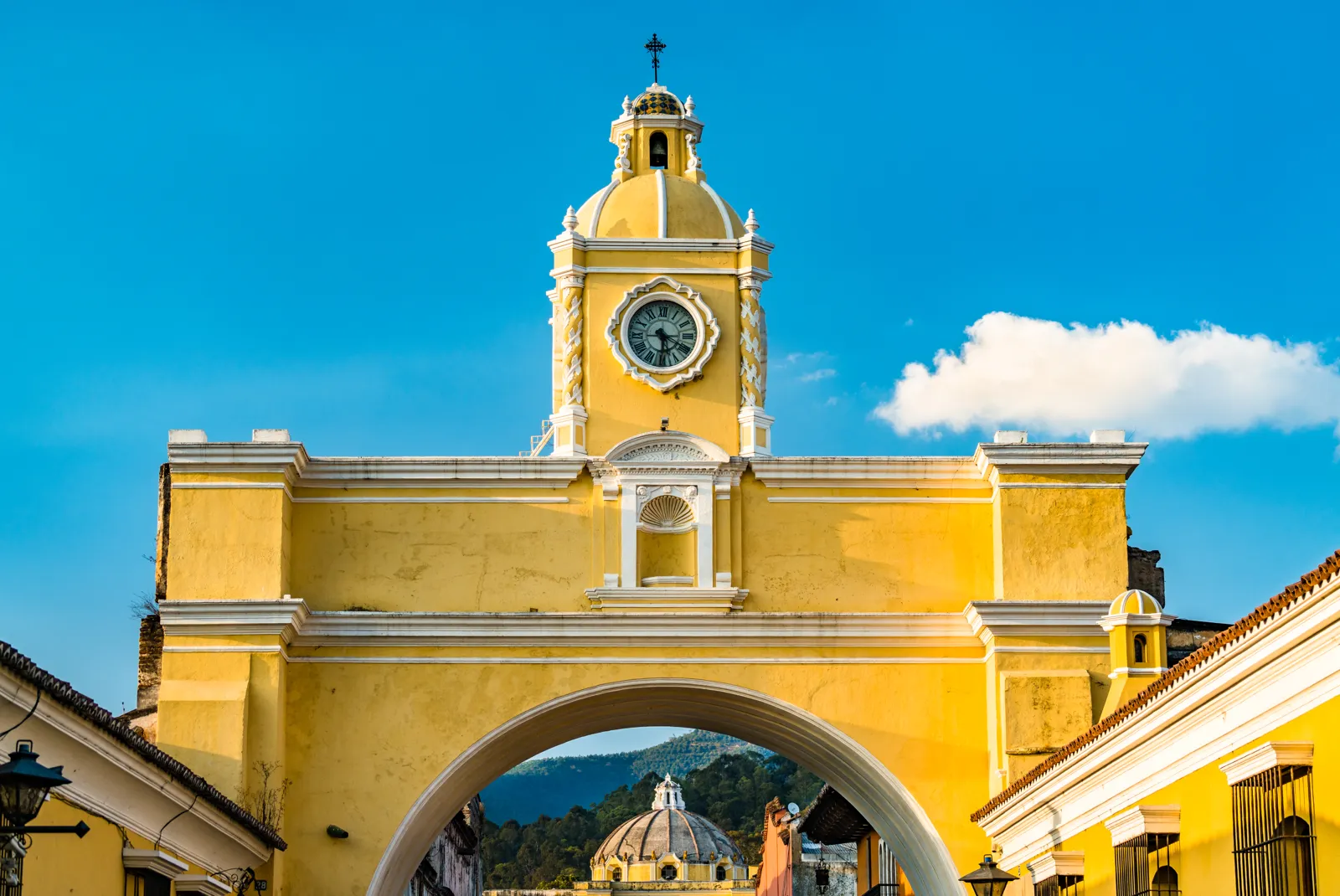
The Santa Catalina Arch and Agua volcano in Antigua Guatemala
Antigua Guatemala
The former capital, a World Heritage Site, lines up cobbled streets, baroque churches and convent ruins at the foot of Agua volcano. It is the most practical base for a first trip: Spanish schools, cafés, excursions to coffee plantations and volcanoes. Holy Week is famous for its processions and flower carpets. Tourist police (DISETUR) provide extra security in Antigua (U.S. Department of State), but keep your belongings close in crowded places.
Lake Atitlán
Surrounded by three volcanoes, Lake Atitlán is lined with Maya villages linked by boat: Panajachel, the main arrival point, San Pedro, San Juan, Santiago Atitlán or San Marcos. People come for the scenery, markets, textile crafts and hiking. To get there from the capital, PROATUR advises avoiding the Godínez bypass through Patzún and the road between Cocales and San Lucas Tolimán; boats between lakeside towns may be a safer alternative (GOV.UK). In San Pedro La Laguna, local authorities may require your original passport or a certified copy.
Chichicastenango
This highland town hosts one of the best-known markets in Central America, on Thursdays and Sundays, with its textiles, masks and the church of Santo Tomás, where Catholic and Maya rites mix. The market is very busy: keep your belongings close and do not display valuables.
Tikal and the Maya sites of Petén
In the heart of the Petén forest, Tikal is one of the largest Maya cities, with temple-pyramids rising above the canopy. The national park, a World Heritage Site, is visited from Flores, a small town on an island in Lake Petén Itzá. Other sites such as Yaxhá, or those of the Río de la Pasión (El Ceibal, Aguateca), are more isolated. The UK FCDO notes high crime levels in and around Petén: stay within tourist areas, travel with a reputable tour company and by daylight where possible.
Semuc Champey and Alta Verapaz
Near Lanquín, Semuc Champey is a natural limestone bridge covered in turquoise pools, at the bottom of a forested valley. A visit to the Lanquín caves is often added. Access is by a dirt track from Cobán. Visit with a group or a reputable operator.
The volcanoes
Guatemala has many volcanoes, several of them active. The most popular climbs are Pacaya, near the capital, and Acatenango, facing the regularly erupting Fuego, with a night at altitude. Before climbing, the UK FCDO advises checking the Guatemalan weather office (INSIVUMEH) and CONRED, the disaster agency, for access and restrictions. Some volcanoes reach freezing temperatures at night: warm clothing and waterproofs are essential. Local tour organizers tend to underestimate the risks, deaths have occurred and there is no mountain rescue service (GOV.UK).
Río Dulce and Livingston
In the east, the Río Dulce links Lake Izabal to the Caribbean Sea through forest-covered gorges. At the end, Livingston, reachable only by boat, is the cradle of Garifuna culture, of Afro-Caribbean origin. The UK FCDO lists Izabal among the departments with high crime levels: go with a reputable operator and check for life jackets.
Things to do in Guatemala: experiences not to miss
Stroll through Antigua Guatemala, its colonial streets and churches
Tour Lake Atitlán and its villages by boat
Visit the Chichicastenango market, on Thursday or Sunday
Explore Tikal and the Maya sites of Petén
Swim in the pools of Semuc Champey
Climb a volcano (Pacaya, Acatenango) with a guide
Sail down the Río Dulce to Livingston
Itinerary ideas for Guatemala
Distances look short on the map, but roads are slow: allow 3 to 4 hours for 100 to 150 km (60 to 95 mi) in the mountains. Favor tourist shuttles and domestic flights to Flores.
10 days: the highlands and Tikal
Days 1 to 3: Antigua and the surroundings (Pacaya volcano, coffee plantations)
Days 4 to 6: Lake Atitlán, with the Chichicastenango market on Thursday or Sunday
Day 7: back to Guatemala City and fly to Flores
Days 8 and 9: Tikal and Yaxhá
Day 10: return
2 weeks: the full loop
Days 1 to 3: Antigua, Acatenango climb with a guide
Days 4 to 6: Lake Atitlán and Chichicastenango
Days 7 and 8: Cobán, Lanquín and Semuc Champey
Days 9 to 11: Flores, Tikal and Yaxhá
Days 12 and 13: Río Dulce and Livingston
Day 14: back to Guatemala City
Budget for a trip to Guatemala
Guatemala is affordable, but safety comes at a cost: tourist shuttles, reputable agencies and booked taxis rather than public buses weigh on the budget. Indicative amounts per person per day, excluding international flights (converted from our euro estimates at the ECB rate of 23 October 2026, €1 = US$1.12):
Indicative estimates. The domestic flight to Flores, guided climbs and 4×4 excursions push the bill up.
To keep your budget under control, eat in « comedores » (small local restaurants) and book tourist shuttles directly with established agencies. Antigua is more expensive than the rest of the country.
Who is Guatemala for?
Our verdict by travel style, based on the information in this guide:
Maya and colonial culture: ideal: Antigua, the Chichicastenango market, Tikal and the Petén sites.
Budget travelers: yes: roughly US$40–65 per person per day; Antigua is more expensive than the rest of the country and tourist shuttles weigh on the budget.
Hiking and volcanoes: yes, with an official guide and in a group: Pacaya, Acatenango with a night at altitude.
Learning Spanish: yes: Antigua has many language schools.
Couples: yes: the quieter villages of San Marcos and San Juan on Lake Atitlán.
Families: with caution: high crime levels, public buses to avoid and boats that must provide life jackets.
Getting around Guatemala
Tourist shuttles: the simplest way to link Antigua, Lake Atitlán, Chichicastenango or Lanquín. Established agencies sell seats in inexpensive minibuses.
Buses: avoid public buses (repainted US school buses, the « chicken buses »): gangs have attacked and extorted drivers, and accidents are common (GOV.UK). Private intercity coaches are generally safer, though they have also been targeted.
Plane: a domestic flight links Guatemala City with Flores (Petén) and avoids a long road journey.
Car: possible, but stick to main roads, travel in convoy if possible and avoid driving at night. UK visitors can use a UK photocard licence for up to 3 months (GOV.UK); valid US licenses are accepted for the first 30 days, then an international driving permit is needed (U.S. Department of State). Using a phone while driving is illegal; keep your licence, ID and rental papers with you for police checkpoints. Use a 4×4 for unpaved roads.
Taxis: in the capital, use radio-dispatched taxis (usually yellow), Uber or hotel taxis; prepaid taxi vouchers are sold at the INGUAT office in the airport arrivals hall (GOV.UK).
Where to stay in Guatemala
In Antigua, the historic center lets you do everything on foot. On Lake Atitlán, Panajachel is the most convenient for transport, San Marcos and San Juan are quieter. In Flores, the island has many small hotels, and a few places to stay near the entrance to Tikal park let you see the site at sunrise. In Guatemala City, if you need to stay overnight, choose a reputable hotel and bear in mind that no zone is crime-free (GOV.UK).
Use your accommodation’s safe for your passport, money and cards, and go out with the bare minimum.
Entry requirements for Guatemala
US citizens
According to the U.S. Department of State (travel.state.gov, last updated June 11, 2026), you need a US passport valid on arrival with at least one blank page; there is no minimum validity and no visa is required. You must fill out the electronic immigration form to enter and exit; some airlines ask for proof at check-in. Stays are usually allowed for 90 days; overstays cost GTQ 15 a day.
No vaccinations are required for entry, but proof of yellow fever vaccination is required if you come from, transit through or have a layover of 12 hours or more in a country with yellow fever risk.
UK citizens
According to the UK FCDO (GOV.UK foreign travel advice, updated 13 August 2026), you can visit for up to 90 days without a visa. Your passport must be valid for at least 6 months after arrival, with at least 2 blank pages. Complete the online immigration declaration form before entering and leaving, and make sure your passport is stamped.
The 90 days cover Guatemala, El Salvador and Nicaragua together (CA-4 agreement); British nationals need a visa for Honduras. The airport departure tax of US$30 is normally included in the ticket. Children traveling alone or with one parent need a notarized letter in Spanish from the absent parent(s). « Entry fees » requested at land borders are illegal: ask for an official receipt.
The two sources differ on passport validity (no minimum for US citizens, 6 months for UK citizens). Entry requirements checked on 24 October 2026; check them again before you travel. For customs allowances on your return, check your home country’s rules (e.g. CBP in the US, HMRC in the UK).
Health and safety
Health: check vaccine recommendations at least 8 weeks before your trip; altitude sickness is a risk in parts of Guatemala (GOV.UK, updated 13 August 2026). Guatemala City offers a full range of medical care, but options are limited elsewhere and public hospitals often lack basic medicines; hospitals usually require payment before treatment and may refuse discharge until you pay (U.S. Department of State). Insurance covering medical costs and evacuation is essential. UK prescriptions cannot be used locally. Tap water is not drinkable in many areas.
Safety: carjacking and armed robbery are common (GOV.UK). Do not display valuables, carry little cash, avoid withdrawing large sums especially at night, and check ATMs for tampering. Criminals posing as police officers have committed theft and extortion. Never resist an attacker. Carrying ID is a legal requirement. Emergency numbers: police 110, fire and ambulance 122 or 123, tourist assistance 1500.
Natural hazards: the rainy season (May to November) brings frequent flooding and landslides; there is a risk of earthquakes and volcanic eruptions: follow CONRED (GOV.UK).
Practical tips for Guatemala
Money: cards are accepted in tourist hotels and restaurants, but cash is essential in villages and at markets. It is safer to change money at hotels, banks or exchange offices, and US dollars are much easier to exchange than pounds (GOV.UK). Keep some money in an easy-to-reach pocket, separate from the rest. Our currency converter helps you estimate your spending.
Internet: a reasonable network in cities and tourist areas, weaker in the mountains and Petén. A local SIM card or an eSIM lets you use ride-hailing apps and share your location.
Documents: keep the original passport in the safe and carry a copy of the photo page (except in San Pedro La Laguna, where the original or a certified copy may be required); when driving, carry your passport and licence.
Etiquette: always ask before photographing people, especially in Maya communities and at markets. A few words of Spanish make a big difference.
Tipping: in restaurants, around 10% is customary; it is sometimes already included in the bill.
Not for a stay of up to 90 days if you are a US or British citizen (travel.state.gov, GOV.UK). You must complete the online immigration form before entering and leaving. British citizens need a passport valid at least 6 months after arrival with 2 blank pages. Checked on 24 October 2026; check the latest rules before you leave.
Is Guatemala dangerous for tourists?
The UK FCDO reports one of the highest violent crime rates in Latin America and armed robberies on most tourist routes, and advises against the Mexican border area. Risks are reduced by using reputable agencies, tourist shuttles and booked taxis, not traveling at night and avoiding public buses.
How much does a trip to Guatemala cost?
Excluding international flights, allow roughly US$40–65 per person per day on a budget, and US$110–225 in comfort. Antigua and guided excursions are the most expensive items.
How long do you need to visit Guatemala?
Ten days lets you see Antigua, Lake Atitlán and Tikal. Two weeks leaves time to add Semuc Champey and the Caribbean coast (Río Dulce, Livingston).
What is the best time to visit Guatemala?
The dry season, from November to April, and especially January–February. The rainy season runs from May to October.
What to see in Guatemala in 10 days?
Antigua and its surroundings, Lake Atitlán with the Chichicastenango market, then Tikal and Petén, reached by domestic flight to Flores. With two weeks, add Semuc Champey or the Río Dulce and Livingston.
European Central Bank, euro reference rates of 23 October 2026: budget conversions
Instituto Nacional de Sismología, Vulcanología, Meteorología e Hidrología (INSIVUMEH): 1991–2020 normals for Guatemala City (La Aurora airport) and Quetzaltenango normals (temperatures 1991–2010, precipitation 1980–2010); WMO 1991–2020 normals for Flores, Cobán and Puerto Barrios published by NOAA
Transparency: this page contains affiliate links, labelled as such. If you book through them we may earn a commission at no extra cost to you; it does not influence our content or recommendations. How we fund the site.