Panama means the canal linking the Atlantic and the Pacific, a skyscraper capital facing a listed colonial quarter, rainforest a few kilometers from downtown and two very different coastlines. The country is small and easy to get around, and prices are in US dollars. Some areas, however, carry specific warnings from the UK and US governments. This Panama travel guide helps you choose what to see, which itinerary to follow and what budget to plan, while staying on the well-traveled routes.
To locate towns, regions, terrain, national parks and airports, see our map of Panama.
Panama at a glance
CapitalPanama City
LanguageSpanishEnglish is spoken in tourist areas and in Bocas del Toro
Currencythe balboa (PAB) and the US dollar · currencies
Time zoneUTC−5, no daylight savingSame as New York in winter, 1 h behind in summer
AirportsPanama City Tocumen International (PTY)Check current routes with the airlines
EntryUS: visa-free up to 180 days; UK: visa-free up to 3 months by land or air; passport stamp essential · travel.state.gov · GOV.UK
Electricitycheck voltage and plug types before you leave · plugs
Budgetroughly US$65–110 per person per day on a budget · details
Panama: areas with official safety warnings
Colombia border: the UK FCDO (GOV.UK, updated 9 October 2026) reports a risk of violence east of a line between Punta Carreto (Guna Yala, Atlantic coast), Yaviza (eastern Darién) and Punta Piña (Pacific coast); only travel there in an organized group and make sure local police know about your visit
Darién and the Mosquito Gulf: the U.S. Department of State (travel.state.gov, last updated August 13, 2026) describes them as extremely remote, with drug and human trafficking and very limited police and emergency services
Panama City: GOV.UK lists San Miguelito, El Chorrillo, Río Abajo, 24 de Diciembre, Santa Ana and Juan Díaz as areas with higher crime, and advises precautions against mugging around Albrook Mall, Vía España and Avenida Central, Calidonia, Casco Viejo and Panamá Viejo
Also flagged by GOV.UK: the Madden Dam area off the Panama–Colón road and the city of Colón, where protests can be particularly large
Earthquake of 9 October 2026: GOV.UK reports a magnitude 7.6 earthquake about 39 km (24 mi) west of Tonosí; follow local authorities’ advice about aftershocks
The situation can change: check the latest advice on GOV.UK and travel.state.gov before booking and during your trip
When to go to Panama
The best period runs from mid-December to April, during the dry season on the Pacific side: it hardly rains in Panama City from January to March, and February is the driest month. From May to November, the rainy season brings afternoon showers, peaking in October and November; it is also humpback whale season. The Caribbean coast, around Bocas del Toro, gets rain all year round, with March and October the most favorable months. According to the UK FCDO (GOV.UK, updated 9 October 2026), hurricanes do not hit Panama directly, but the Atlantic hurricane season (June to November) often brings heavy rain, flash floods and landslides. All the details, month by month and with official climate data, are in our article best time to visit Panama.
What to see in Panama: the highlights
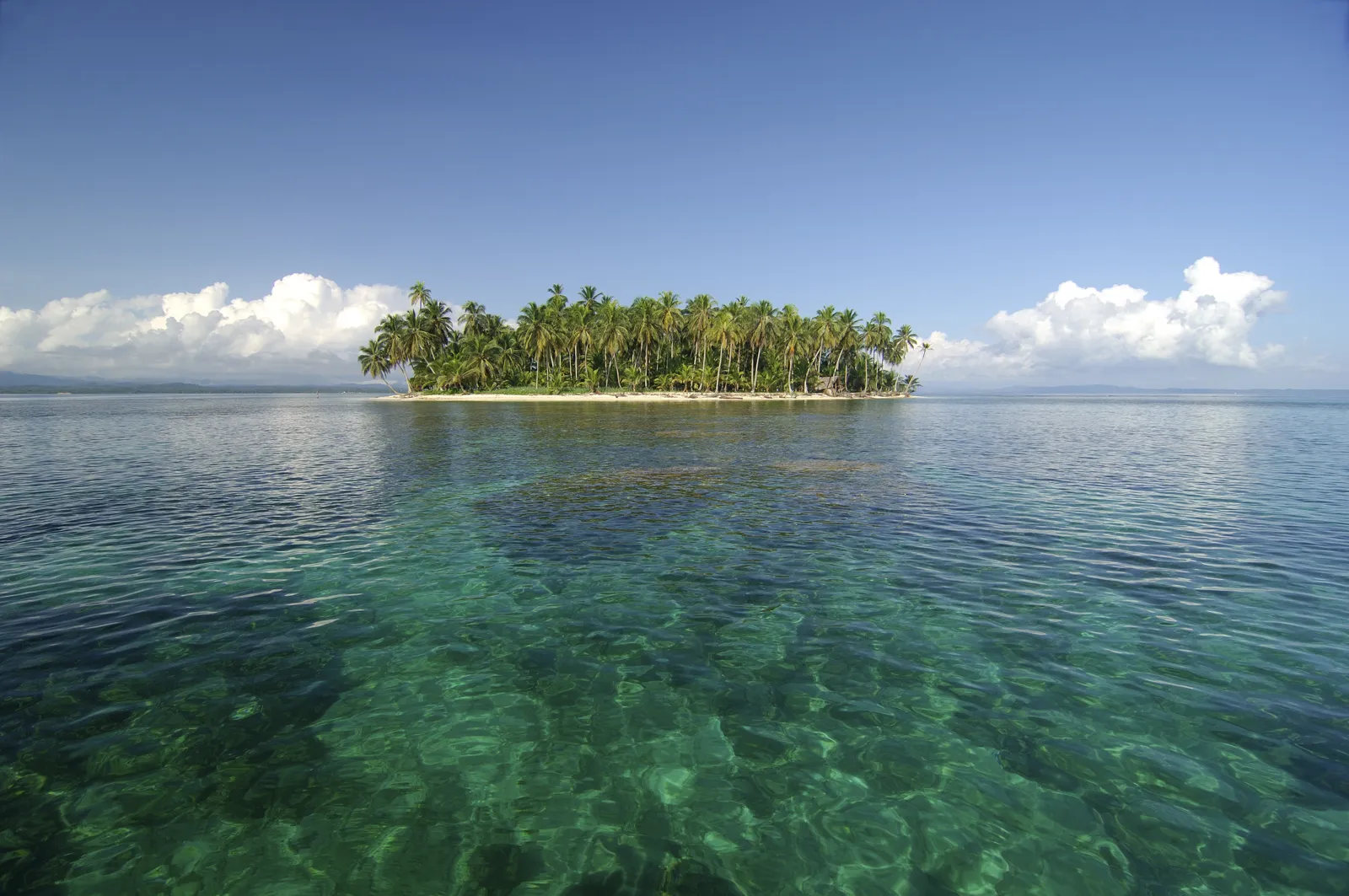
Tropical islet in the San Blas archipelago, Panama
Panama City and Casco Antiguo
The capital lines up its towers along the bay and the Cinta Costera, but its historic heart is Casco Antiguo (or Casco Viejo), the colonial quarter built in the 17th century after the first city was destroyed by the pirate Henry Morgan. Cobbled streets, churches, restored squares and rooftop terraces make it the most pleasant area to stay or go out. To the east, the ruins of Panamá Viejo, the original city, can be visited along with a small museum. The Amador Causeway, which links three islets at the entrance to the canal, makes a good walk with views of the ships. Be careful: GOV.UK lists Santa Ana and El Chorrillo, next to Casco Antiguo, among the higher-crime areas of the city, and advises precautions against mugging in Casco Viejo and Panamá Viejo, especially at night.
The Panama Canal
The visitor center at the Miraflores Locks, about twenty minutes from central Panama City, lets you watch ships pass from terraces and understand how the canal works thanks to a museum. Check transit times, which vary through the day. You can also do a partial transit of the canal by boat with tour operators. Access to the canal area is regulated: follow the authorities’ instructions.
The canal forests: Soberanía and Gatún Lake
Less than an hour from the capital, Soberanía National Park protects a rainforest very rich in birds, crossed by trails such as Pipeline Road, famous among birdwatchers. On Gatún Lake, created for the canal, boat trips take you close to islands where monkeys live. A guided visit is the better option: GOV.UK advises considering an experienced guide for hiking, as trails may not be well marked and mobile coverage is unreliable.
Bocas del Toro
Near the Costa Rican border, this Caribbean archipelago is one of the busiest destinations in the country. The small town of Bocas, on Isla Colón, is the base for water taxis to the beaches, mangroves and snorkeling spots of the neighboring islands (Bastimentos, Carenero, Zapatilla). The atmosphere is laid-back and English is widely spoken. It rains all year round. Keep an eye on your belongings on the beaches.
Boquete and Barú Volcano
In the Chiriquí highlands, in the west, Boquete is a small mountain town surrounded by coffee plantations. The climate is cooler than in the lowlands. People come for cloud forest hikes (the Quetzal Trail), coffee farm tours, the Caldera hot springs and the night ascent of Barú Volcano, the country’s highest peak, to see the sunrise over both oceans in clear weather. Go with a guide and warm gear.
The San Blas Islands (Guna Yala)
On the Caribbean coast, east of the capital, hundreds of sandy, palm-fringed islets make up the autonomous territory of the Guna people, who manage tourism themselves. Visitors stay in simple community-run lodgings, usually as part of organized trips from Panama City (road, then boat). An entry fee is collected by the Guna authorities. Respect local rules, especially regarding photos. Note: the UK FCDO advises traveling only in an organized group east of the Punta Carreto–Yaviza–Punta Piña line, near the Colombian border: stay in the western part of the archipelago.
The Azuero Peninsula
This is rural, traditional Panama: colonial villages, crafts, religious festivals and the famous carnival of Las Tablas. On the coast, Pedasí and Playa Venao attract surfers; offshore, Iguana Island is a reserve reached by boat for snorkeling. The region is the driest in the country during the dry season.
Coiba, the Pearl Islands and the Gulf of Chiriquí
On the Pacific, Coiba National Park, a UNESCO World Heritage Site, is a diving and snorkeling destination reached by boat from Santa Catalina. The Pearl Islands, closer to the capital (by boat or plane), offer beaches and humpback whale watching roughly from July to October. The Gulf of Chiriquí, with its protected islands, is reached from Boca Chica, south of David.
Things to do in Panama: experiences not to miss
Watch the ships at the Miraflores Locks on the Panama Canal
Stroll through Casco Antiguo and visit Panamá Viejo
Spot wildlife in Soberanía National Park and on Gatún Lake
Discover the San Blas Islands (Guna Yala) on an organized trip
Go snorkeling in Bocas del Toro
Hike around Boquete and on the slopes of Barú Volcano
Itinerary ideas for Panama
8 to 10 days: the capital, the canal and the Caribbean
Days 1 to 3: Panama City, Casco Antiguo, Panamá Viejo, Miraflores Locks
Day 4: Soberanía National Park and Gatún Lake, with a guide
Days 5 and 6: San Blas Islands (western part), on an organized trip
Days 7 to 9: flight to Bocas del Toro, beaches and snorkeling
Day 10: back to Panama City
2 weeks: the full loop
Days 1 to 3: Panama City and the canal
Day 4: Soberanía and Gatún Lake
Days 5 and 6: Azuero Peninsula (Las Tablas, Pedasí)
Days 7 and 8: Santa Catalina and Coiba National Park
Days 9 and 10: Boquete, hiking, coffee, Barú Volcano
Days 11 to 13: Bocas del Toro
Day 14: flight back to Panama City
Distances are short on the scale of the country, but inland roads are slow: allow about 6 to 7 hours by road between Panama City and David. Domestic flights save a lot of time to Bocas del Toro or David.
Who is Panama for?
Here is our verdict by traveler profile, based on the stops, budget and conditions described in this Panama guide.
Profile
Our verdict
Nature and wildlife
✅ Birds in Soberanía park, monkeys on Gatún Lake, humpback whales roughly from July to October.
Beaches and islands
✅ San Blas (western part), Bocas del Toro, the Pearl Islands; the Caribbean coast gets rain all year.
Diving
✅ Coiba National Park, a UNESCO site, from Santa Catalina.
Hiking
✅ Boquete, cloud forest and the night ascent of Barú Volcano, with a guide.
Culture
✅ Casco Antiguo, Panamá Viejo, the Miraflores Locks, the Las Tablas carnival.
Budget travelers
⚠️ More expensive than most Central American countries: roughly US$65–110 per person per day.
All profiles
⚠️ Several areas carry official safety warnings: stick to the routes described here.
Budget for a trip to Panama
Panama is more expensive than most Central American countries, especially in Panama City and on the islands. Prices are shown in dollars. Indicative amounts per person per day, based on two travelers, excluding international flights:
Item
Budget
Comfort
Accommodation
roughly US$20–45 (hostel, simple room)
roughly US$80–170 (boutique hotel, Casco Antiguo)
Meals
roughly US$15–30 (local canteens, fondas)
roughly US$45–80
Transport
roughly US$5–15 (bus, metro, water taxis)
roughly US$20–55 (domestic flights, driver, car rental)
Activities
roughly US$10–35
roughly US$45–110 (guided trips, diving, San Blas)
Total per day
roughly US$65–110
roughly US$170–280
Indicative estimates, varying with the season and level of comfort. Prices are higher during the dry season and holidays.
Trips to San Blas, Coiba or the Pearl Islands are often the biggest expense: they include boat transport and sometimes accommodation and meals. Also bring cash for entry fees in some areas.
Getting around Panama
In the city: Panama City has a modern metro. For taxis, the UK FCDO (GOV.UK, updated 9 October 2026) advises using only ride-hailing apps or hotel-arranged transport, as taxis can be in poor condition. The U.S. Department of State (travel.state.gov, last updated August 13, 2026) recommends ride-sharing apps or licensed, registered taxis (usually yellow), avoiding taxis with unknown passengers and agreeing on the fare in advance, since taxis have no meters.
Buses: the Albrook terminal in Panama City serves the whole country. Long-distance buses are cheap and air-conditioned (bring a jacket). GOV.UK warns of pickpocketing on buses and at bus stations.
Domestic flights: they mainly leave from Albrook airport, in the city, for Bocas del Toro, David and other destinations.
Car rental: handy for Azuero and Chiriquí. Traffic drives on the right. According to GOV.UK, you can drive for up to 3 months with a UK photocard licence (paper licences are not accepted), carrying a copy of your passport with the dated entry stamp; any alcohol in your system can lead to a fine, licence revocation and impoundment. According to travel.state.gov, a valid foreign licence can be used for 90 days, third-party insurance is mandatory and night driving can be dangerous; roads may be unlit with large potholes, and flooding makes driving riskier in the rainy season (April to December).
Boats: water taxis in Bocas del Toro, boats to San Blas, the Pearl Islands and Coiba. Check that life jackets are on board: the U.S. Department of State notes that the tourism industry is not well regulated and safety inspections are rare.
Where to stay in Panama
In Panama City, Casco Antiguo has boutique hotels and hostels in a historic setting, but stick to the central streets and take a taxi back at night. The modern districts (Bella Vista, El Cangrejo, Obarrio) offer large hotels and apartments. In Bocas del Toro, choose between Bocas town, lively and practical, and the more isolated lodges on the other islands, reached by boat. In Boquete, small hotels and lodges surrounded by gardens; bring layers, as nights are cool. In San Blas, accommodation is rustic: huts on the sand, shared bathrooms, limited electricity.
For the year-end holidays, carnival and Holy Week, book several months ahead, especially on the islands and in Azuero.
Entry requirements for Panama
US citizens
According to the U.S. Department of State (travel.state.gov, last updated August 13, 2026), US tourists can stay in Panama for 180 days without a visa, and this is strictly enforced. You need a passport valid for 3 months past your date of entry, proof of funds ($500 cash or equivalent) and a return plane ticket. Make sure you receive an entry stamp in your passport on arrival, and always carry your passport with that stamp: police can detain and fine you for not having identification.
UK citizens
According to the UK FCDO (GOV.UK foreign travel advice, updated 9 October 2026), you can visit Panama for up to 3 months without a visa if you arrive by land or air (different rules apply to sea arrivals, except cruise passengers). Your passport must be valid for at least 6 months after the day you plan to leave and have at least one blank page. At the border you may have to give your accommodation address and a phone number, show a return or onward ticket (particularly if arriving overland from Costa Rica), and prove you have at least US$1,000 or a credit card. Make sure your passport is stamped with your arrival date. You cannot normally extend your stay, and leaving for a neighboring country and coming back to extend it may lead to detention. A yellow fever vaccination certificate is required if you arrive from a country with a risk of transmission. A US$40 departure tax is usually included in the ticket price.
The two sources quote different proof-of-funds amounts ($500 for US citizens, $1,000 for UK citizens); if in doubt, check with the Embassy of Panama. Entry requirements checked on 24 October 2026; check them again before you travel.
Health and safety
Health: the UK FCDO (GOV.UK, updated 9 October 2026) lists dengue, malaria, Zika, chikungunya and HIV among health risks and advises checking vaccine recommendations at least 8 weeks before your trip. Tap water is safe to drink in most of the country; follow local advice in rural and island areas. The U.S. Department of State recommends being up to date on CDC-recommended vaccinations. See a doctor or travel clinic before you go.
Medical care: Panama City has good private hospitals, but facilities outside the capital are limited (GOV.UK). According to travel.state.gov, private hospitals require payment up front, costs can exceed $10,000, ambulances are unreliable outside Panama City, Colón and the Pan-American Highway to Chiriquí, and medical evacuation insurance is strongly recommended.
Safety: pickpocketing occurs in busy areas, on buses and at bus stations, and people have been attacked after withdrawing cash: use ATMs inside banks or shopping centers (GOV.UK). Protests can be large and cause road blocks, including at the Paso Canoas border crossing and on the way to airports (GOV.UK; travel.state.gov). See also the box at the top of the page.
Beaches: both sources warn of strong currents and few lifeguards on Pacific and Caribbean beaches; GOV.UK advises against swimming in the Bay of Panama, which is heavily polluted.
Hiking: GOV.UK advises going with an experienced guide: trails may be poorly marked, mobile coverage is unreliable, and tourists have gone missing and died hiking alone.
Local laws: smoking and e-cigarettes are banned in public places, with fines of US$25 to 100, and even small quantities of drugs can lead to prison (GOV.UK).
Emergencies: 911 (all services), 103 (ambulance and fire), 104 (police), according to GOV.UK and travel.state.gov.
Practical tips for Panama
Money: prices are in dollars. Bring cash for the islands and for entry fees. Our currency converter helps you estimate your spending.
Phone and internet: mobile coverage is good in towns and along main roads, but weak or absent on remote islands and in the forest. Check your provider’s roaming terms or consider a local SIM or eSIM for maps and ride apps.
Etiquette: a few words of Spanish are appreciated. In Guna territory, always ask before photographing someone: there may be a charge.
Climate: it is hot and humid all year in the lowlands. Pack light clothing, a rain jacket, mosquito repellent and a warm layer for air-conditioned buses and the Chiriquí mountains.
Tipping: around 10% in restaurants if service is not included; customary for guides and boat operators.
Customs: check your home country’s customs allowances for the return (e.g. CBP in the US, HMRC in the UK).
Women traveling alone: GOV.UK reports violent attacks, including sexual assault, in tourist areas. Avoid poorly lit areas, do not walk alone at night and choose guided hikes.
Not as a tourist if you are a US or British citizen. US citizens can stay up to 180 days with a passport valid 3 months past entry, proof of $500 and a return ticket (travel.state.gov, last updated August 13, 2026). UK citizens can stay up to 3 months when arriving by land or air, with a passport valid 6 months after departure and possible proof of $1,000 or a credit card (GOV.UK, updated 9 October 2026). Make sure your passport is stamped. Checked on 24 October 2026.
Is Panama safe for tourists?
The classic routes (Casco Antiguo, the canal, Bocas del Toro, Boquete, Azuero) can be done with the usual precautions. The UK FCDO warns of violence near the Colombian border (east of the Punta Carreto–Yaviza–Punta Piña line), the U.S. Department of State describes Darién and the Mosquito Gulf as remote areas with trafficking, and GOV.UK lists several higher-crime areas in Panama City, as well as the city of Colón.
What currency is used in Panama?
The balboa (PAB) and the US dollar: prices are shown in dollars. Bring cash for the islands and entry fees.
How many days do you need in Panama?
About ten days lets you see Panama City, the canal, San Blas and Bocas del Toro. With two weeks, you can add Boquete, Azuero and Coiba.
What is the best time to visit Panama?
The dry season, from mid-December to April, especially February and March. For Bocas del Toro, where it rains all year, March and October are the least rainy months.
How much does two weeks in Panama cost?
Excluding the international flight, allow roughly US$65–110 per person per day on a budget, or about US$910–1,540 for 14 days, and roughly US$170–280 per day in comfort (about US$2,380–3,920). Prices are higher during the dry season and holidays.
What should you see first in Panama?
Panama City and Casco Antiguo, the Miraflores Locks on the canal, Soberanía National Park, the San Blas Islands, Bocas del Toro and Boquete. With more time: the Azuero Peninsula, Coiba or the Pearl Islands.
Our sources
Entry, safety, health and driving information read on 24 October 2026: U.S. Department of State, Panama country information (travel.state.gov, last updated August 13, 2026), and UK FCDO, foreign travel advice for Panama (GOV.UK, updated 9 October 2026)
World Meteorological Organization (World Weather Information Service): 1971–2000 normals from the Instituto de Meteorología e Hidrología de Panamá (IMHPA) for the Panama City, Bocas del Toro, David, Santiago, Los Santos and Antón stations
Transparency: this page contains affiliate links, labelled as such. If you book through them we may earn a commission at no extra cost to you; it does not influence our content or recommendations. How we fund the site.