Manaus, capital of Amazonas State, is the big city in the heart of the Amazon rainforest, near the confluence of the Rio Negro and the Solimões: it is the gateway to most trips in the Brazilian Amazon. People come for the Teatro Amazonas, a legacy of the rubber boom, the Adolpho Lisboa market, the Meeting of the Waters by boat and above all to go to a lodge or on a river cruise on the Rio Negro. This guide explains what to do in Manaus, when to go according to the official normals of Brazil’s national meteorological institute (INMET), and what the US and UK governments advise.
For the full itinerary: our Brazil travel guide and the calendar when to go to Brazil.

Our travel deals for Manaus
Affiliate links: we earn a commission, at no extra cost to you.
 FlightsKiwi.comCompare flights and airline combinations to Manaus.Compare flights
- Airport transferKiwitaxiPrivate driver booked in advance at a fixed price.Book a transfer
- eSIMSailyAnother eSIM plan to compare: data, validity, network.See Saily plans



Manaus at a glance
- Time zone UTC−4 all year (Amazon time, no daylight saving): 1 hour behind Rio de Janeiro, 4 hours behind London in winter (5 hours during UK summer time), 1 hour ahead of New York in winter
- Climate hot all year (highs of 31 to 34 °C (88 to 93 °F)), rainy season from December to May (INMET 1991–2020 normals)
- Entry US citizens need a visa or e-visa obtained before travel; UK citizens can visit visa-free for up to 90 days, with a passport valid at least 6 months after arrival (travel.state.gov, GOV.UK)
- Health yellow fever, dengue, chikungunya and oropouche are among the health risks listed by the FCDO (GOV.UK)
- Highlights Teatro Amazonas, Adolpho Lisboa market, Meeting of the Waters, Ponta Negra, Anavilhanas, Rio Negro lodges
What to do in Manaus: the highlights
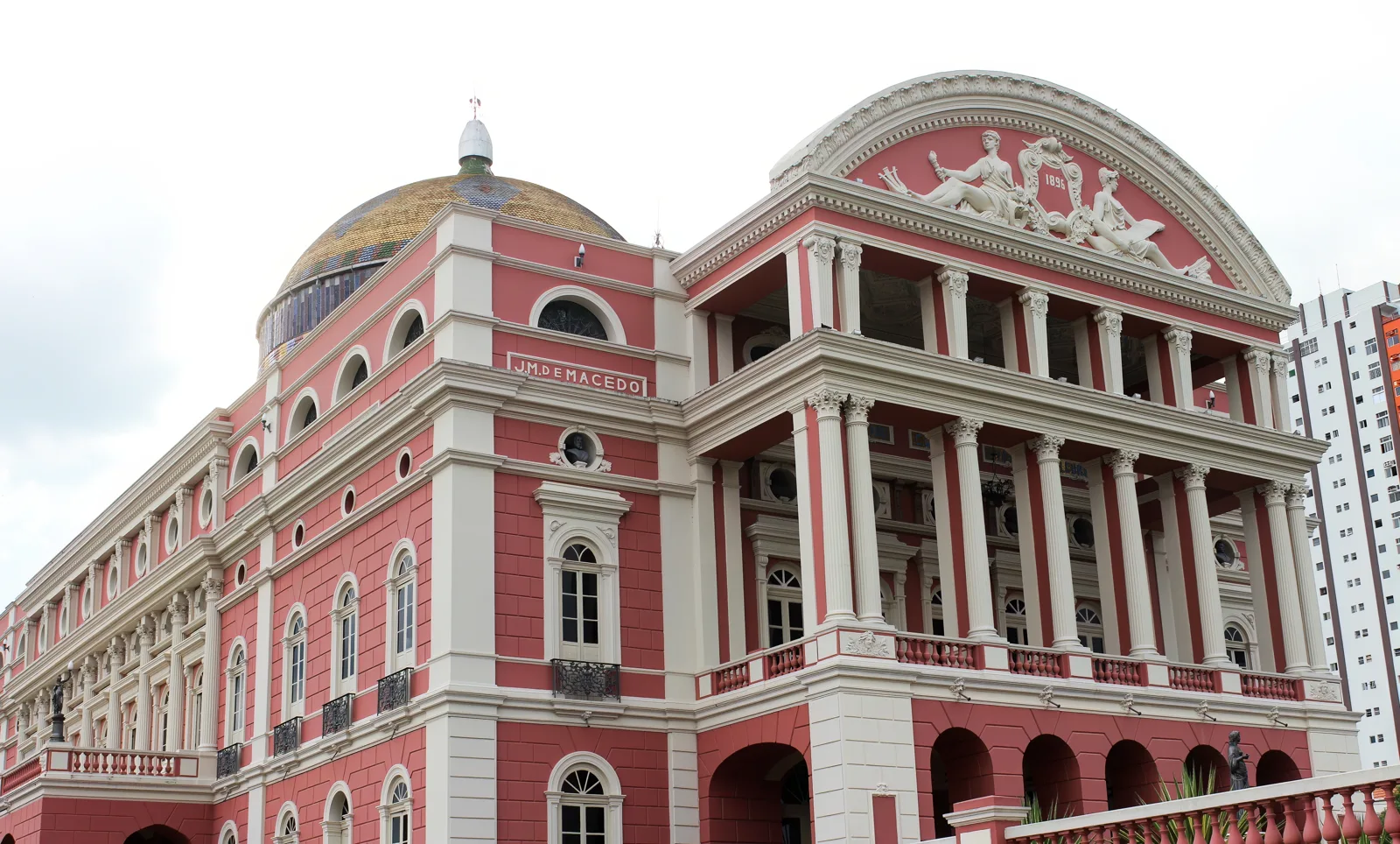
The Teatro Amazonas
The symbol of the city, the Teatro Amazonas is an opera house built during the Belle Époque, when rubber made Manaus rich. The project, proposed as early as 1881, was carried out to the plans of an architecture firm in Lisbon, with construction lasting several years. It hosts the Amazonas Opera Festival every year and is home to the Amazonas Philharmonic Orchestra. Guided tours are offered: check the hours on the official site before going.
The historic center and the Adolpho Lisboa market
On the banks of the Rio Negro, the center preserves several buildings from the rubber era: the Adolpho Lisboa municipal market, founded in 1882 on the model of Les Halles in Paris, where fruit, vegetables and above all fish are sold; the former customs building; the Rio Negro Palace, now a cultural center; and the courthouse. The center is mostly commercial today: visit it by day and follow the general safety advice (no valuables on show, caution at ATMs; use ATMs in secure places such as shopping malls or major hotels, as the State Department advises).
The Meeting of the Waters
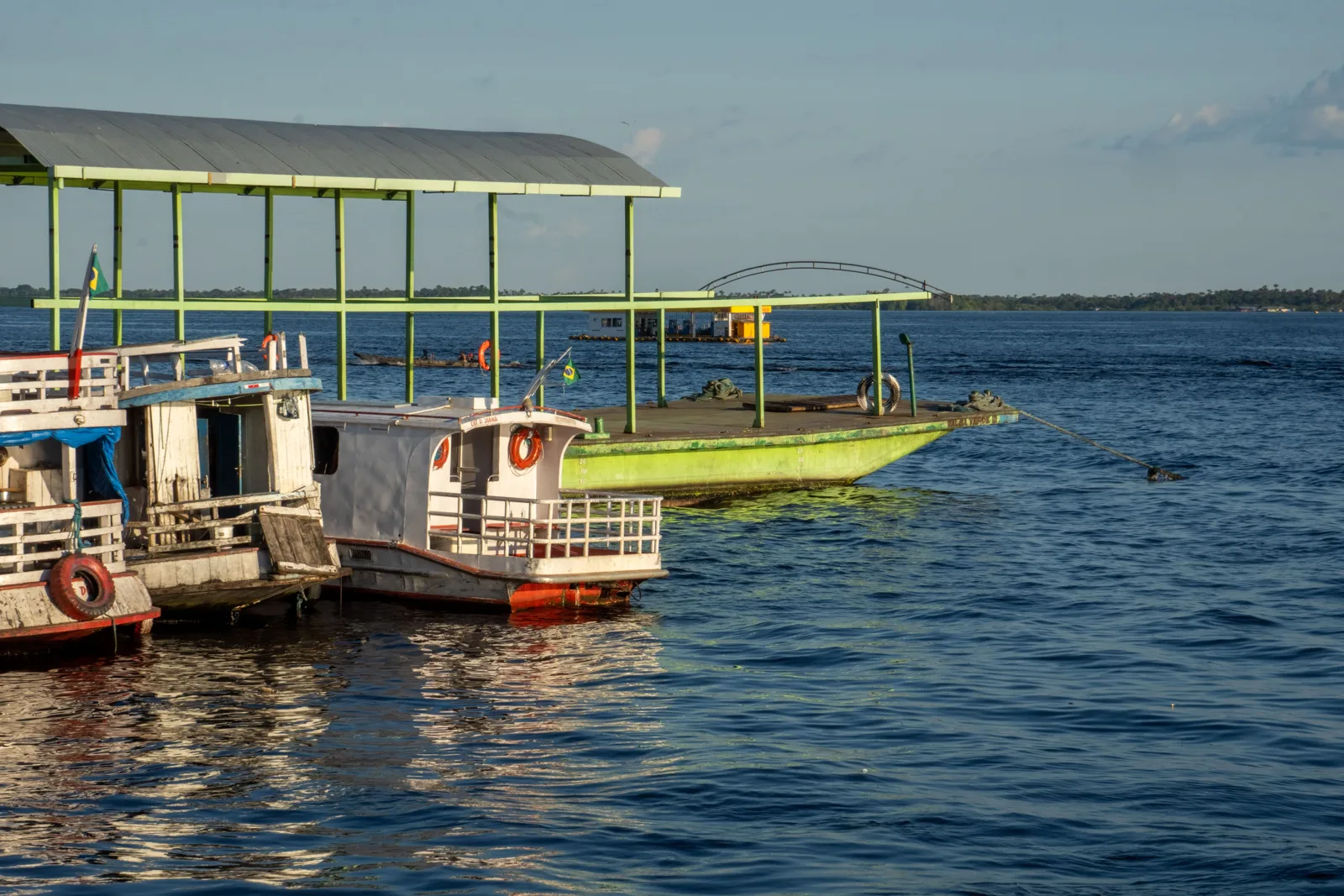
Just east of the city, the black waters of the Rio Negro meet the brown waters of the Solimões: the two rivers flow side by side without mixing for several kilometers before forming the Amazon (according to the Brazilian definition). Excursion boats leave from Manaus to see the phenomenon. It is the simplest outing for a first approach to the river.
Ponta Negra and the urban parks
The Ponta Negra district, to the west, has a beach on the Rio Negro and lively nightlife. For forest without leaving the city, the Bosque da Ciência, run by the National Institute for Amazonian Research (INPA), and the Mindú park preserve areas of native forest.
Lodges, Anavilhanas and the Rio Negro
Around Manaus lie several protected areas: the Adolfo Ducke forest reserve (run by INPA), part of Anavilhanas National Park with its river islands on the Rio Negro, and Rio Negro State Park. Most travelers spend a few nights in a forest lodge or aboard a boat: forest walks, canoe trips along the igarapés (river channels), swimming in calm lakes. Choose a registered operator, ask for the program in writing and check the insurance.
Manaus in three days
- Day 1: historic center, Teatro Amazonas (guided tour), Adolpho Lisboa market, sunset at Ponta Negra.
- Day 2: boat excursion to the Meeting of the Waters, Bosque da Ciência in the afternoon.
- Day 3 and beyond: head to a Rio Negro lodge or the Anavilhanas islands for several nights.
When to go to Manaus: climate month by month
Manaus has an equatorial climate: it is hot all year, and the difference between seasons is mostly about rain. The table gives the official normals and our astronomical daylight calculations.
| Month | Avg. max | Avg. min | Rain | Days with precipitation (at least 1 mm) | Day/night gap | Sunrise / sunset on the 15th | Day length |
|---|---|---|---|---|---|---|---|
| January | 31.3 °C (88 °F) | 23.6 °C (74 °F) | 306 mm (12.0 in) | 18.7 | 7.7 °C (14 °F) | 6:00 am / 6:17 pm | 12 h 17 min |
| February | 31.1 °C (88 °F) | 23.6 °C (74 °F) | 297 mm (11.7 in) | 17.6 | 7.5 °C (14 °F) | 6:07 am / 6:20 pm | 12 h 12 min |
| March | 31.2 °C (88 °F) | 23.7 °C (75 °F) | 321 mm (12.6 in) | 19.0 | 7.5 °C (14 °F) | 6:05 am / 6:12 pm | 12 h 07 min |
| April | 31.3 °C (88 °F) | 23.7 °C (75 °F) | 331 mm (13.0 in) | 17.5 | 7.6 °C (14 °F) | 5:58 am / 6:01 pm | 12 h 02 min |
| May | 31.5 °C (89 °F) | 23.9 °C (75 °F) | 233 mm (9.2 in) | 15.5 | 7.6 °C (14 °F) | 5:57 am / 5:55 pm | 11 h 59 min |
| June | 31.9 °C (89 °F) | 23.8 °C (75 °F) | 117 mm (4.6 in) | 10.4 | 8.1 °C (15 °F) | 6:02 am / 5:58 pm | 11 h 57 min |
| July | 32.5 °C (90 °F) | 23.7 °C (75 °F) | 67 mm (2.6 in) | 6.8 | 8.8 °C (16 °F) | 6:07 am / 6:04 pm | 11 h 57 min |
| August | 33.6 °C (92 °F) | 24.1 °C (75 °F) | 56 mm (2.2 in) | 5.7 | 9.5 °C (17 °F) | 6:04 am / 6:04 pm | 12 h 01 min |
| September | 34.1 °C (93 °F) | 24.5 °C (76 °F) | 79 mm (3.1 in) | 6.1 | 9.6 °C (17 °F) | 5:52 am / 5:57 pm | 12 h 05 min |
| October | 34.0 °C (93 °F) | 24.6 °C (76 °F) | 114 mm (4.5 in) | 8.3 | 9.4 °C (17 °F) | 5:40 am / 5:51 pm | 12 h 10 min |
| November | 33.0 °C (91 °F) | 24.4 °C (76 °F) | 188 mm (7.4 in) | 10.3 | 8.6 °C (15 °F) | 5:36 am / 5:52 pm | 12 h 15 min |
| December | 32.0 °C (90 °F) | 24.0 °C (75 °F) | 254 mm (10.0 in) | 15.3 | 8.0 °C (14 °F) | 5:46 am / 6:04 pm | 12 h 18 min |
Reading the table: April is the wettest month (331 mm (13.0 in) over 17.5 rainy days), August the driest (56 mm (2.2 in) over 5.7 days). The heat follows the opposite pattern: September is the hottest month (34.1 °C (93 °F) average high), with on average 11.2 days at 35 °C (95 °F) or more. Near the equator, the day lasts about 12 hours all year: the sun sets around 6 pm whatever the month.
Rain, sunshine and heat: our cross table
| Month | Rain | Sunshine (hours per month) | Days at 35 °C (95 °F) or more | Our reading |
|---|---|---|---|---|
| January | 306 mm (12.0 in) | 123 | 0.2 | Rainy season |
| February | 297 mm (11.7 in) | 98 | 0.3 | Rainy season, least sunshine |
| March | 321 mm (12.6 in) | 104 | 0.4 | Rainy season |
| April | 331 mm (13.0 in) | 114 | 0.0 | Wettest |
| May | 233 mm (9.2 in) | 142 | 0.0 | End of the heavy rains |
| June | 117 mm (4.6 in) | 191 | 0.0 | Transition, sunshine increasing |
| July | 67 mm (2.6 in) | 223 | 0.6 | Dry and sunny |
| August | 56 mm (2.2 in) | 222 | 6.4 | Driest |
| September | 79 mm (3.1 in) | 196 | 11.2 | Dry, hottest |
| October | 114 mm (4.5 in) | 174 | 10.7 | Dry and very hot |
| November | 188 mm (7.4 in) | 151 | 5.1 | Rains return |
| December | 254 mm (10.0 in) | 127 | 1.8 | Rainy season |
Key points: from July to September, Manaus gets three to five times less rain than in March–April and nearly twice as many hours of sunshine, but the heat is stronger. The FCDO (GOV.UK) notes that forest fires are common from May to September, especially in July and August, because of the dry season: check local alerts. River levels, which determine navigation and canoe access to the flooded forest, also vary with the season: ask your lodge.
Getting to Manaus and getting around
Manaus is served by Eduardo Gomes International Airport, whose terminal 1 handles domestic and international flights. International visitors generally arrive with one or more connections, depending on airlines and seasons: check routes on the airport and airline websites. By road, the city is poorly connected to the rest of the country: the BR-319 to Porto Velho is not passable along its whole length. You can also arrive by boat on the rivers.
Transfers and excursions: how to book
For the airport-to-hotel transfer, follow the FCDO’s advice: do not hail taxis on the street, use authorized taxi booths or book through the official ride-hailing app, and be wary of unregulated drivers posing as app drivers, especially at airports (GOV.UK, updated 29 September 2026). For lodges, cruises and Meeting of the Waters trips, compare booking direct and resellers: exact program, transfers included or not, cancellation terms, the operator’s insurance.
Where to stay in Manaus
The center, near the Teatro Amazonas, is convenient for sightseeing on foot by day. Ponta Negra, more residential, faces the river and its beach. For the forest experience, the most common lodging is the lodge, reached by boat or by road depending on the case. Book a first night in town to recover from the flight.
Entry requirements, health and safety
- US citizens: according to the U.S. Department of State (travel.state.gov, Brazil page last updated August 06, 2026), a visa is required for US citizens to travel to Brazil, regardless of the purpose of travel. You must apply for and be approved for the visa or e-visa before leaving, and you need a valid US passport. The Department rates Brazil Level 2, « Exercise increased caution », because of crime and kidnapping (advisory updated August 30, 2026).
- UK citizens: according to the UK FCDO (GOV.UK, updated 29 September 2026), you can visit Brazil without a visa for up to 90 days for tourism, but your passport must have an expiry date at least 6 months after the date you arrive. Make sure the border officer stamps your passport, or you may be fined when you leave. If you bring in cash or traveller’s cheques worth 10,000 US dollars or more, you must declare it online.
- US and UK rules differ: US citizens need a visa before travel, UK citizens do not. Confirm the current requirements with the Brazilian embassy or consulate before booking.
- River areas: the FCDO advises against all but essential travel along the Amazon River and its tributaries west of Codajás and east of Belém do Solimões, along any part of the Itaquaí and Japurá rivers, and along the Rio Negro north or west of Barcelos, because of criminal activity by armed groups, including pirates and drug traffickers, where police presence is low. Manaus and the lodges close to it are not in those areas, but check before any long expedition on the rivers.
- Crime: the State Department says violent crime occurs in urban areas, day and night, and that express kidnapping at ATMs is an ongoing threat; use ATMs in secure locations such as malls or major hotels. In an attack, do not resist.
- Health: the FCDO lists yellow fever, dengue, chikungunya and oropouche among the health risks in Brazil. The State Department says the yellow fever vaccine is not required to enter Brazil, but some other countries (including Colombia, French Guiana, Suriname, Guyana, Bolivia and Paraguay) require proof of vaccination from travelers who have recently been in Brazil. Check the CDC and TravelHealthPro advice with a clinician at least 8 weeks before your trip.
- Outdoor and river trips: choose a registered operator, and make sure your travel insurance covers adventure activities and medical evacuation (the State Department strongly recommends supplemental insurance for medical evacuation).
- See our travel formalities guide.
Staying connected
Brazil is outside the European Union, so the roaming terms of your home plan may not apply. A data eSIM bought before departure is an alternative; in a lodge, mobile coverage may be absent. See our travel eSIM guide.
If you… then…
| If you… | Then… |
|---|---|
| Want the least rain | Aim for July–August: 56 to 67 mm (2.2 to 2.6 in) a month (INMET normals) |
| Dislike heat | Avoid September–October: 34 °C (93 °F) highs and 11 days at 35 °C (95 °F) or more in September |
| Want to explore the flooded forest by canoe | Ask your lodge about water levels on your dates |
| Come to the Amazon after Rio or Salvador | Fly: the BR-319 road is not passable along its whole length |
| Plan a long expedition on the rivers | Check the FCDO and State Department advice on river areas in western Amazonas |
| Go to an isolated lodge | Yellow fever vaccine, medical advice on malaria, and insurance covering medical evacuation |
Frequently asked questions
What is there to do in Manaus?
Visit the Teatro Amazonas and the historic center, the Adolpho Lisboa market, see the Meeting of the Waters by boat, enjoy Ponta Negra, then spend a few nights in a lodge on the Rio Negro.
What is the best time to go to Manaus?
From July to September for the least rain (56 to 79 mm (2.2 to 3.1 in) a month) and the most sunshine, accepting stronger heat. December to May is the rainy season (more than 230 mm (9.1 in) a month from January to May).
What is the time difference with Manaus?
Manaus is on UTC−4 all year: 4 hours behind London in winter (5 hours during UK summer time) and 1 hour ahead of New York in winter. It is 1 hour behind Rio de Janeiro.
Do you need a visa for Manaus and Brazil?
US citizens need a visa or e-visa before travel (U.S. Department of State, last updated August 06, 2026). UK citizens can visit visa-free for up to 90 days, with a passport valid at least 6 months after arrival (UK FCDO, GOV.UK, updated 29 September 2026).
Do you need a vaccine for Manaus?
The State Department says the yellow fever vaccine is not required to enter Brazil but may be needed for onward travel to some countries; the FCDO lists yellow fever among the health risks. Ask a clinician about vaccines and malaria at least 8 weeks before travel.
Is Manaus dangerous?
The State Department rates Brazil Level 2 because of crime and kidnapping. The FCDO advises against all but essential travel on some river areas in western Amazonas, which do not include Manaus itself. Be careful with ATMs and unlicensed taxis.
Can you drive to Manaus?
Not easily: the BR-319 to Porto Velho is not passable along its whole length. Most visitors arrive by plane, or by boat on the rivers.
Our sources
- U.S. Department of State, Brazil country information (travel.state.gov, last updated August 06, 2026) and Brazil travel advisory (Level 2, updated August 30, 2026), read on 26 October 2026
- UK FCDO, foreign travel advice for Brazil (GOV.UK, updated 29 September 2026), read on 26 October 2026
- World Meteorological Organization, 1991–2020 climate normals, Manaus station (82331), INMET (NOAA/NCEI archive)
- Wikipedia (EN) articles « Manaus », « Teatro Amazonas » and « Eduardo Gomes International Airport »
- Astronomical calculations: NOAA solar algorithm, applied by Destination de Voyage to the coordinates of Manaus (15th of each month, year 2027)
- Our methodology
Updated October 2026.