
Things to do in Zadar? On the northern Dalmatian coast, Zadar occupies a peninsula ringed by Venetian walls. You can visit a Roman forum, the pre-Romanesque Church of St Donatus and the Cathedral of St Anastasia, and above all two contemporary works that have become the city’s symbols: the Sea Organ, which the waves make sing, and the Greeting to the Sun, a glass circle that lights up at nightfall. This guide covers the highlights, day trips (Plitvice, Krka, Kornati), the best time to go based on official normals and the sunset time month by month, calculated for the Sea Organ.

Our travel deals for Zadar
Affiliate links: we earn a commission, at no extra cost to you.
 FlightsKiwi.comCompare flights and airline combinations to Zadar.Compare flights

Zadar at a glance
- Location Northern DalmatiaAbout 160 km (99 mi) north of Split and 285 km (177 mi) from Zagreb
- Language Croatian; English is widely spoken
- Currency euro (since 2023) · currencies
- Time zone UTC+1, UTC+2 in summer (one hour ahead of London, six hours ahead of New York)
- Airports Zadar Airport, served mainly by seasonal flights; Split Airport (about 2 hours by road) has more connections · details
- Entry US and UK citizens: no visa for up to 90 days in any 180-day period (Schengen area) · travel.state.gov · GOV.UK
- Ideal length 2 days for the city, 4 to 5 days with day trips
- Best time May-June and September; July-August for swimming
- Budget see our budget section
Things to do in Zadar: the highlights
The Sea Organ (Morske orgulje)
Designed by architect Nikola Bašić and opened in 2005, the Sea Organ is a flight of white marble steps descending into the sea at the western tip of the peninsula. Under the steps, 35 pipes of different lengths connect to cavities that the waves flow into: the air pushed out produces deep, changing sounds, never the same twice. The sound is louder when the sea is rough or when boats pass. Sitting on the steps, it is the best place to watch the sunset.
The Greeting to the Sun (Pozdrav Suncu)
Right next to it, the same architect installed in 2008 a disk 22 m (72 ft) across made of glass plates and solar panels. It stores energy by day and, after sunset, lights up in a play of colored lights. Children (and adults) love walking on it.
The Roman forum and the Church of St Donatus
The forum, the largest on the eastern Adriatic coast, was founded under Augustus; its paving, fragments of columns and the « pillar of shame », where convicts were chained, remain. Beside it stands St Donatus, a 9th-century pre-Romanesque rotunda built partly with stones from the forum: it is the city’s historic emblem and hosts concerts in summer.
The Cathedral of St Anastasia
The largest cathedral in Dalmatia, in Romanesque style, holds the relics of St Anastasia. Its bell tower, open to visitors, gives the best view over the old town roofs, the sea and the islands.
The Venetian walls and the Land Gate
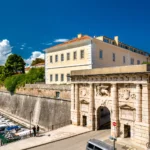
Zadar’s fortifications are part of the « Venetian Works of Defence between the 16th and 17th Centuries », added to the UNESCO World Heritage List in 2017. The Land Gate (Kopnena vrata), decorated with the lion of St Mark, is the finest entrance to the old town. Nearby, the Five Wells Square (Pet bunara) hides old cisterns.
The Museum of Ancient Glass and the Archaeological Museum
The Museum of Ancient Glass displays a rich collection of Roman glassware found in the region. The Archaeological Museum, near the forum, traces the history of northern Dalmatia from prehistory to the Middle Ages.
The market and the barcajoli
The market, at the foot of the walls, sells fruit, vegetables, Pag cheese and fish every morning. To reach the Borik district or the port, the barcajoli, rowing ferrymen, take you across the small harbor in a few minutes, a centuries-old tradition.
Sunset in Zadar: the exact time month by month
Sunset at the Sea Organ is the city’s daily ritual. To help you plan, we calculated the sunset time on the 15th of each month at the tip of the peninsula, its direction on the horizon, and London’s local sunset time for comparison.
| Month | Sunset in Zadar | Sunset direction (azimuth) | Sunset in London (local time) | Day length in Zadar |
|---|---|---|---|---|
| January | 4:46 pm | 240° (WSW) | 4:18 pm | 9 h 15 |
| February | 5:28 pm | 252° (WSW) | 5:13 pm | 10 h 29 |
| March | 6:04 pm | 267° (W) | 6:03 pm | 11 h 53 |
| April | 7:42 pm | 284° (WNW) | 7:55 pm | 13 h 26 |
| May | 8:18 pm | 297° (WNW) | 8:43 pm | 14 h 45 |
| June | 8:44 pm | 303° (WNW) | 9:18 pm | 15 h 29 |
| July | 8:40 pm | 301° (WNW) | 9:12 pm | 15 h 11 |
| August | 8:04 pm | 290° (WNW) | 8:25 pm | 14 h 02 |
| September | 7:10 pm | 274° (W) | 7:17 pm | 12 h 33 |
| October | 6:15 pm | 258° (WSW) | 6:09 pm | 11 h 03 |
| November | 4:32 pm | 244° (WSW) | 4:12 pm | 9 h 39 |
| December | 4:21 pm | 237° (WSW) | 3:51 pm | 8 h 54 |
- Arrive 30 to 45 minutes before the time shown to find a spot on the steps, especially from June to September.
- In June, the sun sets in the west-northwest (about 303°); in December, it goes down in the west-southwest (about 237°): its setting point moves more than 60° along the horizon over the year.
- The Greeting to the Sun lights up once night has fallen: stay half an hour after sunset.
Day trips from Zadar
- Plitvice Lakes: about 2 hours by road; a national park of cascading lakes, the most famous in Croatia. Arrive at opening time in summer, and stay on the marked paths (see the mine warning below).
- Krka National Park: about 1 hour; the Skradinski buk waterfalls, boat access from Skradin.
- Kornati and Telašćica: day boat trips in an archipelago of more than 80 islands, with swimming.
- Paklenica: canyons and hikes in the Velebit range, less than an hour away. Hikers should use marked paths: the UK FCDO notes a risk of getting lost in the mountains on unmarked trails.
- Nin: a small historic town on a lagoon, with sandy beaches and therapeutic mud, about twenty minutes away.
- Pag: a lunar-looking island known for its cheese and lace.
- Ugljan: the island opposite Zadar, a short ferry ride away, for a quiet swim.
- Šibenik and Split: on the road south, see our Split guide.
For sports such as diving or canyoning, choose a recognized operator.
Itinerary: how many days in Zadar?
Zadar in 2 days
- Day 1: Land Gate, Five Wells Square, forum, St Donatus, the cathedral and its bell tower, sunset at the Sea Organ
- Day 2: market in the morning, Museum of Ancient Glass, a swim at Kolovare or Borik, evening on the Riva
Zadar and northern Dalmatia in 5 days
- Days 1-2: Zadar
- Day 3: Plitvice Lakes
- Day 4: Kornati by boat, or Krka
- Day 5: Nin and Pag, or the road to Šibenik and Split
Zadar is a good starting point for a road trip down the coast to Split and then Dubrovnik. For the whole country, see our Croatia travel guide.
When to go to Zadar: climate and best time
The best time to visit Zadar is May to June and September: 21 to 25 °C (70 to 77 °F) in the afternoon, long days, a warming sea and fewer visitors than in midsummer. July and August are the hottest months (28 °C / 83 °F), the driest and sunniest (350 hours of sunshine in July), but also the busiest. From October to December, rain is heavy (more than 95 mm / 3.7 in a month). The table uses the official DHMZ normals.
| Month | High °C (°F) | Low °C (°F) | Rain mm (in) | Rain days | Sunshine (h) | Crowds | Prices | Verdict |
|---|---|---|---|---|---|---|---|---|
| January | 10.8 (51) | 4.3 (40) | 72.6 (2.9) | 10.0 | 115 | Low | Low | ⚠️ Cool, wet, quiet town |
| February | 11.3 (52) | 4.3 (40) | 62.5 (2.5) | 8.5 | 147 | Low | Low | ⚠️ Cool |
| March | 13.6 (56) | 6.3 (43) | 63.5 (2.5) | 8.9 | 186 | Low | Low | ⚠️ Early spring |
| April | 16.6 (62) | 9.3 (49) | 70.0 (2.8) | 10.4 | 207 | Medium | Medium | ⚠️ Mild, frequent rain |
| May | 21.3 (70) | 13.5 (56) | 64.7 (2.5) | 9.5 | 276 | Medium | Medium | ✅ Pleasant, few visitors |
| June | 25.2 (77) | 17.0 (63) | 54.4 (2.1) | 8.2 | 303 | High | High | ✅ Ideal, long days |
| July | 28.2 (83) | 19.3 (67) | 30.4 (1.2) | 5.3 | 350 | Very high | Very high | ✅ Beach, heat, crowds |
| August | 28.2 (83) | 19.3 (67) | 49.6 (2.0) | 5.9 | 322 | Very high | Very high | ✅ Beach, heat, crowds |
| September | 24.3 (76) | 16.0 (61) | 104.0 (4.1) | 8.7 | 246 | High | High | ✅ Warm sea, fewer visitors |
| October | 20.0 (68) | 12.5 (54) | 106.7 (4.2) | 9.8 | 183 | Medium | Medium | ⚠️ Mild but wet |
| November | 15.1 (59) | 8.3 (47) | 105.6 (4.2) | 11.2 | 123 | Low | Low | ❌ Wettest |
| December | 11.9 (53) | 5.5 (42) | 95.2 (3.7) | 10.4 | 108 | Low (Advent) | Low | ⚠️ Cool, Advent market |
Spring (March to May)
Still cool in March (13.6 °C / 57 °F), spring turns pleasant in May (21.3 °C / 70 °F) with 276 hours of sunshine. The sea is still cool for swimming, but the city and national parks are quiet.
Summer (June to August)
Peak season: 25 to 28 °C (77 to 83 °F), little rain (30 mm / 1.2 in in July), a warm sea. Arrive early at the national parks and book accommodation in advance. Wildfires are common in Croatia’s hot, dry summers (UK FCDO).
Autumn (September to November)
September is still summery (24.3 °C / 76 °F), with a warm sea and fewer visitors: an excellent month. It is also when the rain returns, exceeding 100 mm (3.9 in) a month from September to November, often in stormy showers.
Winter (December to February)
Mild for the season (11-12 °C / 52-54 °F in the afternoon), but wet and sometimes windy. Sunsets, around 4:20-4:45 pm, can be enjoyed without crowds. In December, the city holds an Advent market.
For the rest of the country, see when to go to Croatia and, further south, when to go to Dubrovnik. For more ideas, see where to go in June and where to go in September.
Getting to Zadar and getting around
Zadar Airport is mostly served by seasonal European flights; otherwise, Split Airport (about 2 hours by road) has more connections. Zadar Airport is around ten kilometers from the center, linked by a shuttle bus.
- On foot: the pedestrianized old town is explored on foot; the Riva runs along the sea to the Sea Organ.
- Bus: the city network serves Borik and the bus station; buses link Split, Zagreb and Plitvice.
- Ferry: the ferry terminal serves Ugljan and the other islands.
- Car: useful for the national parks; parking near the old town is difficult and paid in summer.
- Organized tours: handy for Plitvice, Krka and Kornati without a car.
Budget for a trip to Zadar
| Item | Tight budget | Comfort |
|---|---|---|
| Accommodation (per person, sharing a double room) | about €30 to €50 | about €70 to €130 |
| Meals | about €20 to €30 | about €40 to €60 |
| Transport | about €3 to €8 | about €10 to €25 |
| Sights and trips | about €10 to €20 | about €30 to €60 |
| Total per day | roughly €60 to €90 | roughly €130 to €220 |
Where to stay in Zadar
- The old town (peninsula): apartments and small hotels, everything on foot, Sea Organ included; little parking.
- Borik and Puntamika: the beach district to the northwest, hotels with a beach, 15-20 minutes by bus from the center.
- Kolovare and Bili Brig: beaches close to the center, to the southeast, apartments at gentler prices.
- Around Zadar (Nin, Petrčane): for a beach stay, with a car.
Entry requirements, health and safety
- US citizens: according to the U.S. Department of State (travel.state.gov, last updated December 11, 2025), you do not need a visa for tourism or business stays of less than 90 days within a 180-day period. Your passport must have at least three months’ validity when you leave Croatia. You must register with the local police within three days of arrival; hotels and vacation rentals do it for you.
- UK citizens: according to the UK FCDO (GOV.UK, updated 11 August 2026), you can travel to the Schengen area, including Croatia, without a visa for up to 90 days in any 180-day period. Your passport must have been issued less than 10 years before you arrive and be valid for at least 3 months after you plan to leave; you may need to show a return or onward ticket. The EU Entry/Exit System (EES) may require you to register your fingerprints and photo at the border.
- Health: health risks include biting insects and ticks (UK FCDO). UK travelers need a GHIC or EHIC for medically necessary state healthcare, but there is always a charge for treatment, up to €530: take out travel insurance.
- Safety: the U.S. Department of State rates Croatia Level 1: Exercise Normal Precautions. Pickpockets operate in tourist areas (UK FCDO); always carry your passport.
- Mines: outside the tourist resorts, beware of unexploded mines in former war-affected areas, including areas around Zadar County and the more remote parts of Plitvice Lakes National Park: do not walk on uncultivated land or step off marked paths (UK FCDO, GOV.UK, updated 11 August 2026).
- Wildfires: they are common in hot, dry summers. Intentionally causing a fire can be fined €2,000 to €20,000 or lead to prison, and you can be fined even for causing one unintentionally; call 112 if you are in immediate danger (UK FCDO).
- Earthquakes: they can be strong in Croatia (UK FCDO).
- Emergencies: 112 (ambulance, fire, police).
- See our travel insurance guide.
Practical tips for Zadar
- Money: euros and cards accepted almost everywhere; keep some change for the barcajoli and markets.
- Swimming: city beaches are mostly pebble or concrete: water shoes are useful.
- Etiquette: dress modestly in churches; walking through town shirtless or in swimwear can be fined in some Croatian town centers (UK FCDO).
- Food: try Pag cheese, pršut (dry-cured ham), grilled fish and maraschino, Zadar’s cherry liqueur.
- Mobile data: check your roaming plan or buy an eSIM before you go.
Frequently asked questions
What time is sunset in Zadar?
According to our astronomical calculation, around 8:40 pm on 15 July, 7:10 pm on 15 September and 4:21 pm on 15 December. Arrive at the Sea Organ 30 to 45 minutes before.
What can you do in Zadar in one day?
The old town (Land Gate, forum, St Donatus, the cathedral and its bell tower), the Museum of Ancient Glass, then the Sea Organ and the Greeting to the Sun at sunset.
When is the best time to go to Zadar?
May-June and September, with 21 to 25 °C (70 to 77 °F) in the afternoon according to DHMZ normals and fewer visitors than in summer. July-August for swimming, with more than 300 hours of sunshine.
How do you get to Zadar?
Zadar Airport is mainly served by seasonal European flights; otherwise, fly into Split, about 2 hours away by road, or take a bus from Zagreb or Split.
Zadar or Split?
Zadar is quieter, with the Sea Organ and easy access to Plitvice, Krka and Kornati. Split has Diocletian’s Palace and more island connections. The two combine well, about 2 hours apart by road.
Do you need a visa to visit Zadar?
No, not for US or UK citizens on a tourist stay of up to 90 days in any 180-day period in the Schengen area. Check passport validity rules and the EU Entry/Exit System before you travel.
Our sources
- Climate normals: 1971-2000 normals for the Zadar (Puntamika) station, published by the Croatian Meteorological and Hydrological Service (DHMZ), via Wikipedia (article « Zadar »)
- U.S. Department of State, Croatia country information (travel.state.gov, last updated December 11, 2025) and Croatia travel advisory (Level 1), read on 26 October 2026
- UK FCDO, foreign travel advice for Croatia (GOV.UK, updated 11 August 2026), read on 26 October 2026
- Wikipedia: « Zadar Airport » (airlines and destinations), checked October 2026
- Astronomical calculations: NOAA solar algorithm (Global Monitoring Laboratory), applied by Destination de Voyage to the coordinates of the Sea Organ and London
- Our methodology
Updated October 2026.
To plan the rest of your trip, see our Croatia travel guide and our other destinations in Europe.