Things to do in Antwerp? Start with the Grote Markt and its town hall, step into the Cathedral of Our Lady for its Rubens paintings, visit the Plantin-Moretus printing house (a World Heritage Site), go up to the roof of the MAS, admire Antwerp Central, one of Europe’s most beautiful stations, and end the day in a café with a local beer. To visit Antwerp, allow 2 days, ideally a weekend. Best time: May to September, but the city can be visited all year round.
Belgium‘s second city and a major European port, Antwerp (Antwerpen in Dutch) is the city of Rubens, diamonds and fashion. This guide brings together the main sights, a 2-day itinerary, budget, neighborhoods and month-by-month climate, with a practical calculation: how many hours of sunshine and rainy days to expect each month.
Our travel deals for Antwerp
Affiliate links: we earn a commission, at no extra cost to you.
FlightsKiwi.comCompare flights and airline combinations to Antwerp.
AirportsBrussels Airport (BRU)then by train to Antwerp Central; Antwerp is also on the high-speed line between Brussels and Amsterdam
EntryUS and UK: no visa for up to 90 days in 180 (Schengen); EES registration at the border · travel.state.gov · GOV.UK
Ideal length2 days, 3 with the museums
Things to do in Antwerp: the main sights
The Grote Markt and the town hall
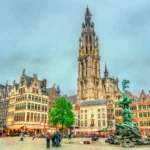
The Grote Markt is lined with gabled guild houses and the 16th-century Renaissance town hall, a UNESCO World Heritage Site. In the middle, the Brabo Fountain illustrates the city’s founding legend: the Roman soldier Brabo is said to have cut off the hand of the giant Antigoon and thrown it into the Scheldt, hence the name Antwerpen (« hand werpen », to throw the hand), according to popular tradition.
The Cathedral of Our Lady
Its 123-metre (404 ft) Gothic spire dominates the old town. The cathedral, the largest Gothic church in the former Low Countries, holds several masterpieces by Peter Paul Rubens, including The Elevation of the Cross and The Descent from the Cross. Visitors pay an entry fee.
The Plantin-Moretus Museum
Set in the home and workshop of the printer Christophe Plantin and his descendants, this 16th- and 17th-century printing house holds the oldest surviving printing presses in the world, a library and an inner courtyard. It is a UNESCO World Heritage Site.
The Rubens House and St. Charles Borromeo Church
The Rubenshuis is the house and studio where the painter lived and worked, with a baroque portico and garden. The site is undergoing major renovation and getting a new visitor centre: check its website for what is open before you go. Nearby, the baroque St. Charles Borromeo Church, on Hendrik Conscienceplein, was decorated with Rubens’s contribution.
Antwerp Central Station and the diamond district
Antwerp Central, with its monumental domed hall, regularly features among the world’s most beautiful stations; even if you arrive by train, step outside to see the facade. It borders the diamond district, home to traders and jewelers, and Antwerp Zoo, opened in 1843, one of the oldest in Europe.
The MAS and the Eilandje district
North of the old town, the former port district of Eilandje has been redeveloped. The MAS (Museum aan de Stroom), a tower of red stone and wavy glass, tells the story of the city, the port and the world; its rooftop panorama walk is free. Nearby, the Red Star Line Museum traces the departure of millions of European emigrants to America from Antwerp’s quays, between the late 19th century and the 1930s.
Het Steen and the Scheldt quays
Het Steen, a small medieval castle on the Scheldt, is the city’s oldest building; it houses a visitor centre and an exhibition on Antwerp’s history. The quays continue as promenades. To reach the left bank, the 1930s St. Anna pedestrian tunnel can be crossed on foot or by bike, with its original wooden escalators.
Art museums and fashion
The KMSKA, the Royal Museum of Fine Arts, reopened in 2022 after a long renovation, shows Flemish Primitives, Rubens, Ensor and modern Belgian art. MoMu, the fashion museum, is a reminder that Antwerp is the city of the « Antwerp Six », designers who graduated from the Royal Academy of Fine Arts in the 1980s; the Sint-Andries district and Nationalestraat are home to designer boutiques. The Meir is the main shopping street.
Zurenborg and Art Nouveau
South-east of the station, the Zurenborg district, around Cogels-Osylei, lines up Art Nouveau, neo-Gothic and eclectic facades from the late 19th century. It makes a free and uncrowded walk.
Beer, fries and chocolate
The city’s signature beer is De Koninck, served in a round glass called a « bolleke ». Brown cafés, fry shops and chocolate makers are part of the visit; the local sweet speciality is the « Antwerp hand » (Antwerpse handjes), a hand-shaped biscuit or chocolate.
Itinerary: Antwerp in 2 days
Day 1, morning: arrive at Central Station, the Meir, the Rubens House (depending on works) and St. Charles Borromeo Church
Day 1, afternoon: Grote Markt, Cathedral of Our Lady, Plantin-Moretus Museum, Het Steen and the Scheldt quays at sunset
Day 2, morning: Eilandje, the MAS and its panoramic view, the Red Star Line Museum
Day 2, afternoon: the KMSKA, the Zuid district or Zurenborg, then the fashion district boutiques
Day 3 (optional): more museums, the zoo, or a train trip to Ghent, Bruges or Amsterdam
When to go to Antwerp
The best time to visit Antwerp is from May to September, with highs of 19 to 24 °C (66 to 75 °F) and 7 hours of sunshine a day on average from May to August. It rains all year round, with no dry season: about 10 to 11 days a month in summer, up to 14 in December. April is the driest month (43 mm / 1.7 in). Winter is mild but grey (under 2 hours of sunshine a day in December), which suits a museums-and-cafés trip; the Christmas market livens up the city in December.
Month
High °C (°F)
Low °C (°F)
Precip. mm (in)
Sun / day
Rainy days / 7 days
Verdict
January
6.8 (44)
1.3 (34)
70 (2.8)
2.0 h
2.8
⚠️ Grey, museums and cafés
February
7.7 (46)
1.2 (34)
63 (2.5)
2.8 h
2.9
⚠️ Cold and grey, few crowds
March
11.2 (52)
3.0 (37)
54 (2.1)
4.4 h
2.4
⚠️ Cool, lengthening days
April
15.3 (60)
5.2 (41)
43 (1.7)
6.4 h
2.1
✅ Driest month
May
18.9 (66)
9.1 (48)
60 (2.4)
7.1 h
2.2
✅ Mild and sunny
June
21.6 (71)
12.2 (54)
77 (3.0)
7.3 h
2.4
✅ Long days, terraces
July
23.6 (75)
14.2 (58)
82 (3.2)
7.3 h
2.4
✅ Warmest month
August
23.6 (75)
13.7 (57)
84 (3.3)
6.8 h
2.4
✅ Warm, sunny
September
20.1 (68)
10.8 (51)
76 (3.0)
5.5 h
2.4
✅ Mild, fewer crowds
October
15.4 (60)
7.6 (46)
73 (2.9)
3.8 h
2.5
⚠️ Cool, autumn
November
10.5 (51)
4.4 (40)
81 (3.2)
2.2 h
3.0
⚠️ Rainy and grey
December
7.2 (45)
2.0 (36)
91 (3.6)
1.6 h
3.2
⚠️ Grey, Christmas market
Temperature, precipitation and sunshine: 1991-2020 normals from the Royal Meteorological Institute of Belgium (RMI/IRM), Antwerp station. Sun per day and rainy days over 7 days: Destination de Voyage calculation (RMI monthly sunshine hours and number of days with precipitation, divided by the number of days in the month, scaled to 1 day and 7 days).
A weekend in Antwerp: what to expect
Over a 2-day stay, you can expect on average about 15 hours of sunshine in July, against 3 in December. And over a week, the normals give between 2.1 rainy days (April) and 3.2 (December): a folding umbrella is useful all year. See our packing list.
Accommodation: hostels and budget hotels for a tight budget, central hotels for more comfort.
Meals: fries, sandwich shops and the dish of the day keep costs down.
Transport: trams and bike-share are enough; the centre is walkable.
Activities: the MAS rooftop and several walks (Zurenborg, St. Anna tunnel, the quays) are free; museums charge admission.
Getting there and getting around Antwerp
By train: Antwerp Central is linked to Brussels, where Brussels-Midi is the Eurostar terminal, and to Amsterdam by international trains.
On foot: the old town, the station and Eilandje are all walkable.
Tram: the De Lijn network serves the city, with underground lines (premetro) from the station.
Bike: Antwerp has a bike-share scheme, handy along the quays.
By car: Antwerp has a low emission zone; according to the UK FCDO (GOV.UK, updated 17 October 2026), foreign vehicles must be pre-registered on the city’s website.
Where to stay in Antwerp
Neighborhood
Best for
Highlights
Old town (around the Grote Markt)
First visit
Everything on foot, cafés and restaurants
Central Station
Arriving by train, tight budget
Convenient, many hotels
Eilandje
Harbour atmosphere
Near the MAS, a new and quiet district
Zuid (south)
Museums, nightlife
Near the KMSKA, restaurants and galleries
At weekends and during major trade fairs, book ahead.
Entry requirements, health and safety
US citizens: Belgium is in the Schengen area. According to the U.S. Department of State (travel.state.gov, last updated July 30, 2026), your passport should be valid for at least three months beyond your stay, and you will need sufficient proof of funds and a return ticket. Belgium does not recognize the 12-page U.S. emergency passport for visa-free entry.
UK citizens: according to the UK FCDO (GOV.UK, updated 17 October 2026), you can travel to the Schengen area, including Belgium, without a visa for up to 90 days in any 180-day period. Your passport must have been issued less than 10 years before you arrive and be valid for at least 3 months after the day you plan to leave. You may have to register your fingerprints and photo under the EU Entry/Exit System (EES).
Terrorism: according to the UK FCDO (GOV.UK, updated 17 October 2026), terrorists are likely to try to carry out attacks in Belgium; the national threat level is 3 (« Serious »), so expect an increased police presence.
Pickpockets: theft and pickpocketing are common in crowded areas, especially in major railway stations and on public transport (UK FCDO).
Laws: you must carry your passport at all times (UK FCDO).
Health: UK travelers need a GHIC or EHIC for medically necessary state healthcare (UK FCDO); the U.S. Department of State notes that US health insurance is generally not accepted and recommends insurance covering medical evacuation.
Emergencies: 112; police 101 (U.S. Department of State).
Entry requirements checked on 26 October 2026; check them again before you travel. Consider travel insurance for assistance and repatriation. For customs allowances on your return, check your home country’s rules (e.g. CBP in the US, HMRC in the UK).
Practical tips for Antwerp
Language: Antwerp is in Flanders, where the language is Dutch; English is widely understood and often better received than French.
Payment: cards are accepted almost everywhere, including contactless.
Museums: many are closed on Mondays; check opening hours on their websites.
Mobile data: check your carrier’s roaming charges for Belgium, or consider an eSIM data plan.
Combining: Antwerp is linked by train to Brussels and Ghent.
Frequently asked questions
How many days do you need in Antwerp?
Two days are enough for the highlights; three to add the museums (KMSKA, Red Star Line, MoMu) or a day trip.
How do you get to Antwerp?
By train: Antwerp Central is linked to Brussels (including Brussels Airport and the Eurostar terminal at Brussels-Midi) and to Amsterdam.
What is the best time to visit Antwerp?
May to September for mild weather and sunshine (about 7 hours a day from May to August); April is the driest month.
What language is spoken in Antwerp?
Dutch. English and French are often understood in tourist settings.
Do US and UK citizens need a visa for Antwerp?
No, for tourist stays of up to 90 days in any 180-day period in the Schengen area, according to the U.S. Department of State and the UK FCDO; check passport validity rules before you travel.
Antwerp or Bruges: which to choose?
Bruges charms with its compact medieval centre; Antwerp is a lively big city with more museums, fashion and the port. The two combine easily by train.
Our sources
Royal Meteorological Institute of Belgium (RMI/IRM): 1991-2020 normals, Antwerp station, via the climate table of the Wikipedia article « Antwerp »
Destination de Voyage calculation: hours of sunshine per day and rainy days over 7 days based on RMI normals


 FlightsKiwi.comCompare flights and airline combinations to Antwerp.Compare flights