Looking for things to do in Ottawa? Tour Parliament Hill and, in summer, watch the Changing of the Guard; follow the Rideau Canal (a UNESCO World Heritage Site); wander through the ByWard Market; discover the National Gallery of Canada and, across the river, the Canadian Museum of History in Gatineau. In winter, the canal becomes a giant skating rink when the ice allows. To visit Ottawa, allow 2 to 3 days. Best time: June to September, or February for winter.
The capital of Canada, Ottawa is in Ontario, on the Ottawa River, which separates it from Gatineau, in Quebec: a bilingual city between Montreal and Toronto. This guide covers the highlights, an itinerary, the budget, the neighborhoods and the climate month by month, with a calculation most guides do not give: how much snow to expect over a one-week stay.
Our travel deals for Ottawa
Affiliate links: we earn a commission, at no extra cost to you.
FlightsKiwi.comCompare flights and airline combinations to Ottawa.
Time zoneEastern Time, UTC−5 (UTC−4 in summer): same time as New York, 5 h behind London · detailsLocal time now: –:–
AirportsOttawa Macdonald–Cartier International (YOW) · detailsmany international travelers connect via Toronto or Montreal
EntryUS: no visa under 180 days, no eTA; UK: no visa for short visits, eTA (CA$7) if flying in · US: travel.state.gov · UK: GOV.UK
Ideal length2 to 3 days
Things to do in Ottawa: the highlights
Parliament Hill
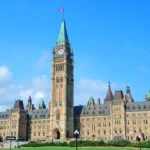
The Gothic Revival Parliament buildings tower over the Ottawa River. Centre Block, with the Peace Tower, is undergoing a long-term renovation: parliamentary debates are held elsewhere during the work, and free guided tours take place in the buildings open to the public (booking recommended on the Parliament website). In summer, the Changing of the Guard takes place on the lawn, and a sound and light show is projected onto the buildings on some evenings: check the year’s schedule.
The Rideau Canal
Opened in 1832, the Rideau Canal links Ottawa and Kingston and has been a UNESCO World Heritage Site since 2007. Downtown, the flight of locks next to Parliament is still operated by hand. In summer, you can follow it on foot, by bike or by boat; in winter, when the ice is thick enough, part of the canal becomes a rink, the Rideau Canal Skateway. Opening dates depend entirely on the weather and vary every year.
The ByWard Market
The ByWard Market district, one of the oldest in the city, brings together produce stalls, restaurants, pubs and shops. It is also the place to try BeaverTails, flat sweet pastries that are a Canadian specialty.
The National Gallery of Canada
In a glass building designed by Moshe Safdie, the National Gallery presents a large collection of Canadian and Indigenous art, including the Group of Seven painters, and European works. In front of the entrance, Louise Bourgeois’s giant spider “Maman” is one of the most photographed sculptures in the city. The gallery faces Notre-Dame Cathedral Basilica.
The Canadian Museum of History (Gatineau)
Across the bridge in Gatineau, this museum with curves designed by architect Douglas Cardinal tells the story of the country and of First Nations. Its Grand Hall displays totem poles from the West Coast, and its windows look out over Parliament Hill.
Other national museums
Ottawa has several national museums: the Canadian War Museum, the Canadian Museum of Nature (dinosaurs, minerals), the Canada Aviation and Space Museum and the Canada Science and Technology Museum. The Royal Canadian Mint, near the ByWard Market, offers tours of its facility.
Gatineau Park
Close to downtown, on the Gatineau side, Gatineau Park has hiking trails, lakes for swimming and canoeing in summer, and cross-country ski trails in winter. Its lookouts (including the Champlain Lookout) are known for fall colors.
Festivals
Ottawa revolves around its major events: Winterlude in February (January 29 to February 15, 2027, according to Canadian Heritage, canada.ca, checked 26 October 2026; ice sculptures and snow slides in Ottawa and Gatineau), the Canadian Tulip Festival in spring, a legacy of the bulbs given by the Netherlands after World War II, and Canada Day on July 1, with celebrations in the city. Check each year’s dates on the official websites.
Itinerary: Ottawa in 2 or 3 days
Day 1: Parliament Hill (guided tour, Changing of the Guard in summer), Rideau Canal locks, ByWard Market, National Gallery of Canada
Day 2: Canadian Museum of History in Gatineau, a walk along the Ottawa River, Canadian War Museum; the show on Parliament in the evening in summer
Day 3: Gatineau Park (hiking, fall colors or cross-country skiing), or the Royal Canadian Mint and the Museum of Nature; in winter, skating on the canal if the Skateway is open
The best time to visit Ottawa is June to September: highs of 24 to 27 °C (75 to 81 °F) in June-July, long days and festivals. Fall (late September-October) is superb for the colors of Gatineau Park. Winter is harsh: in January, the average high is −5.5 °C (22 °F) and the low −14.3 °C (6 °F), with about 232 cm (91 in) of snow a year. For winter lovers, February combines Winterlude and, if the cold allows, skating on the Rideau Canal. Precipitation is steady all year (50 to 100 mm, or 2.0 to 3.9 in, a month), with no dry season.
Month
Max
Min
Precip.
Snow
Snow over 7 days
Precip. days / 7 days
Verdict
January
-5.5 °C (22 °F)
-14.3 °C (6 °F)
70 mm (2.8 in)
59 cm (23.2 in)
13 cm (5.1 in)
3.8
⚠️ Very cold, snow
February
-3.6 °C (26 °F)
-13.2 °C (8 °F)
50 mm (2.0 in)
48 cm (18.9 in)
12 cm (4.7 in)
3.2
✅ Winterlude, skating (ice permitting)
March
2.4 °C (36 °F)
-7.1 °C (19 °F)
66 mm (2.6 in)
39 cm (15.4 in)
9 cm (3.5 in)
2.8
⚠️ Cold, snowmelt
April
11.3 °C (52 °F)
0.5 °C (33 °F)
81 mm (3.2 in)
12 cm (4.7 in)
3 cm (1.2 in)
2.8
⚠️ Cool, transition
May
19.6 °C (67 °F)
7.5 °C (46 °F)
75 mm (3.0 in)
—
—
3.0
✅ Tulips, mild
June
24.4 °C (76 °F)
12.9 °C (55 °F)
97 mm (3.8 in)
—
—
3.2
✅ Mild, long days
July
27.0 °C (81 °F)
15.4 °C (60 °F)
88 mm (3.5 in)
—
—
2.7
✅ Warmest, Canada Day
August
25.8 °C (78 °F)
14.3 °C (58 °F)
79 mm (3.1 in)
—
—
2.5
✅ Warm, festivals
September
21.0 °C (70 °F)
9.6 °C (49 °F)
90 mm (3.5 in)
—
—
2.9
✅ Mild, fall colors
October
13.0 °C (55 °F)
3.4 °C (38 °F)
87 mm (3.4 in)
3 cm (1.2 in)
1 cm (0.4 in)
3.2
✅ Fall colors, cool
November
5.8 °C (42 °F)
-2.4 °C (28 °F)
74 mm (2.9 in)
21 cm (8.3 in)
5 cm (2.0 in)
3.4
⚠️ Gray and cold
December
-1.9 °C (29 °F)
-9.6 °C (15 °F)
72 mm (2.8 in)
50 cm (19.7 in)
11 cm (4.3 in)
3.8
⚠️ Cold, snow, holidays
Temperatures, precipitation and snow: Canadian Climate Normals 1991-2020 from Environment and Climate Change Canada, Ottawa International Airport station. Snow and precipitation days over 7 days: Destination de Voyage calculation (monthly normals scaled to a 7-day stay). Precipitation includes rain and the water equivalent of snow.
A winter week in Ottawa: what to expect
Over a one-week stay in January, the normals give about 13 cm (5.1 in) of snow and 3.8 days with precipitation; in February, about 12 cm (4.7 in). The daily mean stays below freezing from December to March (−9.9 °C, or 14 °F, in January). In practice, layers, a warm coat, hat, gloves and waterproof shoes with non-slip soles are essential; see what to pack. If you drive, the UK FCDO (GOV.UK, updated 2 June 2026) advises taking care in winter storms, following local guidance and making sure your vehicle has snow tires and emergency supplies.
Month
Day length in Ottawa
Sunset in Ottawa
January
9 h 07
16:45
February
10 h 25
17:29
March
11 h 53
19:08
April
13 h 31
19:48
May
14 h 54
20:26
June
15 h 39
20:52
July
15 h 19
20:48
August
14 h 07
20:10
September
12 h 33
19:14
October
10 h 59
18:17
November
9 h 31
16:32
December
8 h 44
16:20
Destination de Voyage calculation: day length and sunset on the 15th of each month in 2026 (NOAA solar algorithm, Ottawa local time, daylight saving included). Ottawa lies further south than London, so its winter days are longer and its summer days shorter.
We do not publish unverified figures: compare prices when you book. Tipping is expected in restaurants.
Getting around Ottawa
From the airport: OC Transpo public transit, taxis or ride-hailing apps; flights to Ottawa vary by airline and season, and many international travelers connect via Toronto or Montreal.
On foot: Parliament, the ByWard Market, the National Gallery and the canal are close together, and Gatineau is on the other bank of the Ottawa River, reached by several bridges.
Public transit: OC Transpo (buses, O-Train light rail) in Ottawa, STO in Gatineau.
Bike: many paths follow the canal and the river in the warmer months.
In winter: drive carefully; the UK FCDO notes that highways are often closed by snowstorms and that vehicles should have snow tires and emergency supplies.
Where to stay in Ottawa
Area
Best for
Highlights
Downtown (near Parliament)
First visit
Main sights within walking distance
ByWard Market
Nightlife
Restaurants, bars, lively evenings
The Glebe
Peace and quiet
Residential area by the canal, cafés and shops
Gatineau (Hull)
Budget, French-speaking
Facing Parliament, near the Museum of History
Book early for Canada Day (July 1) and Winterlude.
Entry requirements, health and safety
US citizens: according to the U.S. Department of State (travel.state.gov, last updated August 11, 2025), US citizens do not need a tourist visa to visit Canada for less than 180 days. You can enter with a valid US passport, passport card or NEXUS card, but if you fly back into the US from Canada you must show a US passport book or another approved document. The Government of Canada (IRCC eTA page, modified 23 April 2024) confirms that US citizens do not need an eTA but must carry proper identification.
UK citizens: according to the UK FCDO (GOV.UK, updated 2 June 2026), you do not need a visa for short visits (normally up to 6 months), but you may need an Electronic Travel Authorization (eTA) instead; it is not required if you arrive by land or sea. Your passport must be valid for the length of your stay, and border officials may ask for a return or onward ticket and proof of sufficient funds. According to IRCC, the eTA is needed to fly to Canada, costs CA$7 on the official site and is valid for up to five years or until your passport expires; GOV.UK warns that unofficial websites charge more.
Weather risks: the main risks are winter-related (extreme cold, snow, ice); the UK FCDO also notes a wildfire risk in forested areas of Ontario and Quebec in summer.
Emergencies: dial 911 for ambulance, fire and police (UK FCDO).
Insurance: the UK FCDO warns that medical treatment can be very expensive; make sure your travel insurance covers medical care. See our travel insurance guide.
Practical tips for Ottawa
Language: federal services are bilingual; on the Gatineau side, French is the everyday language.
Payment: cards, including contactless, are accepted almost everywhere.
Tipping: expected in restaurants.
Mobile data: check your home carrier’s roaming charges; see our eSIM guide.
Museums: some national museums offer free or reduced-price time slots; check their websites.
Frequently asked questions
How many days do you need to visit Ottawa?
Two days for the essentials (Parliament, the canal, the ByWard Market, museums), three with Gatineau Park.
What is the best time to visit Ottawa?
June to September for mild weather and festivals; late September-October for fall colors; February for Winterlude.
Is Ottawa very cold in winter?
Yes: in January, the average low is −14.3 °C (6 °F) and the high −5.5 °C (22 °F), according to Environment Canada normals.
Can you skate on the Rideau Canal?
Yes, in winter, when the ice is thick enough. Opening dates vary every year depending on the weather.
Do you need a visa to visit Ottawa?
US citizens need neither a visa nor an eTA for stays under 180 days. UK citizens need no visa for short visits but need an eTA (CA$7) to fly to Canada (GOV.UK, IRCC).
Is French spoken in Ottawa?
Ottawa is mainly English-speaking but very bilingual; Gatineau, just across the river, is French-speaking.
Environment and Climate Change Canada: Canadian Climate Normals 1991-2020, Ottawa International Airport station, via the Wikipedia climate table (“Ottawa Airport weatherbox” template)
Destination de Voyage calculation: snow and precipitation days over 7 days, day length and sunset in Ottawa (NOAA solar algorithm)
Canadian Heritage (canada.ca): Winterlude 2027 dates, checked 26 October 2026


 FlightsKiwi.comCompare flights and airline combinations to Ottawa.Compare flights