Montreal occupies an island in the St. Lawrence, at the foot of Mount Royal, which gave it its name. Quebec’s largest city combines cobbled Old Montreal, residential neighborhoods with their typical outdoor staircases, skyscrapers and an intense cultural life, in French and in English. This guide covers the things to do in Montreal, neighborhood by neighborhood, and helps you choose day trips for a 3 to 5 day stay.
Our travel deals for Montreal
Affiliate links: we earn a commission, at no extra cost to you.
FlightsKiwi.comCompare flights and airline combinations to Montreal.
Airport: Montreal-Trudeau (YUL), linked to downtown by bus route 747, which runs 24/7 (Montréal-Trudeau Airport, checked 26 October 2026)
Ideal length: 3 to 4 days, plus 2 or 3 days for Quebec City or the Laurentians
Best time: June to September; late September to mid-October for fall colors
Time zone: UTC−5 (one hour later in summer), same time as New York, 5 h behind London
Entry: US citizens need no visa or eTA; UK citizens need an eTA to fly in (GOV.UK, IRCC)
Currency: the Canadian dollar
Language: French, Quebec’s official language; English is widely spoken
Indicative budget: roughly CA$140 to 235 per person per day on a budget, CA$315 to 550 in comfort
Things to do in Montreal: the highlights
Old Montreal and Notre-Dame Basilica
The historic district, by the river, has the city’s oldest buildings: cobbled streets, stone warehouses, Place Jacques-Cartier and City Hall. The neo-Gothic Notre-Dame Basilica impresses with its blue and gold interior; admission is charged. The Pointe-à-Callière museum, built on archaeological remains, tells the story of the city’s founding. The district is best explored on foot, ideally on a weekday or early in the morning in summer.
The Old Port
Along the St. Lawrence, the old docks have been turned into a promenade: bike paths, a Ferris wheel, the Science Centre, river cruise boats and, in winter, an outdoor skating rink. It also hosts several festivals, such as Igloofest in January and February. The Clock Tower offers a view of the Jacques-Cartier Bridge.
Mount Royal
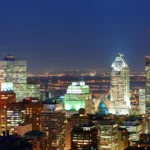
Mount Royal Park, designed by Frederick Law Olmsted, the landscape architect of Central Park, is the city’s green lung. You can walk up from downtown or the Plateau to the Kondiaronk lookout, which overlooks the skyscrapers. On summer Sundays, the « Tam-Tams » gather musicians and strollers at the foot of the George-Étienne Cartier monument. In winter, Beaver Lake becomes a skating rink, and trails are open for snowshoeing and cross-country skiing. On the north slope, Saint Joseph’s Oratory is one of the largest shrines in the country.
The Plateau-Mont-Royal and Mile End
These residential neighborhoods are quintessential Montreal: brick houses, wrought-iron outdoor staircases, green alleys, cafés and independent shops. Stroll along Avenue du Mont-Royal, Rue Saint-Denis and Boulevard Saint-Laurent, known as « the Main ». Mile End is known for its wood-fired bagels, the Plateau for its restaurants and La Fontaine Park.
Downtown, the Quartier des Spectacles and the underground city
Modern downtown stretches around Rue Sainte-Catherine, the main shopping street. The Quartier des Spectacles brings together concert halls, theaters and public squares where the major festivals are held. The Montreal Museum of Fine Arts and the Museum of Contemporary Art are close by. Below the streets, the underground pedestrian network (RÉSO) links metro stations, malls and office buildings: invaluable in winter.
Olympic Park, the Biodôme and the Botanical Garden
To the east, the 1976 Olympic Stadium and its leaning tower dominate a group of sites known as Space for Life: the Biodôme, which recreates several ecosystems of the Americas, the Planetarium, the Insectarium and the Botanical Garden, one of the largest in the world, with its Chinese and Japanese gardens. Allow a full day, ideal with children.
Markets, the Lachine Canal and Parc Jean-Drapeau
Jean-Talon Market, in Little Italy, and Atwater Market, by the Lachine Canal, sell Quebec produce, cheeses and maple products. The Lachine Canal can be followed by bike for several miles, including on BIXI bike-share bikes. On the islands in the river, Parc Jean-Drapeau has the Biosphère, the Circuit Gilles-Villeneuve and the Île Notre-Dame beach.
Day trips from Montreal
Quebec City, about three hours away by road or train, is best visited over two days. The Laurentians and the Mont-Tremblant resort, to the north, are a top destination for fall colors and skiing. The Eastern Townships, to the southeast, offer villages, vineyards and lakes. All the details are in our Quebec guide.
Montreal’s neighborhoods
Old Montreal: charm and character hotels, but quiet in the evening outside summer and fairly expensive
Downtown: convenient, well served by the metro, many chain hotels
Latin Quarter and Quartier des Spectacles: at the heart of the festivals, lively and sometimes noisy
Plateau-Mont-Royal: neighborhood feel, restaurants and cafés, many private rentals
Mile End and Little Italy: quieter, close to Jean-Talon Market
Griffintown and Saint-Henri: former industrial districts revitalized along the Lachine Canal
Itinerary: 3 to 5 days in Montreal
Day 1: Old Montreal, Notre-Dame Basilica, Pointe-à-Callière and the Old Port; dinner in Old Montreal
Day 2: up Mount Royal to the Kondiaronk lookout, down to the Plateau and Mile End; bagels and terraces
Day 3: Olympic Park, the Biodôme and the Botanical Garden, then Jean-Talon Market
Day 4: downtown, the Museum of Fine Arts, the Quartier des Spectacles; a bike ride along the Lachine Canal and Atwater Market
Day 5: Parc Jean-Drapeau, a fall trip to the Laurentians, or on to Quebec City
With only two days, focus on Old Montreal, Mount Royal and the Plateau. With a week, add two nights in Quebec City.
Where to stay in Montreal
For a first visit, downtown and the area around the Quartier des Spectacles are the most convenient: everything is within walking distance or a few metro stops. Old Montreal appeals with its historic setting, with pricier boutique hotels. The Plateau suits travelers who want to live like locals, among cafés and parks. In winter, staying near a metro station or the underground network makes getting around easier.
Options range from hostels to chain hotels, boutique hotels and apartments. Short-term private rentals are regulated in Quebec: check that the listing displays a registration number. During the major festivals and the Grand Prix, book several months ahead.
Getting around Montreal
Metro: run by the STM, fast and heated, serving downtown, Old Montreal, the Plateau, Olympic Park and Parc Jean-Drapeau.
Bus: a dense network; route 747 links Montreal-Trudeau Airport with downtown 24 hours a day, 7 days a week.
On foot: downtown, Old Montreal and the Plateau are easy to walk in the warmer months; in winter, watch out for ice.
Bike: the BIXI bike-share network and the bike paths are widely used from spring to fall.
Train: VIA Rail links Central Station with Quebec City, Ottawa and Toronto.
Car: unnecessary in the city, where parking is expensive and signage complex; Montreal has strict parking laws and may fine you for unlocked doors or visible valuables (U.S. Department of State). Handy for the Laurentians and the Eastern Townships.
The STM’s 24-hour pass covers the bus and metro in Zone A, including route 747 to the airport, according to the STM fares page (checked 26 October 2026); multi-day passes are also sold. Check current fares on the STM website.
When to go to Montreal
✓ Ideal~ Good, with caveats✕ AvoidAverage max. temperature · click a month to see where to go
✅ Best months: June, July, August, September, October
❌ Period to avoid: April, November
The best time is June to September: 21 to 27 °C (70 to 81 °F) in the afternoon and a packed festival season, according to Environment and Climate Change Canada normals. Late September and the first half of October are ideal for fall colors. Winter is very cold (-5 °C / 23 °F in the afternoon in January) but offers a different experience of the city. Month-by-month climate and events: our article on the best time to visit Montreal. These contrasts between blazing fall and icy winter apply across the country, hence the value of knowing the best time to visit Canada.
Who is Montreal for?
Here is our view by profile, based on the stops, budget and conditions presented in this Montreal guide.
Profile
Our view
Culture and festivals
✅ Museums, the Quartier des Spectacles and many festivals, in French and English.
Families
✅ Biodôme, Planetarium, Insectarium and Botanical Garden: an ideal day with children.
Couples
✅ Old Montreal and its boutique hotels, Plateau terraces, the Mount Royal lookout.
Budget travelers
⚠️ Roughly CA$140 to 235 a day; taxes added to displayed prices and tips expected.
Outdoors
✅ Mount Royal, cycling along the Lachine Canal, the Laurentians for fall colors.
Winter
⚠️ Very cold (-5 °C / 23 °F in the afternoon in January), but skating rinks, snowshoeing and the underground city.
Budget for a stay in Montreal
Remember that sales taxes are added to displayed prices and that tips are expected in restaurants, bars and taxis. Indicative amounts per person per day, excluding flights, converted from our euro estimates at the European Central Bank rate of 23 October 2026 (€1 = CA$1.57) and rounded:
Item
Budget
Comfort
Accommodation (sharing a double room)
about CA$65 to 110
about CA$155 to 315
Meals (tip included)
about CA$45 to 70
about CA$95 to 155
Transport (metro, bus, BIXI)
about CA$10 to 15
about CA$15 to 40
Sightseeing
about CA$15 to 40
about CA$45 to 80
Total per day
roughly CA$140 to 235
roughly CA$315 to 550
Indicative estimates, varying with the season and the exchange rate. Accommodation prices peak in summer and during the major festivals.
To save money: enjoy the many free festival shows, picnic with produce from the markets, choose « bring your own wine » restaurants, a Montreal tradition, and buy a multi-day transit pass.
Entry requirements, health and safety
US citizens: according to the U.S. Department of State (travel.state.gov, last updated August 11, 2025), no tourist visa is needed for stays under 180 days. You can enter with a US passport, passport card or NEXUS card, but flying back to the US requires a passport book or another approved document. US citizens are exempt from the eTA (IRCC, eTA facts page, modified 23 April 2024).
UK citizens: according to the UK FCDO (GOV.UK, updated 2 June 2026), no visa is needed for short visits (normally up to 6 months), but you need an eTA to fly in: CA$7 on the official Government of Canada site, valid for up to five years or until your passport expires (IRCC). Unofficial websites charge more. Your passport must be valid for the length of your stay.
Cannabis: legal in Canada, but taking it across the border is illegal (GOV.UK, travel.state.gov).
Health: treatment is very expensive and the public system does not offer free care to non-Canadians; emergency room waits can be long for non-urgent issues (travel.state.gov). Insurance covering medical costs and evacuation is essential. In Quebec, some healthcare professionals may only speak French.
Safety: petty theft occurs, and thieves often target parked cars in big cities: leave nothing in the car (travel.state.gov, GOV.UK).
Winter: winter storms are frequent from November to April (GOV.UK). Dress in layers and watch out for icy sidewalks.
Emergencies: dial 911.
Practical tips for Montreal
Language: French is the official language, with Quebec expressions (« dépanneur » for a convenience store, « déjeuner » for breakfast, « dîner » for lunch). English is widely spoken.
Money: cards are accepted almost everywhere, even for small amounts. Tipping is expected in restaurants.
Taxes: prices displayed in shops and restaurants exclude taxes: the federal and Quebec sales taxes are added at the till.
Internet: check whether your mobile plan covers Canada; an eSIM or international plan avoids surprises.
Etiquette: lining up at bus stops, giving way to pedestrians and not smoking near entrances are local customs.
Three days cover the essentials: Old Montreal, Mount Royal, the Plateau and downtown. Allow four to five days to add Olympic Park, the Botanical Garden, the markets and a day trip.
How do you get from the airport to downtown Montreal?
Bus route 747 links Montreal-Trudeau Airport with downtown 24 hours a day, 7 days a week; the STM 24-hour pass is valid on it. Taxis are also available.
Do you need a visa or an eTA for Montreal?
US citizens need neither a visa nor an eTA for stays under 180 days. UK citizens need no visa for short visits but need an eTA (CA$7) to fly to Canada (GOV.UK, IRCC).
Is Montreal safe?
Yes, overall. Petty theft occurs, especially from parked cars: do not leave valuables in a vehicle, and watch your belongings in busy places.
Do you need to speak French in Montreal?
No. French is Quebec’s official language and the language of most Montrealers, but English is very present, especially in the western part of downtown.
What can you do in Montreal for free?
Walk up to the Kondiaronk lookout on Mount Royal, wander Old Montreal and the Old Port, follow the Lachine Canal, browse the Jean-Talon and Atwater markets. The Cité Mémoire trail, projected onto the walls of Old Montreal and accompanied by an app, is free and open all year.
Which museums should you visit in Montreal?
The Museum of Fine Arts, Pointe-à-Callière (archaeology and city history), the McCord Museum, the Museum of Contemporary Art and Château Ramezay. Space for Life includes the Biodôme and the Botanical Garden, useful when it is cold.
What can you do in Montreal in winter?
Visit museums, get around through the underground city, go skating and enjoy the February festivals. Highs stay below freezing from December to February: see the best time to visit Montreal before booking.
Our sources
U.S. Department of State, Canada country information (travel.state.gov, last updated August 11, 2025), read on 26 October 2026
Government of Canada (IRCC): eTA facts, page modified 23 April 2024
Montréal-Trudeau Airport (ADM), FAQ « What is the 747 line and where does it operate? », and STM, « 24-hr, All modes A » fare page, checked 26 October 2026
Montreal climate normals: 1991-2020 normals for the Montreal-Trudeau station, Environment and Climate Change Canada (via the Wikipedia climate box)
Bonjour Québec, « Montréal en histoires – Cité Mémoire », consulted on 5 October 2026
European Central Bank: euro reference rates of 23 October 2026 (budget conversion)


 FlightsKiwi.comCompare flights and airline combinations to Montreal.Compare flights