Canada, the second-largest country in the world, is shared between cosmopolitan cities, a French-speaking province, mountains with turquoise lakes and vast wilderness. It is an easy destination with good infrastructure, but the distances mean you need to choose your region carefully. This Canada travel guide brings together the essentials: what to see, what to do, which itinerary to follow and what budget to plan.
To locate towns, regions, terrain, national parks and airports, see our map of Canada.
Canada at a glance
CapitalOttawa
LanguagesEnglish and French (official languages)French is the majority language in Quebec
Time zoneUTC−5 in Montreal, Quebec City and Toronto, UTC−7 in Calgary, UTC−8 in Vancouver (one hour later in summer) · detailsEastern Canada is on the same time as New York, 5 h behind London
EntryUS: no visa under 180 days, no eTA; UK: no visa for short visits, eTA (CA$7) if flying in · travel.state.gov · GOV.UK
Electricitycheck voltage and plug types before you leave · plugs
Budgetroughly CA$125–190 per person per day on a budget · details
When to go to Canada
The best period runs from June to September: pleasant temperatures, long days and fully accessible national parks. September is a good compromise between weather and crowds, and late September opens the fall colors season in Quebec and Ontario, which usually lasts until mid-October. Winter, from December to March, is very cold in the East but ideal for skiing, winter carnivals and the northern lights in the Far North. April and November are the least interesting months. The U.S. Department of State (travel.state.gov, last updated August 11, 2025) notes that wildfires are common, especially in western Canada, with the most active period from May to September. All the details, month by month and with official climate data, are in our article best time to visit Canada.
What to see in Canada: the highlights
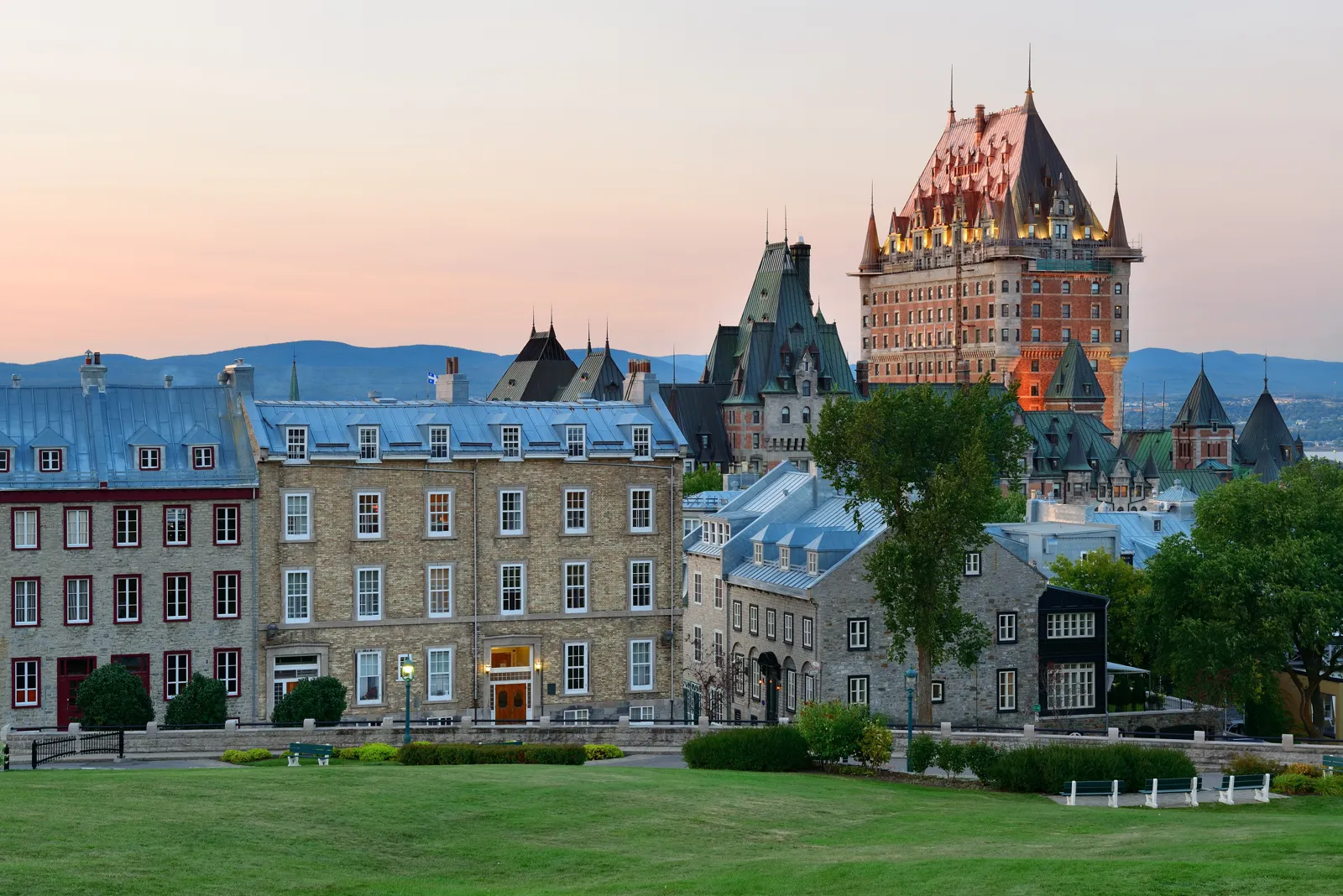
The Château Frontenac and Old Quebec at sunset
Montreal
The country’s second city and a French-speaking metropolis, Montreal is best explored neighborhood by neighborhood: Old Montreal and Notre-Dame Basilica, the Plateau-Mont-Royal and its outdoor staircases, the Jean-Talon Market, and Mount Royal Park overlooking the city. Summer is a season of festivals; in winter, much of downtown is linked by an underground pedestrian network. Food-wise, it is the place to try poutine (fries, cheese curds and gravy) and Montreal bagels. Underground network in winter, festivals in summer: when to go to Montreal completely changes your experience of the city.
Quebec City
The provincial capital, Quebec City is the only fortified city north of Mexico, and its historic district is a World Heritage Site. Wander between the Upper Town, dominated by the Château Frontenac, and the Lower Town around Place Royale. A few kilometers away, Montmorency Falls, higher than Niagara Falls, and Île d’Orléans, with its farms and orchards, make good day trips.
From Toronto, the most popular day trip is to Niagara Falls: our guide covers official tickets, entry requirements and climate.
Charlevoix, Tadoussac and the Saguenay Fjord
Northeast of Quebec City, the Charlevoix region alternates villages, mountains and views of the St. Lawrence. Further on, Tadoussac, at the mouth of the Saguenay Fjord, is one of the best places to watch whales from the shore or by boat, usually from June to October. The fjord can be explored by road, by kayak or on foot.
Toronto and Niagara Falls
The country’s largest city, Toronto stretches along Lake Ontario. Go up the CN Tower, stroll through the Distillery District and St. Lawrence Market, and take a short ferry ride to the Toronto Islands. Niagara Falls is about 130 km (81 mi) away, an easy day trip; the boat cruise at the foot of the falls and the small town of Niagara-on-the-Lake, surrounded by vineyards, round off the visit. Before or after the falls, our Toronto travel guide covers neighborhoods, sights and when to go.
Ottawa
The federal capital is calmer than Montreal or Toronto and can be seen in a day or two: Parliament Hill, the big national museums, the ByWard Market. The Rideau Canal, a World Heritage Site, can be followed by bike in summer; in winter, part of it turns into a skating rink.
The Rockies: Banff, Lake Louise and Jasper
About 1 h 30 by road from Calgary, Banff National Park, the oldest in the country, gathers famous landscapes: Lake Louise, Moraine Lake, snowy peaks and many hiking trails. The Icefields Parkway, about 230 km (143 mi) long, links Lake Louise to Jasper past glaciers and lakes. Jasper National Park, wilder, is known for its wildlife. Access to some sites, such as Moraine Lake, is regulated in high season: check with Parks Canada before you go. GOV.UK (updated 2 June 2026) notes that altitude sickness is a risk in the Rockies around Banff and Lake Louise, and advises particular care in areas where bears have been seen.
Vancouver, Vancouver Island and Whistler
Between ocean and mountains, Vancouver is easy to explore on foot or by bike: Stanley Park and its seawall, Granville Island and its market, the historic Gastown district. The ferry takes about 1 h 30 to Vancouver Island, home to Victoria, the capital of British Columbia, and Tofino, on the west coast, known for its beaches, surfing and whale watching. Ferry to Victoria, Tofino on the west coast: the best time to visit Vancouver also depends on these trips.
About two hours from Vancouver along the scenic Sea-to-Sky Highway, Whistler hosted part of the 2010 Winter Olympics. Its two mountains, Whistler and Blackcomb, form one of the largest ski areas in North America. In summer, the resort turns to mountain biking, hiking and lakes.
Yellowknife and the Far North
The capital of the Northwest Territories, Yellowknife is one of the best-known bases for seeing the northern lights, from late August to April. Winter is extreme (an average high of −21.6 °C, or −7 °F, in January): local operators provide gear and night outings away from the city lights.
Things to do in Canada: 8 experiences not to miss
To sum up what to see and do in Canada on a first trip, here are the experiences that most often make for a successful itinerary:
Stroll through Old Montreal and climb Mount Royal
Discover the old fortified city of Quebec, Montmorency Falls and Île d’Orléans
Watch whales in Tadoussac, from June to October
See Niagara Falls from Toronto
Hike around Lake Louise and Moraine Lake, then drive the Icefields Parkway between Banff and Jasper
Take the ferry to Vancouver Island
Look for the northern lights in the Far North, around Yellowknife, in winter
Taste maple taffy at a sugar shack in spring, or ski in winter (see our ideas for cheap ski trips)
Itinerary ideas and road trips in Canada
Most of these itineraries work as road trips: a car remains the most practical option outside the big cities (see « Getting around » below). Plan reasonable stages, download offline maps and book accommodation and ferries early in summer. Our tips for planning a multi-stop trip fully apply to Canada.
10 days: Eastern Canada
Days 1 to 3: Montreal (Old Montreal, Mount Royal, neighborhoods and markets)
Days 4 to 6: Quebec City, with half a day at Montmorency Falls and Île d’Orléans
Days 7 and 8: Charlevoix and Tadoussac (whale watching from June to October)
Days 9 and 10: back to Montreal along the St. Lawrence; alternative: Ottawa, Toronto and Niagara instead of Charlevoix
2 weeks: Western Canada
Days 1 and 2: arrival in Calgary, drive to Banff
Days 3 to 5: Banff, Lake Louise, Moraine Lake and Yoho National Park
Days 6 and 7: the Icefields Parkway, then Jasper
Days 8 and 9: drive to Vancouver, with a stop in the interior of British Columbia
Days 10 to 12: Vancouver, then Whistler via the Sea-to-Sky Highway
Days 13 and 14: Vancouver Island (Victoria or Tofino), flight home from Vancouver
With three weeks, you can combine East and West by linking Toronto or Montreal to Calgary or Vancouver with a domestic flight.
Budget for a trip to Canada
Canada is an expensive destination, especially in summer and in the national parks. Car rental, often essential in the West, weighs heavily on the budget. Indicative amounts per person per day, excluding international flights:
Item
Budget
Comfort
Accommodation (shared double room)
roughly CA$55–95 (hostel, campground, motel)
roughly CA$140–280
Meals
roughly CA$40–65
roughly CA$80–125
Transport
roughly CA$15–30 (public transit, buses)
roughly CA$45–80 (shared car rental, gas)
Activities and sights
roughly CA$15–30
roughly CA$45–95
Total per day
roughly CA$125–190
roughly CA$280–470
Indicative estimates, varying by season and region. Tips at restaurants come on top of the bill.
To cut costs: travel in June or September rather than July–August, book national park accommodation early and plan picnics, as supermarkets are much cheaper than restaurants.
Getting around Canada
Car: the most practical option outside the big cities, especially in the Rockies and the Gaspé Peninsula. Distances are long: allow about 3 hours by road between Montreal and Quebec City. According to the U.S. Department of State (travel.state.gov, last updated August 11, 2025), US driver’s licenses are valid for visitors, proof of auto insurance is required (US insurance is accepted), some provinces require snow tires, some road signs in Quebec are only in French, and radar detectors are illegal in Quebec, Ontario, Manitoba, Yukon and the Northwest Territories. According to the UK FCDO (GOV.UK, updated 2 June 2026), licence rules vary by province and you may need an International Driving Permit; rental companies may also require one. Winter storms and wildfires can close highways suddenly.
Train: VIA Rail serves the Quebec City – Montreal – Ottawa – Toronto corridor, a good alternative to the car in the East. The transcontinental train between Toronto and Vancouver is a journey in itself, over several days.
Plane: essential for crossing the country. A Montreal or Toronto – Vancouver flight replaces several days on the road.
Bus: lines link the big cities, but service is limited in rural areas and the parks.
Ferry: needed to reach Vancouver Island; in summer, book your crossing if you are traveling by car.
In town: subways in Montreal, Toronto and Vancouver, bus networks everywhere, bike sharing in several cities.
Where to stay in Canada
In Montreal, Old Montreal and downtown are convenient for a first visit, the Plateau-Mont-Royal more residential. In Quebec City, stay in or near Old Quebec to do everything on foot. In Toronto, downtown near the main subway line saves long journeys. In the Rockies, choice is limited in Banff, Lake Louise and Jasper: accommodation sells out fast in summer, and Canmore, at the entrance to Banff National Park, is often a cheaper alternative.
The range is wide: youth hostels, roadside motels, B&Bs and guesthouses, cabins, national park campgrounds (to book well in advance) and hotels of all categories. In summer, book several months ahead in the parks and on Vancouver Island.
Entry requirements for Canada
US citizens
According to the U.S. Department of State (travel.state.gov, last updated August 11, 2025), US citizens do not need a tourist visa to visit Canada for less than 180 days; longer visits generally require a visa. You can enter with a valid US passport, passport card or NEXUS card, but if you fly back into the US from Canada you must show a US passport book or another approved document. The Government of Canada (IRCC, eTA facts page, modified 23 April 2024) confirms that US citizens are exempt from the eTA but must carry proper identification. Recreational cannabis is legal in Canada but cannot be taken across the border.
UK citizens
According to the UK FCDO (GOV.UK foreign travel advice, updated 2 June 2026), you do not need a visa for short visits (normally up to 6 months), but you may need an Electronic Travel Authorization (eTA) instead; you do not need one if arriving by land or sea. Your passport must be valid for the length of your stay. Border officials may ask for a return or onward ticket and proof of sufficient funds, even if you are staying with family or friends. Banned food products are confiscated, and visits to farms must be declared. According to the Government of Canada (IRCC, eTA facts page, modified 23 April 2024), the eTA applies to air travel, costs CA$7 on the official site and is valid for up to five years or until your passport expires, whichever comes first; GOV.UK warns that unofficial websites charge more.
Entry requirements checked on 24 October 2026; check them again before you travel.
Health and safety
Health: GOV.UK (updated 2 June 2026) lists biting insects and ticks, and mpox, among health risks; check vaccine recommendations at least 8 weeks before your trip. Wear covering clothes in wooded and grassy areas and check for ticks.
Medical care: treatment can be very expensive, with no special arrangements for British visitors (GOV.UK). Travel.state.gov notes that the public system does not offer free treatment to non-Canadians, that emergency room waits can be very long for non-urgent issues, and strongly recommends medical evacuation insurance. A travel insurance policy covering medical costs and repatriation is essential.
Nature: wildfires are a particular risk in summer in western Canada and in forested areas of Quebec, Ontario and Nova Scotia; avalanches occur in the mountains of Alberta and British Columbia, and winter storms are frequent from November to April (GOV.UK). When hiking, follow Parks Canada’s rules on bears and wildlife.
Safety: petty theft occurs, and thieves often target parked cars in big cities and tourist spots: do not leave anything in the car (travel.state.gov; GOV.UK). Illegal drugs carry severe penalties, and taking cannabis across the border without a Health Canada permit is illegal (GOV.UK).
Emergencies: 911 for all emergencies, according to GOV.UK and travel.state.gov.
Practical tips for Canada
Money: the Canadian dollar. Our currency converter helps you estimate your spending.
Tipping: in restaurants it is customary to leave around 15 to 20% of the pre-tax amount; people also tip in bars, taxis and for guides.
Internet: mobile coverage is good in cities but disappears on long stretches of road in the parks and the North: download offline maps. Check your provider’s roaming terms or consider an eSIM or local SIM.
Language: in Quebec, French is the everyday language; elsewhere, English dominates. In Quebec, travel.state.gov notes that some healthcare professionals may only speak French.
Weather: in the mountains as in the East, the weather changes fast: bring warm layers even in summer and, in winter, gear for extreme cold (hat, gloves, insulated boots).
Insects: in the forest, from late spring to early summer, mosquitoes and black flies can be numerous: bring repellent and covering clothes.
Customs: check your home country’s customs allowances for the return (e.g. CBP in the US, HMRC in the UK).
Food: beyond poutine, try maple products (syrup, and maple taffy on snow at sugar shacks in spring), Pacific salmon, lobster and seafood from the Atlantic provinces, and Quebec tourtière (meat pie).
Who is Canada for?
Our verdict, profile by profile, based on the information in this guide:
Profile
Our verdict
Nature and hiking
Ideal: Banff, Lake Louise, the Icefields Parkway and Jasper.
Road trips
Ideal: the car is the most practical option outside the big cities, East and West.
A taste of French culture
Yes: Quebec City and Montreal, where French is the everyday language.
Families
Yes: whales in Tadoussac from June to October, Niagara Falls, parks and good infrastructure.
Winter
Yes, for enthusiasts: skiing in Whistler, northern lights around Yellowknife, with extreme cold.
Budget travelers
Not ideal: roughly CA$125–190 per day on a budget; travel in June or September and book early in the parks.
US citizens need neither a visa (for stays under 180 days) nor an eTA, only proper ID such as a US passport (travel.state.gov, last updated August 11, 2025; IRCC). British citizens do not need a visa for short visits but need an eTA when flying in: it costs CA$7 on the official Government of Canada site and is valid up to five years or until the passport expires (GOV.UK, updated 2 June 2026; IRCC). Checked on 24 October 2026.
How much does two weeks in Canada cost?
Excluding the international flight, allow roughly CA$125–190 per person per day on a budget and CA$280–470 in comfort. July–August and the national parks push up the bill, as does car rental.
What is the best time to visit Canada?
June to September for most trips, with September as the best compromise. Late September to mid-October for fall colors in the East, and December to March for skiing and the northern lights.
Is it better to visit Eastern or Western Canada?
For a first 10-day trip, choose one region. The East (Montreal, Quebec City, Toronto, Niagara) mixes cities and nature, with a French-speaking side in Quebec. The West (the Rockies, Vancouver) is more about mountains and big landscapes, and is mostly explored by car.
Is French spoken everywhere in Canada?
No. French is the majority language in Quebec and is present in some regions, notably New Brunswick and eastern Ontario. Elsewhere, English dominates, although federal services are offered in both official languages.
What should you see in Canada on a first trip?
For a first trip, focus on one region: in the East, Montreal, Quebec City, Charlevoix and Tadoussac, Toronto and Niagara Falls; in the West, the Rockies (Banff, Lake Louise, Jasper), then Vancouver and its island. Allow about 10 days for the East and two weeks for the West.
Our sources
Entry, safety, health and driving information read on 24 October 2026: U.S. Department of State, Canada country information (travel.state.gov, last updated August 11, 2025), and UK FCDO, foreign travel advice for Canada (GOV.UK, updated 2 June 2026)
Transparency: this page contains affiliate links, labelled as such. If you book through them we may earn a commission at no extra cost to you; it does not influence our content or recommendations. How we fund the site.