Quebec is Canada’s only majority French-speaking province. A trip there combines two very different cities, Montreal and Quebec City, with nature regions you can reach by car: Charlevoix, the Saguenay Fjord, the Gaspé Peninsula and the Laurentians. This Quebec travel guide helps you choose your stops, your season and your budget.
Our travel deals for Quebec
Affiliate links: we earn a commission, at no extra cost to you.
FlightsKiwi.comCompare flights and airline combinations to Quebec.
Arrival: Montreal-Trudeau Airport (YUL); check current routes with the airlines
Language: French, the province’s official language; some road signs are only in French (U.S. Department of State)
Ideal length: 10 days for Montreal, Quebec City and Charlevoix; 2 to 3 weeks with the Gaspé Peninsula
Best time: June to mid-October; December to March for winter and skiing
Time zone: UTC−5 (one hour later in summer), same time as New York, 5 h behind London
Entry: US citizens need no visa or eTA; UK citizens need an eTA to fly in (GOV.UK, IRCC)
What to see in Quebec: the highlights
Montreal
Canada’s second city is best explored neighborhood by neighborhood. Old Montreal has Notre-Dame Basilica, Place Jacques-Cartier and the Old Port. The Plateau-Mont-Royal and Mile End, with their outdoor staircases and cafés, show the residential city. Mount Royal Park offers a view of downtown from the Kondiaronk lookout. Add the Jean-Talon Market, the Botanical Garden and the Olympic Park. Summer is punctuated by festivals, including the Montreal International Jazz Festival, usually in late June-early July. Summer festivals or fall colors: the best time to visit Montreal depends on what you want from the city.
Quebec City
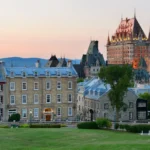
The provincial capital, Quebec City, is the only fortified city north of Mexico, and its historic district is a World Heritage Site. The Upper Town, around the Château Frontenac and Dufferin Terrace, overlooks the Lower Town, with Place Royale and Rue du Petit-Champlain. The Plains of Abraham and the Citadel complete the visit. Two or three days are enough for the city itself; add a day for the surroundings. For another major, more English-speaking Canadian city, our guide to things to do in Toronto covers neighborhoods, sights and Niagara Falls.
Montmorency Falls and Île d’Orléans
About fifteen minutes’ drive from central Quebec City, Montmorency Falls are higher than Niagara Falls. A cable car, stairways and a suspension bridge let you see them from several angles. Just opposite, Île d’Orléans can be explored by car or bike: farms, orchards, vineyards, sugar shacks and old villages.
Charlevoix
Between Quebec City and Tadoussac, the Charlevoix region follows the north shore of the St. Lawrence, between mountains and villages such as Baie-Saint-Paul and La Malbaie. Hautes-Gorges-de-la-Rivière-Malbaie National Park offers hikes and boat trips at the bottom of a deep valley. The road between Baie-Saint-Paul and La Malbaie has fine views of the river, and Île aux Coudres is reached by ferry.
Tadoussac and the Saguenay Fjord
Tadoussac, at the mouth of the Saguenay Fjord, is one of the best places for whale watching, usually from June to October: rorquals, St. Lawrence belugas and, some years, blue whales. Trips go out by boat, Zodiac or kayak, and some species can be seen from the shore. The fjord can then be explored by road, by kayak or on the trails of Fjord-du-Saguenay National Park.
The Gaspé Peninsula
The Gaspé Peninsula takes time: allow a long day’s drive from Montreal to reach it, and a loop of at least a week. The highlights are Gaspésie National Park and its Chic-Choc peaks, Forillon National Park at the tip of the peninsula, Percé Rock and Bonaventure Island, home to a very large northern gannet colony in summer. The tourist season is short: June to September.
Mont-Tremblant and the Laurentians
About 1.5 to 2 hours’ drive north of Montreal, Mont-Tremblant is the best-known mountain resort in eastern Canada. In winter, people come for downhill skiing; in summer and fall, for hiking, cycling and the lakes. The pedestrian village at the foot of the slopes is very developed; for a more natural setting, neighboring Mont-Tremblant National Park offers lakes, trails and canoe camping. It is also a classic trip for fall colors.
Quebec’s national parks
Quebec has many provincial national parks run by Sépaq, in addition to federal parks. Near Quebec City, Jacques-Cartier National Park is ideal for hiking and canoeing in a glacial valley. Admission to these parks is charged; campsites and cabins are booked well in advance for summer.
Itinerary suggestions for Quebec
10 days: Montreal, Quebec City, Charlevoix and the whales
Days 1 to 3: Montreal (Old Montreal, Mount Royal, the Plateau, markets)
Day 4: drive to Quebec City (about 3 hours), or a detour via Mont-Tremblant if you have an extra day
Days 5 and 6: Quebec City, Montmorency Falls and Île d’Orléans
Days 7 and 8: Charlevoix (Baie-Saint-Paul, Hautes-Gorges), then Tadoussac
Day 9: whale watching and the Saguenay Fjord
Day 10: back to Montreal
2 to 3 weeks: the grand loop with the Gaspé Peninsula
Days 1 to 6: Montreal and Quebec City, as above
Days 7 and 8: Charlevoix and Tadoussac
Day 9: ferry to the south shore of the St. Lawrence, drive to the Gaspé Peninsula
Days 10 to 14: Gaspésie National Park, Forillon, Percé and Bonaventure Island
Days 15 to 17: back via Chaleur Bay and the Matapédia Valley, then Montreal
Winter version: Montreal, Quebec City during Carnival and Mont-Tremblant for skiing
When to go to Quebec
Quebec has a continental climate: warm, fairly humid summers and long, cold, snowy winters. Each season has its appeal, but they do not all suit the same trip.
Month
Montreal
Quebec City
Verdict
January
-5.0 (23) / -13.5 (8)
-7.1 (19) / -16.7 (2)
⚠️ Bitter cold: skiing and winter activities
April
11.3 (52) / 1.1 (34)
8.3 (47) / -1.2 (30)
❌ Snowmelt, sugar shacks
June
24.2 (76) / 13.8 (57)
22.5 (73) / 10.8 (51)
✅ Long days, whales return
July
26.7 (80) / 16.7 (62)
25.0 (77) / 13.9 (57)
✅ Warmest, high season
September
21.1 (70) / 10.9 (52)
19.1 (66) / 8.3 (47)
✅ Best compromise
October
13.2 (56) / 4.5 (40)
11.3 (52) / 2.4 (36)
✅ Fall colors in the first half
Average high / low temperatures in °C (°F): 1991-2020 normals from Environment and Climate Change Canada (Montreal-Trudeau and Québec-Jean-Lesage stations).
Summer (June to August)
The easiest season: roads, parks, ferries and excursions are all running, and the days are very long. It is warm in the cities (26.7 °C / 80 °F in the afternoon in July in Montreal, 25 °C / 77 °F in Quebec City). It is also the season of festivals, Quebec’s national holiday on June 24 and local vacations, with high prices. In the forest, mosquitoes and black flies are numerous in early summer. Wildfires are a particular risk in forested areas of Quebec in summer: follow local warnings (GOV.UK).
Fall (September to mid-October)
September still brings 21 °C (70 °F) in the afternoon in Montreal, with fewer people. Fall colors usually peak between late September and mid-October, earlier in the north and at altitude: the Laurentians, Mont-Tremblant, Charlevoix and the national parks are then very busy at weekends. Dates vary each year with the weather.
Winter (December to March)
In Quebec City, the average January high is -7.1 °C (19 °F) and the low -16.7 °C (2 °F). If you are properly equipped, it is the season for skiing (Mont-Tremblant, Mont-Sainte-Anne), snowshoeing, dog sledding and the Quebec Winter Carnival (February 5 to 14, 2027, according to carnaval.qc.ca, checked 26 October 2026). Driving calls for caution: winter storms are frequent from November to April (GOV.UK), and some provinces require snow tires (U.S. Department of State).
Spring (April-May)
The least interesting season for scenery: melting snow and gray vegetation in April. Its highlight is sugaring-off season, in March-April, with traditional meals in sugar shacks. Prices are low. For month-by-month details, see our article on the best time to visit Canada.
Where to stay in Quebec
Area
Best for
Type of accommodation
Old Montreal, downtown
First visit, everything on foot
Hotels, apartments
Plateau-Mont-Royal (Montreal)
Neighborhood feel, restaurants
B&Bs, apartments
Old Quebec
Exploring the city on foot
Historic hotels, B&Bs
Baie-Saint-Paul, La Malbaie
Charlevoix, hiking
Inns, B&Bs
Tadoussac
Whales, the fjord
Inns, motels, campgrounds
Mont-Tremblant
Skiing, lakes, fall colors
Village hotels, chalets
Gaspé Peninsula
Road trip
Motels, B&Bs, park campgrounds
In summer and during the fall color season, book early in Tadoussac, the Gaspé Peninsula and the parks, where supply is limited.
Getting around Quebec
Car: essential for Charlevoix, the Saguenay and the Gaspé Peninsula. Allow about 3 hours’ drive between Montreal and Quebec City. US driver’s licenses are valid for visitors, with proof of auto insurance (U.S. Department of State); UK drivers may need an international driving permit, and rental companies often have stricter requirements (GOV.UK). Some road signs in Quebec are only in French.
Train: VIA Rail links Montreal and Quebec City, a good option if you are only visiting the two cities.
Bus: routes link the main cities, but service becomes sparse in the regions.
Ferries: several ferries cross the St. Lawrence and the Saguenay, including at Tadoussac.
In the cities: metro and buses in Montreal, a bus network in Quebec City; both historic centers are walkable.
Budget for a trip to Quebec
Accommodation and restaurants are the main expenses, especially in summer. Indicative amounts per person per day, excluding international flights, converted from our euro estimates at the European Central Bank rate of 23 October 2026 (€1 = CA$1.57) and rounded:
Item
Budget
Comfort
Accommodation (sharing a double room)
about CA$55 to 95 (hostel, campground, motel)
about CA$125 to 250
Meals
about CA$40 to 65
about CA$80 to 125
Transport
about CA$15 to 30
about CA$45 to 80 (shared rental car)
Activities and sightseeing
about CA$15 to 30
about CA$45 to 95 (whale watching, parks)
Total per day
roughly CA$125 to 190
roughly CA$265 to 440
Indicative estimates. Add sales taxes and restaurant tips to displayed prices.
Who is Quebec for?
Our verdict by travel style, based on the information in this guide:
First trip to Canada: ideal: a French-speaking culture, with Montreal as an easy gateway.
Nature and road trips: yes: Charlevoix, the Saguenay Fjord, the Gaspé Peninsula and the Sépaq national parks.
Families: yes: Montmorency Falls, whale watching in Tadoussac (some species from the shore), camping and cabins in the parks.
Winter: yes: skiing at Mont-Tremblant from December to March.
Cities and festivals: yes: Montreal’s neighborhoods, the International Jazz Festival, UNESCO-listed Old Quebec.
Budget travelers: average: roughly CA$125 to 190 per person per day, plus taxes and tips.
Entry requirements, health and practical tips
US citizens: according to the U.S. Department of State (travel.state.gov, last updated August 11, 2025), no tourist visa is needed for stays under 180 days. You can enter with a US passport, passport card or NEXUS card, but flying back to the US requires a passport book or another approved document. The Government of Canada (IRCC, eTA facts page, modified 23 April 2024) confirms US citizens are exempt from the eTA.
UK citizens: according to the UK FCDO (GOV.UK, updated 2 June 2026), no visa is needed for short visits (normally up to 6 months), but you need an Electronic Travel Authorization (eTA) to fly in. It costs CA$7 on the official Government of Canada site and is valid for up to five years or until your passport expires (IRCC); GOV.UK warns that unofficial websites charge more. Your passport must be valid for the length of your stay, and officials may ask for a return ticket and proof of funds.
Health: biting insects and ticks are among the health risks (GOV.UK): cover up in wooded and grassy areas. Treatment is very expensive and the public system does not offer free care to non-Canadians (travel.state.gov): insurance covering medical costs and evacuation is essential. In Quebec, some healthcare professionals may only speak French.
Safety: wildfires are a summer risk in forested areas of Quebec (GOV.UK); follow local warnings. Emergencies: 911.
Money: the Canadian dollar. Our currency converter helps you estimate your spending.
Language: Quebec French has its own expressions (« dépanneur » for a convenience store, « char » for a car); English is widely understood in Montreal.
Ten days let you see Montreal, Quebec City, Charlevoix and Tadoussac. With two to three weeks, you can add the Gaspé Peninsula, which alone needs at least a week.
When is the best time to visit Quebec?
June to mid-October. September is a good compromise between weather and crowds, and late September to mid-October usually brings the fall colors. Winter, from December to March, suits skiing and the Quebec Winter Carnival.
When can you see whales in Tadoussac?
Usually from June to October, when boat trips run. Belugas live in the St. Lawrence estuary, while the large rorquals come mainly in summer and early fall.
Do you need a car to visit Quebec?
Not for Montreal and Quebec City, linked by train and bus. For Charlevoix, the Saguenay, Mont-Tremblant or the Gaspé Peninsula, a car is almost essential.
Do you need a visa for Quebec?
No for short tourist stays. US citizens need neither a visa nor an eTA; UK citizens need an eTA (CA$7) to fly to Canada (GOV.UK, IRCC).
How much does a trip to Quebec cost?
Excluding international flights, roughly CA$125 to 190 per person per day on a budget (hostel, campground, motel) and CA$265 to 440 in comfort, sharing a double room. Summer is the most expensive season for accommodation. The item-by-item breakdown is in our budget table above.


 FlightsKiwi.comCompare flights and airline combinations to Quebec.Compare flights