Sarajevo, the capital of Bosnia and Herzegovina, takes 2 to 3 days to explore: the Ottoman bazaar of Baščaršija, the Austro-Hungarian districts, memorials of the 1992-1995 siege and the cable car up Mount Trebević. There are plenty of things to do in Sarajevo; aim for May-June or September, as winter is cold and air pollution is at its worst then, according to the U.S. Department of State.
This guide covers the highlights, a 3-day itinerary, the official month-by-month climate with our own calculations (expected rainy days per week, sunshine, sunset) and the entry rules you need to know, including police registration.
Our travel deals for Sarajevo
Affiliate links: we earn a commission, at no extra cost to you.
FlightsKiwi.comCompare flights and airline combinations to Sarajevo.
Time zoneUTC+1 (Central European Time)1 h ahead of London and 6 h ahead of New YorkLocal time now: –:–
AirportsSarajevo International Airport (SJJ) · detailsCheck current routes with the airlines
EntryUS and UK: visa-free up to 90 days in 6 months; police registration required · travel.state.gov · GOV.UK
Things to do in Sarajevo: the highlights
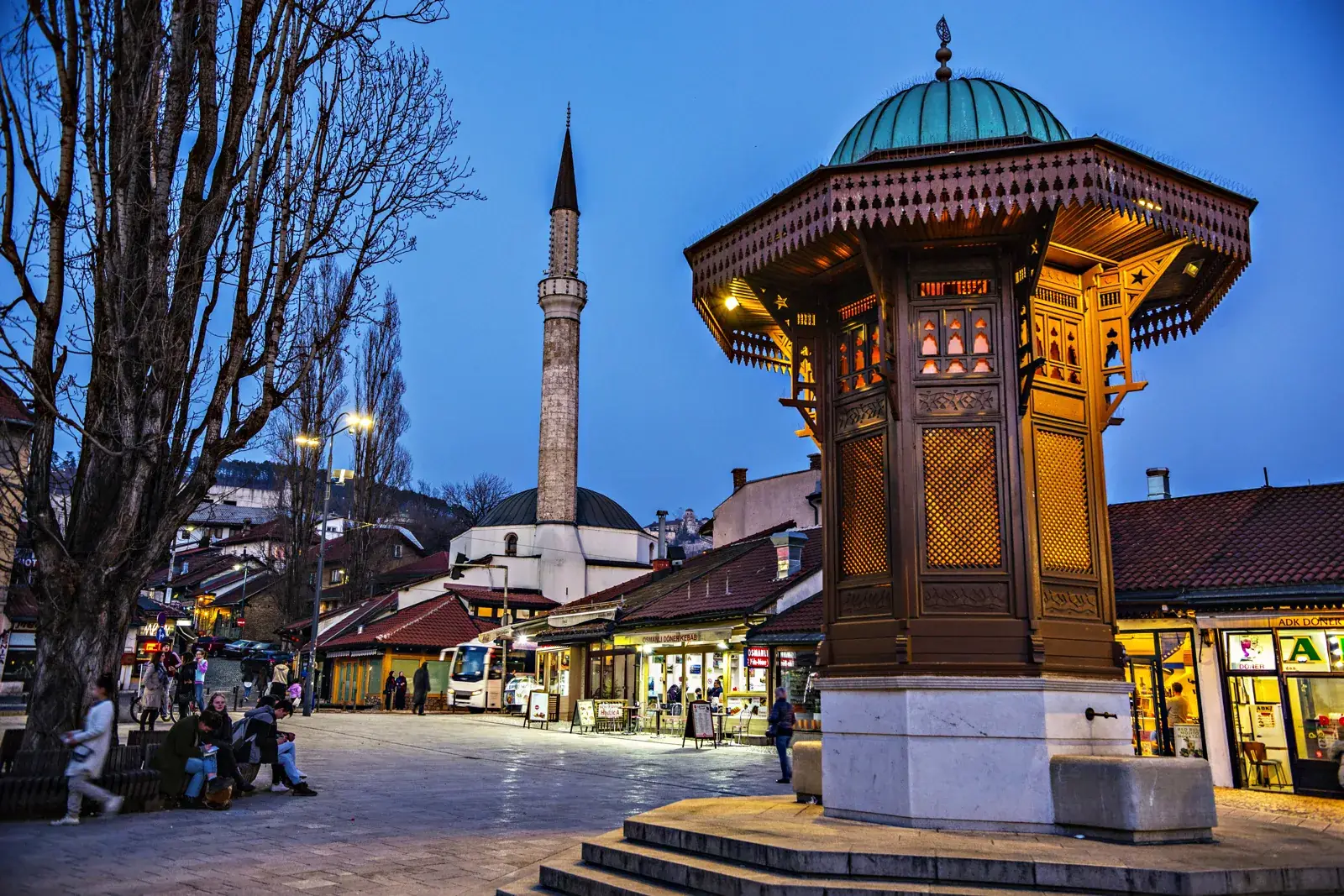
The old bazaar at dusk.
Baščaršija, the old bazaar
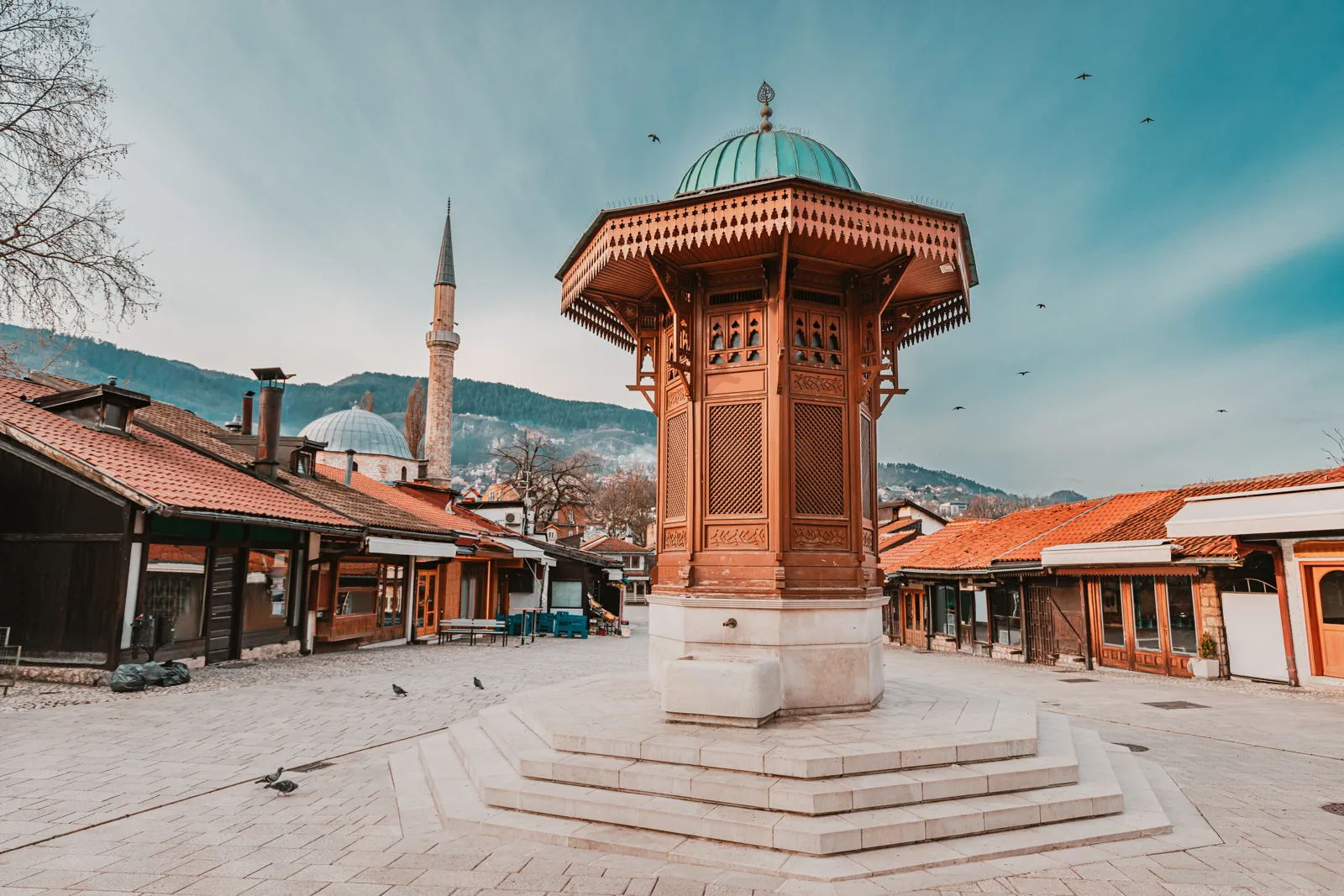
The Sebilj fountain, symbol of Baščaršija.
The Ottoman heart of the city, founded in the 15th century: alleys of coppersmiths, the wooden Sebilj fountain on Pigeon Square, ćevapi and burek stalls. Ferhadija street marks the transition to the Austro-Hungarian city; a marker on the ground indicates the « meeting of cultures ».
Gazi Husrev-beg Mosque and places of worship
Built in the 16th century, it is the country’s main Ottoman mosque. A few minutes’ walk away, the Catholic Sacred Heart Cathedral, the Orthodox Cathedral of the Nativity and the old synagogue (Jewish Museum) illustrate the coexistence of the communities.
The Latin Bridge
At the corner of this small bridge over the Miljacka, Archduke Franz Ferdinand was assassinated on 28 June 1914, the event that triggered World War I. The Museum of Sarajevo 1878-1918, opposite, tells the story of the Austro-Hungarian period.
The Vijećnica (former City Hall)
A neo-Moorish building from the Austro-Hungarian era that housed the national library. It burned in 1992 during the siege, with a large part of its collections, and was restored and reopened in 2014.
The Tunnel of Hope
Dug under the airport runway during the siege, it linked the encircled city to free territory. Part of it can be visited from the museum set up in a house in Butmir, near the airport: take a taxi or a guided tour.
The war museums
The War Childhood Museum displays objects and stories from children of the siege; Gallery 11/07/95 is dedicated to the Srebrenica genocide. Harrowing visits, but essential to understand the city.
Mount Trebević and the bobsleigh track
A cable car runs from the lower edge of the old town up Mount Trebević. At the top, the graffiti-covered bobsleigh track from the 1984 Olympic Games can be walked. The UK FCDO reports an increase in thefts from cars around Sarajevo, particularly on Mount Trebević: lock your vehicle and keep belongings out of sight (GOV.UK, updated 13 August 2026).
The Yellow Fortress and viewpoints
Žuta Tabija, an Ottoman bastion above Baščaršija, is the classic viewpoint for sunset over the minarets and the valley.
Vrelo Bosne
The park at the springs of the Bosna river, in Ilidža on the western outskirts, is reached by tram and then along an avenue of plane trees on foot or by horse-drawn carriage. An easy half-day outing in nature.
Itinerary: Sarajevo in 3 days
Day 1: Baščaršija, Gazi Husrev-beg Mosque, Ferhadija, the Latin Bridge and the Museum of Sarajevo 1878-1918, the Vijećnica; sunset from the Yellow Fortress.
Day 2: War Childhood Museum and Gallery 11/07/95 in the morning; Trebević cable car and bobsleigh track in the afternoon.
Day 3: the Tunnel of Hope, then Vrelo Bosne in Ilidža; or a mountain trip (Bjelašnica, Lukomir in summer) with a guide.
With one more day, Mostar can be reached by road or train to the southwest, through the Neretva valley.
When to go to Sarajevo
The best times are May-June and September: 21 to 25 °C (70 to 77 °F) in the afternoon, cool evenings and long days. July and August are warm (average high of 28 °C / 82 °F) but more bearable than in Herzegovina. In winter, the city is cold (highs of 4 °C / 39 °F in December-January, frost at night). The U.S. Department of State notes that air pollution is a significant problem in most cities in Bosnia and Herzegovina and is at its worst in winter: if you have a respiratory or heart condition, consult your doctor before traveling.
Month
High °C (°F)
Low °C (°F)
Rain mm (in)
Rainy days
Rain per 7 days
Sunshine (h/month)
Sunset
Verdict
January
4.1 (39)
−2.9 (27)
68 (2.7)
9.6
≈ 2.2 d
82
4:34 pm
❌ Cold, pollution
February
6.6 (44)
−1.9 (29)
67 (2.6)
9.6
≈ 2.4 d
102
5:15 pm
❌ Cold, pollution
March
11.5 (53)
1.4 (35)
67 (2.6)
9.4
≈ 2.1 d
145
5:52 pm
⚠️ Cool
April
16.5 (62)
5.1 (41)
78 (3.1)
10.8
≈ 2.5 d
158
7:29 pm
✅ Mild, spring
May
21.4 (71)
9.0 (48)
89 (3.5)
11.1
≈ 2.5 d
194
8:04 pm
✅ Ideal
June
25.4 (78)
12.6 (55)
88 (3.5)
10.3
≈ 2.4 d
231
8:30 pm
✅ Ideal
July
27.8 (82)
14.2 (58)
75 (3.0)
8.7
≈ 2.0 d
256
8:26 pm
✅ Warm
August
28.3 (83)
14.3 (58)
63 (2.5)
7.4
≈ 1.7 d
240
7:51 pm
⚠️ Warm
September
22.5 (73)
10.4 (51)
89 (3.5)
8.8
≈ 2.1 d
177
6:57 pm
✅ Ideal
October
17.3 (63)
6.5 (44)
91 (3.6)
8.7
≈ 2.0 d
155
6:03 pm
✅ Mild, fall colors
November
10.6 (51)
2.8 (37)
85 (3.3)
8.9
≈ 2.1 d
94
4:20 pm
⚠️ Cool, wet
December
4.3 (40)
−1.7 (29)
89 (3.5)
10.2
≈ 2.3 d
62
4:09 pm
❌ Cold, pollution
Temperatures, precipitation, rainy days (≥ 1 mm) and sunshine: 1991-2020 normals from the World Meteorological Organization (WMO), Sarajevo and Mostar stations, published by the Federal Hydrometeorological Institute of Bosnia and Herzegovina and archived by NOAA (NCEI). « Rain per 7 days »: Destination de Voyage calculation (rainy days in the month × 7 / number of days in the month). Sunset on the 15th of the month: Destination de Voyage calculation (NOAA solar algorithm, local time).
How to read the table: it rains a little all year round in Sarajevo (about 2 to 2.5 days a week), with no real dry season; the difference lies mainly in temperature and sunshine, four times higher in July than in December. August is the least rainy month. The Sarajevo Film Festival takes place in summer: check its dates on the official website and book early. In December and January, fog often delays or cancels flights at Sarajevo airport, and many airlines do not arrange accommodation when delays are weather-related (GOV.UK, travel.state.gov).
Getting around Sarajevo
On foot: the old town and the center can be explored on foot, east to west along the Miljacka.
Tram and bus: the tram serves the main axis as far as Ilidža; the UK FCDO warns of pickpockets and bag-snatchers on public transport and in the tourist areas of Sarajevo.
Taxi: handy for the airport and the Tunnel of Hope. Official taxis in Sarajevo are regulated and metered (GOV.UK).
From the airport: it lies southwest of the city; taxi is the simplest option. Drivers at the airport rank may try to charge a fixed fare instead of using the meter, or charge for luggage: agree a price before setting off, or pre-book with an established taxi company (GOV.UK).
Where to stay in Sarajevo
District
Best for
Pros
Baščaršija
First visit
Ottoman atmosphere, everything on foot; lively and sometimes noisy
Center (Ferhadija, Marijin Dvor)
Comfort, transport
Larger hotels, tram nearby
Hillsides (Bistrik, Vratnik)
Quiet, views
Panoramas, guesthouses; steep streets
Ilidža
Longer stays, nature
Close to Vrelo Bosne and the airport; far from the center
Carry your passport: you must show ID, including when checking into hotels (GOV.UK).
Entry requirements, health and safety
US citizens: according to the U.S. Department of State (travel.state.gov, last updated August 27, 2026), no visa is needed for stays of up to 90 days in total within six months of your first entry; your passport should be valid for at least three months past your planned departure. If you stay three or more days in a private residence, you or your host must register with the local police or the Department for Foreigners within 48 hours of arrival.
UK citizens: according to the UK FCDO (GOV.UK, updated 13 August 2026), you can travel without a visa for up to 90 days within a 6-month period; your passport must have been issued less than 10 years before you arrive and be valid for at least 90 days after you leave. Make sure it is stamped on entry and exit, or you may be fined. All foreign nationals must register with the police within 72 hours of arrival; hotels and some hostels usually do it for their guests.
Registration deadlines differ between the two sources (48 or 72 hours): register as soon as you arrive, or check with the embassy of Bosnia and Herzegovina.
Safety: Sarajevo has a high rate of property crime, mostly pickpocketing in tourist areas (U.S. Department of State). Around the city, landmines remain a risk in less populated and rural areas: do not step off roads and paved areas without an experienced guide (GOV.UK).
Health: the EHIC and GHIC do not cover Bosnia and Herzegovina; take out travel insurance covering treatment and evacuation (GOV.UK). Biting insects and ticks are among the health risks. In Sarajevo, tap water is potable and tested regularly (U.S. Department of State).
Money: convertible marks; some businesses accept cards and ATMs are available at banks in Sarajevo (U.S. Department of State). Cash is useful in the bazaar.
What to eat: ćevapi (small grilled sausages in somun bread), burek, Bosnian coffee, baklava.
Etiquette: modest dress in mosques, tact in political discussions.
Internet: a non-EU country, so roaming is often not included: see our eSIM guide.
Frequently asked questions
How many days do you need to visit Sarajevo?
Two full days for the old town, the museums and Trebević; three to add the Tunnel of Hope and Vrelo Bosne.
How do you get to Sarajevo?
By air to Sarajevo International Airport, usually with a connection, or overland from Croatia via Mostar. Check current routes with the airlines; in December and January, fog often disrupts flights.
Is Sarajevo safe for tourists?
With simple precautions, yes. Watch your belongings on the tram and in the bazaar, do not leave anything visible in parked cars and stay on paved areas and well-used trails in the mountains.
Do you have to register with the police in Sarajevo?
Yes. The FCDO says all foreign nationals must register within 72 hours; the State Department gives 48 hours for private stays of three days or more. Hotels usually do it; in private rentals, it is up to you or your host.
What is the best month to visit Sarajevo?
June and September combine mild weather, long days and moderate rain. Avoid December to February for the cold and air pollution.
Our sources
Climate: 1991-2020 normals from the World Meteorological Organization (WMO), Sarajevo and Mostar stations, published by the Federal Hydrometeorological Institute of Bosnia and Herzegovina and archived by NOAA (NCEI)
Destination de Voyage calculations: rain per 7 days (monthly proportion), sunset (NOAA solar algorithm)


 FlightsKiwi.comCompare flights and airline combinations to Sarajevo.Compare flights