Australia combines big oceanside cities, the desert of the Red Centre, the Great Barrier Reef and tropical rainforests. It is a distant, vast destination that requires choices: distances are counted in thousands of kilometers. This Australia travel guide brings together the essentials: what to see and do, which itinerary or road trip to choose, what budget to plan and which entry requirements to complete.
Off Queensland, our Great Barrier Reef guide covers the season, trips and rules.
To locate cities, regions, terrain, national parks and airports, see our map of Australia.
The seasons are reversed compared with the northern hemisphere. For a tour combining Sydney, Uluru and the Great Barrier Reef, the best periods are September to October and April to May. The tropical north (Cairns, Darwin) is best visited from May to October, during the dry season; from December to April it gets heavy rain and a cyclone risk. The south (Sydney, Melbourne, Tasmania) is most pleasant from November to April. All the details, month by month and with official Bureau of Meteorology normals, are in our article best time to visit Australia.
For the Red Centre, our guide to visiting Uluru (Ayers Rock) covers the official park pass, opening hours month by month and the trails around the rock.
What to see in Australia: the highlights
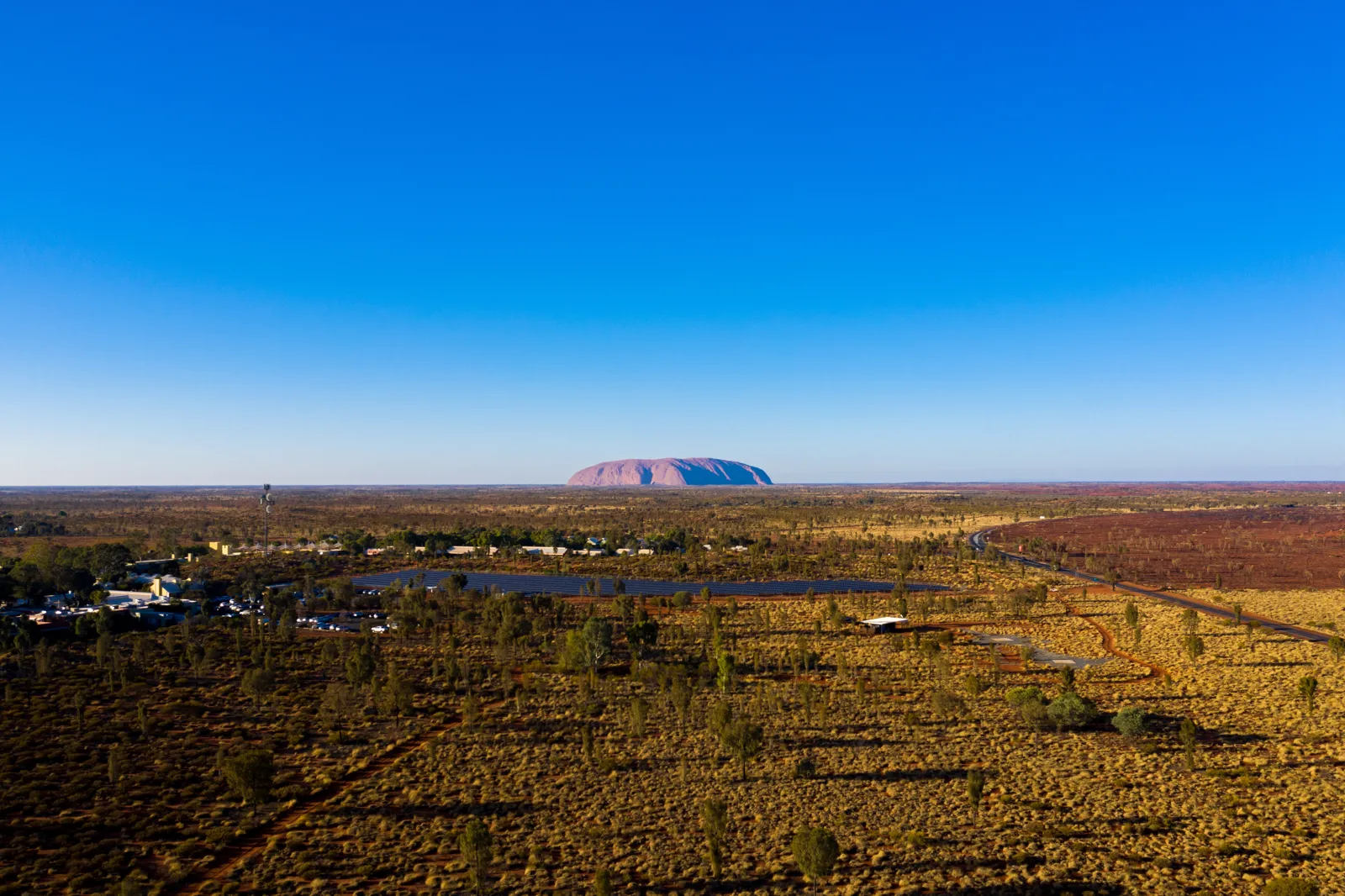
Uluru monolith in Australia’s Red Centre
Sydney
The arrival point for most travelers, Sydney is built around its harbor. Allow three to four days for the Opera House and the Harbour Bridge, the historic Rocks district, the Botanic Garden, the ferry ride to Manly and the coastal walk from Bondi to Coogee. Opera House, The Rocks, the Manly ferry and the Bondi to Coogee walk: our guide to things to do in Sydney organizes these three to four days.
The Blue Mountains
About two hours by train from Sydney, this World Heritage-listed range offers cliffs, eucalyptus forests and many hiking trails. The Three Sisters lookout at Katoomba is the best known. One day gives you an overview, two let you hike.
Melbourne and the Great Ocean Road
Melbourne is known for its street-art laneways, cafés, museums and sporting events. To the west, the Great Ocean Road follows the Victorian coast to the cliffs and rock stacks of the Twelve Apostles. Allow at least two days for the drive, in a rental car.
Uluru and the Red Centre
The Uluru monolith, a sacred site for the Anangu, its traditional owners, stands in Uluru-Kata Tjuta National Park. Climbing is no longer allowed: you walk around it, and discover the nearby domes of Kata Tjuta. It is reached by plane to Ayers Rock Airport, or by road from Alice Springs, several hours away. Kings Canyon can be added to the tour.
Cairns and the Great Barrier Reef
Cairns and Port Douglas are the main bases for reaching the reef by boat, diving or snorkeling. To the north, the Daintree rainforest runs down to the sea. The best season is June to October; during the hot season, dangerous jellyfish are present near the coast.
The Whitsunday Islands
Off the Queensland coast, this archipelago is known for the white sand of Whitehaven Beach and its turquoise waters. It is explored on a day trip or a multi-day cruise from Airlie Beach.
Darwin and Kakadu National Park
In the Top End, Kakadu brings together wetlands, escarpments and Aboriginal rock art sites. Litchfield, closer to Darwin, is known for its waterfalls. Saltwater crocodiles live in the rivers and along the coasts: swim only where it is expressly permitted. The dry season (May to September) is the only really suitable time.
Perth, Tasmania and the rest of the country
Perth, on the west coast, gives access to the region’s beaches and Rottnest Island. Tasmania, in the south, draws hikers with Cradle Mountain and the Freycinet Peninsula. These regions take time: they suit a second trip or a stay of three weeks or more. With even more time, neighboring New Zealand can round off the trip.
Things to do in Australia: 8 experiences for a first trip
To sum up what to see and do in Australia on a first trip, here are the experiences that feature in most itineraries (all described above):
Take the ferry across Sydney Harbour and walk from Bondi to Coogee
Hike in the Blue Mountains from Katoomba
Drive the Great Ocean Road to the Twelve Apostles
Walk around Uluru and discover Kata Tjuta
Dive or snorkel on the Great Barrier Reef from Cairns or Port Douglas
See the Daintree rainforest run down to the sea
Sail the Whitsunday Islands to Whitehaven Beach
Discover Kakadu’s Aboriginal rock art in the dry season
Itinerary ideas and road trips in Australia
For an Australian road trip, pick a region rather than the whole country: the Great Ocean Road from Melbourne, the Queensland coast between Cairns and Airlie Beach (or further south around Brisbane, between the Gold Coast and the Sunshine Coast), Tasmania or the Top End in the dry season all suit a car or van, combined with domestic flights for long distances (see « Getting around » below). Our tips for planning a multi-stop trip apply fully.
Given the length of the journey, plan at least two weeks on the ground. Links between regions are made by domestic flights.
10 days: the east coast essentials
Days 1 to 4: Sydney, with a day in the Blue Mountains
Days 5 to 7: fly to Uluru, walk around the rock and visit Kata Tjuta
Days 8 to 10: fly to Cairns, a day on the Great Barrier Reef, Daintree
2 to 3 weeks: south, center and north
Days 1 to 4: Sydney and the Blue Mountains
Days 5 to 8: Melbourne and the Great Ocean Road by car
Days 9 to 11: Uluru, Kata Tjuta and Kings Canyon
Days 12 to 16: Cairns, the Great Barrier Reef, Port Douglas and Daintree
Days 17 to 20 (optional): the Whitsunday Islands, or Darwin and Kakadu in the dry season
Budget for a trip to Australia
Australia is an expensive destination, for both accommodation and food. International and domestic flights weigh heavily in the budget. Indicative amounts per person per day, excluding flights (converted from our euro estimates at the ECB rate of 23 October 2026, €1 = A$1.59):
Item
Budget
Comfort
Accommodation (based on a shared double room)
roughly A$48–96 (hostel, motel, campground)
roughly A$160–320
Meals
roughly A$40–64 (groceries, food courts)
roughly A$96–160
Local transport
roughly A$16–32
roughly A$48–96 (car rental)
Activities and sightseeing
roughly A$16–48
roughly A$80–160
Total per day
roughly A$130–190
roughly A$320–560
Indicative estimates, varying by season and region. Great Barrier Reef trips and stays at Uluru cost considerably more.
To keep costs down, cook some of your meals (hostels and campgrounds often have kitchens), use the free public barbecues in parks and enjoy the many free or inexpensive natural sites.
Who is Australia for?
Our verdicts by traveler profile, based on the places, conditions and budget ranges in this guide:
Nature and wide open spaces: ideal: Uluru and Kata Tjuta, the Blue Mountains, the Daintree rainforest, Kakadu in the dry season, Cradle Mountain in Tasmania.
Diving and beaches: excellent: the Great Barrier Reef from Cairns or Port Douglas, Whitehaven Beach in the Whitsundays, the coast from Bondi to Coogee. Beware of jellyfish in the hot season and crocodiles in the north.
Road trips: a very good choice, region by region: the Great Ocean Road, the Queensland coast, Tasmania or the Top End in the dry season, driving on the left.
Families: yes: Sydney’s ferries, free public barbecues in parks, holiday parks with cabins. The long journey and the distances call for at least two weeks on the ground.
Couples: yes: a multi-day cruise in the Whitsundays, Port Douglas (quieter than Cairns), Melbourne’s cafés and laneways.
Budget travelers: difficult: roughly A$130–190 a day excluding flights, and domestic flights weigh heavily. Hostels with kitchens and campgrounds keep costs down.
Short trips: no: given the long journey from Europe or North America, plan at least two weeks.
Getting around Australia
Plane: essential for linking regions quickly: Sydney, Melbourne, Cairns, Uluru (Ayers Rock Airport), Darwin and Perth are connected by domestic flights.
Car or van: the best way to explore a region at your own pace (Great Ocean Road, Tasmania, the Queensland coast). Traffic drives on the left (U.S. Department of State, travel.state.gov, last updated August 13, 2026). In rural areas, watch for free-roaming animals such as kangaroos and for road trains. UK visitors can drive on a UK photocard licence; those with a paper licence may need a 1949 International Driving Permit (GOV.UK, updated 19 March 2026). Rules on foreign licences vary by state, and rental companies may require an IDP. Hire car insurance often does not cover unsealed roads.
Outback: mobile coverage can be very limited or non-existent outside towns (GOV.UK). Leave your route and expected return time with someone, and check track conditions before setting off.
Train: convenient around Sydney and Melbourne; the great long-distance tourist trains are an experience in themselves, and fairly expensive.
In town: good-quality trains, buses, ferries and trams; in Sydney and Melbourne you generally pay by contactless bank card or transit card.
Where to stay in Australia
In Sydney, stay near the center and the harbor (CBD, The Rocks, Darling Harbour) to do everything on foot and by ferry, or in Bondi and Manly for the beach. In Melbourne, the city center and the Fitzroy and St Kilda neighborhoods are well connected. In Cairns, choose between the city waterfront and quieter Port Douglas. Near Uluru, accommodation is concentrated in Yulara: book well in advance.
Options include hostels, motels, equipped campgrounds (with van sites and cabins), apartments and hotels in every category. Campgrounds and holiday parks are a good option for a road trip.
Entry requirements for Australia
US citizens
According to the U.S. Department of State (travel.state.gov, last updated August 13, 2026), you need a valid US passport and a visa or an approved Electronic Travel Authority (ETA). For tourism or business stays of less than 90 days, the ETA, an electronic visa obtained through the Australian ETA app for a small fee, is enough; airlines and many travel agents can also apply for you. Overstaying, even briefly, can lead to detention and removal. Travelers aged 16 and over with a chipped passport can use the SmartGate automated border system on arrival.
UK citizens
According to the UK FCDO (GOV.UK foreign travel advice, updated 19 March 2026), you must have a visa to visit Australia. British citizens can usually get an eVisitor visa (no application charge or service fee) or an Electronic Travel Authority through the ETA app (no visa charge, but there may be a service fee). Your passport must be valid for the length of your planned stay.
Customs and quarantine: you must fill in an Incoming Passenger Card and declare risk goods such as food, animal products and plant material, including wooden articles, as well as any recent contact with farms or wilderness areas (GOV.UK). Strict rules also apply to importing vaping goods.
Entry requirements checked on 24 October 2026; check them again before you travel.
Health and safety
Health: the standard of healthcare is very good (GOV.UK). UK visitors can get essential and urgent care under the UK-Australia reciprocal healthcare agreement; other visitors can face high costs, so travel insurance covering treatment and repatriation is essential, especially for US travelers, whose health insurance often does not apply abroad. Dengue is among the health risks listed (GOV.UK). Bushfire smoke can degrade air quality, including in major cities. Emergency number: 000.
Safety: petty theft targets visitors in popular tourist areas (U.S. Department of State). The main risks are natural: bushfires, especially from November to February; floods; and tropical cyclones, mainly in Queensland, the Northern Territory and Western Australia, from November to April (GOV.UK). Follow the authorities’ instructions and each state’s fire alerts.
Sea and wildlife: rip currents are the main hazard for swimmers; swim only between the flags where a lifeguard is present (U.S. Department of State). Crocodiles, jellyfish, sharks, venomous snakes and spiders live in many parts of the country (GOV.UK). Protect yourself from the sun and carry plenty of water when hiking.
Practical tips for Australia
Money: bank cards, including contactless, are accepted almost everywhere; a little cash is enough. Check your bank’s foreign transaction fees. Our currency converter helps you estimate your spending.
Tax refund: according to Tourism Australia, Tourist Refund Scheme facilities are in the departure area of international terminals, for goods bought from a single business for A$300 or more within 60 days before departure.
Internet: good mobile coverage in cities and along the coast, but large inland areas have no coverage. A local SIM card or an eSIM is still useful for navigation and bookings.
Etiquette: respect Aboriginal sacred sites and photography bans at signposted places. Do not feed wild animals.
Tipping: hotels and restaurants do not add service charges and tipping is your choice; in upscale restaurants, 10% for good service is common (Tourism Australia).
Read more
The seasons are reversed and vary widely between the tropical north and the south: read the best time to visit Australia before building your itinerary. Our page on the time difference with Australia helps you prepare for arrival, as the offset varies by state and season. And if you have more time, our New Zealand travel guide presents the neighboring country, often combined on the same trip.
Frequently asked questions
Do I need a visa for Australia?
Yes, in electronic form. US citizens need an Electronic Travel Authority (ETA) for tourism stays of less than 90 days (travel.state.gov, last updated August 13, 2026). British citizens can usually get an eVisitor or an ETA, and their passport must be valid for the whole stay (GOV.UK, updated 19 March 2026). Checked on 24 October 2026.
How much does a trip to Australia cost?
Excluding flights, allow roughly A$130–190 per person per day on a budget, and A$320–560 in comfort. International and domestic flights are a large share of the budget.
How long do you need to visit Australia?
At least two weeks, given the long journey. That is enough for Sydney, Uluru and Cairns; three weeks let you add Melbourne, the Great Ocean Road or Kakadu.
What is the best time to visit Australia?
September to October and April to May for a full tour. The tropical north is best from May to October, the south from November to April.
Is Australia safe?
Yes. The main risks are natural (bushfires, floods, cyclones in the north), on the road (long distances, animals on rural roads) and in the water (rip currents, jellyfish, crocodiles), according to GOV.UK and the U.S. Department of State.
Where should you go in Australia on a first trip?
The most common trio is Sydney (with the Blue Mountains), Uluru and Cairns for the Great Barrier Reef, linked by domestic flights. With three weeks, add Melbourne and the Great Ocean Road.
Can you do a road trip in Australia?
Yes, but region by region: the Great Ocean Road, the Queensland coast, Tasmania or the Top End in the dry season. Traffic drives on the left, distances are long, and the U.S. Department of State advises watching for free-roaming animals such as kangaroos in rural areas.
Tourism Australia, useful tips: electricity, tipping, Tourist Refund Scheme (read on 24 October 2026)
Bureau of Meteorology (BoM): 1991–2020 normals for Sydney Airport, Melbourne (Olympic Park), Cairns, Darwin Airport and Alice Springs Airport stations; normals published by the BoM for the Perth Metro station
European Central Bank, euro foreign exchange reference rates of 23 October 2026 (budget conversion)
Transparency: this page contains affiliate links, labelled as such. If you book through them we may earn a commission at no extra cost to you; it does not influence our content or recommendations. How we fund the site.