When is the best time to visit New Zealand? December to March, during the austral summer, with two very good compromises in November and in March-April. Days are long, temperatures pleasant (about 20 to 24 °C (68 to 75 °F) in the afternoon in most cities) and the great hiking trails are open. Winter (June to August) mainly suits skiing and travelers who accept rain and cold in exchange for lower prices.
The seasons are the reverse of those in the northern hemisphere. The country stretches over more than 1500 km (932 mi) from north to south: the North Island is milder and wetter, the South Island cooler, with mountains where snow falls as early as autumn. Above all, the weather changes quickly in any season: according to the U.S. State Department (travel.state.gov, last updated May 7, 2026), weather conditions can change quickly, leaving you stranded or injured if you are in an isolated area. This guide is based on the official climate normals published by NIWA, New Zealand’s public research institute for water and atmosphere.

Our travel deals for New Zealand
Affiliate links: we earn a commission, at no extra cost to you.
 FlightsKiwi.comCompare flights and airline combinations to New Zealand.Compare flights
- eSIMAiraloData plan to install before you leave (eSIM-compatible phone).See plans


When to go to New Zealand at a glance
- Best time December to March (austral summer), for hiking, lakes and road trips
- Best compromises November and March-April: fewer crowds, gentler prices, still decent weather
- Skiing the austral winter, roughly late June to September depending on the resort and snow conditions (Queenstown, Wanaka, Mount Ruapehu)
- Most expensive periods late December to late January (New Zealand summer holidays and festive season); local school holidays
- Good to know the west coast of the South Island and Fiordland are very rainy all year; always pack a warm, waterproof layer
When to go to New Zealand by priority
- Best weather: December to March, during the austral summer; November and March-April are very good compromises
- Cheapest: May-June and September, outside local school holidays
- Fewest crowds: May, June, August and September; March, after the New Zealand summer holidays, for still summery weather
- Events: Waitangi Day on February 6, Matariki in June or July, ski season opening in late June – early July, New Year’s Eve on December 31
New Zealand: the calendar at a glance
✅ Best months: January, February, March, April, October, November, December
Climate and weather in Auckland month by month
The table below gives the normals for Auckland, the country’s main gateway and representative of the north of the North Island. The cooler South Island is covered in detail further down. Both islands are shown on our map of New Zealand.
| Month | Avg. max | Avg. min | Rain | Crowds | Prices | Verdict |
|---|---|---|---|---|---|---|
| January | 23.9 °C (75 °F) | 16.1 °C (61 °F) | 58 mm (2.3 in) | Very high (summer holidays) | Very high | ✅ Midsummer, beaches and hiking |
| February | 24.4 °C (76 °F) | 16.6 °C (62 °F) | 63 mm (2.5 in) | High | High | ✅ Warmest month, often the most settled |
| March | 22.9 °C (73 °F) | 14.9 °C (59 °F) | 75 mm (3.0 in) | Moderate | Moderate | ✅ End of summer, fewer crowds |
| April | 20.4 °C (69 °F) | 12.8 °C (55 °F) | 87 mm (3.4 in) | Moderate (Easter) | Moderate | ✅ Autumn colors in the south |
| May | 17.7 °C (64 °F) | 10.8 °C (51 °F) | 120 mm (4.7 in) | Low | Low | ⚠️ Cooler and wetter |
| June | 15.5 °C (60 °F) | 8.7 °C (48 °F) | 119 mm (4.7 in) | Low | Low | ⚠️ Start of winter, ski opening |
| July | 14.6 °C (58 °F) | 7.7 °C (46 °F) | 137 mm (5.4 in) | Moderate (winter holidays) | Moderate | ⚠️ Coolest and wettest month |
| August | 15.2 °C (59 °F) | 8.3 °C (47 °F) | 117 mm (4.6 in) | Low | Low | ⚠️ Good for skiing, cool elsewhere |
| September | 16.5 °C (62 °F) | 9.7 °C (49 °F) | 100 mm (3.9 in) | Low | Low | ⚠️ Unsettled spring |
| October | 17.9 °C (64 °F) | 11.3 °C (52 °F) | 92 mm (3.6 in) | Moderate | Moderate | ✅ Spring, nature in bloom |
| November | 19.6 °C (67 °F) | 12.8 °C (55 °F) | 69 mm (2.7 in) | Moderate | Moderate | ✅ Very good compromise before summer |
| December | 22.0 °C (72 °F) | 15.0 °C (59 °F) | 82 mm (3.2 in) | High (festive season) | High | ✅ Summer, year-end festivities |
In Auckland it rains all year, but twice as much in winter (137 mm (5.4 in) in July) as in summer (58 mm (2.3 in) in January). Temperatures stay moderate: it is never very hot or very cold. The differences become clear on the South Island and in the mountains.
New Zealand’s seasons: pros and cons
Austral summer (December to February): high season
This is the most popular season, for good reasons. Average highs reach 22 to 24 °C (72 to 75 °F) in Auckland, Christchurch and Queenstown, days are long and mountain trails are accessible. It is also the New Zealand summer holiday period, from Christmas to about the end of January: campgrounds, inter-island ferries and campervan rentals are in very high demand.
- Pros: hiking (Tongariro Alpine Crossing, Great Walks), swimming in Northland and Abel Tasman, kayaking, South Island lakes
- Cons: highest prices, reservations essential, busy sites; the sun is strong (high UV index), even in cool weather
- Our tip: February is often a little quieter than January, with the same climate
Austral autumn (March to May): the best value
In March the weather is still summery (22.9 °C (73 °F) in the afternoon in Auckland, 19.1 °C (66 °F) in Queenstown) and crowds drop noticeably after the school holidays. In April, the trees around Queenstown, Arrowtown and Wanaka turn to autumn colors. May is cooler and wetter, especially on the North Island.
- Pros: falling prices, quieter roads, soft light, conditions still decent for hiking in March-April
- Cons: shortening days, cool nights in the south (4.5 °C (40 °F) average minimum in April in Queenstown), Easter holidays
- Who is it for? A full road trip across both islands, preferably in March or early April
Austral winter (June to August): skiing and low prices
Winter is mild in the north (about 15 °C (59 °F) in the afternoon in Auckland) but cold inland on the South Island: in Queenstown, the average minimum is below zero in June and July (-1.4 °C (29 °F) in July). It is the ski season at the resorts around Queenstown and Wanaka, and on Mount Ruapehu on the North Island. Elsewhere, rain is more frequent and some mountain roads can be closed by snow.
- Pros: skiing, snowy landscapes, Rotorua hot springs, low prices outside local school holidays (July)
- Cons: short days, rainy weather in the north, chains sometimes required on passes, alpine hikes reserved for well-equipped, experienced people
- Who is it for? Skiers, and those traveling in July-August who accept a trip more focused on cities, volcanoes and thermal spas
Austral spring (September to November): the awakening
Spring is a changeable season: you can get sun, showers and wind in the same day. It warms up noticeably in November (19.6 °C (67 °F) in the afternoon in Auckland, 17.5 °C (64 °F) in Queenstown). It is the time of lambs in the countryside and gardens in bloom. At altitude, snow remains for much of the season.
- Pros: moderate prices, few crowds until mid-November, waterfalls well fed by snowmelt
- Cons: unsettled weather in September-October, some high-altitude trails still snowy
- Who is it for? Travelers who want to make the most of November, a very good month
When to go to New Zealand by region
Comparison of the normals for five cities, from the north of the North Island to the interior of the South Island:
| Month | Auckland | Rotorua | Wellington | Christchurch | Queenstown |
|---|---|---|---|---|---|
| January | 23.9 °C (75 °F) / 58 mm (2.3 in) | 22.9 °C (73 °F) / 94 mm (3.7 in) | 20.3 °C (69 °F) / 79 mm (3.1 in) | 22.5 °C (73 °F) / 42 mm (1.7 in) | 22.0 °C (72 °F) / 72 mm (2.8 in) |
| February | 24.4 °C (76 °F) / 63 mm (2.5 in) | 23.1 °C (74 °F) / 100 mm (3.9 in) | 20.6 °C (69 °F) / 56 mm (2.2 in) | 22.2 °C (72 °F) / 40 mm (1.6 in) | 21.8 °C (71 °F) / 51 mm (2.0 in) |
| March | 22.9 °C (73 °F) / 75 mm (3.0 in) | 21.1 °C (70 °F) / 100 mm (3.9 in) | 19.1 °C (66 °F) / 100 mm (3.9 in) | 20.3 °C (69 °F) / 45 mm (1.8 in) | 19.1 °C (66 °F) / 49 mm (1.9 in) |
| April | 20.4 °C (69 °F) / 87 mm (3.4 in) | 18.1 °C (65 °F) / 133 mm (5.2 in) | 16.7 °C (62 °F) / 127 mm (5.0 in) | 17.2 °C (63 °F) / 58 mm (2.3 in) | 15.2 °C (59 °F) / 58 mm (2.3 in) |
| May | 17.7 °C (64 °F) / 120 mm (4.7 in) | 15.2 °C (59 °F) / 130 mm (5.1 in) | 14.6 °C (58 °F) / 145 mm (5.7 in) | 14.7 °C (58 °F) / 58 mm (2.3 in) | 11.9 °C (53 °F) / 75 mm (3.0 in) |
| June | 15.5 °C (60 °F) / 119 mm (4.7 in) | 12.7 °C (55 °F) / 132 mm (5.2 in) | 12.4 °C (54 °F) / 124 mm (4.9 in) | 11.7 °C (53 °F) / 68 mm (2.7 in) | 8.6 °C (47 °F) / 62 mm (2.4 in) |
| July | 14.6 °C (58 °F) / 137 mm (5.4 in) | 12.0 °C (54 °F) / 137 mm (5.4 in) | 11.7 °C (53 °F) / 147 mm (5.8 in) | 11.2 °C (52 °F) / 64 mm (2.5 in) | 8.2 °C (47 °F) / 56 mm (2.2 in) |
| August | 15.2 °C (59 °F) / 117 mm (4.6 in) | 12.8 °C (55 °F) / 125 mm (4.9 in) | 12.4 °C (54 °F) / 139 mm (5.5 in) | 12.5 °C (55 °F) / 58 mm (2.3 in) | 10.2 °C (50 °F) / 53 mm (2.1 in) |
| September | 16.5 °C (62 °F) / 100 mm (3.9 in) | 14.5 °C (58 °F) / 107 mm (4.2 in) | 13.6 °C (56 °F) / 108 mm (4.3 in) | 14.8 °C (59 °F) / 42 mm (1.7 in) | 13.0 °C (55 °F) / 62 mm (2.4 in) |
| October | 17.9 °C (64 °F) / 92 mm (3.6 in) | 16.4 °C (62 °F) / 93 mm (3.7 in) | 15.1 °C (59 °F) / 119 mm (4.7 in) | 16.9 °C (62 °F) / 49 mm (1.9 in) | 15.4 °C (60 °F) / 62 mm (2.4 in) |
| November | 19.6 °C (67 °F) / 69 mm (2.7 in) | 18.6 °C (65 °F) / 87 mm (3.4 in) | 16.6 °C (62 °F) / 85 mm (3.3 in) | 18.8 °C (66 °F) / 45 mm (1.8 in) | 17.5 °C (64 °F) / 61 mm (2.4 in) |
| December | 22.0 °C (72 °F) / 82 mm (3.2 in) | 20.8 °C (69 °F) / 117 mm (4.6 in) | 18.7 °C (66 °F) / 91 mm (3.6 in) | 21.1 °C (70 °F) / 48 mm (1.9 in) | 20.2 °C (68 °F) / 60 mm (2.4 in) |
Auckland, Northland and the Coromandel
The north of the North Island has the mildest climate in the country, with frost-free but rainy winters. For the beach (Bay of Islands, Coromandel), aim for December to March; the sea stays cool the rest of the year. Spring and autumn suit sightseeing and coastal hiking well.
Rotorua, Taupo and Tongariro
The central plateau is cooler and wetter than Auckland. Rotorua’s geothermal sites can be visited all year. The Tongariro Alpine Crossing is done in good conditions mainly from December to March; in winter it becomes a mountaineering outing that requires equipment and a guide. Mount Ruapehu and Tongariro are active volcanoes: check local conditions before you go.
Wellington and the Nelson region
Wellington is known for its wind, and it is one of the wettest cities in the table in winter (147 mm (5.8 in) in July). The best time is December to March. Across Cook Strait, the Nelson region and Abel Tasman National Park are among the sunniest in the country, with an ideal season from December to April for kayaking and coastal hiking.
Christchurch, Canterbury and Mount Cook
The east coast of the South Island is sheltered by the Southern Alps: Christchurch is dry all year (less than 70 mm (2.8 in) a month), but cold at night in winter (0.7 °C (33 °F) average minimum in July). For Lake Tekapo and Aoraki / Mount Cook, prefer November to April. The night sky there is particularly clear, notably in winter.
Queenstown, Wanaka and Fiordland
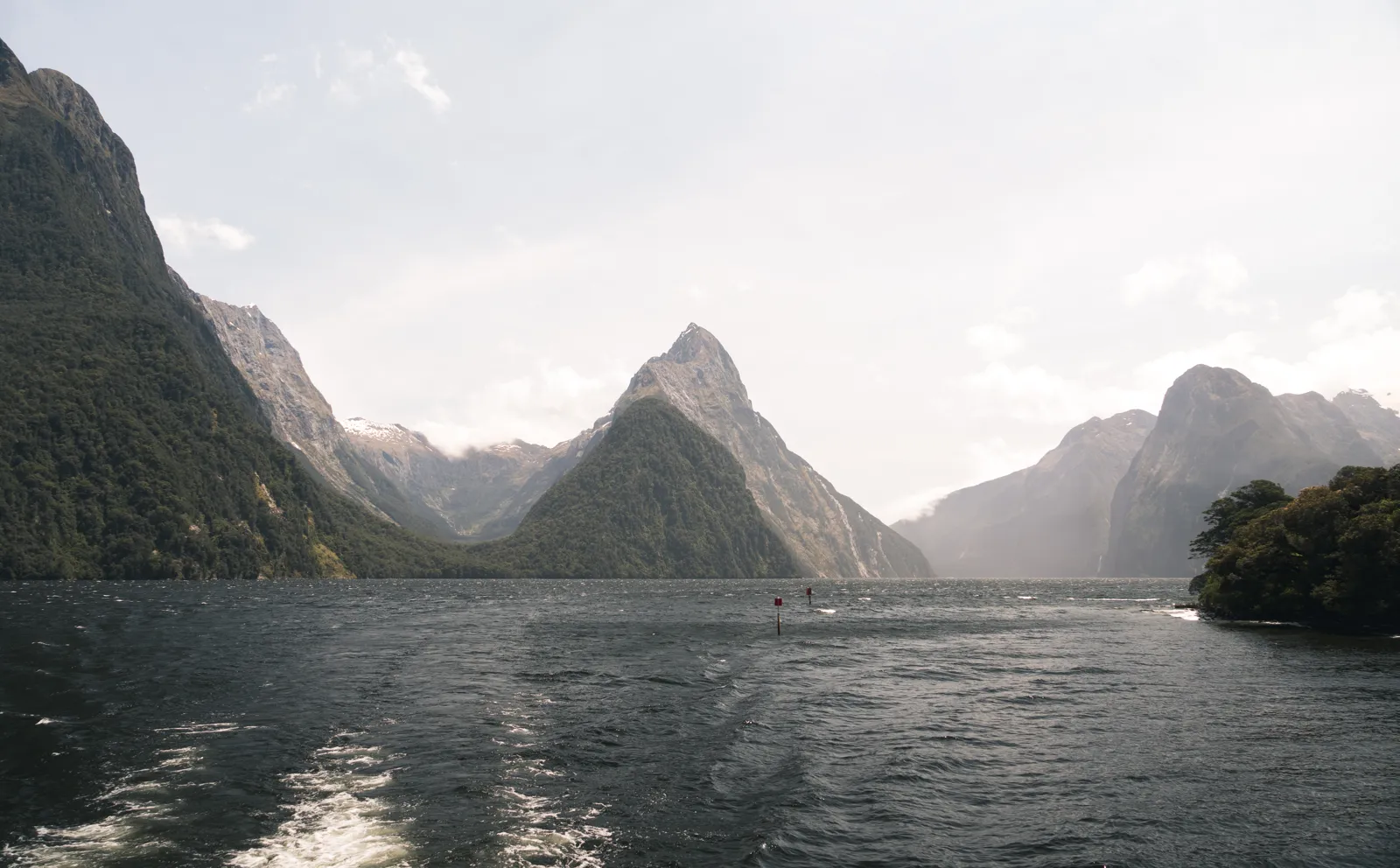
Queenstown has the most contrasting climate: about 22 °C (72 °F) in the afternoon in January, but sub-zero nights in winter. December to March is ideal for hiking and outdoor activities, July-August for skiing. Further west, Fiordland (Milford Sound, Doubtful Sound) receives enormous amounts of rain in every season: the waterfalls are all the more spectacular, but the Milford Sound road can be closed by snow or avalanches in winter. Our Milford Sound guide covers access and fjord cruises.
The west coast (Franz Josef and Fox glaciers)
Between the Tasman Sea and the Southern Alps, the west coast is green and very wet all year. There is no dry season: build flexibility into your itinerary, as glacier flights and hikes depend on the weather of the day.
Region-by-region summary: the right month depending on the part of the country you are visiting. The west coast and Fiordland remain very rainy all year.
| Month | Auckland and Northland | Rotorua and Tongariro | Christchurch and Mount Cook | Queenstown and Wanaka |
|---|---|---|---|---|
| January | ✅ Midsummer | ✅ Tongariro Crossing | ✅ Dry and mild | ✅ Outdoors |
| February | ✅ Warmest | ✅ Tongariro Crossing | ✅ Dry and mild | ✅ Outdoors |
| March | ✅ End of summer | ✅ Tongariro Crossing | ✅ Dry and mild | ✅ Outdoors |
| April | ✅ Mild autumn | ⚠️ Cooler and rainy | ✅ Autumn | ✅ Autumn colors |
| May | ⚠️ Wetter | ⚠️ Rainy | ⚠️ Cool | ⚠️ Cool |
| June | ⚠️ Start of winter | ⚠️ Winter, hot springs | ⚠️ Cold at night | ⚠️ Ski opening |
| July | ⚠️ Wettest | ⚠️ Winter, hot springs | ⚠️ Cold at night, starry skies | ✅ Skiing |
| August | ⚠️ Cool | ⚠️ Winter, hot springs | ⚠️ Cold at night | ✅ Skiing |
| September | ⚠️ Unsettled spring | ⚠️ Unsettled spring | ⚠️ Spring | ⚠️ End of ski season |
| October | ✅ Spring | ⚠️ Unsettled spring | ⚠️ Spring | ⚠️ Spring |
| November | ✅ Very good compromise | ⚠️ Spring | ✅ Good season | ✅ Very good compromise |
| December | ✅ Summer | ✅ Tongariro Crossing | ✅ Good season | ✅ Outdoors |
✅ favorable conditions, ⚠️ possible with caveats, ❌ best avoided. Summary based on the normals cited on this page and the regional advice above.

When to go to New Zealand by trip type
| Trip | Best time | Where? |
|---|---|---|
| First road trip across both islands | November to April (ideally February-March) | Auckland, Rotorua, Wellington, Queenstown |
| Multi-day hikes (Great Walks) | December to March; longer official season depending on the trail | Tongariro, Abel Tasman, Routeburn, Milford Track |
| Beach and swimming | December to March | Northland, Coromandel, Abel Tasman |
| Skiing and snowboarding | July to September | Queenstown, Wanaka, Mount Ruapehu |
| Autumn colors | April | Arrowtown, Queenstown, Wanaka |
| July-August trip | July-August | Rotorua, Auckland, southern ski resorts |
| Budget trip | May-June and September (outside local holidays) | Everywhere, avoiding snowy passes |
| Honeymoon | February-March | Queenstown, Fiordland, Bay of Islands |
Major events to plan your trip around
| When | Event | Location |
|---|---|---|
| December 31 | New Year’s Eve: New Zealand is one of the first countries to celebrate it | Auckland and nationwide |
| February 6 | Waitangi Day, national day (1840 Treaty of Waitangi) | Waitangi (Bay of Islands) and nationwide |
| June or July (date varies) | Matariki, Māori New Year, a public holiday since 2022 | Nationwide |
| Late June – early July (varies by year) | Ski season opening | Queenstown, Wanaka, Ruapehu |
| Late December to late January | New Zealand summer holidays (crowds, high prices) | Nationwide |
New Zealand weather month by month: what to expect
January: Midsummer and local holidays: fine weather, long days, but prices and crowds at their peak. Book campervans, ferries and Great Walks very early.
February: The warmest month in Auckland (24.4 °C (76 °F) in the afternoon), with slightly fewer people once school resumes. Waitangi Day on February 6. An excellent month.
March: Still summery, crowds falling: one of the best months for a full road trip across both islands.
April: Autumn colors around Queenstown and Arrowtown, cool nights in the south. Watch out for the Easter holidays.
May: Late autumn, wetter on the North Island (120 mm (4.7 in) in Auckland). Low prices, quiet roads.
June: Start of winter, the darkest month. Ski resorts open gradually. Matariki in some years.
July: The coolest month (14.6 °C (58 °F) in Auckland, -1.4 °C (29 °F) at night in Queenstown). Skiing and local winter holidays.
August: Still winter, good ski conditions. Frequent rain in Wellington and Auckland.
September: Start of spring, very changeable weather. Few tourists and low prices.
October: Spring settles in, lambs and gardens in bloom. Snow still present at altitude.
November: A very good compromise: about 18 to 20 °C (64 to 68 °F) in the afternoon, green countryside, fewer crowds than in summer.
December: Start of summer and of the holidays from Christmas. Prices rise sharply from mid-December.
When to book your trip to New Zealand
For a trip between December and February, book your flights 6 months ahead or more: the festive season coincides with the New Zealand summer holidays. Campervans, ferries between Wellington and Picton and Great Walks huts (bookable through the Department of Conservation) also go very quickly. In the shoulder seasons (March-April, November), 3 to 4 months is generally enough.
Planning your trip to New Zealand
- Entry requirements: see the entry requirements for New Zealand in our complete travel guide to New Zealand.
- Customs and biosecurity: New Zealand has very strict biosecurity procedures. Goods considered a biosecurity risk, such as honey, fresh fruit, seeds and plants, must be declared; otherwise you can receive an immediate fine of NZD 400 (U.S. Department of State, travel.state.gov, last updated May 7, 2026).
- Time difference: New Zealand is UTC+12, and UTC+13 during daylight saving time. That is about 13 hours ahead of London and 18 ahead of New York in the northern winter, and about 11 and 16 in the northern summer (the clocks change on different dates in each country).
- Currency: the New Zealand dollar (NZD). Cards are accepted almost everywhere. Use our currency converter to estimate your budget.
- Health: have travel insurance that covers your itinerary, planned activities and expenses in an emergency (UK FCDO, GOV.UK, updated 19 March 2026).
For more, see our complete travel guide to New Zealand. Thinking of combining it with a neighboring country? See when to go to Australia. To compare with other destinations at the same time of year: where to go in November, in February or in March.
Frequently asked questions
What is the best month to visit New Zealand?
February and March are the most balanced months: summery weather, long days and slightly fewer people than in January. November is also a very good choice, with gentler prices.
Can you visit New Zealand in July or August?
Yes, but it is the austral winter: about 15 °C (59 °F) in the afternoon in Auckland, sub-zero nights in Queenstown and more rain. It is the right season for skiing; for mountain hiking and the beach, it is better to go between December and March.
When is the best time to do the Great Walks in New Zealand?
The main season covers the austral summer, from late October or November to April depending on the trail. Huts are booked through the Department of Conservation, often several months ahead for the most popular ones.
What is the cheapest time to go to New Zealand?
From May to September, outside the July New Zealand school holidays. Campervan rentals are noticeably cheaper than in December-January.
When should you not go to New Zealand?
There is no bad season, but late December and January are the most expensive and busiest, and winter (June to August) limits mountain hiking and makes some passes difficult.
Is New Zealand hot in summer?
It is mild rather than hot: average highs in January-February are around 20 to 24 °C (68 to 75 °F) in the main cities. The sun is very strong, though, and the weather can change quickly, especially in the mountains.
What is the climate like in New Zealand?
The seasons are the reverse of those in the northern hemisphere. In Auckland it is about 24 °C (75 °F) in the afternoon in February and 14.6 °C (58 °F) in July, with heavier rain in winter. The south is cooler, with night frosts in winter (-1.4 °C (29 °F) average at night in July in Queenstown), and the weather changes quickly in the mountains.
Is the weather good in New Zealand in November?
It is a very good compromise: about 18 to 20 °C (64 to 68 °F) in the afternoon, green countryside and fewer crowds than in summer. Spring remains changeable and snow can still be present at altitude.
Our sources
- NIWA (National Institute of Water and Atmospheric Research, now Earth Sciences New Zealand): 1991-2020 normals for the Auckland Airport, Rotorua, Wellington (Kelburn), Christchurch Airport and Queenstown Airport stations. Waitangi Day and Matariki dates: New Zealand Government, Employment New Zealand, public holidays page, checked November 11, 2026
- Safety and customs information read on October 26, 2026: U.S. Department of State, New Zealand country information (travel.state.gov, last updated May 7, 2026), and UK FCDO, foreign travel advice for New Zealand (GOV.UK, updated 19 March 2026)
- Our methodology
Updated November 2026.