Zanzibar means, first of all, Unguja, the main island of the archipelago, a few dozen kilometers off the Tanzanian coast. People come for the old town of Stone Town, the white-sand beaches of the north and east, boat trips around Mnemba Atoll, and often to end a safari. This Zanzibar travel guide helps you choose what to see and do, which coast to pick depending on the tides, how to build an itinerary and how to estimate your budget.
Our travel deals for Zanzibar
Affiliate links: we earn a commission, at no extra cost to you.
FlightsKiwi.comCompare flights and airline combinations to Zanzibar.
Statussemi-autonomous archipelago of Tanzania, with its own governmentCapital: Zanzibar City (Stone Town)
LanguagesSwahili and English
CurrencyTanzanian shilling (TZS) · currenciesUS dollars often accepted for hotels and excursions
Time zoneUTC+3, no daylight saving3 h ahead of London and 8 h ahead of New York in winter
AirportsZanzibar Abeid Amani Karume International (ZNZ)Check current routes with the airlines; many connections via mainland Tanzania, the Gulf or East African hubs
EntryUS and UK: visa required (e-visa or on arrival) and mandatory local travel insurance · travel.state.gov · GOV.UK
Electricitycheck voltage and plug types before you go · plugs
Safety, read before you go: according to the UK FCDO (GOV.UK, updated 20 October 2026), there is a risk of armed crime throughout Tanzania, and in Zanzibar incidents have taken place in Stone Town, at hotels and on popular tourist beaches throughout the island. Previous elections in Zanzibar have turned violent, and protests after the 29 October 2025 election led to deaths and injuries: stay away from demonstrations. Elsewhere in Tanzania, the FCDO advises against all but essential travel within 20 km (12 mi) of the border with Mozambique’s Cabo Delgado province. These areas are far from Zanzibar, but check the latest advice before booking.
What to see and do in Zanzibar: the places to know
Stone Town, the old town
Inscribed on the UNESCO World Heritage List in 2000, the « Stone Town » is described by the organization as an outstanding example of a Swahili trading town, blending African, Arab, Indian and European influences. Wander its lanes, between carved wooden doors, mosques and the Hamamni Persian baths. Monuments cited by UNESCO include the Old Fort, the House of Wonders (a palace built by Sultan Barghash), the Old Dispensary, St Joseph’s Cathedral and the Anglican Christ Church Cathedral, built on the site of the last slave market. In the evening, the Forodhani Gardens host a street food market. Allow one to two nights.
Prison Island and the sandbanks
A short boat ride from Stone Town, Changuu Island, known as Prison Island, is home to Aldabra giant tortoises. Excursions often combine this visit with a swim on a sandbank such as Nakupenda, which only emerges at low tide.
Nungwi and Kendwa, in the north
The northern tip has a large share of the island’s hotels. Its big advantage: the tide affects swimming less than on the east coast, so you can swim at almost any time. Nungwi is lively, with a traditional dhow-building yard and a turtle conservation pool at Mnarani. Kendwa, just to the south, is known for its long beach and sunsets. Stay alert in the evening, as incidents have occurred on popular beaches (GOV.UK).
The northeast and Mnemba Atoll
Between Matemwe, Pongwe and Kiwengwa, the northeast coast is lined with reef-fringed lagoons, with more widely spaced hotels and a quiet atmosphere. It is the ideal base for Mnemba Atoll, the island’s best-known snorkeling and diving site. Mnemba Island itself is private: excursions go by boat around the atoll, in a marine protected area where an entry fee is usually charged. Trips leave early in the morning; choose an operator that respects the protected area’s rules.
Paje, Jambiani and the east coast
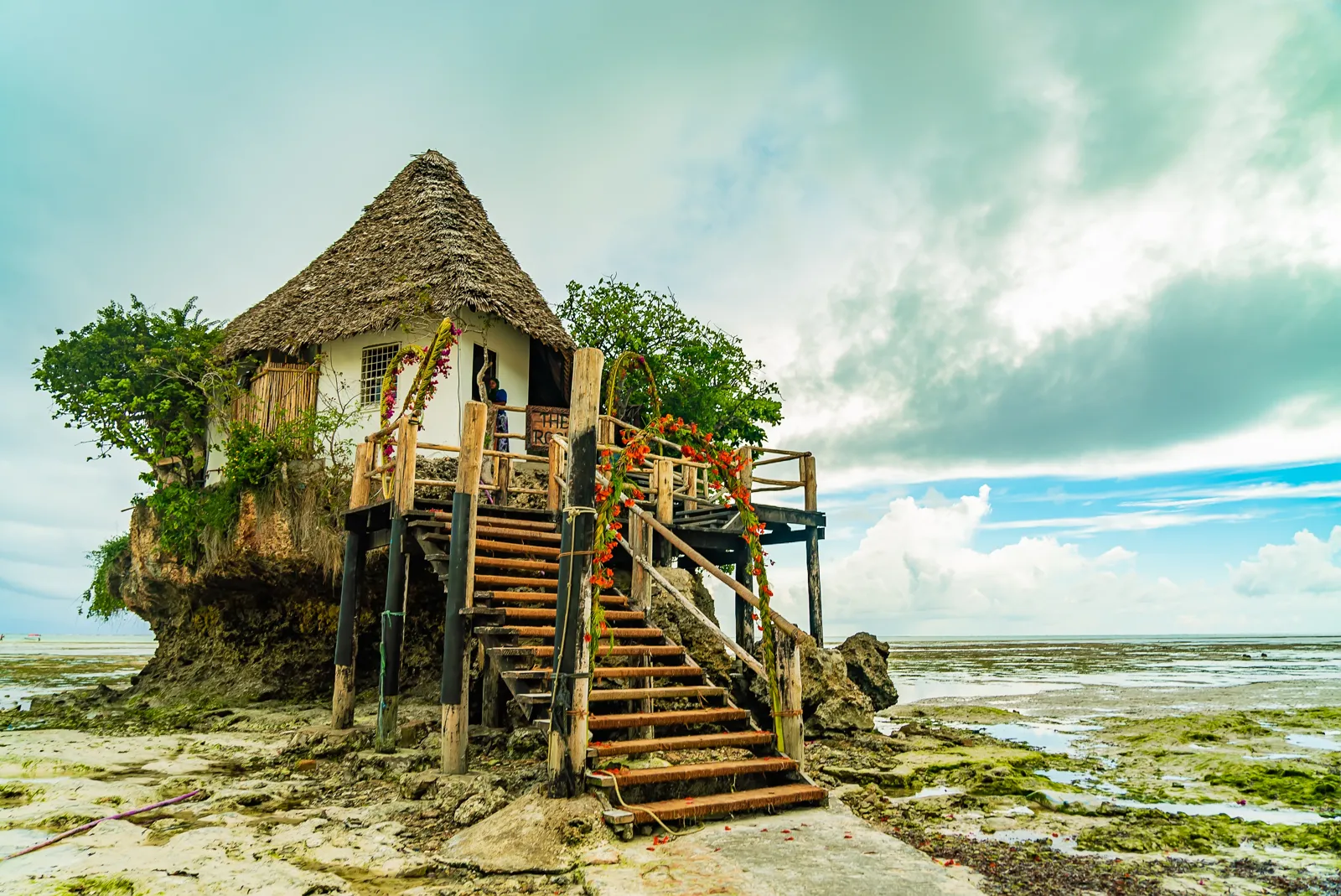
The east and southeast coast (Michamvi, Bwejuu, Paje, Jambiani) has long, very flat beaches and a more laid-back atmosphere. It is Zanzibar’s kitesurfing spot, thanks to steady winds from June to September and from December to February. At low tide, the sea retreats a very long way, revealing women farming seaweed on the tidal flats. On the Michamvi Pingwe peninsula, The Rock restaurant, built on a rock, can be reached on foot at low tide and by small boat at high tide. Choose secure accommodation rather than an isolated villa.
The Rock, in Pingwe, on the east coast.
Jozani Forest
In the south-center of the island, Jozani Chwaka Bay National Park protects one of the last areas of natural forest on Unguja. Zanzibar red colobus, a monkey endemic to the archipelago, are easy to spot, and a boardwalk crosses the mangrove. The guided visit takes one to two hours, on the road to the east coast.
The spice plantations
Zanzibar has long been nicknamed the Spice Island: cloves, cinnamon, nutmeg, pepper, vanilla and cardamom are grown here. Plantation tours, half an hour’s drive from Stone Town, let you smell and taste the spices on the plant. It is an easy half-day to add to a stay in town.
Kizimkazi and the south
The south of the island is more rural. Kizimkazi is known for boat trips to see dolphins in Menai Bay. Boats sometimes crowd around the animals: choose an operator that keeps its distance and does not encourage jumping into the water among the group.
Pemba and Mafia
Pemba, to the north, is greener, less touristy and known for diving. Mafia, to the south, belongs to mainland Tanzania. The UK FCDO notes that there have been several ferry disasters in recent years, including between the islands of Zanzibar: flying is the safer option.
Understanding the tides before choosing your beach
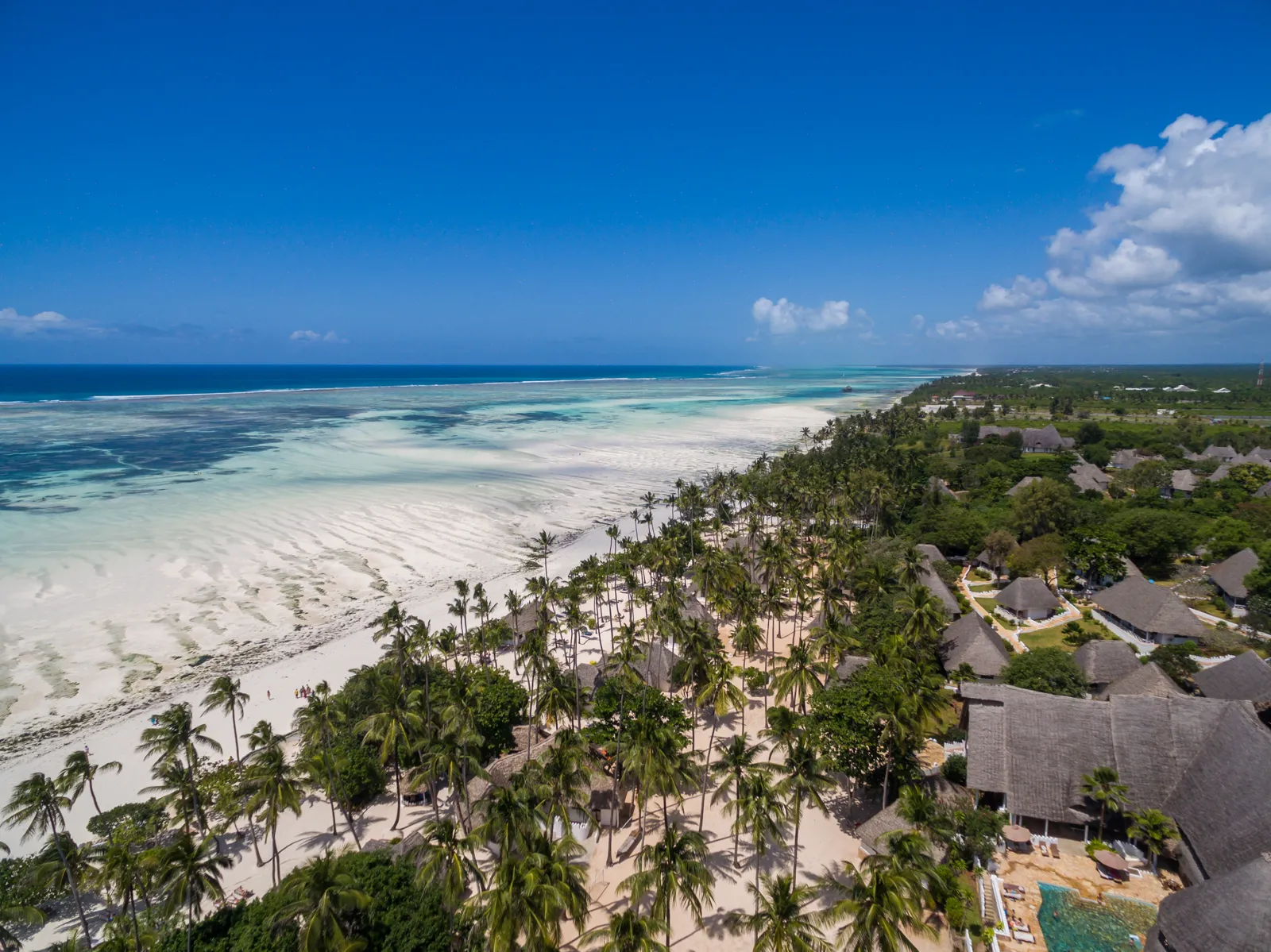
This is Zanzibar’s particularity. Twice a day, the sea goes out and comes back in. On the east coast (Paje, Jambiani, Bwejuu) and to a lesser extent in the northeast (Matemwe, Kiwengwa), it can retreat several hundred meters: for several hours, the beach looks out over a flat of sand, seagrass and rocks, and swimming is no longer possible.
At low tide, the sea retreats far across the flats.
Where the effect is smallest: Nungwi and Kendwa, at the northern tip, where swimming remains possible at almost any time.
When tides are strongest: around the full moon and new moon (spring tides). Around the first and last quarters, the range is more moderate.
How to plan: check a tide table for your dates (many hotels display one at reception), schedule swimming at high tide and walks on the flats at low tide.
On the flats: wear water shoes, because of sea urchins and coral, and don’t get caught by the rising tide, which comes in fast over very flat areas.
Itinerary: suggested routes for a Zanzibar trip
5 to 7 days: Stone Town and one coast
Day 1: arrival, night in Stone Town
Day 2: Stone Town sightseeing, Prison Island or a sandbank, dinner at Forodhani
Day 3: spice plantation in the morning, transfer to the north (Nungwi or Kendwa)
Days 4 to 6: beach, snorkeling trip to Mnemba
Day 7: back to the airport
10 days: Stone Town, the north and the east
Days 1 and 2: Stone Town, Prison Island, spices
Days 3 to 5: Nungwi, Kendwa or the northeast, trip to Mnemba
Day 6: Jozani Forest on the way to the east coast
Days 7 to 9: Paje, Jambiani or Michamvi (kitesurfing, The Rock, Kizimkazi)
Day 10: back to the airport, about an hour’s drive
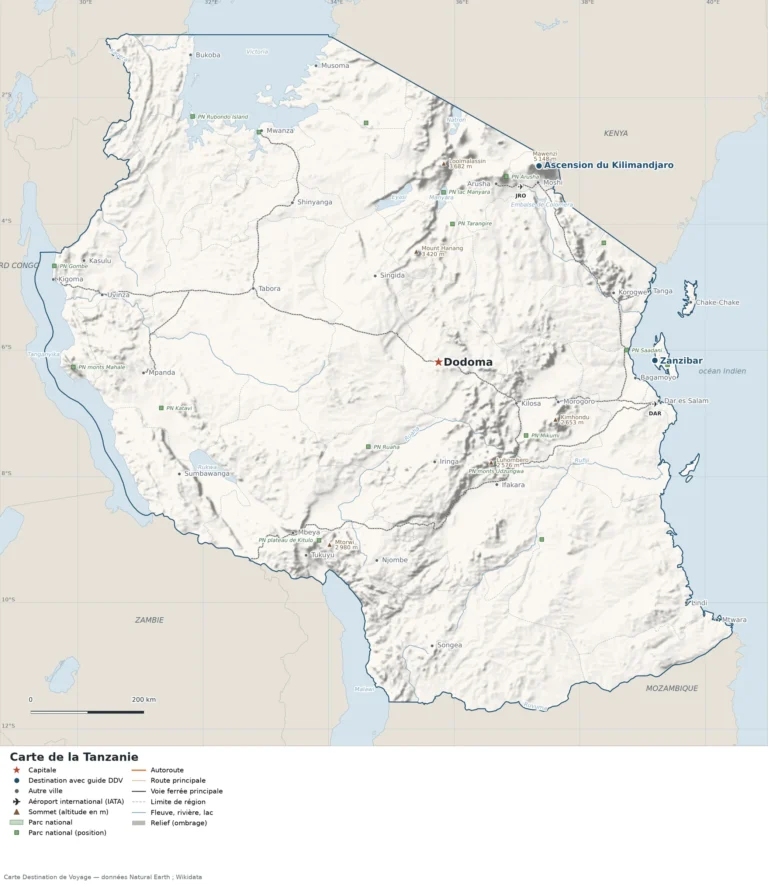
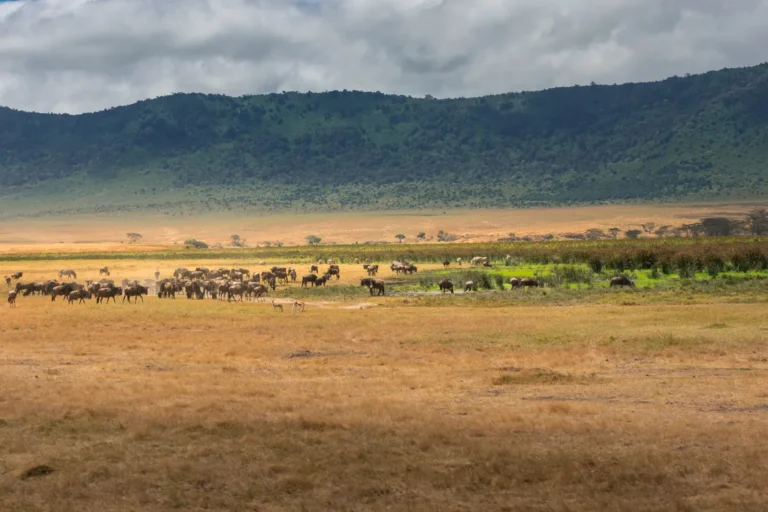
Safari and Zanzibar: the most common combination is 5 to 7 days of safari in northern Tanzania (Tarangire, Serengeti, Ngorongoro), then a domestic flight to Zanzibar for 4 to 6 days on the beach. Full details in our Tanzania travel guide.
Where to stay in Zanzibar by coast
Area
Best for
Good to know
Stone Town
Culture, first or last night
Boutique hotels in old houses; lively, noisy in the evening
Nungwi
Swimming at any time, nightlife
Plenty of hotels and restaurants; stay alert on popular beaches
Kendwa
Beach, sunsets
Swimming little affected by the tide; party atmosphere in places
Northeast (Matemwe, Kiwengwa, Pongwe)
Quiet, couples, diving at Mnemba
Widely spaced hotels; marked tides
East (Paje, Jambiani, Bwejuu)
Kitesurfing, small budgets, laid-back feel
Very strong tides; choose secure accommodation
Michamvi
Quiet, sunsets over the bay
Peninsula at the end of the east coast, isolated
South (Kizimkazi)
Nature, dolphins, peace and quiet
More limited choice, far from the sights
For a first trip, two bases are enough: one or two nights in Stone Town, then a coast chosen according to the tide and the wind.
Particularly if you are traveling alone, prefer secure hotels to isolated villas, close doors and windows and lock your room at night.
Getting there and getting around Zanzibar
Arriving: Abeid Amani Karume International Airport is a few kilometers from Stone Town. From Dar es Salaam, ferries link the port with Stone Town; the U.S. Department of State advises using the high-speed ferry and buying tickets inside the ferry terminal or online in advance, and the UK FCDO notes several ferry disasters between Dar es Salaam and Zanzibar: do not board a ferry that looks overloaded.
Domestic flights: flights link Zanzibar with Arusha, Kilimanjaro, Dar es Salaam, Pemba and the parks.
Taxis and transfers: the simplest solution. It is safest to arrange a taxi through your hotel or travel operator, and to ask to see the driver’s ID (GOV.UK).
Dala-dala: local minibuses, cheap but slow and often crowded; the U.S. Department of State advises avoiding dala-dalas, bajajis and boda-boda motorbike taxis, which are often poorly maintained.
Car rental: according to the UK FCDO, you also need a local Zanzibar driving permit, which you can get through your car hire company; carry several copies of your licence, permits and insurance documents. Avoid driving at night outside towns.
Travel times: allow about 1 to 1.5 hours between Stone Town and Nungwi or Paje, depending on traffic.
When to go to Zanzibar
✓ Ideal~ Good, with caveats✕ AvoidAverage max. temperature · click a month to see where to go
✅ Best months: January, February, June, July, August, September, October
❌ Period to avoid: April, may
The best time is from June to October, during the dry season, then January to February, hotter but with very few rainy days. The long rains, from March to May, are best avoided, especially April (409 mm, 16.1 in). The short rains of November-December mostly bring showers. Month-by-month climate, number of rainy days and advice depending on your plans: our article when to go to Zanzibar.
Budget for a stay in Zanzibar
Zanzibar is much more affordable than a safari. Indicative amounts per person per day, excluding international flights, converted to US dollars at the European Central Bank rate of 23 October 2026:
Indicative estimates, varying with the season and the coast. Prices rise in July-August and over the year-end holidays.
Add the fixed costs on arrival: the visa (US$100 for US citizens, according to the U.S. Department of State) and the mandatory Zanzibar inbound insurance. Also bring US dollars in small bills for tips and some excursions.
Zanzibar: who is it for?
Our verdict depending on how you travel, based on the information in this guide:
Beach: yes, provided you choose your coast according to the tide: in Nungwi and Kendwa, swimming remains possible at almost any time.
Couples: yes: the quiet northeast coast (Matemwe, Pongwe), sunsets at Kendwa, boutique hotels in Stone Town.
Kitesurfing: ideal: Paje and the east coast, with steady winds from June to September and from December to February.
End of a safari: yes: Zanzibar is often the last stop of a trip to Tanzania.
Small budget: yes: roughly US$45 to $112 per person per day, plus the visa and the mandatory insurance.
Solo female travelers: with caution: choose secure hotels rather than isolated villas, use reputable taxis and avoid walking alone at night.
Entry requirements, health and safety
US citizens: according to the U.S. Department of State (travel.state.gov, last updated September 3, 2026), tourists must obtain a one-year multiple-entry visa for $100, applied for online in advance or obtained on arrival. You need a passport with at least one blank page and six months’ validity, a round-trip ticket and proof of sufficient funds. Volunteer work is not allowed on a tourist visa.
UK citizens: according to the UK FCDO (GOV.UK, updated 20 October 2026), you must have a visa: apply for an e-visa before you travel, or get a single-entry visa on arrival at the main ports of entry. Your passport must be valid for at least 6 months after arrival, with at least one blank page, and you must show a return or onward ticket.
Mandatory insurance: all visitors to mainland Tanzania and Zanzibar must buy Tanzanian government-provided inbound travel insurance, even if they already have their own policy. If Zanzibar is your first port of entry, buy it from the Zanzibar Insurance Corporation (ZIC), online beforehand or on arrival; it covers up to 92 days, and you only need it for your first port of entry (UK FCDO). Keep your own travel insurance for medical care.
Health: according to the UK FCDO, health risks include malaria, dengue and cholera: see a doctor about malaria prevention at least 8 weeks before your trip and drink bottled water. A yellow fever certificate is required if you arrive from a country with a risk of transmission. Take out insurance covering medical evacuation.
Safety: avoid walking alone at night, don’t display valuables, use only reputable taxis, and do not accept lifts from strangers (GOV.UK). Stay away from demonstrations.
Laws: same-sex sexual activity is illegal in Tanzania, including Zanzibar (GOV.UK; U.S. Department of State). Plastic bags are banned and handed over on arrival by air (GOV.UK). Drug penalties are severe.
Practical tips for Zanzibar
Dress: there is a high proportion of Muslims in Zanzibar. Dress modestly: women wearing shorts or sleeveless tops away from tourist resorts, particularly in Stone Town, may cause offence, and the Zanzibari authorities can fine you US$700 or more for clothing they consider inappropriate (GOV.UK). During Ramadan, avoid eating or drinking in public outside hotels and restaurants.
Photos: always ask permission before photographing someone. Do not photograph the airport, official buildings or military personnel.
Money: cards are accepted only in some hotels, supermarkets and restaurants. Bank ATMs in major towns accept foreign debit cards but sometimes break down or run out of money; use ATMs inside banks (GOV.UK). Our currency converter helps you get your bearings.
Electricity: power cuts happen; power usually comes back fairly quickly.
Internet: mobile coverage is good across the island. A local SIM card or an eSIM is handy for maps and transfers.
Beach vendors: a polite « hapana, asante » (no, thank you) is enough. Book boat trips with established operators that provide life jackets.
Allow 5 to 7 days for Stone Town and one coast, and about ten days to add a second coast, Jozani and the south. After a safari, 4 to 6 days on the beach is a good format.
Which coast should you choose in Zanzibar?
To swim at any time, the north (Nungwi, Kendwa). For peace and diving at Mnemba, the northeast. For kitesurfing and a laid-back atmosphere, the east (Paje, Jambiani), bearing in mind the strong tides.
Is Zanzibar insurance mandatory?
Yes. According to the UK FCDO, all visitors must buy Tanzanian government-provided inbound travel insurance, from the Zanzibar Insurance Corporation (ZIC) if Zanzibar is your first port of entry, even if they already have their own policy. Keep your own insurance for medical care.
Is Zanzibar safe?
Most visits go smoothly, but the UK FCDO reports incidents in Stone Town, at hotels and on popular beaches, and a risk of protests linked to elections. Choose secure accommodation, use reputable taxis and avoid walking alone at night.
What is the best time to go to Zanzibar?
From June to October, then January-February. Avoid April and May, at the height of the long rains.
What is there to do in Zanzibar?
Explore Stone Town, the World Heritage-listed old town; see the giant tortoises of Prison Island and swim on a sandbank at low tide; visit a spice plantation; watch the endemic red colobus monkey in Jozani Forest; snorkel around Mnemba Atoll; go kitesurfing on the east coast (Paje). Each place is covered in detail above.
Our sources
Entry, health and safety information read on 26 October 2026: U.S. Department of State, Tanzania country information (travel.state.gov, last updated September 3, 2026), and UK FCDO, foreign travel advice for Tanzania (GOV.UK, updated 20 October 2026)
UNESCO World Heritage List: Stone Town of Zanzibar (page checked on 5 October 2026)
Climate normals: 1991-2020 normals for the Zanzibar station (Kisauni airport, WMO station 63870), published by the World Meteorological Organization (NOAA archive)
European Central Bank, euro reference rates of 23 October 2026 (budget conversion)


 FlightsKiwi.comCompare flights and airline combinations to Zanzibar.Compare flights