To go down into the Ngorongoro Crater, a foreign visitor (from outside East Africa) first pays the conservation area entry permit, USD 70.80 per adult, then a « crater service fee » of USD 295 per vehicle per descent, according to the official tariff of the Ngorongoro Conservation Area Authority (NCAA). Only 4×4 vehicles are admitted onto the crater floor, the descent gates close at 4 pm and each permit is valid for a single entry within 24 hours. This page details what you actually pay, the crater rules, sun times and what to check before booking a safari.
The Ngorongoro almost always fits into a northern Tanzania circuit. To build the full itinerary (parks, length, Zanzibar), see our guide to travelling in Tanzania and our Serengeti page, the neighbouring park.

Our travel deals for Ngorongoro Crater
Affiliate links: we earn a commission, at no extra cost to you.
 FlightsKiwi.comCompare flights and airline combinations to Ngorongoro Crater.Compare flights
- eSIMAiraloData plan to install before you leave (eSIM-compatible phone).See plans


Ngorongoro Crater: the essentials
- Entry permit (non-resident from outside East Africa): USD 70.80 from age 16, USD 23.60 for a child, free under 5 — checked 27 October 2026 on ncaa.go.tz
- Descent into the crater: « crater service fee » of USD 295 per vehicle per trip, on top of individual permits.
- Validity: an issued permit is valid for a single entry within 24 hours.
- Hours: driving permitted from 6 am to 6 pm; the crater descent gates close at 4 pm.
- Vehicles: only 4×4 vehicles of up to 3,500 kg (7,716 lb) unladen on the crater floor; a licensed guide or official NCAA guide is compulsory.
- Where: Ngorongoro Conservation Area, Arusha region, northern Tanzania, between Karatu and the Serengeti.
- Entry requirements and safety: see entry requirements for Tanzania; safety notes below.
The Ngorongoro Crater in figures
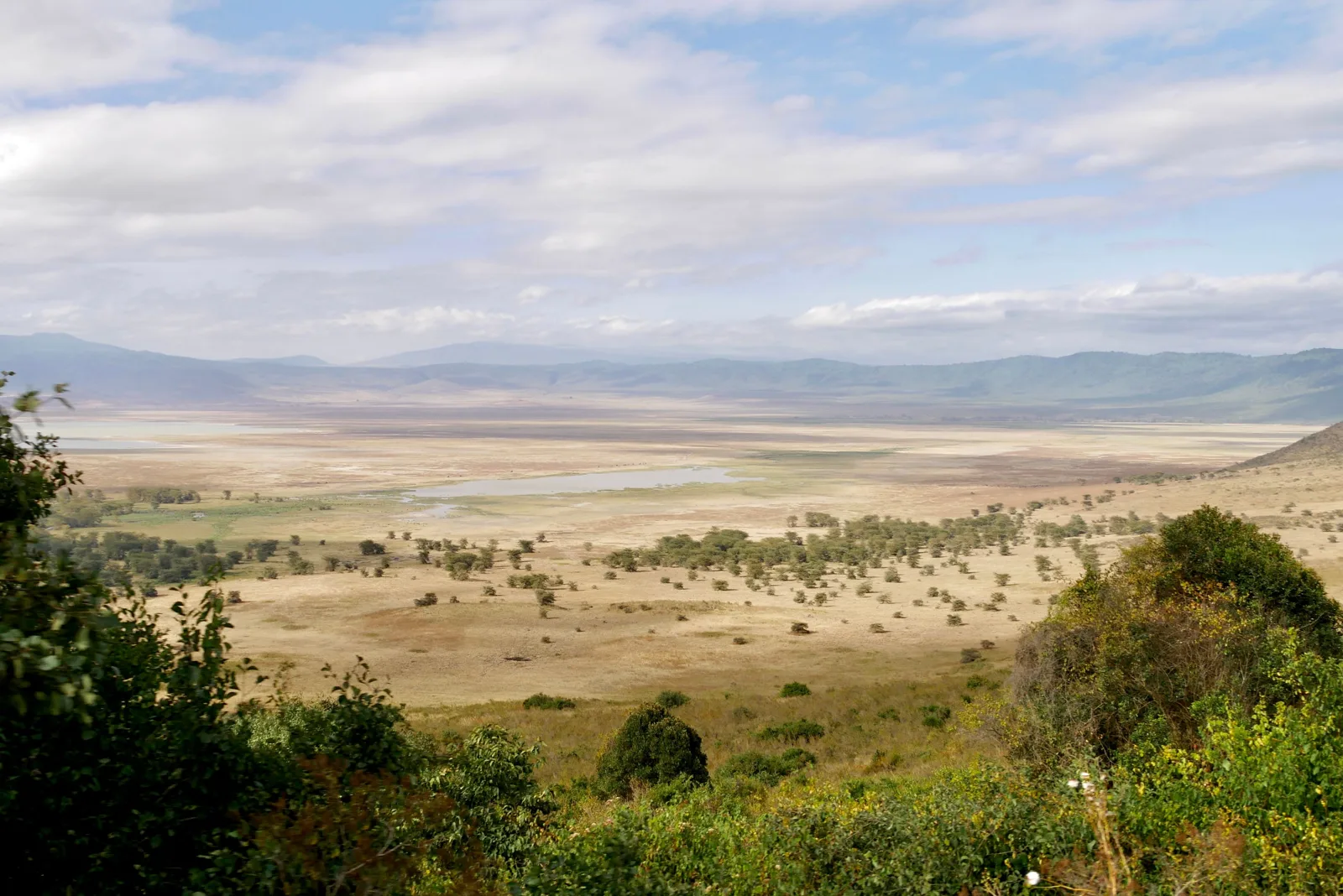
The NCAA presents the crater as the largest intact, unfilled volcanic caldera in the world. It is thought to have formed about 2.5 million years ago, when a massive volcano, almost the size of present-day Kilimanjaro, collapsed in on itself because of tectonic activity.
| Data | Value according to the NCAA |
|---|---|
| Age | About 2.5 million years |
| Area | Nearly 260 km² (100 sq mi) |
| Diameter | About 20 km (12 mi) |
| Caldera depth | 610 m (2,001 ft) |
| Wildlife | More than 25,000 animals, including the « Big Five » |
The name is said to come from a Maasai expression, « orgirra le kkorongorro », meaning « big bowl »; the NCAA explains that early documents distorted the word into « Ngorongoro ». The crater floor combines grassland, swamp, rivers and woodland, and animals can enter and leave freely all year round.
What you actually pay: the NCAA tariff
This is the point most online guides skip: at the Ngorongoro, access costs add up. For a non-East African visitor, the official tariff distinguishes several items.
| Item (non-residents from outside East Africa) | Official rate | Who it applies to |
|---|---|---|
| Entry permit, age 16 and over | USD 70.80 | Per person, entry valid 24 h |
| Entry permit, child | USD 23.60 | Per child (category under 16) |
| Entry permit, under 5 | Free | — |
| Crater service fee | USD 295 | Per vehicle per descent into the crater |
| Foreign-registered vehicle, up to 2,000 kg (4,409 lb) | USD 47.20 | Per vehicle |
| Foreign-registered vehicle, 2,001 to 3,000 kg (4,410 to 6,614 lb) | USD 177 | Per vehicle |
| Public campsite, age 16 and over | USD 35.40 | Per person |
| Olduvai Gorge / Shifting Sands, age 16 and over | USD 35.40 | Per person |
In practice, for a descent to the crater floor you need to count each passenger’s individual permit, the vehicle’s crater service fee (once per vehicle per descent) and the vehicle permit itself. If you go with a safari agency, these amounts are in principle included in the package; if you are comparing two quotes, check in black and white that the crater service fee is included.
The 24-hour trap
The NCAA states that an issued permit is valid for only one entry within 24 hours, and that entry and camping fees must be paid within 24 hours of entry. A two-night stay on the crater rim therefore means several 24-hour periods of entry fees. Fines are set by the same tariff: TZS 118,000 per vehicle for speeding or driving off-track, and the full fee plus 100% for fraud.
Crater rules
The NCAA’s « Guidelines and Procedures for Visitors » page sets out precise rules, which your guide will apply. It is better to know them before you go.
- Hours: driving is permitted from 6 am to 6 pm; outside those hours, authorisation is needed. The crater descent gates close at 4 pm (the official page also cites 6 pm in the same sentence, without saying what that second time refers to: have your guide confirm it).
- Speed: 50 km/h (31 mph) in the conservation area, 25 km/h (16 mph) in the craters.
- Vehicles: only 4×4 vehicles of up to 3,500 kg (7,716 lb) (unladen weight) go down onto the crater floor, apart from trucks authorised for organised groups; commercial vehicles must be registered with a TALA licence.
- Guide: a licensed guide or an official NCAA guide must accompany all crater visitors.
- Stay in the vehicle: except in designated areas, visitors stay on board at all times. Walking is prohibited on the crater floor, but allowed on the rim and elsewhere, accompanied by an armed NCAA ranger.
- Wildlife viewing: at most 5 vehicles around an animal or a kill, silence required, at least 25 metres (82 ft) away.
- Environment: no off-road driving, no litter, plastic bags are banned in the conservation area, no fires, no picking or collecting.
- Photos: photographing local people is prohibited, except in designated « cultural bomas » (entry USD 20 per vehicle according to the tariff).
- Pets: not allowed.
Picnics are permitted free of charge in designated public areas; special picnic sites must be booked and paid for in advance. A hot meal served in the crater by a lodge (« bush lunch ») is subject to a permit of USD 23.60 per vehicle.
What to see in and around the crater
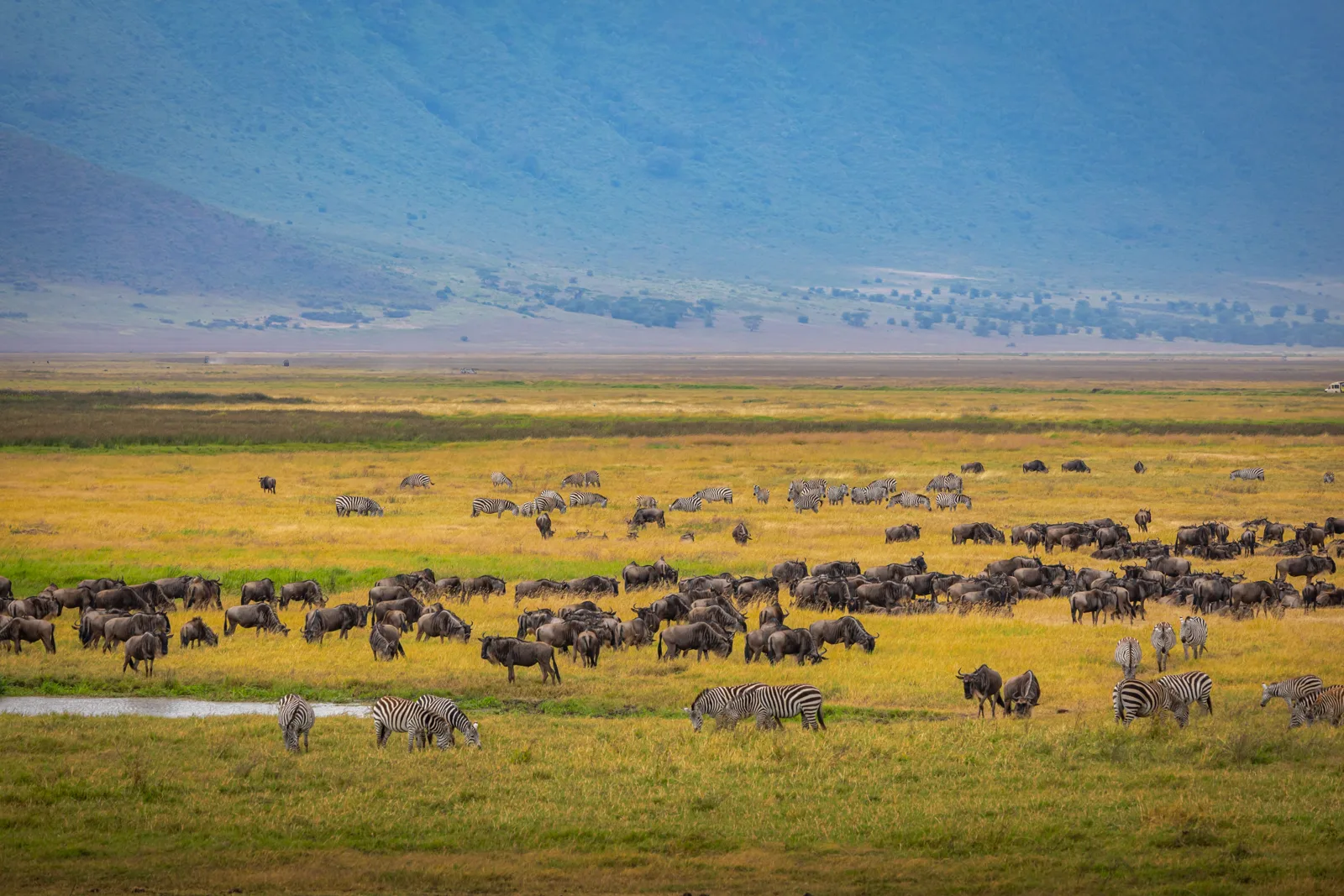
According to the NCAA, the crater is home to the « Big Five » (elephants, buffalo, rhinoceros, lions and leopards), but also hippos, hyenas, warthogs, zebras, elands, gazelles and wildebeest. The authority describes it as probably the best site in Tanzania for easily seeing the Big Five. The permitted activities listed on its page: game drives, photo safaris, birdwatching, walks (on the rim), bush meals and sundowners (subject to a « sundown fee » of USD 5.90 per adult).
The conservation area is not just the crater. The NCAA also manages:
- Olduvai Gorge: an archaeological site where Mary and Louis Leakey unearthed, over more than 30 years, fossils of human ancestors, including the « Zinjanthropus » skull. The NCAA states that an official guide is needed to visit the excavations and that the gorge can be visited all year.
- The Shifting Sands (moving dunes) and the Laetoli footprints (USD 23.60 per adult).
- The Empakai and Olmoti craters, as well as the highland forest and the Endoro Waterfalls (trail at USD 17.70 per adult).
- The Ndutu plains, bordering the Serengeti.
Olduvai Gorge has been part of the UNESCO World Heritage site since 1979, the NCAA points out.
Best time to visit
The NCAA answers simply: the crater is accessible all year, thanks to the state of the roads and the presence of wildlife in every season. For the rainy seasons and temperatures, see our page on the best time to visit Tanzania. As for light, since the crater is almost on the equator, day length varies very little: the table below shows how that compares with the official hours.
| Month | Sunrise | Sunset | Day length |
|---|---|---|---|
| January | 6:38 am | 6:55 pm | 12 h 17 min |
| February | 6:45 am | 6:58 pm | 12 h 13 min |
| March | 6:43 am | 6:50 pm | 12 h 08 min |
| April | 6:36 am | 6:39 pm | 12 h 02 min |
| May | 6:35 am | 6:33 pm | 11 h 58 min |
| June | 6:40 am | 6:36 pm | 11 h 56 min |
| July | 6:45 am | 6:42 pm | 11 h 57 min |
| August | 6:42 am | 6:42 pm | 12 h 00 min |
| September | 6:30 am | 6:35 pm | 12 h 05 min |
| October | 6:18 am | 6:29 pm | 12 h 10 min |
| November | 6:14 am | 6:30 pm | 12 h 16 min |
| December | 6:23 am | 6:42 pm | 12 h 19 min |
What the figures show: day length stays between 11 h 56 min and 12 h 19 min all year. The sun rises between 6:14 am and 6:45 am: when driving opens, at 6 am, it is still dark whatever the month. Since descents close at 4 pm, an early start from your lodge is the only way to lengthen your time on the crater floor, and to enjoy the low morning light.
Getting there, accommodation and organising your safari
The NCAA does not publish journey times from Arusha. In practice the crater is visited as part of an organised safari: commercial vehicles must belong to a registered company (TALA licence), and only 4×4 vehicles go down onto the floor. The NCAA mentions accommodation on the rim and nearby: the Simba A public campsite, lodges and special campsites (the latter to be booked and confirmed before arrival).
Booking your Ngorongoro safari
Whether you use a local agency or a tour operator, ask four questions before paying: is the crater service fee (USD 295 per vehicle) included; how many 24-hour periods of entry fees does the quote cover; is the vehicle a registered 4×4 with a licensed guide; and what are the cancellation terms. Entry rules: see entry requirements for Tanzania; mobile internet: our travel eSIM guide.
Safety: what the UK FCDO says
The UK Foreign, Commonwealth & Development Office (FCDO), in its Tanzania travel advice (GOV.UK, updated 20 October 2026), says: « If you’re visiting game reserves and national parks, always follow park regulations and advice from wardens. » It also advises using only reputable tour operators, not buying safari tours from touts, and notes that the Tanzania Association of Tour Operators (TATO) maintains a list of licensed tour companies.
On roads, the same advice says that roads in Tanzania’s national parks, mainly dirt tracks, can become hazardous or impassable after heavy rain, that a 4-wheel drive vehicle may be essential, and to avoid driving outside major towns and cities at night. For wildlife, it warns of the risks of viewing animals, particularly on foot or at close range. That is one more reason to travel by day with an experienced driver and to stay in the vehicle as the NCAA rules require.
Common mistakes to avoid
- Comparing quotes without checking the USD 295 per vehicle crater service fee, often the heaviest line.
- Forgetting the 24-hour rule: each new period generates new entry fees.
- Arriving too late at the descent gate: it closes at 4 pm.
- Getting out of the vehicle for a photo: it is prohibited outside designated areas.
- Photographing the Maasai without being invited: it is prohibited outside the cultural bomas.
- Bringing plastic bags: they are banned in the conservation area.
What to see nearby
- Serengeti: the large neighbouring park and the Migration.
- Kilimanjaro: climbing the roof of Africa.
- Zanzibar: the classic beach extension after the safari.
- Safari in Africa: comparing the main destinations.
- Masai Mara: the other side of the ecosystem, in Kenya.
Frequently asked questions
How much does it cost to enter the Ngorongoro Crater?
For a non-resident from outside East Africa: USD 70.80 per adult for the entry permit, plus USD 295 per vehicle per descent into the crater (crater service fee), according to the NCAA tariff consulted on 27 October 2026.
What time does the crater descent close?
According to the NCAA, the descent gates close at 4 pm; driving is permitted from 6 am to 6 pm in the conservation area.
Can you visit the Ngorongoro without a guide?
Not for the crater: a licensed guide or an official NCAA guide must accompany all visitors, and only 4×4 vehicles of up to 3,500 kg (7,716 lb) go down onto the floor.
Can you walk in the crater?
No. The NCAA prohibits walking on the crater floor; walks are possible on the rim and elsewhere, with an armed ranger.
What is the best season for the Ngorongoro?
The NCAA states that the crater is accessible all year, with wildlife present permanently.
Is the Ngorongoro safe?
The UK FCDO (GOV.UK, updated 20 October 2026) advises following park regulations and wardens’ advice, using reputable tour operators and avoiding driving outside major towns at night.
Our sources
- Ngorongoro Conservation Area Authority (NCAA): « Tariffs », « Ngorongoro Crater », « Guidelines and Procedures for Visitors » and « Olduvai Gorge » pages, ncaa.go.tz, consulted on 27 October 2026
- UK Foreign, Commonwealth & Development Office (FCDO), Tanzania travel advice, Safety and security (GOV.UK, updated 20 October 2026), text downloaded on 26 October 2026
- Coordinates of the crater: Wikipedia, « Ngorongoro Crater » article
- Sunrise, sunset and day length: calculation by Destination de Voyage, NOAA solar algorithm, Africa/Dar_es_Salaam time zone, coordinates of the Ngorongoro Crater (Wikipedia), 15th of each month (year 2027)
- Our methodology
Updated November 2026.