
Choose Krakow for an intact medieval old town, Wawel Castle, the Jewish district of Kazimierz and two major day trips: Auschwitz-Birkenau and the Wieliczka salt mine. Choose Warsaw for a modern capital rebuilt after 1945, its history museums (Uprising, POLIN), its parks and its alternative neighborhoods. For a first stay in Poland, Krakow is often the simpler choice; the ideal is to combine both by train.
Krakow or Warsaw? Poland’s two big cities share the same time zone, the same simple entry rules and the same currency, the zloty. Yet they tell two opposite stories: Krakow, the former royal capital, came through the Second World War almost undamaged; Warsaw, razed, was rebuilt stone by stone. On the weather side, we compared the official normals of the Institute of Meteorology and Water Management (IMGW) month by month: Krakow is a little milder, but also wetter. For the rest, see our guides to Krakow and Warsaw.
Krakow or Warsaw: key points
- Old heritage and a city on foot: Krakow (Main Market Square, St. Mary’s Basilica, Wawel, Kazimierz)
- 20th-century history, museums and big parks: Warsaw (Warsaw Rising Museum, POLIN, Łazienki, Praga)
- Day trips: Auschwitz-Birkenau and Wieliczka from Krakow; Wilanów Palace in Warsaw
- Climate: Krakow milder in the afternoon eleven months out of twelve, but about 22% more rain over the year (our calculation from IMGW data)
- Entry: both are Schengen; see the entry requirements section below for US and UK citizens
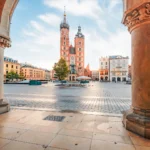
Krakow or Warsaw: criterion-by-criterion comparison
| Criterion | Krakow | Warsaw | Advantage |
|---|---|---|---|
| Historic center | Medieval and Renaissance, authentic, World Heritage listed | Old town rebuilt after 1945, World Heritage listed for that reconstruction | Krakow |
| 20th-century history | Kazimierz, Podgórze ghetto, Schindler’s factory; Auschwitz-Birkenau as a day trip | Warsaw Rising Museum, POLIN Museum, traces of the ghetto | Tie |
| Museums | Cloth Hall, underground museum, Collegium Maius | Royal Castle, POLIN, Rising Museum, Chopin Museum, Copernicus Science Centre | Warsaw |
| Parks and nature | Planty, Kościuszko Mound; Tatras further away | Łazienki Park, Wilanów Palace, Vistula banks | Warsaw |
| Evening atmosphere | Kazimierz and Old Town bars | Praga, Vistula banks, wider scene | Tie |
| July (high / rain) | 25.3 °C (78 °F) / 98 mm (3.9 in) | 25.2 °C (77 °F) / 82 mm (3.2 in) | Warsaw (drier) |
| September (high / rain) | 19.5 °C (67 °F) / 66 mm (2.6 in) | 19.1 °C (66 °F) / 50 mm (2.0 in) | Tie |
| January (high / low) | 1.6 °C (35 °F) / −4.7 °C (24 °F) | 1.0 °C (34 °F) / −4.0 °C (25 °F) | Tie |
| Entry rules | Same for both: Poland follows Schengen rules (see below) | Same for both | Tie |
| Safety | Normal vigilance; thieves and pickpockets operate at major tourist destinations, stations and on trains and trams (U.S. State Department, Poland-wide) | Same Poland-wide advice | Tie |
Month-by-month climate: our comparison of IMGW normals
The two reference stations are the airport ones (Kraków-Balice and Warsaw-Chopin, or Okęcie). The table puts the two series side by side and calculates the difference, month by month.
| Month | Krakow: high / low / rain | Warsaw: high / low / rain | High-temperature difference (Krakow − Warsaw) | Rain difference |
|---|---|---|---|---|
| January | 1.6 °C (35 °F) / −4.7 °C (24 °F) / 38 | 1.0 °C (34 °F) / −4.0 °C (25 °F) / 31 | +0.6 °C (+1 °F) | +7 mm |
| February | 3.7 °C (39 °F) / −3.7 °C (25 °F) / 32 | 2.6 °C (37 °F) / −3.3 °C (26 °F) / 30 | +1.1 °C (+2 °F) | +2 mm |
| March | 8.4 °C (47 °F) / −0.8 °C (31 °F) / 38 | 7.4 °C (45 °F) / −0.6 °C (31 °F) / 29 | +1.0 °C (+2 °F) | +9 mm |
| April | 15.1 °C (59 °F) / 3.7 °C (39 °F) / 46 | 14.6 °C (58 °F) / 4.0 °C (39 °F) / 35 | +0.5 °C (+1 °F) | +11 mm |
| May | 19.8 °C (68 °F) / 8.5 °C (47 °F) / 79 | 19.8 °C (68 °F) / 8.8 °C (48 °F) / 56 | +0.0 °C (0 °F) | +24 mm |
| June | 23.2 °C (74 °F) / 12.2 °C (54 °F) / 77 | 23.1 °C (74 °F) / 12.4 °C (54 °F) / 64 | +0.1 °C (0 °F) | +13 mm |
| July | 25.3 °C (78 °F) / 13.8 °C (57 °F) / 98 | 25.2 °C (77 °F) / 14.5 °C (58 °F) / 82 | +0.1 °C (0 °F) | +16 mm |
| August | 25.0 °C (77 °F) / 13.4 °C (56 °F) / 72 | 24.7 °C (76 °F) / 13.8 °C (57 °F) / 61 | +0.3 °C (+1 °F) | +12 mm |
| September | 19.5 °C (67 °F) / 9.2 °C (49 °F) / 66 | 19.1 °C (66 °F) / 9.5 °C (49 °F) / 50 | +0.4 °C (+1 °F) | +15 mm |
| October | 14.0 °C (57 °F) / 4.7 °C (40 °F) / 51 | 12.9 °C (55 °F) / 5.0 °C (41 °F) / 40 | +1.1 °C (+2 °F) | +11 mm |
| November | 7.6 °C (46 °F) / 0.6 °C (33 °F) / 41 | 6.5 °C (44 °F) / 1.3 °C (34 °F) / 36 | +1.1 °C (+2 °F) | +5 mm |
| December | 2.7 °C (37 °F) / −3.4 °C (26 °F) / 33 | 2.3 °C (36 °F) / −2.5 °C (28 °F) / 36 | +0.4 °C (+1 °F) | −3 mm |
What our calculation shows, based on these normals:
- Krakow is slightly warmer in the afternoon eleven months out of twelve: up to 1.1 °C (2 °F) more in February, October and November, 1.0 °C (2 °F) in March. In May, the two cities are level (19.8 °C (68 °F)).
- Nights are cooler in Krakow from March to October (for example 9.2 °C (49 °F) against 9.5 °C (49 °F) in September, 13.8 °C (57 °F) against 14.5 °C (58 °F) in July).
- Warsaw is clearly drier: 550 mm (21.7 in) a year against 673 mm (26.5 in) in Krakow, or about 18% less rain. The gap is greatest in May (56 mm against 79 mm) and in July (82 mm against 98 mm).
- Summer is the wettest season in both cities: May to August concentrate the thunderstorms. September offers the best compromise: 19 to 20 °C (66 to 68 °F) in the afternoon and less rain than in summer.
Climate conclusion: the difference is small for a city break. If you travel in May-July and fear rain, Warsaw has a slight edge; in spring and autumn, Krakow is a little more pleasant in the afternoon. In winter, it freezes at night in both cities.
What to see: the intact city or the rebuilt city
Krakow
Krakow is visited on foot. The Main Market Square (Rynek Główny), one of the largest medieval squares in Europe, surrounds the Cloth Hall; St. Mary’s Basilica houses the Veit Stoss altarpiece, and the trumpeter plays the hejnał every hour from the highest tower. The Royal Route leads from the Barbican to Wawel, the hill of the castle and the cathedral of the kings of Poland. Kazimierz, the former Jewish quarter, brings together synagogues, cafés and bars; across the Vistula, Podgórze keeps the memory of the ghetto and of Oskar Schindler’s factory. The city is also the base for day trips to Auschwitz-Birkenau (book on the Memorial’s official site) and the Wieliczka salt mine.
Warsaw
Warsaw is explored by tram and metro. The old town and its market square were rebuilt identically after the war, from plans, photographs and old paintings. The Royal Castle, the Royal Route (Krakowskie Przedmieście, Nowy Świat) and Łazienki Park form the classic itinerary. The two major museums are the Warsaw Rising Museum (1944) and POLIN, devoted to a thousand years of Jewish history in Poland. The Palace of Culture and Science dominates the center; on the other bank, Praga, less affected by the war, is home to workshops, bars and the Neon Museum. In the south, the Baroque Wilanów Palace needs half a day.
Krakow or Warsaw by traveler profile
| Profile | Verdict | Why |
|---|---|---|
| First trip to Poland | Krakow | Compact, intact center, everything on foot, major day trips nearby |
| Second World War history | Both | Auschwitz-Birkenau and Schindler from Krakow; Rising and POLIN in Warsaw |
| Museums | Warsaw | More major museums, several suited to families |
| Couple, romantic weekend | Krakow | Old town and Kazimierz in the evening, the Vistula below Wawel |
| Family | Warsaw, narrowly | Parks, Copernicus Science Centre; Auschwitz is not recommended for young children |
| Contemporary architecture, urban life | Warsaw | Business-district towers, Praga, redeveloped riverbanks |
| Mountains | Krakow | Gateway to the Tatras and Zakopane |
First trip
Krakow has the advantage of simplicity: the main monuments fit in a small area, and the country’s two most popular day trips leave from the city. Allow three days for the city, four to five with Auschwitz-Birkenau and Wieliczka. Verdict: Krakow.
History enthusiasts
The two cities are complementary. Krakow shows a city that was spared and the memorial site of Auschwitz-Birkenau, in Oświęcim. Warsaw explains the destruction: the Warsaw Rising Museum tells the story of the 63 days of 1944, and the reconstruction of the old town is itself a subject of history. Verdict: do both if possible.
Families
In Warsaw, Łazienki Park, the Vistula banks and the Copernicus Science Centre easily fill a day. In Krakow, Wawel and its Dragon’s Den appeal to children; a visit to Auschwitz-Birkenau, which is distressing, is not suited to the youngest. Verdict: Warsaw, narrowly.
Entry requirements for Poland
Both cities are in Poland, so the rules are identical.
US citizens
- According to the U.S. Department of State (travel.state.gov, last updated August 20, 2026), Poland follows Schengen requirements: your passport should be valid for at least three months beyond the period of stay, and you will need proof of sufficient funds and a return plane ticket. The State Department also notes that US citizens are restricted from entering Poland from Belarus and Russia unless they meet one of the exceptions in place.
UK citizens
- According to the UK FCDO (GOV.UK, updated 11 August 2026), you can travel to the Schengen area, including Poland, without a visa for up to 90 days in any 180-day period as a tourist. Your passport must have been issued less than 10 years before arrival and expire at least 3 months after the day you plan to leave the Schengen area. The FCDO notes that most visitors do not experience difficulties, and that serious crime against foreigners is rare.
Check travel.state.gov and GOV.UK before you go.
Why not both?
It is the most common formula for a first week in Poland: three to four days in Krakow, two to three in Warsaw. The two cities are linked by train; check schedules and journey times on the operator’s site before you book. If possible, fly into one city and out of the other. In every case, keep your passport with you.
When to go to Krakow or Warsaw
May-June and September are the best periods in both cities: 19 to 23 °C (66 to 73 °F) in the afternoon according to IMGW. July-August is the hottest and stormiest. December has its Christmas markets, but it freezes at night. The month-by-month detail, with events, is on our page when to go to Poland.
Frequently asked questions
Krakow or Warsaw for a first trip?
Krakow, generally: its medieval center is intact, compact and easy to visit on foot, and the day trips to Auschwitz-Birkenau and Wieliczka leave from the city. Warsaw suits you better if you like big history museums and the atmosphere of a capital.
Which city is warmer?
Krakow, narrowly: its average high exceeds Warsaw’s by 0.1 to 1.1 °C (0 to 2 °F) depending on the month, with a tie in May (IMGW 1991-2020 normals, Destination de Voyage calculation). Warsaw is drier, though.
How many days for Krakow and Warsaw?
Three days for Krakow, four to five with Auschwitz-Birkenau and Wieliczka; two to three days for Warsaw. A week lets you combine the two by train.
Do you need a visa for Poland?
Not for tourist stays of up to 90 days: Poland follows Schengen rules, for US citizens (travel.state.gov) and UK citizens (GOV.UK). Your passport should be valid for at least three months beyond your stay; see the entry requirements section above for dates and details.
Can you pay in euros?
Poland’s currency is the zloty (PLN), not the euro. Pay by card in zlotys or withdraw cash at an ATM; our currency converter helps you estimate amounts.
Our sources
- Institute of Meteorology and Water Management (IMGW-PIB): 1991-2020 normals for the Kraków-Balice and Warszawa-Okęcie stations, read via Wikipedia (an article citing IMGW) on 23 October 2026; monthly differences and annual totals: Destination de Voyage calculation
- Entry and safety information read on 12 November 2026: U.S. Department of State, Poland country information (travel.state.gov, last updated August 20, 2026) and UK FCDO, foreign travel advice for Poland (GOV.UK, updated 11 August 2026)
- Method: our methodology
To go further: our guides travel to Poland, things to do in Krakow and things to do in Warsaw, and our other destination comparisons, including Prague or Budapest and Prague or Vienna. Updated November 2026.