
Varna, the great Black Sea port, is worth visiting for its beaches, its huge Sea Garden (Morska Gradina), its Roman baths and its Archaeological Museum, which displays the gold of the Varna Necropolis, considered the oldest worked gold discovered to date. It is also a base for the nearby beach resorts and trips along the north coast. Things to do in Varna, when to go according to official normals, and what to know about entry rules: here are the essentials, with sources.
For inland Bulgaria, see our Sofia guide, our Bulgaria travel guide and the best time to visit Bulgaria.

Our travel deals for Varna
Affiliate links: we earn a commission, at no extra cost to you.
 FlightsKiwi.comCompare flights and airline combinations to Varna.Compare flights
- Airport transferKiwitaxiPrivate driver booked in advance at a fixed price.Book a transfer


Varna: key facts
- Archaeological Museum: gold from the Varna Necropolis, dated 4600 to 4200 BC
- Beach season: June to September; July and August are the hottest months (highs of 29 °C / 84 °F) and the sunniest (over 10 hours of sunshine a day)
- Entry: US and UK citizens can stay up to 90 days without a visa under Schengen rules (travel.state.gov, GOV.UK)
- Currency: the euro since 1 January 2026 (GOV.UK)
Things to do in Varna: the highlights
The Archaeological Museum and the Varna gold
This is the city’s major sight. The museum displays the grave goods of the Varna Necropolis, discovered in the city: a group of burials containing, according to the Wikipedia article on the site, the oldest gold objects discovered to date, dated 4600 to 4200 BC. Of the 312 graves, only four held three quarters of the gold, a sign of an already highly hierarchical society. The collections also cover the Thracian, Greek, Roman and medieval periods. Opening hours and tickets: check the museum’s website before your visit.
The Roman baths of Odessos
In antiquity, Varna was Odessos, a Greek colony and then a Roman city. Its large Roman baths, right in the center, are among the best-preserved ancient remains in the country: you can still make out the layout of the hot and cold rooms and the hypocausts.
The Dormition Cathedral and the center
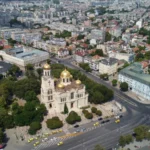
The Cathedral of the Dormition of the Mother of God, with its golden domes, is the city’s main religious monument, built at the end of the 19th century. Around it, the pedestrian center links Independence Square, the theater and the shopping streets down to the Sea Garden.
The Sea Garden (Morska Gradina) and the beaches
This large park runs along the coast above the city beaches. It has shady paths, an aquarium, a dolphinarium, an observatory-planetarium and a naval museum. Below, the city beaches are lined with clubs and restaurants, lively in summer. Swim only on supervised beaches: the UK FCDO advises obeying warning signs, following lifeguards’ instructions and observing the flags, and following local advice if jellyfish or sea urchins are present.
Aladzha Monastery
North of the city, this medieval rock monastery is carved into a limestone cliff, in a wooded reserve. Steps cut into the rock lead up to the cells and the chapel. It combines easily with the beach resorts of the north coast.
Pobiti Kamani and the surroundings
West of Varna, Pobiti Kamani (the « Stone Forest ») lines up natural stone columns in a sandy landscape, a protected geological curiosity. The north coast has the resorts of Golden Sands (Zlatni Pyasatsi) and Saints Constantine and Helena; to the south lies the Kamchia river mouth reserve. Check access conditions and opening hours on the managers’ websites.
Booking your visits: official site or reseller?
Tickets for museums and sites are sold on site or on their official websites. Resellers offer day trips (Aladzha, Pobiti Kamani, Balchik and Cape Kaliakra, Nessebar): check which admissions are included, the guide’s language, the pick-up point and the time actually spent at each site.
Itinerary: Varna in two days
- Day 1, morning: the Archaeological Museum, then the Dormition Cathedral.
- Day 1, afternoon: the Roman baths, the pedestrian center, then the Sea Garden down to the beaches.
- Day 2: Aladzha Monastery and the north coast, or Pobiti Kamani; in summer, an afternoon on the beach.
- With more time: Balchik and Cape Kaliakra to the north, Nessebar and Burgas to the south.
When to go to Varna
Varna has a temperate climate moderated by the Black Sea: hot, sunny summers and cool, gray winters, without extremes. The table uses the World Meteorological Organization’s 1991-2020 normals for the Varna station, distributed by NOAA, with our calculations of average daily sunshine and sunrise and sunset times.
| Month | High °C (°F) | Low °C (°F) | Precipitation mm (in) | Sunrise / sunset on the 15th | Daylight | Sunshine (h/day) | Verdict |
|---|---|---|---|---|---|---|---|
| January | 6.6 (44) | −0.5 (31) | 45 (1.8) | 7:37 am / 4:57 pm | 9 h 20 | 3.2 | ❌ Cold, resorts closed |
| February | 8.1 (47) | 0.3 (33) | 33 (1.3) | 7:06 am / 5:38 pm | 10 h 32 | 4.2 | ❌ Cold |
| March | 11.2 (52) | 3.1 (38) | 42 (1.7) | 6:21 am / 6:14 pm | 11 h 53 | 5.0 | ⚠️ Cool, early spring |
| April | 15.5 (60) | 7.2 (45) | 38 (1.5) | 6:26 am / 7:50 pm | 13 h 24 | 6.8 | ⚠️ Mild, cold sea |
| May | 21.2 (70) | 12.3 (54) | 38 (1.5) | 5:45 am / 8:25 pm | 14 h 40 | 8.4 | ✅ Ideal for the city |
| June | 26.1 (79) | 16.7 (62) | 52 (2.0) | 5:27 am / 8:49 pm | 15 h 22 | 9.3 | ✅ Beach season begins |
| July | 28.9 (84) | 18.9 (66) | 48 (1.9) | 5:41 am / 8:46 pm | 15 h 05 | 10.3 | ✅ High summer, warm sea |
| August | 29.4 (85) | 19.2 (67) | 29 (1.1) | 6:13 am / 8:11 pm | 13 h 58 | 10.3 | ✅ Sunniest and driest |
| September | 24.8 (77) | 15.2 (59) | 49 (1.9) | 6:47 am / 7:19 pm | 12 h 32 | 7.9 | ✅ Still warm, fewer people |
| October | 19.0 (66) | 10.5 (51) | 56 (2.2) | 7:21 am / 6:26 pm | 11 h 05 | 5.3 | ⚠️ Mild, end of season |
| November | 13.2 (56) | 5.9 (43) | 49 (1.9) | 7:00 am / 4:44 pm | 9 h 44 | 3.5 | ❌ Cool and gray |
| December | 8.2 (47) | 1.3 (34) | 47 (1.9) | 7:33 am / 4:33 pm | 9 h 00 | 3.0 | ❌ Cold and gray |
How to read it: July and August are the hottest (highs of 28.9 and 29.4 °C / 84 and 85 °F) and the sunniest, with about 10.3 hours of sunshine a day, more than three times as much as in December (3.0 h/day), a Destination de Voyage calculation from WMO normals. August is also the driest month (29 mm / 1.1 in, 3 rainy days on average). May, June and September offer mild (21 to 26 °C / 70 to 79 °F), long days: ideal for sightseeing. Winter stays above 0 °C (32 °F) on average but under often gray skies; most of the nearby beach resorts are then closed.
To compare with Sofia, Burgas or the mountains, see the best time to visit Bulgaria.
Getting to Varna and getting around
Airport and transfers
Varna Airport serves the city and the north coast; check routes on the airport’s and airlines’ websites, otherwise you will arrive with a connection. The city is also linked to Sofia by train and bus. From the airport, city buses, taxis and pre-booked transfers reach the center and the resorts. The UK FCDO advises avoiding taxis parked outside hotels or in tourist areas, asking your hotel to call one or hailing a passing taxi with a green « available » light, and checking the licence sticker and tariffs on the window before getting in (GOV.UK, updated 11 August 2026). Taxi drivers are known to overcharge in Black Sea resort areas (U.S. Department of State).
In the city and along the coast
The center is walkable. City buses serve the beaches, Saints Constantine and Helena and Golden Sands. A rental car gives more freedom for Aladzha, Pobiti Kamani and the coast; to use motorways and main roads outside towns, buy a digital vignette online before your journey (GOV.UK). Thieves sometimes puncture tires or flag down cars to steal from them: keep the trunk locked and luggage secure (GOV.UK).
Where to stay in Varna
The city center, near the Sea Garden, lets you do everything on foot, beaches included. Saints Constantine and Helena, to the north, is quieter and close to the sea; Golden Sands, further on, is a large resort geared to all-inclusive hotel stays. Book early for July-August.
If you… then…
| If you… | Then… |
|---|---|
| Want the beach and a warm sea | July-August, or early September for more calm |
| Want to see the city without the summer crowds | May, June or September |
| Only have one day | Archaeological Museum, Roman baths, cathedral, Sea Garden |
| Have a passport close to expiry | Check validity: UK and US rules require at least 3 months beyond your departure |
| Come in winter | City and museums only: the beach resorts are closed |
Entry requirements, health and safety
US citizens: according to the U.S. Department of State (travel.state.gov, last updated December 4, 2025), you cannot stay more than 90 days in total within a 6-month period on a regular tourist passport, which must be valid for at least three months from your expected departure. You need proof of sufficient funds, a return ticket and medical insurance for your stay.
UK citizens: according to the UK FCDO (GOV.UK, updated 11 August 2026), you can travel to the Schengen area, including Bulgaria, without a visa for up to 90 days in any 180-day period. Your passport must have been issued less than 10 years before you arrive and be valid for at least 3 months after you plan to leave; a passport reported lost or stolen will be refused. UK travelers need a GHIC or EHIC for state healthcare, alongside travel insurance.
On safety, the UK FCDO notes that tourists are targeted by thieves and pickpockets in larger cities and resorts: do not take valuables to the beach. ATM skimming and card fraud are among the most common problems (U.S. Department of State). Stray dogs are common and can be dangerous; seek medical advice after any animal bite (GOV.UK). There are earthquakes and small tremors throughout the year, usually without serious consequences. Emergencies: 112.
Practical tips
- Phone: check your provider’s roaming rates for Bulgaria before you leave; see also our eSIM guide.
- Money: the euro; pounds and US dollars are easily exchanged, but only at banks and exchange bureaus (GOV.UK). Follow rates with our currency converter.
- Alphabet: signs are in Cyrillic, often also in Latin script in the center.
- Gestures: in Bulgaria, nodding up and down can mean « no »: ask for clarification if in doubt.
- Beach: swim at supervised spots and use sunscreen in July-August (over 10 hours of sunshine a day).
Frequently asked questions
How many days do you need to visit Varna?
One day for the Archaeological Museum, the Roman baths, the cathedral and the Sea Garden; two or three days with Aladzha, Pobiti Kamani and the coast, more for a beach holiday.
When should you go to Varna?
June to September for the beach (July-August are the hottest, with highs of 29 °C / 84 °F); May, June and September to see the city in peace, according to WMO 1991-2020 normals.
Do you need a visa for Varna?
No, for US and UK citizens staying up to 90 days (Schengen rules). Your passport must be valid for at least 3 months beyond your departure (travel.state.gov, GOV.UK).
What is the Varna gold?
The gold objects from the Varna Necropolis, dated 4600 to 4200 BC and considered the oldest discovered to date; they are displayed at the city’s Archaeological Museum.
Varna or Burgas: which should you choose?
Varna has more sights (museum, baths, cathedral, Aladzha) and the north coast; Burgas is closer to Nessebar and the south coast. Their climates are very similar.
Our sources
- U.S. Department of State, Bulgaria country information (travel.state.gov, last updated December 4, 2025), read on 26 October 2026
- UK FCDO, foreign travel advice for Bulgaria (GOV.UK, updated 11 August 2026), read on 26 October 2026
- World Meteorological Organization: 1991-2020 normals for the Varna station (no. 15552), distributed by NOAA (NCEI), file consulted on 24 October 2026
- Wikipedia article « Varna Necropolis » (dating and distribution of the gold)
- Calculations: average daily sunshine and NOAA solar algorithm, by Destination de Voyage (15th of each month, year 2027)
- Our methodology
Updated October 2026.