Things to do in Sofia: step inside Alexander Nevsky Cathedral with its golden domes, go down into the crypt of Saint Sofia Basilica, see the Rotunda of St. George and the Roman ruins of Serdica among the buildings, walk the « triangle of tolerance » (mosque, synagogue, cathedrals), stroll up Vitosha Boulevard, then head for the frescoes of Boyana Church and the trails of Mount Vitosha. Allow 2 to 3 days, plus Rila Monastery; the best months are May to September.
The capital of Bulgaria, Sofia stands at about 550 m (1,804 ft) at the foot of the Vitosha massif. This guide covers the highlights, two itineraries, the budget, neighborhoods and the month-by-month climate from Bulgaria’s weather service, with an original comparison between Sofia and Varna, on the Black Sea, to help you choose where to spend winter or summer.
Our travel deals for Sofia
Affiliate links: we earn a commission, at no extra cost to you.
FlightsKiwi.comCompare flights and airline combinations to Sofia.
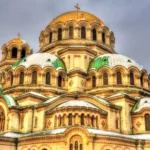
Completed in the early 20th century in tribute to the Russian soldiers who died in the 1877-1878 war of liberation, it is one of the largest Orthodox churches in the Balkans. Its golden domes dominate the city; the dark interior is covered with frescoes and chandeliers. The crypt holds a collection of icons. An antiques market often sets up on the square.
Saint Sofia Basilica
Right opposite, this 6th-century brick basilica gave the city its name. Beneath the nave, an underground route leads through a necropolis with painted tombs from late antiquity. Next door is the Tomb of the Unknown Soldier.
The Rotunda of St. George and the ruins of Serdica
In a courtyard surrounded by the presidency buildings, the red-brick Rotunda of St. George is the oldest building still standing in Sofia; it preserves medieval frescoes. Around it, and in Serdica metro station, the remains of the Roman city of Serdica (streets, baths) are visible in the open air. The changing of the guard takes place in front of the presidency.
The « triangle of tolerance »
A few hundred meters apart stand the Ottoman-era Banya Bashi Mosque, Sofia Synagogue, one of the largest in Europe, St. Joseph’s Catholic Cathedral and the Orthodox Church of St. Nedelya. The former Central Mineral Baths, with Secession-style decoration, house the Sofia History Museum; in front, hot mineral water fountains let locals fill their bottles. The Central Market Hall is just opposite.
The Russian Church and Vitosha Boulevard
The small, colorful Russian Church of St. Nicholas, with its golden onion domes, is one of the most photographed in the city. Pedestrianized Vitosha Boulevard is lined with cafés, restaurants and shops up to the National Palace of Culture (NDK), with the mountain as a backdrop. The garden of the Ivan Vazov National Theater is a favorite local resting spot.
Boyana Church and the National History Museum
At the foot of Vitosha, Boyana Church, a UNESCO World Heritage Site, preserves frescoes from 1259 of striking realism for their time; visits are in small groups, for a few minutes. Nearby, the National History Museum, housed in the former government residence, displays Thracian gold treasures among other collections.
Mount Vitosha
The massif overlooking the city peaks at over 2,200 m (7,218 ft) at Cherni Vrah. From the center, buses or taxis reach the trailheads at Zlatni Mostove (a « stone river ») or the Aleko area, which also has a small ski area in winter. Half a day is enough for a first walk, such as to Boyana Waterfall.
Rila and Plovdiv day trips
Rila Monastery, the most famous in the country and UNESCO-listed, is about two hours’ drive south: a day trip, often combined with Boyana. Plovdiv, with its Roman theater and old town, is about two hours away by road or train. See our Bulgaria travel guide.
Itinerary: Sofia in 2 or 3 days
Day 1, morning: Alexander Nevsky, Saint Sofia, the Russian Church, the Ivan Vazov Theater
Day 1, afternoon: the Largo, the Rotunda of St. George, Serdica, the triangle of tolerance, the Central Market Hall; evening on Vitosha Boulevard
Day 2, morning: Boyana Church and the National History Museum
Day 2, afternoon: a hike on Vitosha (Zlatni Mostove or Boyana Waterfall)
Sofia or Varna? Altitude versus the Black Sea, in figures
Sofia and Varna, on the Black Sea coast, are the two most visited cities in the country, but their climates differ: one sits at altitude in a basin surrounded by mountains, the other by the sea. We compared their normals month by month.
Month
High Sofia
High Varna
Low Sofia
Low Varna
Nights milder in Varna by…
January
3.5 °C (38 °F)
6.6 °C (44 °F)
−3.9 °C (25 °F)
−0.5 °C (31 °F)
3.4 °C
February
6.5 °C (44 °F)
8.1 °C (47 °F)
−2.4 °C (28 °F)
0.3 °C (33 °F)
2.7 °C
March
11.4 °C (53 °F)
11.2 °C (52 °F)
1.1 °C (34 °F)
3.1 °C (38 °F)
2.0 °C
April
16.7 °C (62 °F)
15.5 °C (60 °F)
5.3 °C (42 °F)
7.2 °C (45 °F)
1.9 °C
May
21.4 °C (71 °F)
21.2 °C (70 °F)
9.8 °C (50 °F)
12.3 °C (54 °F)
2.5 °C
June
25.2 °C (77 °F)
26.1 °C (79 °F)
13.4 °C (56 °F)
16.7 °C (62 °F)
3.3 °C
July
27.8 °C (82 °F)
28.9 °C (84 °F)
15.3 °C (60 °F)
18.9 °C (66 °F)
3.6 °C
August
28.3 °C (83 °F)
29.4 °C (85 °F)
15.0 °C (59 °F)
19.2 °C (67 °F)
4.2 °C
September
23.3 °C (74 °F)
24.8 °C (77 °F)
10.9 °C (52 °F)
15.2 °C (59 °F)
4.3 °C
October
17.6 °C (64 °F)
19.0 °C (66 °F)
6.3 °C (43 °F)
10.5 °C (51 °F)
4.2 °C
November
10.7 °C (51 °F)
13.2 °C (56 °F)
1.9 °C (35 °F)
5.9 °C (43 °F)
4.0 °C
December
4.6 °C (40 °F)
8.2 °C (47 °F)
−2.4 °C (28 °F)
1.3 °C (34 °F)
3.7 °C
Destination de Voyage calculation based on 1991-2020 normals from NIMH (Sofia) and the WMO as published by NOAA (Varna).
Nights are always cooler in Sofia, by 1.9 to 4.3 °C depending on the month; the biggest gap is in September.
In winter, the average January low is −3.9 °C (25 °F) in Sofia versus −0.5 °C (31 °F) in Varna: pack warm clothes for a weekend in December or January.
In summer, Varna is also warmer in the afternoon (0.9 to 1.1 °C more from June to August): the afternoons are similar, but Sofia’s cooler nights make walking tours more pleasant in the morning and evening.
In practice: for a summer trip, start with Sofia and Rila and finish on the Black Sea.
When to go to Sofia
The best months are May to September, with 21 to 29 °C (70 to 84 °F) in the afternoon and over 300 hours of sunshine in July and August. May and June are the wettest months, often with thunderstorms. Fall is mild and bright until early October. Winter is cold (average January high of 3.5 °C / 38 °F): it is ski season on Vitosha and in nearby resorts.
Month
High °C (°F)
Low °C (°F)
Precip. mm (in)
Precip. days
Per 7 days
Sunshine (h)
Crowds
Prices
Verdict
January
3.5 (38)
−3.9 (25)
36 (1.4)
10
2.3
88
Low
Low
⚠️ Cold, skiing on Vitosha
February
6.5 (44)
−2.4 (28)
36 (1.4)
11
2.8
117
Low
Low
⚠️ Cold
March
11.4 (53)
1.1 (34)
45 (1.8)
10
2.3
169
Low
Low
⚠️ Cool
April
16.7 (62)
5.3 (42)
52 (2.0)
12
2.8
195
Medium
Medium
✅ Spring
May
21.4 (71)
9.8 (50)
73 (2.9)
15
3.4
236
Medium
Medium
✅ Mild, thunderstorms
June
25.2 (77)
13.4 (56)
82 (3.2)
13
3.0
268
High
Medium
✅ Warm, thunderstorms
July
27.8 (82)
15.3 (60)
65 (2.6)
9
2.0
312
High
High
✅ Hot and very sunny
August
28.3 (83)
15.0 (59)
53 (2.1)
7
1.6
307
High
High
✅ Hot and very sunny
September
23.3 (74)
10.9 (52)
52 (2.0)
8
1.9
225
Medium
Medium
✅ Mild, ideal for hiking
October
17.6 (64)
6.3 (43)
54 (2.1)
11
2.5
167
Medium
Medium
✅ Cool and bright
November
10.7 (51)
1.9 (35)
38 (1.5)
10
2.3
108
Low
Low
⚠️ Gray
December
4.6 (40)
−2.4 (28)
40 (1.6)
10
2.3
69
Medium
Medium
⚠️ Cold, holiday season
Temperatures, precipitation, precipitation days and sunshine: 1991-2020 normals from Bulgaria’s National Institute of Meteorology and Hydrology (NIMH), published by the WMO and NOAA. « Per 7 days »: Destination de Voyage calculation (precipitation days in the month × 7 / number of days in the month). Crowds and prices: estimates.
Indicative estimates excluding flights, to be checked: the switch to the euro in 2026 may have changed some prices.
Getting around Sofia
From the airport: unlicensed taxis overcharge passengers; take an official licensed taxi from the booking office in the arrivals hall and check the meter is working (GOV.UK, updated 11 August 2026).
In the city: the center is walkable; Sofia’s metro and extensive bus network are reliable (U.S. Department of State). Taxis are plentiful but known to overcharge: insist on the meter or use an app-based taxi service.
To Vitosha: buses from the stops on the south side of the city, or taxi.
To Rila and Plovdiv: buses from the central bus station, train to Plovdiv, or an organized tour.
By car: to use motorways and main roads outside towns, buy a digital vignette online before your journey, or you will be fined (GOV.UK). Heavy truck traffic makes the two-lane road from the Greek border at Kulata to Sofia hazardous (U.S. Department of State).
Where to stay in Sofia
Area
Best for
Pros
Center (Alexander Nevsky, the Largo)
First visit
Everything on foot
Vitosha Boulevard and around
Couples, nightlife
Restaurants, bars, shops
Lozenets and Doctor’s Garden
Quiet
Residential areas close to the center
Near the NDK
Convenience
Metro, views of Vitosha
Taxi drivers are known to overcharge around the Central Train Station (U.S. Department of State).
Entry requirements, health and safety
US citizens: according to the U.S. Department of State (travel.state.gov, last updated December 4, 2025), you cannot stay more than 90 days in total within a 6-month period on a regular tourist passport; your passport must be valid for at least three months from your expected departure. You need proof of sufficient funds, a return ticket and medical insurance for your stay, which may be checked on arrival.
UK citizens: according to the UK FCDO (GOV.UK, updated 11 August 2026), you can travel without a visa to the Schengen area, including Bulgaria, for up to 90 days in any 180-day period. Your passport must have been issued less than 10 years before you arrive and be valid for at least 3 months after you plan to leave; a passport reported lost or stolen will be refused. You may have to register your fingerprints and photo under the EU Entry/Exit System (EES).
Health: UK travelers need a GHIC or EHIC for state healthcare, which does not replace travel insurance (GOV.UK); the State Department strongly recommends insurance covering medical evacuation.
Safety: most crime in Bulgaria takes place in Sofia, and ATM skimming and card fraud are common (U.S. Department of State). Tourists have been overcharged by hundreds of pounds in « gentlemen’s clubs » in Sofia (GOV.UK). Exchange money only at banks and exchange bureaus. Demonstrations mainly occur downtown around Parliament and the Presidency.
Earthquakes: there are earthquakes and small tremors throughout the year, usually without serious consequences (GOV.UK). Emergencies: 112.
Money: the euro replaced the lev on 1 January 2026; major cards are accepted in most banks and hotels and most ATMs take international cards (GOV.UK).
Internet: check your provider’s roaming rates before you leave; see our eSIM guide.
Language: signs are in Cyrillic, often also in Latin script in the center. Note that a nod can mean « no » and a shake of the head « yes ».
Food: shopska salad, banitsa (cheese pastry), tarator (cold yogurt soup), kebapche; rakia as an aperitif.
Mineral water: the public fountains near the Central Mineral Baths deliver naturally hot mineral water.
Frequently asked questions
How many days do you need to visit Sofia?
Two days for the center, Boyana and Vitosha; three to four to add Rila Monastery or Plovdiv.
When is the best time to visit Sofia?
May to September, with 21 to 29 °C (70 to 84 °F) in the afternoon according to 1991-2020 normals. Winter is cold but you can ski on Vitosha.
What currency is used in Sofia?
The euro, since 1 January 2026. The Bulgarian lev is no longer the country’s currency.
How do you get from Sofia Airport to the center?
Take an official licensed taxi from the booking office in the arrivals hall and check the meter (GOV.UK), or use public transport.
Is Sofia safe?
Yes, with usual precautions. Watch for pickpockets and card fraud at ATMs, use metered or app-based taxis and avoid « gentlemen’s clubs », where overcharging has been reported.
Can you visit Rila Monastery from Sofia?
Yes, as a day trip: the monastery is about two hours’ drive away.
Our sources
Bulgaria’s National Institute of Meteorology and Hydrology (NIMH), via the WMO and NOAA: 1991-2020 normals (climate table of the Wikipedia article « Sofia »); Varna: WMO 1991-2020 normals published by NOAA (article « Varna, Bulgaria »)
Destination de Voyage calculations: Sofia-Varna comparison, precipitation days per 7 days
ISO 4217, list published on 17 September 2026 (euro for Bulgaria)
U.S. Department of State, Bulgaria country information (travel.state.gov, last updated December 4, 2025), read on 26 October 2026


 FlightsKiwi.comCompare flights and airline combinations to Sofia.Compare flights