Looking for things to do in Riga? Stroll through the UNESCO-listed old town, from the House of the Blackheads to Riga Cathedral, ride up the tower of St. Peter’s Church, admire the Art Nouveau facades of Alberta Street, taste smoked fish at the Central Market, visit the Museum of the Occupation and the Latvian National Museum of Art, then cross the Daugava to the National Library. To visit Riga, allow 2 to 3 days; the best time is May to September. To place the capital in the rest of the country, see the map of Latvia.
The capital of Latvia and the largest city in the Baltic states, Riga was founded in the early 13th century and was part of the Hanseatic League. This guide brings together the highlights, two itineraries, the budget, transportation, where to stay and the month-by-month climate from the Latvian weather service, with an original table: daylight in Riga, Tallinn and Vilnius, month by month.
Our travel deals for Riga
Affiliate links: we earn a commission, at no extra cost to you.
Learn the languageTargumiLearn a few words of Latvian before you go — 30% off via our link.
CountryLatvia (capital), about 600,000 inhabitants
LanguageLatvianRussian is widely spoken, English common in tourism. To learn a few words before you go, try Targumi’s online Latvian lessons with native teachers (30% off via our link).
Time zoneUTC+2, UTC+3 in summer: 2 hours ahead of London, 7 hours ahead of New YorkLocal time now: –:–
AirportsRiga International (RIX)Check current routes with the airlines
EntrySchengen area: no visa for US or UK citizens for short stays; passport valid 3 months beyond your stay · travel.state.gov · GOV.UKEU Entry/Exit System (EES): fingerprints and photo at the border
Electricitycheck voltage and plug types before you go · plugs
Ideal length2 to 3 days, 4 with Jūrmala or Sigulda
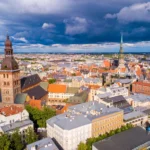
Riga’s historic center has been a UNESCO World Heritage Site since 1997, together with the Art Nouveau district. Its cobbled lanes, squares and churches can be explored on foot in half a day. On Town Hall Square, the House of the Blackheads, once a merchants’ guild, was destroyed during the war and rebuilt identically in the 1990s. Further on, the Three Brothers, three houses from different periods, the Swedish Gate and the Powder Tower tell the story of the fortifications.
St. Peter’s Church and Riga Cathedral
The tower of St. Peter’s Church, reached by elevator, offers the best view over the rooftops of the old town and the Daugava. Riga Cathedral (Doms), the largest medieval church in the Baltic states, houses a great 19th-century organ; concerts are held there regularly.
The Art Nouveau district
Riga has a very high concentration of Art Nouveau buildings, built at the turn of the 20th century. The most spectacular line Alberta and Elizabetes streets, with faces, statues and ornaments on the facades, several of them by the architect Mikhail Eisenstein. The Art Nouveau Museum, in a period apartment on Alberta Street, shows a reconstructed interior.
The Central Market and the Spīķeri quarter
Housed in former zeppelin hangars reused in the 1930s, the Central Market is one of the largest in Europe: smoked fish, black bread, cheese, honey, berries in season. Right next door, the old brick warehouses of Spīķeri host cafés and cultural venues. The U.S. Department of State reports that thieves target foreign visitors in the old town, at the central train and bus stations and at the Central Market: keep an eye on your belongings.
The Freedom Monument and the central parks
Between the old town and the modern district, the Freedom Monument, unveiled in 1935, is the symbol of Latvian independence; the changing of the guard takes place during the day. It is surrounded by parks along the city canal, pleasant on foot or by small boat.
Museums: Occupation, national art, history
The Museum of the Occupation of Latvia covers the Soviet and Nazi periods between 1940 and 1991. The Latvian National Museum of Art, in a renovated palace, shows Latvian and Baltic painting. In the old town, the Museum of the History of Riga and Navigation completes the visit. Check closing days, often Monday.
The Academy of Sciences and the Maskavas district
This Stalinist-style skyscraper, nicknamed « Stalin’s birthday cake », has a panoramic terrace high up. It overlooks the Maskavas (Moscow) district, a former suburb of Russian merchants and the Jewish community, more working-class, which is also home to the memorial of the Great Choral Synagogue.
The National Library and the left bank (Pārdaugava)
Across the Daugava, the National Library of Latvia, nicknamed the « Castle of Light », is partly open to visitors and offers a view of the old town. The left bank also hides the renovated Āgenskalns Market and streets of wooden houses. For some nature, Mežaparks forest park, to the north, hosts the great stage of the Latvian Song and Dance Festival.
Day trips to Jūrmala and Sigulda
Riga is a good base: the beach at Jūrmala is half an hour away by train, and Sigulda and Turaida Castle, in Gauja National Park, about an hour. Rundāle Palace makes a half-day trip by car or on a tour. All these stops are covered in our Latvia travel guide.
Itinerary: Riga in 2 or 3 days
Riga in 2 days
Day 1, morning: the old town, Town Hall Square and the House of the Blackheads, Riga Cathedral, the Three Brothers
Day 1, afternoon: St. Peter’s tower, the Museum of the Occupation, the Freedom Monument and the canal parks
Day 2, morning: the Central Market and Spīķeri, the Academy of Sciences
Day 2, afternoon: the Art Nouveau district (Alberta and Elizabetes streets), the National Museum of Art; an organ concert at the cathedral if the program allows
Riga in 3 days
Days 1 and 2: as above
Day 3: Jūrmala by train and the Ķemeri bog, or Sigulda and Turaida; in winter, the National Library and the left bank
For other short breaks, see our cheap weekend getaways; for another northern capital, our guide to Stockholm, linked to Riga by ferry.
Riga, Tallinn or Vilnius? Daylight in figures
The three Baltic capitals are spread from south to north over about 500 km (311 mi). The difference in latitude clearly changes the length of the day, especially in winter and summer. We calculated it for the 15th of each month. To the north, Tallinn is the capital of Estonia; to the south, Vilnius is the capital of Lithuania.
Month
Vilnius
Riga
Tallinn
Sunset in Riga
January
7 h 51 min
7 h 26 min
6 h 52 min
4:15 pm
February
9 h 46 min
9 h 33 min
9 h 17 min
5:24 pm
March
11 h 49 min
11 h 47 min
11 h 46 min
6:26 pm
April
14 h 06 min
14 h 17 min
14 h 31 min
8:32 pm
May
16 h 06 min
16 h 30 min
17 h 02 min
9:34 pm
June
17 h 16 min
17 h 50 min
18 h 37 min
10:19 pm
July
16 h 45 min
17 h 14 min
17 h 53 min
10:06 pm
August
14 h 57 min
15 h 13 min
15 h 34 min
9:04 pm
September
12 h 44 min
12 h 48 min
12 h 53 min
7:42 pm
October
10 h 33 min
10 h 25 min
10 h 15 min
6:21 pm
November
8 h 27 min
8 h 06 min
7 h 39 min
4:11 pm
December
7 h 16 min
6 h 46 min
6 h 06 min
3:41 pm
Destination de Voyage calculation: length of day (sunrise to sunset) on the 15th of each month of 2026, NOAA solar algorithm with refraction, city-center coordinates; sunset in Riga local time. Accurate to within a minute or two depending on the year.
In December: 6 h 06 min of daylight in Tallinn, 6 h 46 min in Riga and 7 h 16 min in Vilnius. For a winter trip, Vilnius has the most light and Tallinn the least.
In June: the order is reversed: 18 h 37 min in Tallinn, 17 h 50 min in Riga, 17 h 16 min in Vilnius. In Riga, the sun sets around 10:19 pm and twilight lasts for much of the night.
In practice: for a winter tour of the three capitals, start with Tallinn to make the most of the light before the shortest days, or plan your outdoor sightseeing between 10 am and 3 pm.
When to go to Riga
The best months are May, June and September: 17 to 21 °C (63 to 70 °F) in the afternoon, long days and fewer visitors than in high summer. July and August are the warmest (an average high of 23.8 °C / 75 °F in July) but also the wettest. May is surprisingly sunny, with 287 hours of sunshine on average. Winter is cold, with highs close to 0 °C (32 °F) from December to February and very little sun (24 hours in December); the Christmas market on Cathedral Square and the concerts make up for it.
Month
High °C (°F)
Low °C (°F)
Rain mm (in)
Rainy days
Sunshine (h)
Crowds
Prices
Verdict
January
−0.1 (32 °F)
−4.5 (24 °F)
46.5 (1.8 in)
11
36.6
Low
Low
❌ Cold, frost, very short days
February
0.3 (33 °F)
−4.6 (24 °F)
40.1 (1.6 in)
9
64.2
Low
Low
❌ Cold, snow possible
March
4.8 (41 °F)
−1.7 (29 °F)
34.1 (1.3 in)
8
141.2
Low
Low
⚠️ End of winter
April
11.9 (53 °F)
2.9 (37 °F)
35 (1.4 in)
7
203.6
Medium
Medium
⚠️ Cool, late spring
May
17.8 (64 °F)
8.2 (47 °F)
47.5 (1.9 in)
8
286.7
Medium
Medium
✅ Mild and very sunny
June
21.3 (70 °F)
12.4 (54 °F)
65 (2.6 in)
10
282.2
High
High
✅ Long days, Midsummer
July
23.8 (75 °F)
14.9 (59 °F)
79.5 (3.1 in)
9
291.2
High
High
✅ The warmest; thunderstorms
August
22.7 (73 °F)
14.1 (57 °F)
77.9 (3.1 in)
10
250.4
High
High
✅ Warm, wetter
September
17.3 (63 °F)
9.8 (50 °F)
67.1 (2.6 in)
9
166.7
Medium
Medium
✅ Mild, fewer visitors
October
10.5 (51 °F)
4.9 (41 °F)
75.6 (3.0 in)
12
95.5
Low
Low
⚠️ Cool and rainy
November
4.8 (41 °F)
1.1 (34 °F)
56.3 (2.2 in)
11
36.1
Low
Low
❌ Gray, early nightfall
December
1.4 (35 °F)
−2.4 (28 °F)
50.2 (2.0 in)
11
24.4
Medium
Medium
⚠️ Cold, Christmas market
Temperatures, precipitation and sunshine: 1991-2020 normals from the Latvian Environment, Geology and Meteorology Centre (LVĢMC), Riga station; days with precipitation: NOAA, 1991-2020. Crowds and prices: estimates based on the tourist seasons.
Spring (April-May): April stays cool, May is one of the best months: sunshine, parks in bloom, café terraces reopening.
Summer (June-August): the Midsummer festival (June 23-24), the beach at Jūrmala, festivals; book accommodation early.
Autumn (September-October): September is a good compromise; October has the most rainy days.
Indicative estimates excluding flights. Prices rise in the old town and in summer.
Is Riga expensive? Meals and transportation are reasonably priced, but accommodation in the old town gets expensive in summer. Eating at the Central Market or in self-service canteens helps keep costs down.
Getting around Riga
From the airport: Riga International Airport is about ten kilometers (6 mi) from the center; according to the official Riga tourism website, bus 22 takes about 40 minutes to the center, with tickets at €1.50 bought in advance (ticket machines, Narvesen shops, apps) or €1.81 from the driver, and a taxi takes 15 to 25 minutes for about €10 to 25 (liveriga.com, checked 26 October 2026).
In the city: the old town and the Art Nouveau district are walkable; trams, trolleybuses and buses cover the rest. The UK FCDO notes that you can be fined on the spot for traveling without a ticket or with an unvalidated one: validate it as soon as you board.
To Jūrmala and Sigulda: regional trains from the central station.
To Tallinn and Vilnius: comfortable buses, about 4 to 4.5 hours. To Warsaw, expect a long day by bus; see our guide to Warsaw. The U.S. Department of State advises carrying your passport even on day trips to neighboring Baltic countries, as random checks are possible.
Ferry: a line links Riga to Stockholm; check schedules with the operators.
Where to stay in Riga
District
Best for
Strengths
Old town (Vecrīga)
First or short stay
Everything on foot; more expensive, lively in the evening
Art Nouveau district (Centrs)
Couples, quiet
Beautiful streets, restaurants, 10-15 min walk from the old town
Around the station and the market
Tight budget, arriving by bus or train
Convenient; thieves target visitors at the stations and the market (U.S. Department of State)
Ķīpsala and the left bank
Views, peace and quiet
Views of the old town, further from restaurants
Book early for Midsummer and summer weekends.
Entry requirements, health and safety
US citizens: according to the U.S. Department of State (travel.state.gov, last updated September 10, 2026), Latvia applies Schengen rules: your passport should be valid for at least three months beyond your stay, and you may need proof of sufficient funds and a return ticket. Latvia does not accept the U.S. emergency passport for visa-free entry.
UK citizens: according to the UK FCDO (GOV.UK, updated 11 August 2026), you can travel to the Schengen area without a visa for up to 90 days in any 180-day period. Your passport must have been issued less than 10 years before you arrive and expire at least 3 months after the day you plan to leave. At the border you may be asked for proof of accommodation, travel insurance, a return ticket and sufficient funds. The EU Entry/Exit System (EES) records fingerprints and a photo at the border (free).
Health: ticks are present in the warm season between March and October and can carry encephalitis and Lyme disease (UK FCDO); the U.S. Department of State notes that tick-borne encephalitis is widespread and that the vaccine is not available in the United States. Bring insurance with medical repatriation; see our travel insurance guide.
Safety: petty crime, particularly bag snatching and pickpocketing, is a greater risk in Riga Old Town (UK FCDO). Some tourists have been charged very high prices for drinks or found fraudulent transactions on their cards, and there have been cases of drink spiking in Riga: never leave your drink unattended and get bar recommendations from trustworthy sources (UK FCDO, U.S. Department of State). Drinking alcohol in public, including in parks and streets, is illegal. Take official taxis (yellow license plates) and agree on the approximate fare before setting off.
Emergencies: 112 (general), 110 (police), 113 (ambulance); Riga Tourist Police: +371 6718 1818 (UK FCDO, U.S. Department of State).
Practical tips for Riga
Money: euro; ATMs are widely available in Riga, and the U.S. Department of State recommends using those inside major hotels or malls. Contactless cards are accepted almost everywhere.
Internet: check your carrier’s roaming rates or use a local SIM or eSIM; see our eSIM guide.
Food: smoked fish, black rye bread, pelmeni, gray peas with bacon, and Riga Black Balsam, a herbal liqueur drunk neat or in coffee.
Concerts: the cathedral organ, the Latvian National Opera and the many churches offer a rich program at reasonable prices.
Tipping: about 10% in restaurants if service is not included.
Frequently asked questions
How many days do you need to visit Riga?
Two days are enough for the old town, the Art Nouveau district, the Central Market and two museums. Allow three days to add Jūrmala or Sigulda.
What is the best time to visit Riga?
May, June and September: 17 to 21 °C (63 to 70 °F) in the afternoon according to the LVĢMC 1991-2020 normals. July and August are warmer but wetter; winter is cold and very dark.
Riga, Tallinn or Vilnius: which should you choose?
Riga is the largest, with Art Nouveau and the Central Market; Tallinn has the most complete medieval old town; Vilnius its Baroque churches. The three can be combined by bus, about 4 hours apart.
How do you get from Riga airport to the center?
Bus 22 takes about 40 minutes, with a ticket at €1.50 bought in advance or €1.81 from the driver; a taxi takes 15 to 25 minutes for about €10 to 25 (liveriga.com, checked October 2026).
Do I need a visa to visit Riga?
No, not for US or UK citizens on short stays: Latvia is in the Schengen area (up to 90 days in any 180-day period). Your passport must be valid at least 3 months beyond your stay, and the EES records your fingerprints and photo at the border.
Is Riga a safe city?
Generally yes, but the UK FCDO and the U.S. Department of State warn about pickpocketing in the old town, inflated drink prices and card fraud in some bars, and drink spiking.
Our sources
LVĢMC (Latvian Environment, Geology and Meteorology Centre) and NOAA: 1991-2020 normals, Riga station; days with precipitation from NOAA, 1991-2020, via the climate table of the Wikipedia article « Riga »
Destination de Voyage calculation: daylight and sunset in Riga, Tallinn and Vilnius (NOAA solar algorithm)


 Learn the languageTargumiLearn a few words of Latvian before you go — 30% off via our link.See the course