This Estonia travel guide takes you to the northernmost of the Baltic states: the medieval old town of Tallinn, the forests and manor houses of Lahemaa National Park, the university town of Tartu, the seaside resort of Pärnu, the islands of Saaremaa and Hiiumaa and the bogs of Soomaa. It helps you organise your trip to Estonia: when to go, where to go, how many days, what budget, how to get around and how to combine the country with Latvia and Lithuania.
Time zoneUTC+2, UTC+3 in summer: 2 hours ahead of London, 7 hours ahead of New York
AirportsTallinn (TLL)Ferries also link Tallinn with Helsinki
EntrySchengen area: no visa for UK citizens for up to 90 days in any 180-day period; US citizens need a passport valid 3 months beyond their stay · travel.state.gov · GOV.UKEU Entry/Exit System (EES): fingerprints and photo at the border
Electricitycheck voltage and plug types before you go · plugsReference: IEC World Plugs
Ideal length3 days for Tallinn7 to 10 days for the country, 2 weeks for the three Baltic states
When to go to Estonia
The best time runs from May to September. May and June are bright and fairly dry; around the solstice it never gets fully dark (18 h 37 of daylight in Tallinn on 15 June), and Midsummer (Jaanipäev) is the big summer festival. July and August are the warmest months, the season for the beach in Pärnu and for the islands, but also the wettest. The long, dark winter appeals for snow, Tallinn’s Christmas market and, in some years, the ice roads to the islands, open only when the authorities allow it.
Month
High °C (°F)
Low °C (°F)
Rain mm (in)
Sun (h)
Rainy days per week
Daylight
Verdict
January
−0.7 (31)
−5.5 (22)
56 (2.2)
30
2.9
6 h 52
❌ Cold, frost, very short days
February
−1.0 (30)
−6.2 (21)
40 (1.6)
59
2.6
9 h 17
❌ The coldest month
March
2.8 (37)
−3.7 (25)
37 (1.5)
148
2
11 h 46
⚠️ Still winter
April
9.5 (49)
0.7 (33)
35 (1.4)
217
1.8
14 h 31
⚠️ Cool spring
May
15.4 (60)
5.2 (41)
37 (1.5)
306
1.6
17 h 01
✅ Bright, the sunniest
June
19.2 (67)
9.8 (50)
68 (2.7)
294
2.2
18 h 37
✅ White nights, Midsummer
July
22.2 (72)
13.1 (56)
82 (3.2)
312
2.1
17 h 53
✅ The warmest
August
21.0 (70)
12.3 (54)
85 (3.3)
256
2.3
15 h 34
✅ Warm but rainy
September
16.1 (61)
8.4 (47)
58 (2.3)
162
2.4
12 h 53
✅ Mild, fewer people
October
9.5 (49)
3.7 (39)
78 (3.1)
88
2.9
10 h 15
⚠️ Cool and rainy
November
4.1 (39)
−0.2 (32)
66 (2.6)
29
2.9
7 h 39
❌ Grey, early nightfall
December
1.2 (34)
−3.1 (26)
59 (2.3)
21
3
6 h 06
⚠️ Cold, Christmas market
Temperatures, precipitation and sunshine: 1991-2020 normals from the Estonian Weather Service (Riigi Ilmateenistus), Tallinn station; days with precipitation: NOAA/NCEI, 1991-2020. Rainy days per week and daylight (on the 15th of the month): Destination de Voyage calculation (average number of days with precipitation ÷ days in the month × 7; NOAA solar algorithm).
The table gives the normals for Tallinn, on the north coast. The interior (Tartu) has slightly colder winters and slightly warmer summers; the western islands are milder in autumn, influenced by the sea.
Estonia in figures: daylight and rain
Month
Daylight in Tallinn
Sunset in Tallinn
January
6 h 52
3:56 pm
February
9 h 17
5:13 pm
March
11 h 46
6:22 pm
April
14 h 31
8:36 pm
May
17 h 01
9:48 pm
June
18 h 37
10:39 pm
July
17 h 53
10:23 pm
August
15 h 34
9:12 pm
September
12 h 53
7:42 pm
October
10 h 15
6:14 pm
November
7 h 39
3:55 pm
December
6 h 06
3:19 pm
Destination de Voyage calculation: daylight and sunset on the 15th of each month in 2026, NOAA solar algorithm (including refraction), Tallinn local time.
In June, Tallinn gets 18 h 37 of daylight: ideal for long hikes in Lahemaa or on the islands.
In December, daylight drops to 6 h 06: plan outdoor visits before 3 pm.
Rain: about 1.6 days with precipitation per week in May, against 3.0 in December (calculation based on NOAA data).
What to see in Estonia: the highlights
Tallinn
The capital holds most of the sights: the UNESCO-listed medieval old town, Toompea Hill, Kadriorg, and the creative districts of Kalamaja and Telliskivi. Everything is covered in our guide to things to do in Tallinn.
Lahemaa National Park
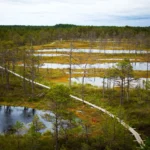
About an hour east of Tallinn, Lahemaa combines forests, bogs with boardwalks, fishing villages, glacial boulders on the coast and Baltic manor houses, including Palmse and Sagadi. It is the easiest nature trip from the capital.
Tartu
Estonia’s second city is its university town: a university founded in the 17th century, Toome Hill and the ruins of its cathedral, and the Estonian National Museum, housed in a contemporary building on a former airfield. It was a European Capital of Culture in 2024.
Pärnu
On the south-west coast, Pärnu is the « summer capital »: a long sandy beach, villas, spa and bathing establishments, and old streets. The resort comes alive in July and August.
Saaremaa and Muhu
The country’s largest island is reached by ferry from the mainland via Muhu. People come for the episcopal castle in Kuressaare, the Angla windmills, the Kaali meteorite crater, the Panga cliffs and a countryside of drystone walls and junipers.
Soomaa and the interior
Soomaa National Park, between Pärnu and Viljandi, is a world of bogs and rivers explored on foot or by canoe; in spring, the floods create what Estonians call the « fifth season ». Viljandi, with its ruined castle, hosts a folk music festival in summer.
Haapsalu and the west coast
A small seaside town of wooden houses, Haapsalu has an episcopal castle and a seafront promenade. It is the gateway to the wilder island of Hiiumaa, known for its lighthouses.
Itinerary ideas for Estonia
Weekend: Tallinn (old town, Toompea, Kadriorg, Telliskivi).
7 days: Tallinn (2 days), Lahemaa (1 day), Tartu (1 day), Soomaa or Viljandi (1 day), Pärnu (1 day), back to Tallinn.
10 days: add Saaremaa and Muhu (2 to 3 days) between Pärnu and Tallinn, via Haapsalu.
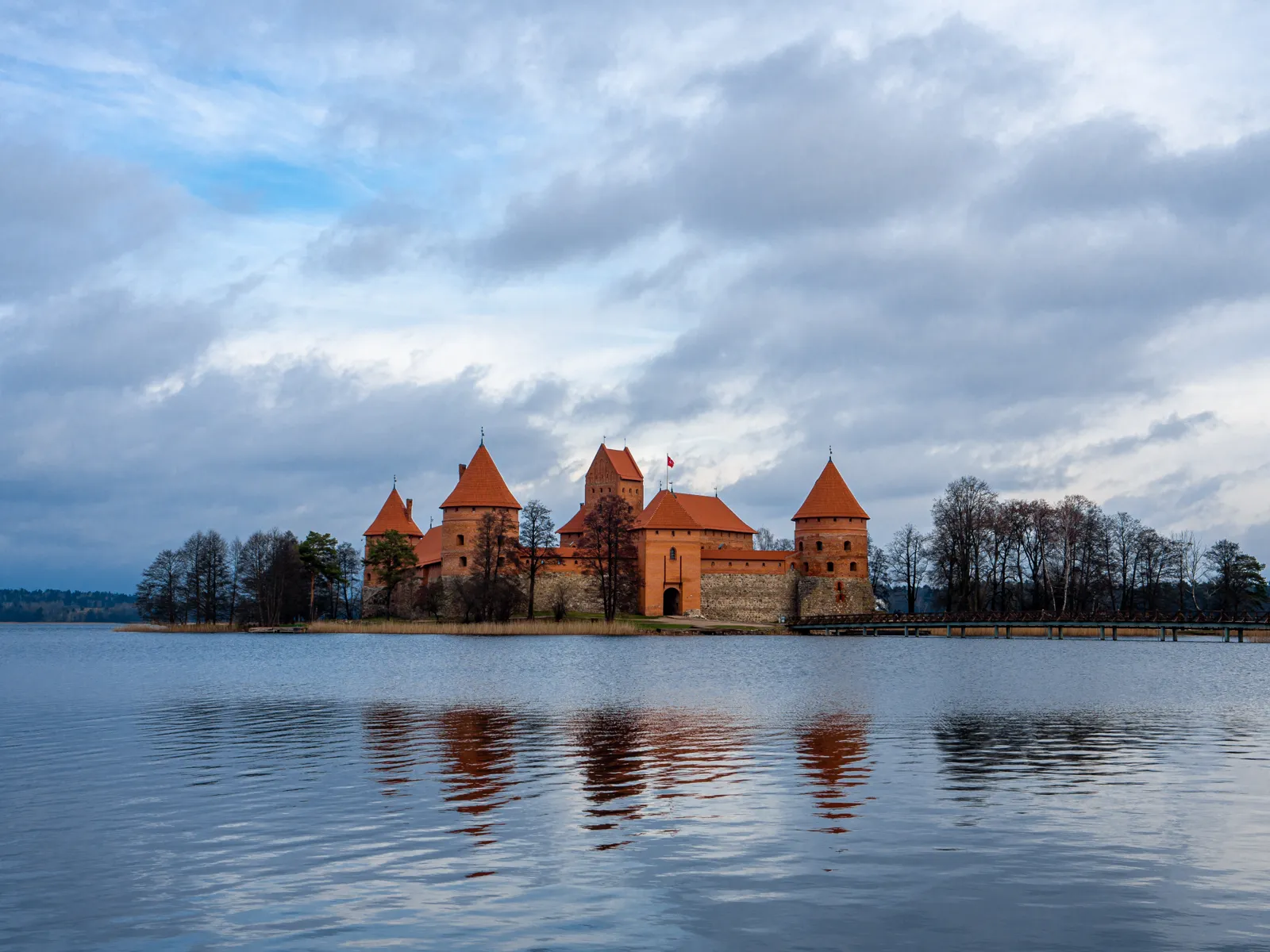
2 weeks in the Baltic states: Tallinn – Tartu – Pärnu – Riga and the Gauja Valley – Vilnius and Trakai, by bus or car (see our Latvia page).
With Finland:Helsinki is linked to Tallinn by ferry; see our Finland page.
Budget for a trip to Estonia
Your budget depends mainly on accommodation and the season. Tallinn is more expensive than the rest of the country; the countryside and Tartu are more affordable.
Getting around Estonia
Bus: a dense, comfortable network between Tallinn, Tartu, Pärnu, Haapsalu and Kuressaare; international buses to Riga and Vilnius.
Train: Elron trains link Tallinn with Tartu, Viljandi, Pärnu and Narva.
Car: ideal for Lahemaa, Soomaa and the islands. The U.S. Department of State notes that roads can be icy and dangerous in winter, that some rural roads are unpaved, that headlights must be on at all times and that Estonia takes a zero-tolerance approach to drink-driving. A valid US licence is accepted, with an International Driving Permit if it does not show the vehicle category (travel.state.gov, last updated September 10, 2026). UK licences can be used (GOV.UK, updated 11 August 2026); rental companies may require a year of driving experience or a higher minimum age.
Ferries: to Saaremaa, Muhu and Hiiumaa, and to Helsinki from Tallinn; book ahead in summer.
Getting there
Estonia’s main international airport is Tallinn (TLL). Many travellers also arrive by ferry from Helsinki or by bus from Riga. Check current routes from your home airport with the airlines and the airport.
Where to stay in Estonia
In Tallinn, the old town and its surroundings are the most convenient. In the countryside, farm stays and restored manor houses (Lahemaa, Saaremaa) are an Estonian speciality, often with a sauna. In Pärnu, seafront hotels fill up in July and August: book early.
Entry requirements for Estonia, health and safety
US citizens: Estonia is in the Schengen area. Your passport should be valid for at least three months beyond your stay, and you need sufficient proof of funds and a return ticket; for stays over 90 days you can apply for a longer-term visa (U.S. Department of State, travel.state.gov, last updated September 10, 2026). The State Department’s travel advisory rates Estonia at Level 1 (exercise normal precautions).
UK citizens: no visa for up to 90 days in any 180-day period as a tourist. Your passport must have been issued less than 10 years before the day you arrive and be valid at least 3 months after the day you plan to leave the Schengen area; you may be asked for a return ticket and proof of sufficient funds. The EU Entry/Exit System (EES) is being implemented: fingerprints and a photo may be taken at your first entry, free of charge (GOV.UK, updated 11 August 2026).
Safety: the State Department describes the risk from crime as minimal, though pickpocketing occurs in crowded and tourist areas; GOV.UK mentions pickpockets in bars and nightclubs in Tallinn’s Old Town. GOV.UK also notes that some Ukrainian drones aimed at Russia have crossed into Estonian airspace: follow official guidance.
Local laws: everyone must wear small reflectors on clothing when it is dark outside (travel.state.gov). Illegal drugs, including cannabis, are strictly prohibited even in very small quantities (GOV.UK).
Health: according to the State Department, tick-borne encephalitis and Lyme disease are widespread throughout the country: use insect repellent in parks and forests, and talk to your doctor about vaccination. It also recommends two documented doses of MMR vaccine because of frequent measles outbreaks in Europe. UK travellers need a GHIC or EHIC for state healthcare; whatever your nationality, take out travel insurance covering medical costs and evacuation (see our travel insurance guide). Emergency number: 112.
Practical tips for Estonia
Payment: only euros are accepted and ATMs are widely available in Tallinn and major towns (travel.state.gov); cards are used almost everywhere in this highly digital country.
Mobile data: check your home carrier’s roaming charges; see our eSIM guide.
Sauna: a pillar of Estonian culture, especially the smoke sauna, inscribed on UNESCO’s Intangible Cultural Heritage list.
Nature: access to nature is generous, but stay on the marked boardwalks in the bogs.
Frequently asked questions
How many days do you need to visit Estonia?
Three days for Tallinn, a week for Tallinn, Lahemaa, Tartu and Pärnu, ten days with Saaremaa.
When is the best time to visit Estonia?
From May to September. June has the longest days and the Midsummer festival; July and August bring warmth and beach weather.
Do I need a visa to visit Estonia?
Not for a short tourist stay as a UK citizen: up to 90 days in any 180-day period in the Schengen area (GOV.UK). US citizens need a passport valid at least three months beyond their stay, proof of funds and a return ticket (travel.state.gov). Check both sites before you leave.
What currency is used in Estonia?
The euro, since 2011.
Estonia, Latvia or Lithuania: which one to choose?
Estonia for Tallinn, nature and the islands; Latvia for Riga and Art Nouveau; Lithuania for baroque Vilnius and the Curonian Spit. In two weeks, you can combine all three.
Our sources
Estonian Weather Service (Riigi Ilmateenistus) and NOAA/NCEI: 1991-2020 normals, Tallinn station; days with precipitation from NOAA/NCEI, 1991-2020, via the climate table of the Wikipedia article « Tallinn »
Destination de Voyage calculation: daylight and sunset (NOAA solar algorithm), rainy days per week
Transparency: this page contains affiliate links, labelled as such. If you book through them we may earn a commission at no extra cost to you; it does not influence our content or recommendations. How we fund the site.