This Latvia travel guide introduces the middle Baltic state: Riga, its capital, with a Hanseatic old town and Art Nouveau façades, the long sandy beaches of Jūrmala, the forests and castles of the Gauja Valley around Sigulda and Cēsis, the baroque Rundāle Palace and the small town of Kuldīga. It helps you organise a trip to Latvia: when to go, where to go, how many days, what budget, how to get around and how to combine the country with Estonia and Lithuania.
To locate the cities, regions, relief, national parks and airports, see our map of Latvia.
Time zoneUTC+2, UTC+3 in summer: 2 hours ahead of London, 7 hours ahead of New York
AirportsRiga International (RIX)Buses link Riga with Tallinn and Vilnius
EntrySchengen area: no visa for UK citizens for up to 90 days in any 180-day period; US citizens need a passport valid 3 months beyond their stay · travel.state.gov · GOV.UKEU Entry/Exit System (EES): fingerprints and photo at the border
Electricitycheck voltage and plug types before you go · plugsReference: IEC World Plugs
Ideal length3 days for Riga7 to 10 days for the country, 2 weeks for the three Baltic states
The best time runs from May to September, with afternoon highs of 18 to 24 °C (64 to 75 °F) in Riga and very long days around the solstice: 17 h 50 of daylight on 15 June. June is the month of Midsummer (Jāņi, the night of 23 to 24 June), the country’s most popular festival; July and August are beach months, but also the wettest. Winter is long, cold and dark: highs close to 0 °C (32 °F) from December to February and only 6 h 46 of daylight on 15 December; in return, Riga has a fine Christmas market and low prices.
Month
High °C (°F)
Low °C (°F)
Rain mm (in)
Sun (h)
Crowds
Prices
Verdict
January
−0.1 (32)
−4.5 (24)
46.5 (1.8)
36.6
Low
Low
❌ Cold, frost, very short days
February
0.3 (33)
−4.6 (24)
40.1 (1.6)
64.2
Low
Low
❌ Cold, snow possible
March
4.8 (41)
−1.7 (29)
34.1 (1.3)
141.2
Low
Low
⚠️ End of winter
April
11.9 (53)
2.9 (37)
35.0 (1.4)
203.6
Medium
Medium
⚠️ Cool spring
May
17.8 (64)
8.2 (47)
47.5 (1.9)
286.7
Medium
Medium
✅ Mild, very sunny
June
21.3 (70)
12.4 (54)
65.0 (2.6)
282.2
High
High
✅ Light nights, Midsummer festival
July
23.8 (75)
14.9 (59)
79.5 (3.1)
291.2
High
High
✅ The warmest, beach time
August
22.7 (73)
14.1 (57)
77.9 (3.1)
250.4
High
High
✅ Warm but rainy
September
17.3 (63)
9.8 (50)
67.1 (2.6)
166.7
Medium
Medium
✅ Mild, fewer people
October
10.5 (51)
4.9 (41)
75.6 (3.0)
95.5
Low
Low
⚠️ Cool, autumn colours
November
4.8 (41)
1.1 (34)
56.3 (2.2)
36.1
Low
Low
❌ Grey, early nightfall
December
1.4 (35)
−2.4 (28)
50.2 (2.0)
24.4
Medium
Medium
⚠️ Cold, Christmas market in Riga
Temperatures, precipitation and sunshine in Riga: 1991-2020 normals from the Latvian Environment, Geology and Meteorology Centre (LVĢMC), Riga station; days with precipitation: NOAA, 1991-2020. Crowds and prices: estimate based on the tourist seasons.
Spring (April–May): May is the most pleasant month for nature, with nearly 290 hours of sunshine, as much as in July.
Summer (June–August): the beaches of Jūrmala and Courland, festivals, hiking in the Gauja; storms are frequent in July and August.
Autumn (September–October): September stays mild; October colours the forests but has the most days with rain.
Winter (November–March): for a short break in Riga, with museums, concerts and the Christmas market; see our selection of Christmas markets in Europe. GOV.UK warns that temperatures may drop to −25 °C (−13 °F) or below between October and March, and that snowfall can disrupt transport.
Latvia in figures: daylight and rain
Two questions often decide the dates of a Baltic trip: how many hours of daylight will you get, and how many rainy days are you likely to have in a week? We did the maths.
Month
Daylight in Riga (15th)
Sunset in Riga
Expected rainy days per week
January
7 h 26
4:15 pm
2.5
February
9 h 33
5:24 pm
2.2
March
11 h 47
6:26 pm
1.8
April
14 h 17
8:32 pm
1.6
May
16 h 30
9:34 pm
1.8
June
17 h 50
10:19 pm
2.3
July
17 h 14
10:06 pm
2
August
15 h 13
9:04 pm
2.3
September
12 h 48
7:42 pm
2.1
October
10 h 25
6:21 pm
2.7
November
8 h 06
4:11 pm
2.6
December
6 h 46
3:41 pm
2.5
Destination de Voyage calculation: sunrise and sunset computed for the 15th of each month in 2026 with the NOAA solar algorithm (including refraction), Riga local time; rainy days per week = average number of days with precipitation in the month (NOAA, 1991-2020) ÷ number of days in the month × 7. This is an average, not a forecast.
June: 17 h 50 of daylight in Riga; the sun sets around 10:19 pm and it never gets fully dark around Midsummer.
December: only 6 h 46 of daylight, with sunset around 3:41 pm: plan outdoor visits before 3 pm.
Rain: over a week, expect on average about 1.6 days with precipitation in April, the driest month by frequency, against 2.7 in October.
What to see in Latvia: the highlights
Riga
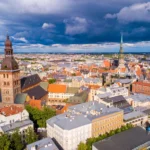
The capital holds half of the sights: a UNESCO-listed old town, the House of the Blackheads, the tower of St Peter’s Church, the Art Nouveau district around Alberta iela, and the Central Market housed in former zeppelin hangars. Everything is covered in our guide to things to do in Riga.
Jūrmala
Half an hour by train from Riga, this seaside resort stretches along some thirty kilometres (about 19 mi) of sandy beach lined with pines. Its wooden villas, many dating from the 19th and early 20th centuries, are explored by bike or on foot around the pedestrian street Jomas iela. The Baltic Sea stays cool, even in summer.
Gauja National Park: Sigulda, Turaida and Cēsis
About an hour from Riga, the Gauja Valley is the country’s great natural area: forests, red sandstone cliffs and caves. In Sigulda, visit the red-brick Turaida Castle and the ruins of the Livonian Order castle; a cable car crosses the valley. Further on, Cēsis has kept its medieval castle, visited by lantern light, and a pretty old town. In autumn, the forest colours draw many visitors.
Rundāle Palace
In the south of the country, near the Lithuanian border, this baroque and rococo palace was designed by the architect Rastrelli, who also designed the Winter Palace in St Petersburg. The state rooms and the French-style garden, with its rose garden, can be visited in half a day from Riga, by car or on an organised tour. Beyond that border lies Lithuania, which can be added to a Baltic tour.
Kuldīga
This small Courland town, inscribed on the UNESCO World Heritage List in 2023, has kept its wooden houses and lanes along a stream. On the Venta River, the Ventas Rumba waterfall is often described as the widest in Europe, but it is only about two metres (7 ft) high; in spring, you can see fish leaping.
Liepāja and the Courland coast
On the west coast, Liepāja combines a long beach, a wooden centre and the Karosta district, a former naval base of the Tsar and then the Soviet army, with its Orthodox cathedral and former military prison open to visitors. To the north, Cape Kolka marks the meeting point of the Baltic Sea and the Gulf of Riga; avoid swimming there in rough weather.
Ķemeri National Park
Very close to Jūrmala, a boardwalk crosses the Great Ķemeri Bog, with an observation tower. It is an easy nature outing from Riga, best early in the morning or at sunset.
Latgale
In the east, this region of lakes is less visited. Daugavpils, the country’s second city, has a 19th-century fortress and an art centre dedicated to the painter Mark Rothko, who was born there; Aglona Basilica is a major pilgrimage site. The UK FCDO advises against all travel to Belarus and notes that access within 2 km (1 mi) of the Belarusian border is restricted and requires a special permit from the Latvian Border Guard (GOV.UK, updated 11 August 2026).
How many days and what kind of trip? A decision tree
You have a weekend: Riga alone, 2 to 3 days, possibly half a day in Jūrmala. See also our cheap weekends.
You have 5 days: Riga (3 days) + Sigulda and Turaida (1 day) + Jūrmala or Rundāle (1 day), without a car, by train, bus or tour.
You have 8 to 10 days and a car: a loop Riga – Rundāle – Kuldīga – Liepāja – Cape Kolka – Jūrmala – Gauja (Sigulda, Cēsis) – Riga.
You have 2 weeks: the three Baltic states, from south to north: Vilnius (Lithuania), Riga, then Tallinn (Estonia), by bus from capital to capital (about 4 h to 4 h 30 per journey). The State Department advises carrying your passport on trips to neighbouring Baltic countries, even day trips, as random checks are possible.
You are travelling in winter: stay in Riga and its museums; the days are too short for a road trip.
You love the big northern capitals: combine with Stockholm or Finland (Baltic ferries), or with Warsaw to the south.
Itinerary: 8 days in Latvia
Days 1 to 3: Riga (old town, Art Nouveau, Central Market, museums)
Day 4: Rundāle Palace, then drive to Kuldīga
Day 5: Kuldīga and Ventas Rumba, then Liepāja
Day 6: the Courland coast to Cape Kolka, overnight in the area or in Jūrmala
Day 7: Jūrmala and the Ķemeri bog
Day 8: Sigulda, Turaida and Cēsis, back to Riga
Budget for a trip to Latvia
Item (per person per day)
Tight budget
Comfortable
Accommodation (based on a shared double room)
about €20–40 (hostel, guesthouse)
about €60–110 (4-star hotel)
Meals
about €15–25 (canteens, market, dish of the day)
about €35–60 (restaurants)
Transport
about €5–15 (regional trains and buses)
about €30–50 (shared car hire, fuel)
Sightseeing
about €5–15
about €20–40 (Rundāle, guided tours)
Total
about €60–90
about €120–200
Rough estimates excluding flights. Riga is more expensive than the rest of the country, especially in summer.
Getting around Latvia
Train: regional trains leave Riga Central Station for Jūrmala, Sigulda, Cēsis and other towns; handy and cheap.
Bus: buses serve the whole country from Riga bus station and link Riga with Tallinn and Vilnius. On buses and trams, validate your ticket as soon as you board: on-the-spot fines apply (GOV.UK).
Car: essential for Courland and Latgale. US drivers must obtain an International Driving Permit (without one, police could confiscate the vehicle), headlights must be on at all times, and speed limits are usually 50 km/h (31 mph) in town and 90 km/h (55 mph) on highways (travel.state.gov, last updated September 10, 2026). UK licences can be used; rental companies may require a year of driving experience or a higher minimum age (GOV.UK).
Taxis: use official vehicles with yellow licence plates, from a rank or by hailing, and agree an approximate price before setting off (GOV.UK).
Ferries: routes link Riga with Stockholm; check timetables with the operators.
Getting there
Latvia’s main international airport is Riga International (RIX). Many travellers also arrive by bus from Tallinn or Vilnius, or by ferry from Stockholm. Check current routes from your home airport with the airlines and the airport.
Where to stay in Latvia
Riga: the old town for a first visit, the Art Nouveau district for peace and quiet; details in our Riga guide.
Jūrmala: spa hotels and villas for beach stays, to book early for July–August.
Gauja: guesthouses and B&Bs in Sigulda and Cēsis.
Courland: small hotels in Kuldīga and Liepāja, campsites and holiday homes near the coast.
Entry requirements for Latvia, health and safety
US citizens: Latvia is in the Schengen area. Your passport should be valid at least three months beyond your stay, and you need sufficient proof of funds and a return ticket. Latvia does not recognise the 12-page US emergency passport for visa-free entry (U.S. Department of State, travel.state.gov, last updated September 10, 2026).
UK citizens: no visa for up to 90 days in any 180-day period as a tourist. Your passport must have been issued less than 10 years before the day you arrive and be valid at least 3 months after the day you plan to leave the Schengen area; you may be asked for a return ticket. The EU Entry/Exit System (EES) is being implemented: fingerprints and a photo may be taken at your first entry, free of charge (GOV.UK, updated 11 August 2026).
Health: GOV.UK warns of tick bites between March and October, which occasionally carry encephalitis and Lyme disease; the State Department says both are widespread and that hepatitis A is a significant concern for longer or rural stays. Use repellent in forests, check your skin after walks and talk to your doctor about vaccination. Take out travel insurance covering medical costs and repatriation; UK travellers can also use a GHIC or EHIC.
Safety: petty crime is a greater risk in Riga Old Town, the Central Market and the central train and bus stations (GOV.UK). Some tourists have been charged exorbitant prices for drinks or found fraudulent card transactions in certain bars: get recommendations from trustworthy sources and keep your card in sight. GOV.UK also notes that some Ukrainian drones aimed at Russia have crossed into Latvian airspace: follow official guidance.
Local laws: drinking alcohol in public, including in parks and streets, is illegal (GOV.UK).
Emergencies: 112.
Practical tips for Latvia
Money: the euro. Use ATMs inside banks where possible and check street ATMs for tampering (GOV.UK).
Mobile data: check your home carrier’s roaming charges; otherwise, see our eSIM guide.
Food: dark rye bread, smoked fish, grey peas with bacon (pelēkie zirņi), cold beetroot soup in summer, and Riga Black Balsam, a herbal liqueur.
Language: a few words of Latvian (« Labdien », hello; « Paldies », thank you) are appreciated.
Midsummer: around 23 June, many residents leave the city for the countryside and some shops close. See our ideas for where to go in June.
Frequently asked questions
When is the best time to visit Latvia?
From May to September: 18 to 24 °C (64 to 75 °F) in the afternoon in Riga according to the LVĢMC 1991-2020 normals, and days of more than 17 hours in June. Winter is cold and very dark.
How many days do you need to visit Latvia?
Three days for Riga, a week to ten days to add Jūrmala, the Gauja, Rundāle, Kuldīga and the Courland coast, two weeks for the three Baltic states.
Do I need a visa to visit Latvia?
Not for a short tourist stay as a UK citizen: up to 90 days in any 180-day period in the Schengen area (GOV.UK). US citizens need a passport valid at least three months beyond their stay, proof of funds and a return ticket (travel.state.gov). Check both sites before you leave.
What currency is used in Latvia?
The euro, since 2014.
How do you get to Riga?
Riga International Airport (RIX) is the country’s main gateway; check current routes from your home airport. Riga is also linked by bus with Tallinn and Vilnius, and by ferry with Stockholm.
Latvia, Estonia or Lithuania: which one to choose?
Latvia is in the middle and Riga is the largest city of the three countries: it is a good starting point. For a first two-week trip, all three combine easily by bus.
Our sources
LVĢMC (Latvian Environment, Geology and Meteorology Centre) and NOAA: 1991-2020 normals, Riga station; days with precipitation from NOAA, 1991-2020, via the climate table of the Wikipedia article « Riga »
Destination de Voyage calculation: daylight and sunset (NOAA solar algorithm), rainy days per week
Transparency: this page contains affiliate links, labelled as such. If you book through them we may earn a commission at no extra cost to you; it does not influence our content or recommendations. How we fund the site.