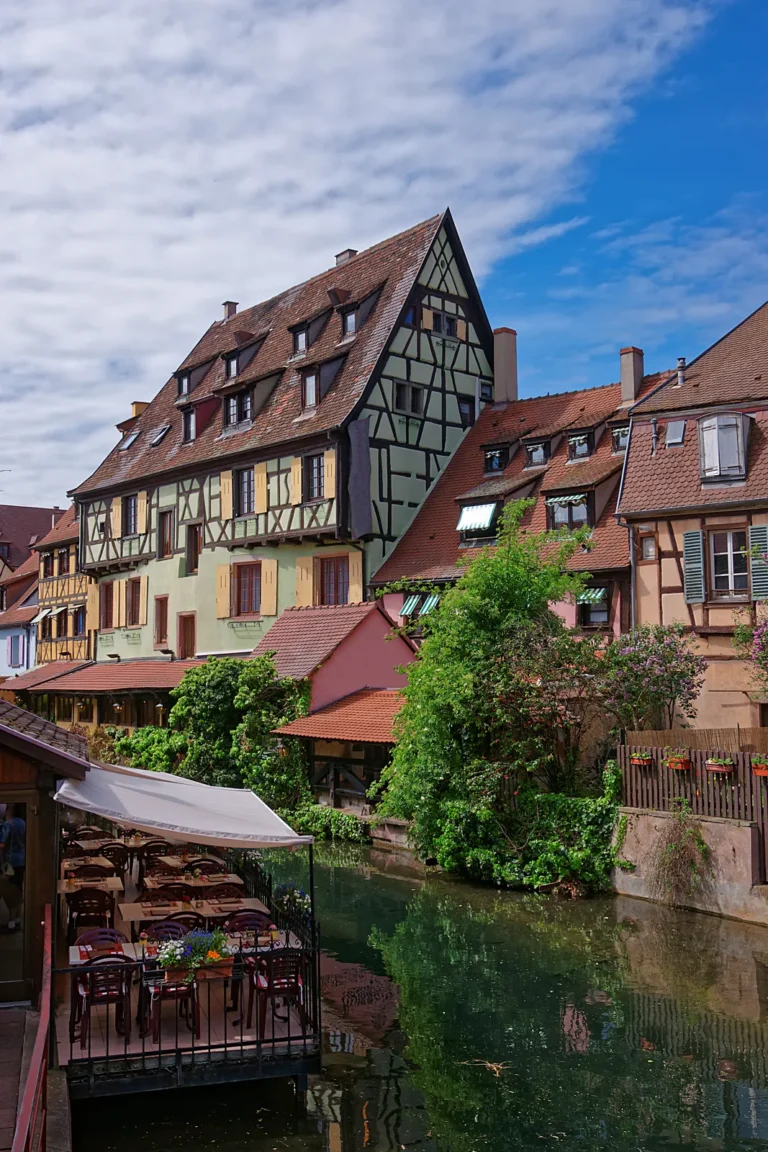
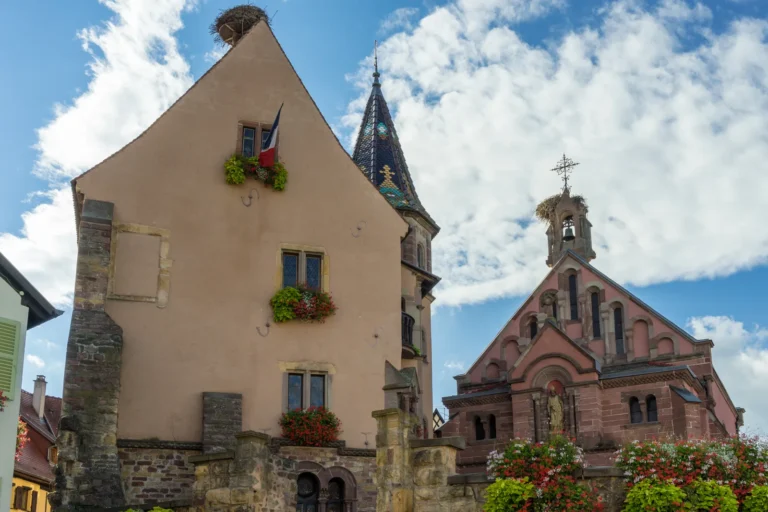
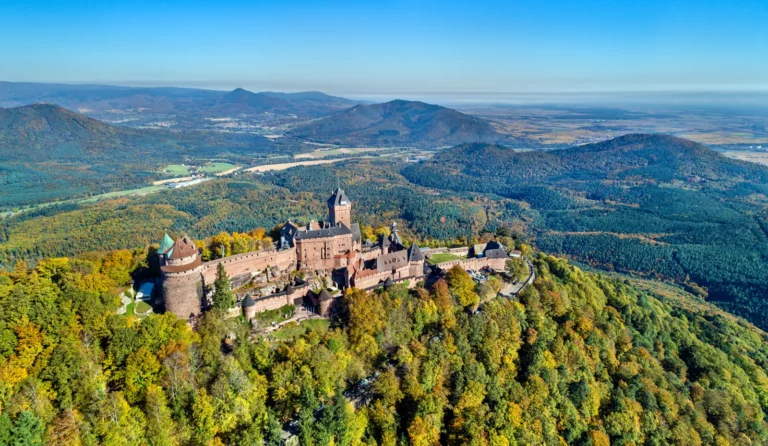
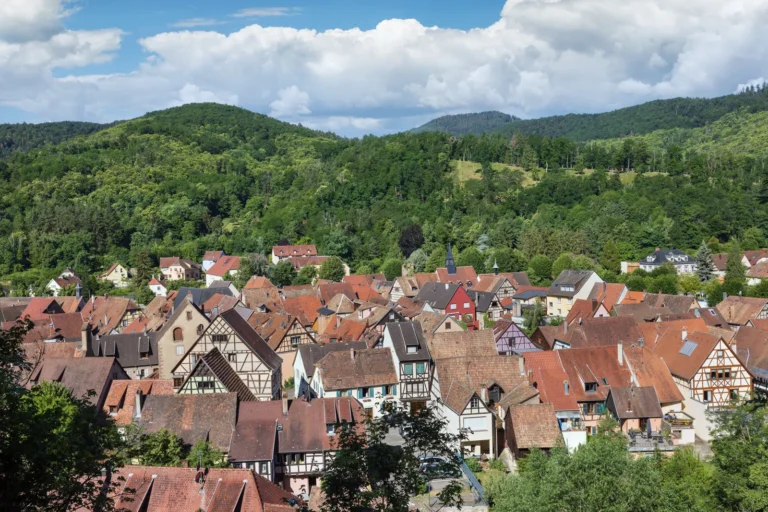
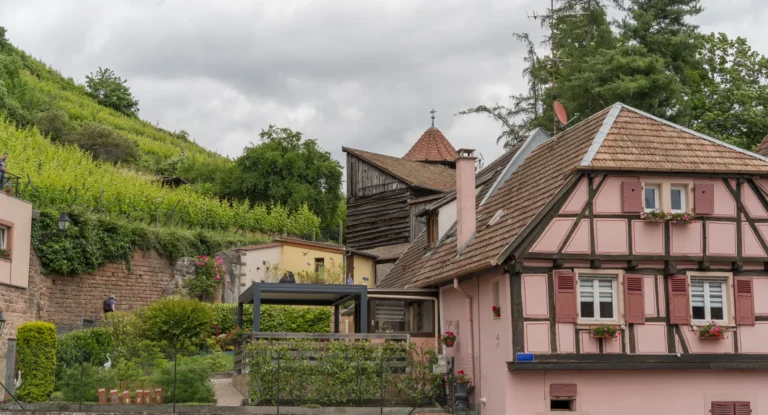
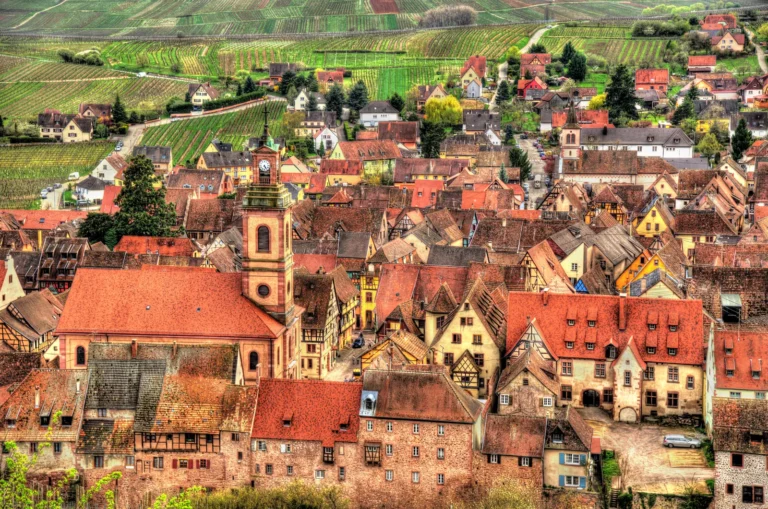
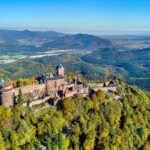
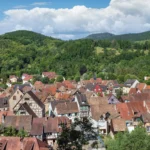
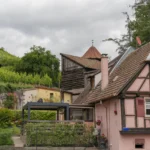
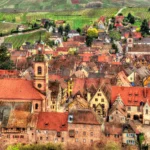
Looking for things to do in Alsace? Stroll through Petite France in Strasbourg and Little Venice in Colmar, follow the wine route from one flower-decked village to the next (Riquewihr, Eguisheim, Kaysersberg), climb up to Haut-Koenigsbourg Castle and, in December, wander the Christmas markets. The best times to visit Alsace are May to September, and December for the Christmas atmosphere. To place Alsace among the other regions, open our map of France.
Stretched between the Rhine and the Vosges, Alsace is a small region: about 190 km (118 mi) from north to south. You can see the essentials in a week, or even a long weekend around Strasbourg and Colmar. Its climate is the most continental in France: hot summers, cold winters, rain mostly in late spring and summer. Here are the places to see, itineraries, the budget and the month-by-month climate based on Météo-France normals.
Our travel deals for Alsace
Affiliate links: we earn a commission, at no extra cost to you.
FlightsKiwi.comCompare flights and airline combinations to Alsace.
Time zoneUTC+1 (UTC+2 in summer): 1 hour ahead of London, 6 hours ahead of New York
AirportsStrasbourg (SXB), EuroAirport Basel-Mulhouse-Freiburg (BSL/MLH) · detailsTGV high-speed trains link Paris-Est station with Strasbourg, Colmar and Mulhouse
May, June and September offer the best balance: 21 to 24 °C (70 to 75 °F) in the afternoon in Strasbourg, flower-filled villages and accessible vineyards. July and August are the hottest (above 26 °C, or 79 °F) but also stormier and busier. October is the month of the grape harvest and colorful forests. December is a season apart: cold (6 °C, or 43 °F, in the afternoon) but very popular for the Christmas markets, with full hotels and high prices.
Month
High
Low
Rain
Crowds
Prices
Verdict
January
5.2 °C (41 °F)
-0.2 °C (32 °F)
35.4 mm (1.4 in)
Very low
Low
❌ Coldest, frequent frost
February
7.3 °C (45 °F)
0.0 °C (32 °F)
34.1 mm (1.3 in)
Low
Low
⚠️ Cold but dry, skiing in the Vosges if there is snow
March
12.1 °C (54 °F)
2.6 °C (37 °F)
38.6 mm (1.5 in)
Low
Low
⚠️ Early spring
April
17.0 °C (63 °F)
5.7 °C (42 °F)
41.8 mm (1.6 in)
Medium (Easter)
Medium
✅ Mild and fairly dry, orchards in bloom
May
20.9 °C (70 °F)
10.1 °C (50 °F)
77.2 mm (3.0 in)
Medium
Medium
✅ Flower-filled villages, but the wettest month
June
24.4 °C (76 °F)
13.4 °C (56 °F)
68.5 mm (2.7 in)
Medium
Medium
✅ Ideal for the wine route and the Vosges
July
26.4 °C (80 °F)
14.9 °C (59 °F)
71.9 mm (2.8 in)
High
High
⚠️ Hot and stormy, very busy
August
26.1 °C (79 °F)
14.5 °C (58 °F)
61.3 mm (2.4 in)
High
High
⚠️ Hot, wine villages packed
September
21.6 °C (71 °F)
10.7 °C (51 °F)
54.6 mm (2.1 in)
Medium
Medium
✅ Mild, harvest begins
October
15.8 °C (60 °F)
7.2 °C (45 °F)
59.5 mm (2.3 in)
Medium
Medium
✅ Harvest, colorful forests
November
9.4 °C (49 °F)
3.3 °C (38 °F)
47.6 mm (1.9 in)
Medium (from late November)
Medium to high
⚠️ Grey; Christmas markets open at the end of the month
December
5.9 °C (43 °F)
0.8 °C (33 °F)
45.2 mm (1.8 in)
Very high
Very high
⚠️ Cold, but Christmas markets: book very early
Temperatures and precipitation: Météo-France 1991-2020 normals, Strasbourg-Entzheim station. Crowds and prices: estimate based on tourist seasons.
Colmar, sheltered by the Vosges, is one of the driest towns in France: 595 mm (23.4 in) of rain a year according to the Météo-France data sheet for Colmar-Meyenheim, against 636 mm (25.0 in) in Strasbourg. It is also a little sunnier:
Station
July high
January low
Rain per year
Sunshine per year
Strasbourg-Entzheim
26.4 °C (80 °F)
-0.2 °C (32 °F)
636 mm (25.0 in)
1,747 h
Colmar-Meyenheim
26.7 °C (80 °F)
-0.8 °C (31 °F)
595 mm (23.4 in)
1,882 h
1991-2020 normals, Météo-France climate data sheets. In the mountains (Vosges), temperatures are much lower and snow is frequent in winter.
Spring (April-June): flower-decked villages, storks, vines turning green; May is the wettest month, often in showers.
Summer (July-August): sometimes intense heat on the plain, thunderstorms; the Vosges ridges offer cooler hiking.
Fall (September-October): grape harvest and wine festivals, colors in the vineyards; a good time for the wine route.
Winter (November-March): the Christmas markets usually open in late November and run until late December (check the dates each year). In January-February, Alsace is quiet and cheap.
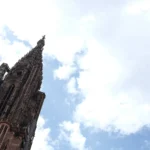
The Grande Île, Strasbourg’s historic heart, is a UNESCO World Heritage Site, as is the Neustadt, the German-era district. The pink sandstone Notre-Dame Cathedral houses an astronomical clock; its viewing platform is open to visitors. Petite France lines up half-timbered houses and canals as far as the Ponts Couverts and the Vauban Dam. The Palais Rohan holds several museums. The city is also the seat of the European Parliament and the Council of Europe. A boat trip on the Ill takes in the essentials.
Colmar
Colmar packs in half-timbered houses, Little Venice on the banks of the Lauch and the Maison Pfister. The Unterlinden Museum displays the Isenheim Altarpiece, a late medieval masterpiece. It is the ideal base for the Haut-Rhin wine route. Little Venice, the Maison Pfister and the Isenheim Altarpiece: our guide to things to do in Colmar covers these visits and the wine route.
The wine route and its villages
The Alsace Wine Route winds along the foot of the Vosges, from Marlenheim in the north to Thann in the south. Among the most visited villages: Riquewihr and its ramparts, Eguisheim and its circular lanes, Kaysersberg, Ribeauvillé, Turckheim, Obernai. Stop at winemakers to taste Riesling, Gewurztraminer, Pinot Gris or Crémant (in moderation if you are driving). In summer and during the Christmas markets, the villages are very busy: arrive in the morning.
Haut-Koenigsbourg Castle
Perched more than 700 m (2,300 ft) above the plain, this fortified castle, restored in the early 20th century at the request of Emperor Wilhelm II, looks out over the vineyards and, on clear days, the Black Forest. Nearby, the Volerie des Aigles (birds of prey) and the Montagne des Singes (monkey park) are popular with families.
Mulhouse and its museums
Mulhouse is the capital of technical museums: the Cité de l’Automobile (Schlumpf collection) and the Cité du Train rank among the largest museums of their kind in Europe. To the north, the Écomusée d’Alsace at Ungersheim recreates a traditional village with houses moved piece by piece.
The Vosges and the Route des Crêtes
The Route des Crêtes follows the Vosges watershed, with views over the Alsace plain. The Grand Ballon, the highest point of the range (1,424 m, or 4,672 ft), the Hohneck and the lakes are good for hiking; you can lunch at a ferme-auberge (farm inn serving the traditional « repas marcaire »). The road is partly closed in winter. Mont Sainte-Odile, a spiritual landmark of Alsace, and the Struthof memorial site (the former Natzweiler concentration camp) are in the Bas-Rhin Vosges.
Northern Alsace
Less visited, Northern Alsace offers Wissembourg, the villages of Hunspach and Seebach with their white half-timbered houses, the potters’ villages (Soufflenheim, Betschdorf) and the sandstone castles of the Northern Vosges, such as Fleckenstein.
Day 1: Strasbourg (cathedral, Petite France, boat trip)
Day 2: Obernai, Haut-Koenigsbourg and Riquewihr
Day 3: Colmar, then Eguisheim
7 days: the whole of Alsace
Days 1 and 2: Strasbourg, with half a day in Kehl, Germany, reached by tram
Day 3: Obernai and Mont Sainte-Odile
Day 4: Haut-Koenigsbourg, Ribeauvillé and Riquewihr
Day 5: Kaysersberg and the Route des Crêtes
Day 6: Colmar and Eguisheim
Day 7: Mulhouse (Cité de l’Automobile or Cité du Train) or the Écomusée d’Alsace
To extend the trip, Germany’s Black Forest and Basel in Switzerland are less than an hour away: see our Germany and Switzerland guides.
Alsace: who is it for?
Our view by traveler profile, based on the information in this guide:
Profile
Our view
Why
Couples
✅ Ideal
Colmar’s Little Venice, wine route villages, tastings at winemakers and winstubs.
Families
✅ Yes
Volerie des Aigles and Montagne des Singes near Haut-Koenigsbourg, Cité du Train and Cité de l’Automobile in Mulhouse, Écomusée d’Alsace.
Culture
✅ Yes
Strasbourg’s Grande Île and Neustadt on the UNESCO list, the cathedral, the Isenheim Altarpiece at the Unterlinden Museum.
Nature and hiking
✅ Yes
Route des Crêtes, Grand Ballon, lakes and farm inns in the Vosges; the ridges stay cooler in summer.
Tight budget
✅ Yes
Roughly €70 to 120 per person per day on a tight budget: regional trains, bikes, tarte flambée; allow more during the Christmas markets.
No car
✅ Yes
TGV high-speed trains to Strasbourg, Colmar and Mulhouse; regional trains, buses and bikes locally.
Budget for a trip to Alsace
Item (per person per day)
Tight budget
Comfort
Accommodation (shared double room)
roughly €30 to 50 (hostel, campsite, simple B&B)
roughly €80 to 150
Meals
roughly €20 to 35 (tarte flambée, winstub)
roughly €45 to 70
Local transport
roughly €10 to 20 (regional trains, buses, bikes)
roughly €25 to 40 (shared rental car)
Activities (museums, castle, tastings)
roughly €10 to 20
roughly €20 to 40
Total
roughly €70 to 120
roughly €150 to 250
Rough estimates, excluding travel from home. In December, hotel prices in Strasbourg and Colmar rise sharply.
Getting around Alsace
Train: regional TER trains quickly link Strasbourg, Sélestat, Colmar and Mulhouse, as well as Obernai and Kaysersberg (nearest station). Our guide: cheap train travel.
Car: convenient for the wine route and the Vosges; paid and limited parking in the villages in high season. According to GOV.UK, vehicles in certain mountain areas must have winter tyres or carry chains from 1 November to 31 March.
Bike: the region is well equipped with cycle paths, including the vineyard cycle route and EuroVelo 15 along the Rhine.
Tram and bus: Strasbourg has a dense tram network, extended to Kehl in Germany.
On foot: trails waymarked by the Club Vosgien across the whole range.
Where to stay in Alsace
For a car-free trip, choose Strasbourg and Colmar, well linked by train. With a car, a wine route village (Riquewihr, Ribeauvillé, Eguisheim, Obernai) lets you enjoy the place in the evening, once the day visitors have gone. Gîtes and B&Bs at winemakers’ estates are plentiful. For the Christmas markets, book several months ahead, or stay in Sélestat, Mulhouse or Kehl, often cheaper.
Entry requirements, health and safety
US citizens (travel.state.gov, last updated August 11, 2025): you may enter the Schengen area, including France, for up to 90 days for tourism or business without a visa; your passport should be valid at least three months beyond your stay, and officers may ask for proof of sufficient funds and a return ticket.
UK citizens (GOV.UK, updated 22 October 2026): no visa for up to 90 days in any 180-day period as a tourist; your passport must have been issued less than 10 years before you arrive and be valid at least 3 months after you leave the Schengen area. The EU Entry/Exit System (EES) is being implemented: fingerprints and a photo may be taken at your first entry, free of charge.
Health: take out travel insurance that covers medical costs; UK residents can also use a GHIC or a valid EHIC (GOV.UK). The State Department advises being up to date on CDC-recommended vaccinations.
Crossing into Germany or Switzerland: France has temporarily reintroduced border controls with its Schengen neighbours (travel.state.gov), and GOV.UK notes temporary controls at Germany’s land borders: carry your passport for Kehl, the Black Forest or Basel.
Christmas markets: the UK FCDO considers that terrorists are very likely to try to carry out attacks in France; stay alert in crowded places (GOV.UK). Town centers have security checks and traffic restrictions during this period.
Mountains: in winter, Vosges roads can be snowy or closed; GOV.UK reminds drivers that winter tyres or chains are compulsory in certain mountain areas.
Emergencies: 112 (European emergency number), 15 for medical emergencies (travel.state.gov, GOV.UK).
Practical tips for Alsace
Public holidays: according to Service-Public (the French government’s official site, checked 26 October 2026), Alsace and Moselle have two extra public holidays: December 26 and Good Friday (the latter in municipalities with a Protestant or mixed church).
Money: cards are accepted almost everywhere; carry some cash for Christmas market stalls.
Mobile data: near the border, your phone may switch to a German or Swiss network; Switzerland is outside the EU, so check your roaming charges.
Food: choucroute (sauerkraut with meats), baeckeoffe, tarte flambée, kougelhopf, Munster cheese, bredele cookies at Christmas; winstubs are the traditional restaurants.
Wine: cellars are happy to welcome you for a tasting, but call ahead for groups.
May, June and September for the weather (21 to 24 °C, or 70 to 75 °F, in the afternoon in Strasbourg according to Météo-France) and the flower-filled villages; October for the grape harvest; December for the Christmas markets.
When are the Christmas markets in Alsace?
Usually from late November to late December; some close on the 24th, others on December 30 or 31. Check each town’s dates.
Can you visit Alsace without a car?
Yes for Strasbourg, Colmar, Mulhouse, Sélestat and Obernai, linked by regional trains. To string together the small wine villages, bikes, local buses or a car are more practical.
Colmar or Strasbourg: where should you stay?
Strasbourg for city life and museums, Colmar to explore the wine route. Many travelers combine the two, about 30 minutes apart by train.
Is Alsace cold in winter?
Yes: in Strasbourg, the average January low is -0.2 °C (32 °F) and the high 5.2 °C (41 °F) (1991-2020 normals). Pack warm clothes for the Christmas markets.
Our sources
Météo-France: climate data sheets, 1991-2020 statistics, Strasbourg-Entzheim and Colmar-Meyenheim stations


 FlightsKiwi.comCompare flights and airline combinations to Alsace.Compare flights