Things to do in Normandy include Mont-Saint-Michel, the D-Day beaches and the Caen Memorial, the Bayeux Tapestry, a stroll around Honfleur, a cliff-top walk at Étretat and Monet’s gardens at Giverny. To visit Normandy at the right time, aim for May to September, ideally June or September.
About two hours west of Paris, Normandy works as well for a weekend as for a one- or two-week road trip. Its five départements bring together very different landscapes: the chalk cliffs of the Alabaster Coast, the seaside resorts of the Côte Fleurie, the hedgerows and orchards of the Pays d’Auge, the wild Cotentin peninsula, and art cities such as Rouen and Caen. This guide helps you choose your stops, your timing (backed by Météo-France normals), your budget and how to get around.
Our travel deals for Normandy
Affiliate links: we earn a commission, at no extra cost to you.
FlightsKiwi.comCompare flights and airline combinations to Normandy.
Time zoneUTC+1, UTC+2 in summer: 1 hour ahead of London, 6 hours ahead of New York
AirportsParis-Charles de Gaulle (CDG) and Paris-Orly (ORY), then the train · detailsParis-Saint-Lazare to Rouen (about 1 h 15 to 1 h 30), Caen (about 2 h), Cherbourg or Le Havre
EntrySchengen area: no visa for up to 90 days for US citizens (tourism or business) and UK citizens (in any 180-day period) · US: travel.state.gov · UK: GOV.UK
Electricitycheck voltage and plug types before you go · plugs
June and September are the best months: 20 to 22 °C (68 to 72 °F) in the afternoon in Caen, long days and fewer people than in July-August. The climate is oceanic: mild, cool in summer and damp in winter, with rain spread across the year and a peak from October to December. Spring is apple-blossom season in the Pays d’Auge.
Month
Avg max
Avg min
Rain
Crowds
Prices
Verdict
January
8.3 °C (47 °F)
2.9 °C (37 °F)
63.1 mm (2.5 in)
Very low
Low
❌ Cold and damp, short days
February
9.1 °C (48 °F)
2.8 °C (37 °F)
52.8 mm (2.1 in)
Low
Low
⚠️ Quiet, ideal for museums
March
11.7 °C (53 °F)
4.2 °C (40 °F)
49.7 mm (2.0 in)
Low
Low
⚠️ Changeable, big equinox tides
April
14.4 °C (58 °F)
5.5 °C (42 °F)
53.4 mm (2.1 in)
Moderate (Easter)
Medium
⚠️ Apple blossom, Giverny reopens
May
17.4 °C (63 °F)
8.5 °C (47 °F)
59.4 mm (2.3 in)
Moderate (bank holidays)
Medium
✅ Green and in bloom, good for walking
June
20.5 °C (69 °F)
11.2 °C (52 °F)
58.0 mm (2.3 in)
High around 6 June
Medium to high
✅ D-Day commemorations, long days
July
22.9 °C (73 °F)
13.1 °C (56 °F)
51.1 mm (2.0 in)
High
High
✅ Best for the beach
August
23.2 °C (74 °F)
13.3 °C (56 °F)
59.6 mm (2.3 in)
Very high
Very high
⚠️ Warmest, but crowds and peak prices
September
20.4 °C (69 °F)
11.1 °C (52 °F)
54.3 mm (2.1 in)
Moderate
Medium
✅ Mild, quiet, late-season light
October
16.2 °C (61 °F)
8.8 °C (48 °F)
78.9 mm (3.1 in)
Low
Medium to low
⚠️ Autumn colours, more rain
November
11.8 °C (53 °F)
5.6 °C (42 °F)
78.7 mm (3.1 in)
Very low
Low
❌ Grey and wet
December
8.8 °C (48 °F)
3.3 °C (38 °F)
81.3 mm (3.2 in)
Low (holidays)
Low
❌ Wettest, Christmas markets in Rouen
Temperatures and rainfall: Météo-France 1991-2020 normals, Caen-Carpiquet station. Crowds and prices: estimate based on tourist seasons.
According to the same sheet, Caen gets about 70 hours of sunshine in January against more than 210 in June and July. Differences between stations are modest:
Station
July max
January max
Rain per year
Caen (Calvados)
22.9 °C (73 °F)
8.3 °C (47 °F)
740 mm (29.1 in)
Rouen-Boos (Seine-Maritime)
23.4 °C (74 °F)
6.9 °C (44 °F)
848 mm (33.4 in)
Le Havre, Cap de la Hève (coast)
20.9 °C (70 °F)
7.6 °C (46 °F)
790 mm (31.1 in)
Alençon (Orne, inland)
24.3 °C (76 °F)
7.4 °C (45 °F)
744 mm (29.3 in)
1991-2020 normals, Météo-France climate sheets.
Spring (April-May): orchards in bloom, the Giverny gardens, quiet sites. Bring warm clothes.
Summer (June-August): beach and resort season; peak crowds at Mont-Saint-Michel and on the D-Day beaches, especially around 6 June and in August.
Autumn (September-October): September is very pleasant; October brings forest colours and the apple season, but more rain.
Winter (November-March): Mont-Saint-Michel and the museums stay open, with far fewer visitors. Some seaside resorts are very quiet.
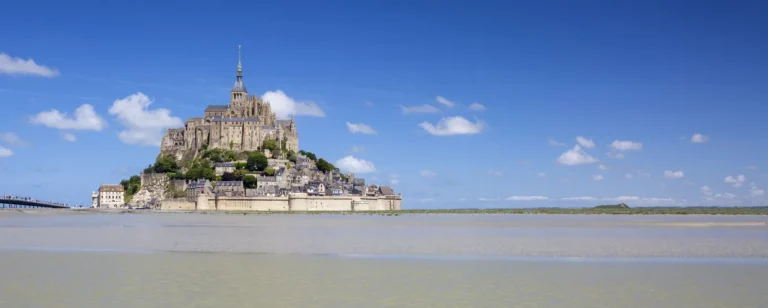
A UNESCO World Heritage Site together with its bay, Mont-Saint-Michel is crowned by its abbey. You leave the car in the mainland car parks (parking is charged), then reach the rock on the free Le Passeur shuttle or on foot (about 45 minutes); according to the Mont-Saint-Michel tourist office (checked 26 October 2026), the shuttle is free and runs daily. Arrive early in the morning or late in the afternoon to avoid the crowds. Crossing the bay on foot is only done with an approved guide: the tides and quicksand are dangerous. Shuttles, opening times and guided bay crossings: our Mont-Saint-Michel travel guide explains how to organise your visit.
The D-Day beaches
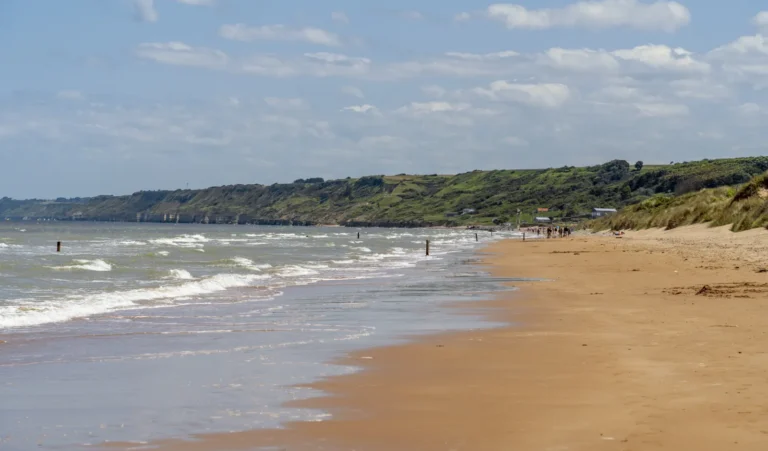
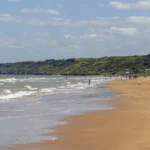
On 6 June 1944, the Allies landed on five beaches, from west to east: Utah, Omaha, Gold, Juno and Sword. The main sites are the American Cemetery at Colleville-sur-Mer overlooking Omaha Beach, the Pointe du Hoc, Arromanches and the remains of the artificial harbour, Sainte-Mère-Église and many museums. Allow one or two full days, ideally with a guided tour.
Caen and Bayeux
Caen is the ideal base for the D-Day sites: its Memorial is one of the major museums of the Second World War. The city also has William the Conqueror’s castle and the Abbaye aux Hommes and Abbaye aux Dames. 30 km (19 mi) away, Bayeux was spared by the fighting: it is home to the Bayeux Tapestry, which tells the story of the conquest of England in 1066, and its cathedral.
For the Calvados and Manche coast, our page visiting the D-Day beaches brings together opening times, prices and an itinerary.
Honfleur and the Côte Fleurie
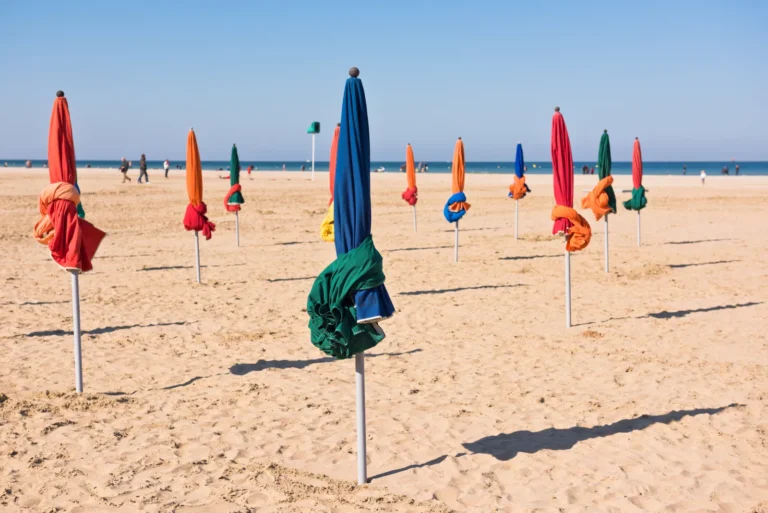
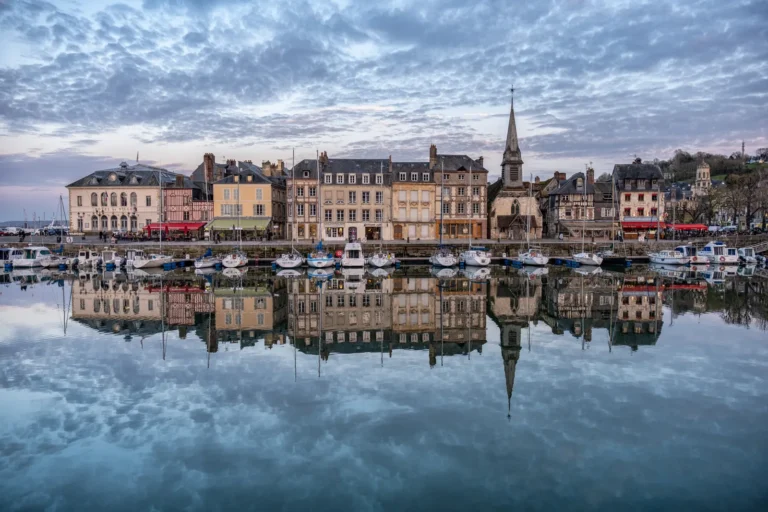
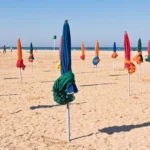
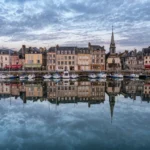
Honfleur’s Vieux Bassin, lined with tall narrow houses, and the wooden church of Sainte-Catherine are among the best-known images of Normandy. To the west, the Côte Fleurie strings together seaside resorts: Trouville and its fish market, Deauville and its boardwalk, Houlgate and Cabourg. The resort has its own guide: visiting Deauville. The Vieux Bassin and the houses of the estuary are covered in our page visiting Honfleur.
Étretat and the Alabaster Coast
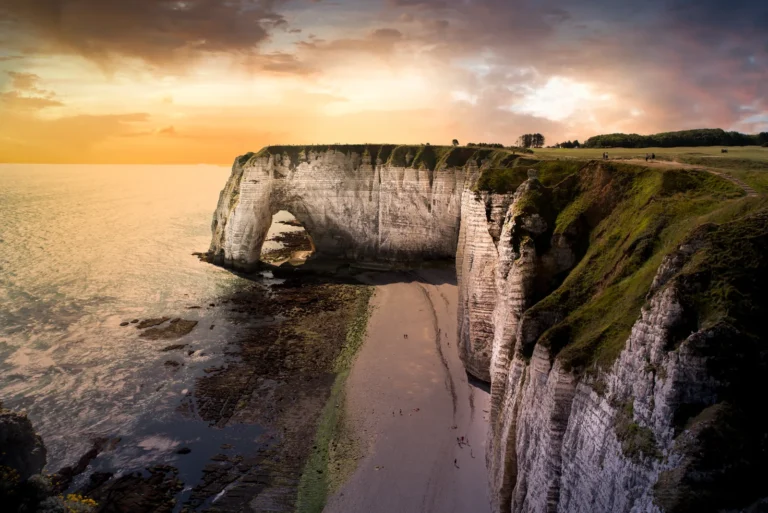
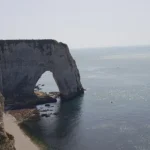
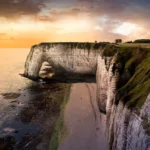
The chalk cliffs of Étretat, with their arches and needle, are best seen from the cliff-top paths. The site is very busy at weekends and in summer: come early. The Alabaster Coast continues towards Fécamp (Bénédictine palace), Veules-les-Roses and Dieppe. Le Havre, rebuilt by Auguste Perret, is a UNESCO World Heritage Site and home to the André Malraux modern art museum (MuMa). For the cliffs themselves, our Étretat travel guide details the arches, the needle, the trails and tide times.
Rouen and the Seine abbeys
Rouen, the « city of a hundred spires », has the Notre-Dame cathedral painted by Monet, the Gros-Horloge, streets lined with half-timbered houses and the Place du Vieux-Marché, where Joan of Arc was burned in 1431. Downstream, the abbey route follows the loops of the Seine: Jumièges, Saint-Wandrille. Our guide to things to do in Rouen covers the city over one or two days.
Giverny
Claude Monet lived in Giverny from 1883 until his death. His house and gardens, including the water-lily pond, can be visited during the opening season, from spring to autumn (check the dates on the official Fondation Monet website). Book your tickets in high season.
Near Vernon, our guide to visiting Giverny gives opening times, prices and month-by-month flowering in Monet’s gardens.
The Pays d’Auge, the Cotentin and the Suisse Normande
The Pays d’Auge, between Lisieux and the coast, is the land of half-timbering, orchards, cider, calvados and cheeses (camembert, livarot, pont-l’évêque); Beuvron-en-Auge is one of the most visited villages. The Cotentin has wilder scenery: La Hague and the Nez de Jobourg, Barfleur, Cherbourg and its Cité de la Mer. South of Caen, the Suisse Normande, around Clécy and the Orne valley, is ideal for hiking and canoeing.
Day 4 (optional): Giverny on the way back to Paris
7 to 10 days: the grand tour
Day 1: Giverny, then Rouen
Day 2: Étretat and Fécamp
Day 3: Honfleur, Trouville and Deauville
Day 4: Pays d’Auge (Beuvron-en-Auge, cider farms)
Day 5: Caen and the Memorial
Day 6: D-Day beaches (Arromanches, Omaha, Pointe du Hoc)
Day 7: Bayeux, then on to Mont-Saint-Michel
Day 8: Mont-Saint-Michel
Days 9 and 10 (optional): Granville and the Chausey Islands, or the Cotentin
To continue into another region, Mont-Saint-Michel is about an hour from Rennes and Saint-Malo, in Brittany. From there, you can easily extend the trip with a stay in Brittany, on the other side of the bay.
Budget for a trip to Normandy
Item (per person per day)
Budget
Comfort
Accommodation (sharing a double room)
roughly €30 to €50 (campsite, hostel, simple B&B)
roughly €80 to €150
Meals
roughly €20 to €35
roughly €45 to €70
Local transport
roughly €10 to €20
roughly €25 to €40 (shared car hire)
Activities (museums, abbey)
roughly €10 to €20
roughly €20 to €40
Total
roughly €70 to €120 per person per day
roughly €150 to €250 per person per day
Rough estimates, excluding your journey to Normandy. Deauville, Honfleur and the area around Mont-Saint-Michel are more expensive than the rest of the region.
Getting around Normandy
Train: lines out of Paris-Saint-Lazare to Rouen, Le Havre, Caen, Bayeux and Cherbourg; Granville is served out of Paris-Montparnasse. Our guide: cheap train travel.
Car: essential for the D-Day beaches, the Pays d’Auge and the Cotentin. Some motorway sections are toll roads.
Mont-Saint-Michel without a car: according to the Mont-Saint-Michel tourist office (checked 26 October 2026), buses run from Pontorson station (about 9 km away) and from Rennes station, and line 308 of the Nomad network serves the site from Granville and Avranches.
Bike: the Véloscénie (Paris – Mont-Saint-Michel) and the Vélomaritime cycle routes run through part of the region.
Tours: guided minibus tours of the D-Day beaches leave from Caen and Bayeux.
By ferry: Cherbourg, Caen-Ouistreham, Le Havre and Dieppe have ferry links with the UK or Ireland.
Where to stay in Normandy
Rouen for the Seine and the Alabaster Coast, Honfleur or Trouville for the Côte Fleurie, Caen or Bayeux for the D-Day beaches, Pontorson, Avranches or Granville for Mont-Saint-Michel: three bases are enough for a one-week tour. B&Bs and self-catering cottages on Pays d’Auge farms are a good option. Book early for the period around 6 June and for summer weekends.
Entry requirements, health and safety
US citizens: you may enter the Schengen area, including France, for up to 90 days for tourism or business without a visa; your passport should be valid at least three months beyond your period of stay (six months recommended), and immigration officers may ask for proof of sufficient funds and a return ticket (U.S. Department of State, travel.state.gov, last updated August 11, 2025).
UK citizens: no visa for up to 90 days in any 180-day period as a tourist; your passport must have been issued less than 10 years before you arrive and be valid at least 3 months after the day you plan to leave the Schengen area. The EU Entry/Exit System (EES) is being implemented: fingerprints and a photo may be taken at the border, free of charge (UK FCDO, GOV.UK, updated 22 October 2026).
ID: according to GOV.UK, you must be able to prove your identity when asked by the police, or within 4 hours at a police station: carry your passport.
Health and emergencies: UK travellers need a GHIC or valid EHIC for state healthcare; everyone should have travel insurance covering medical costs. Emergency numbers: 112 (European emergency number) and 15 (medical emergencies) (GOV.UK; travel.state.gov).
Tides: in the Bay of Mont-Saint-Michel, never venture onto the sands without a guide.
Cliffs: at Étretat and along the Alabaster Coast, rockfalls are frequent: keep away from both the edge and the foot of the cliffs.
Swimming: GOV.UK advises following the lifeguards’ flag warning system on beaches.
Practical tips for Normandy
Money: cards are accepted almost everywhere; cash is handy at markets and small producers.
Mobile data: check your home carrier’s roaming charges before you go.
Remembrance: the military cemeteries are places of remembrance: dress and behave accordingly.
Food: seafood, mussels, cream and butter, PDO cheeses, teurgoule (rice pudding), cider, perry and calvados. The Pays d’Auge cider route lets you visit producers.
Weather: even in summer, pack a sweater and a raincoat.
Major events in Normandy
When
Event
Where
Around 6 June
D-Day commemorations
Calvados and Manche beaches
Early September
American Film Festival
Deauville
October-November
Apple and cider festivals
Pays d’Auge and villages
December
Christmas markets
Rouen, Caen
Exact dates change every year: check with the organisers before booking.
Who is Normandy for?
Our view, traveller by traveller, based on the information in this guide:
Profile
Our verdict
History lovers
Ideal: D-Day beaches, Caen Memorial, Bayeux Tapestry, Rouen and Mont-Saint-Michel.
Couples on a short break
Ideal: about two hours by road or rail out of Paris, Honfleur, Étretat or Giverny can be seen in two or three days.
Families
Yes: Côte Fleurie resorts, the Cité de la Mer in Cherbourg, Mont-Saint-Michel; take care with the tides in the bay and near the cliffs.
Walking and cycling
Yes: the Étretat trails, the Suisse Normande, the Véloscénie and Vélomaritime.
Without a car
Possible: Rouen, Caen, Bayeux, Le Havre and Cherbourg are served by train, but a car is still useful for the Pays d’Auge and the Cotentin.
Beach and heat
Not ideal: oceanic climate, with an average high of about 23 °C (73 °F) in August in Caen according to Météo-France.
Pick one area: Rouen, Étretat and Honfleur in the east; or Caen, the D-Day beaches and Bayeux in the west. Mont-Saint-Michel alone takes a day.
What is the best time to visit Normandy?
May to September, ideally June or September. July and August are the warmest months (an average high of 23 °C, or 73 °F, in Caen according to Météo-France) but also the busiest.
Where to stay to visit the D-Day beaches?
Caen and Bayeux are the most convenient bases; Arromanches and the coastal villages let you sleep closest to the sites.
Can you visit Normandy without a car?
Rouen, Caen, Bayeux, Le Havre and Cherbourg can be reached by train, and guided tours serve the D-Day beaches. For the Pays d’Auge or the Cotentin, a car is still very useful.
Is Mont-Saint-Michel free?
Access to the rock and its streets is free, and so is the shuttle from the car parks, but parking is charged. Visiting the abbey costs extra.


 FlightsKiwi.comCompare flights and airline combinations to Normandy.Compare flights