
Things to do in Étretat: climb the Falaise d’Aval to see the Arch and the Needle, walk up to the Notre-Dame-de-la-Garde chapel on the Falaise d’Amont, follow the GR21 trail to the Manneporte, and stroll along the pebble beach and through the village centre with its half-timbered houses. One day is enough to visit Étretat; come early in the morning or late in the day, ideally on a weekday and outside summer.
A small resort on the Alabaster Coast, in Seine-Maritime, Étretat owes its fame to its chalk cliffs, painted by Monet and Courbet. The village is small, but it draws huge numbers of visitors. This guide brings together viewpoints and walks, safety advice (rockfalls, tides), access, where to stay, budget and the month-by-month climate based on Météo-France. On the Côte Fleurie, our page Deauville: boardwalk and beaches rounds off a stay on the Normandy coast.

Our travel deals for Étretat
Affiliate links: we earn a commission, at no extra cost to you.
 FlightsKiwi.comCompare flights and airline combinations to Étretat.Compare flights

Étretat at a glance
- Location Seine-Maritime(Normandy), about 30 km (19 mi) from Le Havre and 90 km (56 mi) from Rouen
- Getting there by car or by train to Le Havre, then coachThere is no railway station in Étretat
- Ideal length one day; two with Fécamp or Le Havre
- Best time May-June and SeptemberOctober to March for peace and quiet
- Good to know frequent rockfallsCheck tide times before any walk on the foreshore
- Entry US and UK citizens: no visa for up to 90 days in the Schengen area · travel.state.gov · GOV.UK
- Currency the euro · currencies
- Budget see our budget section
Things to do in Étretat: the highlights
The Falaise d’Aval, the Arch and the Needle
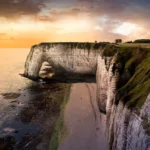
West of the beach, a stepped path climbs the Falaise d’Aval. From the top you see the Porte d’Aval, a great chalk arch, and the Aiguille (Needle), an isolated spire about 50 m (164 ft) high. This is Étretat’s most famous view. Stay on the marked paths: the cliff edge is unstable and the fences are there for a reason.
The Manneporte
Continuing west along the Falaise d’Aval, the path reaches the Manneporte, the largest of the three arches, which Monet painted several times. Further on, the Pointe de la Courtine offers a quieter view of the coast. Allow about an hour there and back from the beach, more with photo stops.
The Falaise d’Amont and the Notre-Dame-de-la-Garde chapel
To the east, the Falaise d’Amont is topped by the Notre-Dame-de-la-Garde chapel, dedicated to sailors, and the monument to Nungesser and Coli, aviators who disappeared in 1927 while attempting to fly across the Atlantic. The view of the Falaise d’Aval across the bay is the most photographed at the end of the day. Go up by steps from the beach or by road.
The beach and seafront
The pebble beach stretches between the two cliffs. Swimming is possible in summer, but the pebbles and cool water make it one for the brave. Do not take pebbles: they protect the coastline from erosion. At low tide the foreshore is exposed at the foot of the cliffs; never go beyond the Trou à l’Homme, at the foot of the Falaise d’Aval, or you risk being cut off by the sea.
The village centre
The centre is just a few streets around Place du Maréchal-Foch and its old wooden market hall. You will find half-timbered houses, shops and restaurants. The Notre-Dame church, Romanesque in origin, stands a little apart. The Clos Lupin, home of Maurice Leblanc, author of the Arsène Lupin stories, is open to visitors.
Les Jardins d’Étretat
On the Falaise d’Amont, Les Jardins d’Étretat are contemporary gardens combining clipped plants and artworks, with sea views. There is an admission charge; check opening times before you go up.
The GR21 and the Alabaster Coast
The GR21 long-distance trail follows the cliffs from Le Havre to Le Tréport. From Étretat you can walk to Bénouville and Le Tilleul to the south-west, or Yport and Fécamp to the north-east, past valleuses (small valleys running down to the sea). Fécamp, with its Bénédictine palace and port, is about twenty minutes away by car. Le Havre, a UNESCO World Heritage Site for its centre rebuilt by Auguste Perret, is about thirty minutes away.
Itinerary: Étretat in one day
- Arrive early in the morning (before 10 am), coffee in the centre
- Climb the Falaise d’Aval: Porte d’Aval, the Needle, then the Manneporte
- Lunch in the village (mussels, fish, crêpes)
- Afternoon: the Falaise d’Amont, the chapel and Les Jardins d’Étretat
- End of the day: sunset over the Falaise d’Aval seen from the Falaise d’Amont
With a second day, add Fécamp and Yport via the GR21 or by car, or Le Havre and Honfleur. To plan a longer stay, see our ideas for visiting Normandy, from Rouen to Mont-Saint-Michel. Mont-Saint-Michel needs its own planning: our guide to things to do at Mont-Saint-Michel covers shuttles, opening times and the abbey.
Getting there and parking
- By car: the simplest option. Parking in the centre is limited and paid, and car parks fill up quickly at weekends and in summer: arrive in the morning.
- By train and coach: there is no station in Étretat. Take the train to Le Havre (on the line to Paris-Saint-Lazare), then a regional coach to Étretat; timetables are published by the Le Havre Étretat tourist office and the regional network. See our tips for cheap train travel.
- On foot: once there, everything is on foot; the climbs to the cliffs are steep.
- Public transport recommended: the tourist office recommends using public transport whenever possible.
Safety: cliffs and tides
The tourist office points out that the risk of rockfalls is real and frequent and that a municipal by-law governs walking along the shore.
- Stay on open, marked paths, away from the cliff edge.
- Do not linger at the foot of the cliffs.
- Check tide times before walking on the foreshore; do not go beyond the Trou à l’Homme.
- Do not take pebbles.
- In strong winds or after heavy rain, give the cliff-edge paths a miss.
When to go to Étretat
The best months are May, June and September: mild weather, long days and fewer people than in July and August. The climate is oceanic and cool: 21 °C (70 °F) in the afternoon in August at Cap de la Hève, mild winters (nearly 8 °C, 46 °F, in January), heavier rain from October to December. The tourist office advises avoiding long weekends, the May public holidays and summer, and highlights the period from October to March.
| Month | Avg max | Avg min | Rain | Crowds | Prices | Verdict |
|---|---|---|---|---|---|---|
| January | 7.6 °C (46 °F) | 3.9 °C (39 °F) | 67.5 mm (2.7 in) | Low | Low | ⚠️ Quiet, windy, short days |
| February | 8.0 °C (46 °F) | 3.9 °C (39 °F) | 53.7 mm (2.1 in) | Low to moderate | Low | ⚠️ Fine winter skies, paths sometimes muddy |
| March | 10.5 °C (51 °F) | 5.6 °C (42 °F) | 52.5 mm (2.1 in) | Low to moderate | Low | ⚠️ Cool, few people |
| April | 13.3 °C (56 °F) | 7.5 °C (46 °F) | 52.3 mm (2.1 in) | Moderate | Moderate | ✅ Spring, busy at Easter |
| May | 16.2 °C (61 °F) | 10.3 °C (51 °F) | 56.5 mm (2.2 in) | High on holiday weekends | Moderate to high | ✅ Mild, avoid long weekends |
| June | 19.0 °C (66 °F) | 13.1 °C (56 °F) | 58.0 mm (2.3 in) | Moderate to high | Moderate to high | ✅ Long days, evening light |
| July | 20.9 °C (70 °F) | 15.1 °C (59 °F) | 48.7 mm (1.9 in) | Very high | High | ⚠️ Driest month but very busy |
| August | 21.2 °C (70 °F) | 15.6 °C (60 °F) | 66.0 mm (2.6 in) | Very high | High | ⚠️ Come early, car parks full |
| September | 19.1 °C (66 °F) | 13.7 °C (57 °F) | 65.4 mm (2.6 in) | Moderate | Moderate | ✅ Mild, sea still pleasant |
| October | 15.5 °C (60 °F) | 10.8 °C (51 °F) | 86.2 mm (3.4 in) | Low to moderate | Moderate | ⚠️ Wetter, beautiful light |
| November | 11.3 °C (52 °F) | 7.4 °C (45 °F) | 87.5 mm (3.4 in) | Low | Low | ❌ Rain and wind |
| December | 8.4 °C (47 °F) | 4.7 °C (40 °F) | 95.5 mm (3.8 in) | Low | Low | ❌ Wettest month |
- Spring: April to June is the best time for hiking, with about 52 to 58 mm (2.0 to 2.3 in) of rain a month.
- Summer: peak crowds; come before 10 am or after 5 pm.
- Autumn: September stays mild; from October the rain increases (86 mm (3.4 in)) but the crowds disappear.
- Winter: quiet, with low-angled light; bring a windproof jacket and good shoes.
Where to stay in Étretat
| Area | Best for | Highlights |
|---|---|---|
| Étretat centre | Sunrise and sunset over the cliffs | Everything on foot; high prices in summer |
| Nearby villages (Bénouville, Le Tilleul, Yport) | Peace and nature | Holiday cottages and B&Bs, access to the GR21 |
| Fécamp | A gentler budget | Port town, restaurants, railway station |
| Le Havre | Without a car | Station, plenty of hotels, coach to Étretat |
How much does a trip to Étretat cost?
| Item (per person per day) | Budget | Comfort |
|---|---|---|
| Accommodation (sharing a double room) | roughly €35 to €55 (Le Havre, Fécamp, campsite) | roughly €80 to €140 |
| Meals | roughly €20 to €30 (picnic, crêperie) | roughly €40 to €60 |
| Transport and parking | roughly €5 to €15 | roughly €10 to €20 |
| Sightseeing | free (cliffs, trails, beach) | roughly €15 to €30 (Jardins d’Étretat, Clos Lupin) |
| Total | roughly €60 to €100 per person per day | roughly €140 to €220 per person per day |
Entry requirements, health and safety
- US citizens: you may enter the Schengen area, including France, for up to 90 days for tourism or business without a visa; your passport should be valid at least three months beyond your period of stay (six months recommended), and immigration officers may ask for proof of sufficient funds and a return ticket (U.S. Department of State, travel.state.gov, last updated August 11, 2025).
- UK citizens: no visa for up to 90 days in any 180-day period as a tourist; your passport must have been issued less than 10 years before you arrive and be valid at least 3 months after the day you plan to leave the Schengen area. The EU Entry/Exit System (EES) is being implemented: fingerprints and a photo may be taken at the border, free of charge (UK FCDO, GOV.UK, updated 22 October 2026).
- Health and emergencies: UK travellers need a GHIC or valid EHIC for medically necessary state healthcare; everyone should have travel insurance covering medical costs. Emergency numbers: 112 (European emergency number, with some English-speaking staff) and 15 (medical emergencies) (GOV.UK; travel.state.gov).
Practical tips for Étretat
- Footwear: steep steps and sometimes slippery paths: walking shoes recommended.
- Timing: early morning and late afternoon are the best times for light and calm.
- Drones: flying is regulated; check the rules before taking off.
- Restaurants: book for dinner in summer and at weekends.
- Mobile data: check your home carrier’s roaming charges before you go.
Frequently asked questions
How long do you need in Étretat?
One day is enough for the Falaise d’Aval, the Manneporte, the Falaise d’Amont and the village. Allow two days to add Fécamp, Yport or Le Havre. Our guide to Le Havre, rebuilt by Auguste Perret, covers the listed centre and the seafront.
What is the best time to visit Étretat?
May, June and September, early in the morning or late in the day. The tourist office advises avoiding long weekends, the May public holidays and summer.
Can you get to Étretat without a car?
Yes, by train to Le Havre and then by regional coach, but there is no station in Étretat. Check coach timetables, which are less frequent out of season.
Can you walk at the foot of the Étretat cliffs?
Only if you follow the municipal by-law, check the tides and do not go beyond the Trou à l’Homme: rockfalls are frequent and the sea can cut off your way back.
What to do in Étretat when it rains?
The Clos Lupin, the market hall and the shops in the centre, then Fécamp (Bénédictine palace) or Le Havre (André Malraux modern art museum), half an hour away.
Can you swim in Étretat?
Yes, in summer, on the pebble beach, which is supervised in season. The water stays cool and the beach shelves quite steeply.
Our sources
- Le Havre Étretat tourist office: « Étretat, mode d’emploi » page (safety, tides, crowds), accessed October 2026
- Météo-France: climate sheet, 1991-2020 statistics, Cap de la Hève station (Sainte-Adresse, about 20 km (12 mi) south of Étretat)
- Entry requirements, health and safety checked on 26 October 2026: U.S. Department of State, France country information (last updated August 11, 2025) and UK FCDO, GOV.UK foreign travel advice for France (updated 22 October 2026)
- Our methodology
Updated October 2026.
To extend your trip, see our France travel guide, our page on visiting Brittany, our budget weekend ideas and our destinations in Europe.