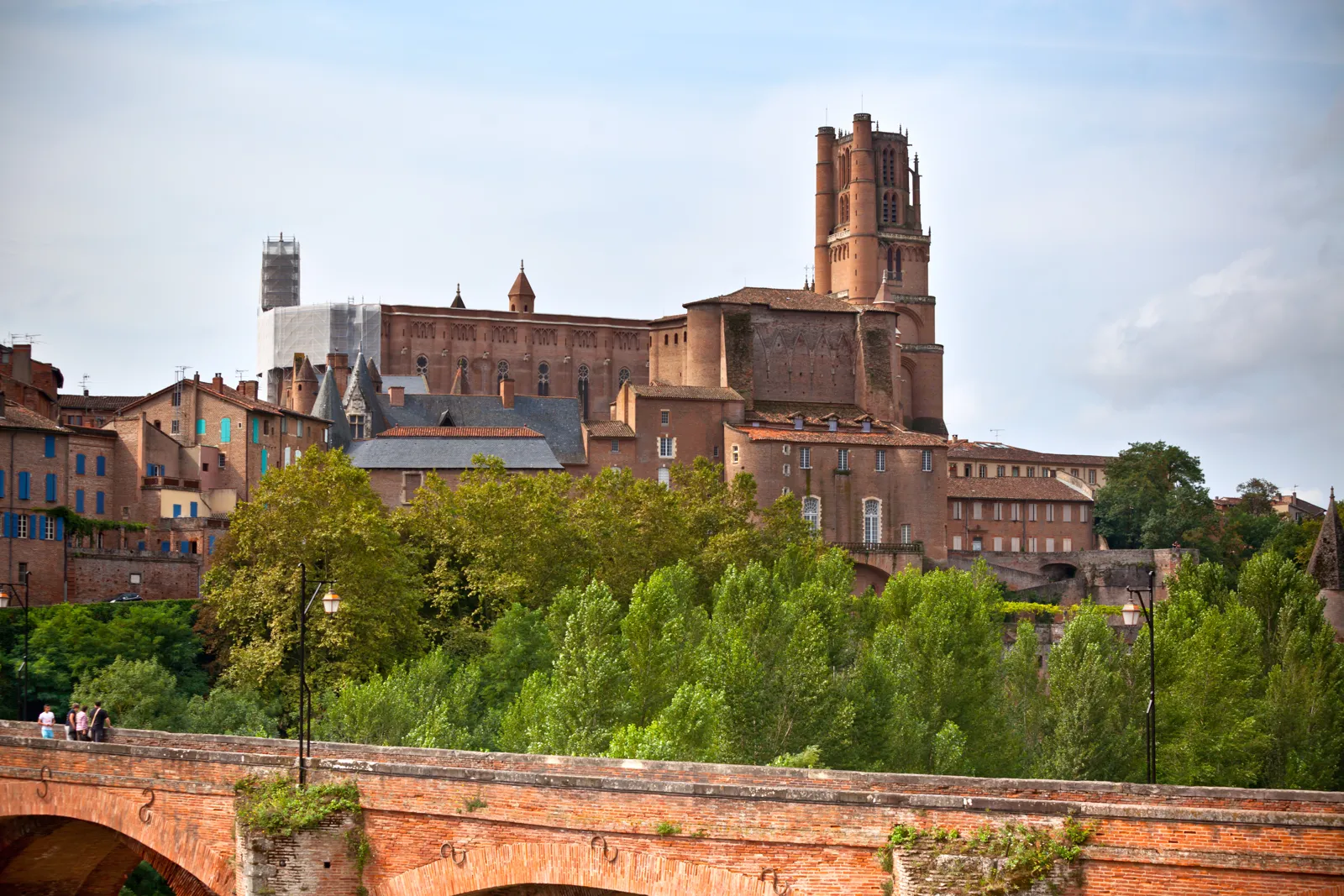
Things to do in Rouen take you through a Norman capital of half-timbered houses, dominated by a Gothic cathedral painted by Monet and marked by the trial and death of Joan of Arc. What to see in Rouen, how to plan a weekend and when to go based on Météo-France normals: here are the essentials, backed by verified sources.
Capital of the Seine-Maritime department and of the Normandy region, Rouen has about 118,000 inhabitants (2023) and lies 136 km (85 mi) north-west of Paris, on the Seine. Capital of the Duchy of Normandy between 911 and 1204, it has held the French « City of Art and History » label since 2002. Its nickname, « the city of a hundred spires », comes from the large number of religious buildings in its centre.

Our travel deals for Rouen
Affiliate links: we earn a commission, at no extra cost to you.
 FlightsKiwi.comCompare flights and airline combinations to Rouen.Compare flights
- Tickets and toursTiqetsEntry tickets and guided tours to book online; compare with the official price.See tickets
- Audio guidesWeGoTripSelf-guided audio tours on your phone.See audio tours



Rouen: key facts
- Location: Seine-Maritime, Normandy, 136 km (85 mi) north-west of Paris
- Highlights: Notre-Dame cathedral, the Gros-Horloge, Place du Vieux-Marché, Saint-Maclou church and its aître, Saint-Ouen abbey church, museums
- Getting there: train to Rouen-Rive-Droite station; timetables on the SNCF website
- Getting around: the historic centre on foot (Rue du Gros-Horloge pedestrianised since 1971), TEOR bus rapid transit
- Entry: see entry requirements for US and UK citizens below
- Ideal length: 1 to 2 days, more with the Seine valley abbeys
What to see in Rouen: the highlights
Notre-Dame cathedral
A Gothic primatial cathedral, Notre-Dame inspired Claude Monet’s « Cathedrals » series. Its lantern tower is topped by a cast-iron spire rising to 151 m (495 ft), the tallest in France. Inside, the stained glass spans the history of the art from the 13th century to the present day, and the choir holds the tombs of early Dukes of Normandy, including Rollo, as well as the heart of Richard the Lionheart. The spire has undergone a long restoration: check which areas are open before your visit.
The Gros-Horloge
The city’s emblem, the Gros-Horloge is a Renaissance arch spanning the street of the same name, with a two-faced astronomical clock. The adjoining 14th-15th-century belfry houses one of the oldest clock mechanisms in France, with a movement dating from 1389. The ensemble has been a listed historic monument since 1862. In 1971, Rue du Gros-Horloge became the first street in France to be pedestrianised.
Place du Vieux-Marché and Joan of Arc
It was on this square that Joan of Arc was burned at the stake on 30 May 1431. A large cross marks the site of the pyre, and the modern church of Sainte-Jeanne-d’Arc was built here. Around it, the remains of the church of Saint-Sauveur have been uncovered, and the square is surrounded by half-timbered houses.
Saint-Maclou church and the Aître Saint-Maclou
Saint-Maclou church, built between 1437 and 1517, is an example of Flamboyant Gothic: its façade opens through five porches arranged in a curve. Nearby, the Aître Saint-Maclou is a former charnel house built after the Black Death of 1348: four stone and half-timbered wings surround a square courtyard.
Saint-Ouen abbey church
Next to the town hall, Saint-Ouen abbey church is the end point of the Seine valley abbey route, which passes through Saint-Wandrille, Jumièges and Saint-Georges-de-Boscherville. An idea for a second day by car.
The museums
The historic district has several museums: the Musée des Beaux-Arts, the Ceramics Museum and the Musée Le Secq des Tournelles, devoted to ironwork and housed in the former church of Saint-Laurent, behind the Musée des Beaux-Arts. The natural history museum, opened in 1828 in a former convent, holds about 800,000 objects. Good options when it rains.
The Armada
Every four to six years, Rouen hosts the Armada, a great gathering of tall ships along the Seine quays. Check the dates of the next edition with the organisers.

Itinerary: Rouen in 1 or 2 days
| Day | Morning | Afternoon | Evening |
|---|---|---|---|
| 1 | Notre-Dame cathedral | Rue du Gros-Horloge, the Gros-Horloge, Place du Vieux-Marché | The half-timbered quarter |
| 2 | Saint-Maclou church and the Aître Saint-Maclou | Saint-Ouen abbey church, then the Musée des Beaux-Arts | Seine quays |
| 3 (optional) | Jumièges or Saint-Wandrille abbey | Seine valley abbey route | Back to Rouen |
For a longer stay in Normandy, combine Rouen with the cliffs of Étretat, the coast at Deauville or Mont-Saint-Michel. Rouen also works well as a two-day side trip from Paris.
When to go to Rouen
From May to September, when highs exceed 17.9 °C (64 °F) and days are sunniest (6.4 hours of sunshine a day in July). June and September offer a good balance between mild weather and moderate rain. Summer stays temperate: 23.4 °C (74 °F) on average in the afternoon in July and August, and only 5.8 days a year at 30 °C (86 °F) or more. From October to January rain is more frequent: December is the wettest month (101.8 mm (4.0 in), 14.1 rainy days). Frosts are frequent in winter (10.4 days in January).
| Month | Avg max | Avg min | Rain | Rainy days | Sun / day | Sun vs Paris | Verdict |
|---|---|---|---|---|---|---|---|
| January | 6.9 °C (44 °F) | 1.6 °C (35 °F) | 75.6 mm (3.0 in) | 13.8 | 1.7 h | −0.2 h | ⚠️ Cold, grey, museums |
| February | 7.9 °C (46 °F) | 1.6 °C (35 °F) | 65.0 mm (2.6 in) | 11.5 | 2.7 h | −0.3 h | ⚠️ Cold, short days |
| March | 11.4 °C (53 °F) | 3.5 °C (38 °F) | 61.6 mm (2.4 in) | 10.9 | 3.8 h | −0.5 h | ⚠️ Cool, changeable spring |
| April | 14.8 °C (59 °F) | 5.2 °C (41 °F) | 55.9 mm (2.2 in) | 10.0 | 5.5 h | −0.4 h | ✅ Mild, less rain |
| May | 17.9 °C (64 °F) | 8.3 °C (47 °F) | 67.2 mm (2.6 in) | 10.7 | 5.9 h | −0.6 h | ✅ Pleasant |
| June | 21.1 °C (70 °F) | 11.1 °C (52 °F) | 64.3 mm (2.5 in) | 9.4 | 6.6 h | −0.2 h | ✅ Ideal |
| July | 23.4 °C (74 °F) | 13.0 °C (55 °F) | 64.4 mm (2.5 in) | 9.0 | 6.4 h | −0.7 h | ✅ Sunniest |
| August | 23.4 °C (74 °F) | 13.1 °C (56 °F) | 69.8 mm (2.7 in) | 9.6 | 6.1 h | −0.8 h | ✅ Mild and bright |
| September | 20.1 °C (68 °F) | 10.6 °C (51 °F) | 62.1 mm (2.4 in) | 9.3 | 5.3 h | −0.5 h | ✅ Ideal, still mild |
| October | 15.4 °C (60 °F) | 8.0 °C (46 °F) | 79.4 mm (3.1 in) | 12.7 | 3.5 h | −0.4 h | ⚠️ More rain |
| November | 10.4 °C (51 °F) | 4.6 °C (40 °F) | 80.4 mm (3.2 in) | 13.1 | 1.9 h | −0.4 h | ❌ Wet, dark |
| December | 7.3 °C (45 °F) | 2.1 °C (36 °F) | 101.8 mm (4.0 in) | 14.1 | 1.6 h | −0.3 h | ❌ Wettest |
Less sunny than Paris?
Yes, slightly, every month of the year. Rouen-Boos gets an average of 1,554 hours of sunshine a year, against 1,717 at Paris-Montsouris. The gap is small in winter (January: 1.7 hours a day against 1.9 in Paris) and clearer in summer (August: 6.1 hours against 6.9). See also our ranking of the rainiest cities in France.
How many rainy days over a weekend?
Scaling each month’s average number of rainy days (≥ 1 mm) to a two-day stay gives an average of 0.6 rainy days over a weekend in July, against 0.9 in December. Pack an umbrella in every season and keep the museums for the rainy hours.
| Month | Rainy days over 2 days | Days ≥ 25 °C (77 °F) in the month |
|---|---|---|
| January | 0.9 | 0.0 |
| February | 0.8 | 0.0 |
| March | 0.7 | 0.0 |
| April | 0.7 | 0.5 |
| May | 0.7 | 2.1 |
| June | 0.6 | 5.1 |
| July | 0.6 | 10.3 |
| August | 0.6 | 9.5 |
| September | 0.6 | 3.1 |
| October | 0.8 | 0.1 |
| November | 0.9 | 0.0 |
| December | 0.9 | 0.0 |
Getting there and around Rouen
- By train: Rouen-Rive-Droite station, north of the centre, is served by SNCF. Timetables on the SNCF website.
- In town: the historic centre is best explored on foot; the metropolitan area is served by, among others, the TEOR bus rapid transit lines.
- By car: the centre has 8 km (5 mi) of pedestrian streets; it is best to leave the car in a car park.
Where to stay
The Vieux-Marché – Cathedral area, on the right bank, puts most monuments and museums within walking distance. The station area (Gare – Jouvenet) is convenient if you arrive by train. During the Armada, book very early.
If you… then…: choosing your trip
| If you… | Then… |
|---|---|
| only have one day | cathedral, Gros-Horloge, Vieux-Marché and Saint-Maclou, all a few minutes apart on foot |
| love painting | Musée des Beaux-Arts, then the cathedral painted by Monet |
| are following Joan of Arc | Place du Vieux-Marché, the pyre cross and the church of Sainte-Jeanne-d’Arc |
| have a car | add the Seine valley abbey route |
| want to avoid rain | aim for May to September, the least rainy months according to Météo-France |
Entry requirements, health and safety
- US citizens: you may enter the Schengen area, including France, for up to 90 days for tourism or business without a visa; your passport should be valid at least three months beyond your period of stay (six months recommended), and immigration officers may ask for proof of sufficient funds and a return ticket (U.S. Department of State, travel.state.gov, last updated August 11, 2025).
- UK citizens: no visa for up to 90 days in any 180-day period as a tourist; your passport must have been issued less than 10 years before you arrive and be valid at least 3 months after the day you plan to leave the Schengen area. The EU Entry/Exit System (EES) is being implemented: fingerprints and a photo may be taken at the border, free of charge (UK FCDO, GOV.UK, updated 22 October 2026).
- Health and emergencies: UK travellers need a GHIC or valid EHIC for medically necessary state healthcare; everyone should have travel insurance covering medical costs. Emergency numbers: 112 (European emergency number, with some English-speaking staff) and 15 (medical emergencies) (GOV.UK; travel.state.gov).
Practical tips for Rouen
- Weather: an oceanic climate, with rain possible in any season: bring a waterproof jacket.
- Visits: check the opening times of religious buildings, which are closed to sightseers during services.
- Mobile data: check your home carrier’s roaming charges before you go.
Frequently asked questions
How many days do you need in Rouen?
One day is enough for the cathedral, the Gros-Horloge, Place du Vieux-Marché and Saint-Maclou; two days for the museums and Saint-Ouen abbey church.
What is the best time to visit Rouen?
May to September, with June and September as the best compromise. December is the wettest month (101.8 mm (4.0 in)) according to Météo-France.
Where was Joan of Arc burned in Rouen?
On Place du Vieux-Marché, on 30 May 1431. A large cross marks the site of the pyre.
How tall is Rouen cathedral?
Its cast-iron spire rises to 151 m (495 ft), the tallest in France.
What to do in Rouen when it rains?
The Musée des Beaux-Arts, the Ceramics Museum, the Musée Le Secq des Tournelles, the natural history museum and the cathedral.
Our sources
- Météo-France, climate sheet for Rouen-Boos (76116001), 1991-2020 statistics (sunshine 1991-2019), accessed 23 October 2026
- Météo-France, climate sheet for Paris-Montsouris (1991-2020), for the sunshine comparison
- Wikipedia (French edition): « Rouen », « Gros-Horloge », « Cathédrale Notre-Dame de Rouen », accessed 23 October 2026
- Destination de Voyage calculations: sun per day, difference with Paris, rainy days over a weekend
- Entry requirements, health and safety checked on 26 October 2026: U.S. Department of State, France country information (last updated August 11, 2025) and UK FCDO, GOV.UK foreign travel advice for France (updated 22 October 2026)
- Our methodology
Updated October 2026.
To extend your trip, see our guides to Normandy and France, and our destinations in Europe.