Romania is one of the largest countries in Eastern Europe: the Carpathians, Transylvania and its Saxon towns, the wooden churches of Maramureș, the painted monasteries of Bucovina, the Danube Delta and the Black Sea coast. It remains cheaper than Western Europe and lends itself well to road trips. This Romania travel guide gathers the essentials for planning your trip: what to see, itineraries, budget and getting around.
To locate cities, regions, terrain, national parks and airports, see our map of Romania.
Romania at a glance
CapitalBucharest
LanguageRomanian, a Romance languageEnglish is common among young people and in tourism; Hungarian is spoken in parts of Transylvania
Currencythe Romanian leu (RON); Romania does not use the euro · currencies
Time zoneUTC+2 (UTC+3 in summer) · details2 h ahead of London and 7 h ahead of New York
AirportsBucharest Henri Coandă (OTP), Cluj-Napoca (CLJ), Sibiu (SBZ)Check current routes with the airlines
EntryUS and UK: visa-free up to 90 days in any 180 days (Schengen rules) · travel.state.gov · GOV.UK
Electricitycheck the plug type with your adapter supplier · plugs
The best periods are May to June and September to early October: it is mild in Transylvania (21 to 25 °C, 70 to 77 °F, in the afternoon), the mountains are accessible and crowds are reasonable. July and August are the season for the Black Sea and the high mountain roads, with afternoons above 30 °C (86 °F) in Bucharest. Winter is cold, but it is the season for Christmas markets and skiing. All the details, region by region and month by month, are in our article best time to visit Romania.
What to see in Romania: the highlights
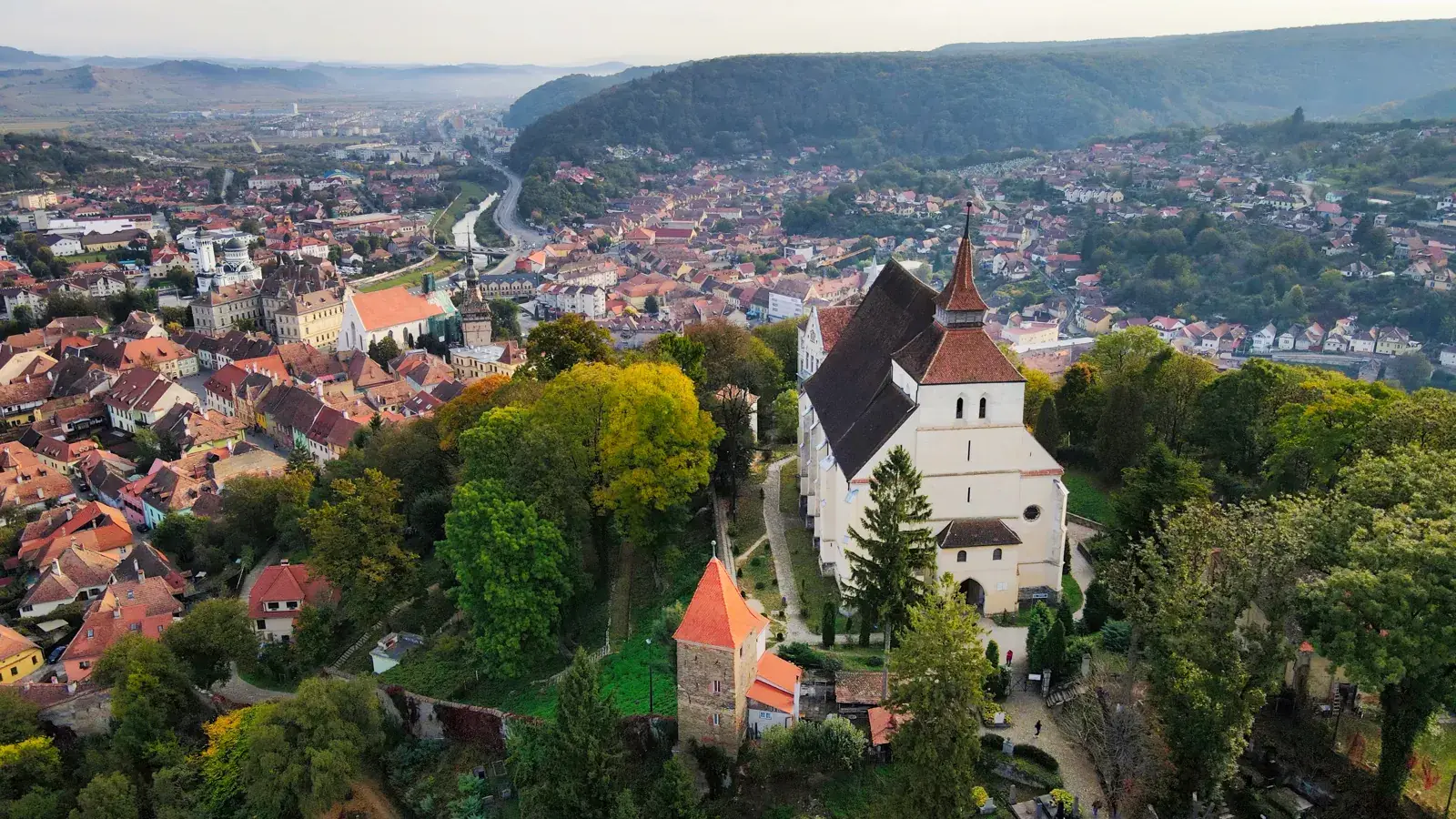
The historic center of Sighișoara and the Church on the Hill, in Transylvania
Bucharest
The capital surprises with its contrasts: old Orthodox churches, Belle Époque villas, wide boulevards and communist-era architecture. The Palace of the Parliament, one of the largest administrative buildings in the world, can be visited by reservation. The historic center (Lipscani), the open-air Village Museum on the shore of Lake Herăstrău and the Romanian Athenaeum are worth the detour. Two days are enough for a first look.
Brașov and Bran Castle
At the foot of the Carpathians, Brașov is an ideal base in Transylvania: the Council Square, the Gothic Black Church, lanes and ramparts. About thirty kilometers (19 mi) away, Bran Castle is associated with the Dracula legend, even if its link with Vlad the Impaler is tenuous. Peleș Castle in Sinaia, a former royal residence, and Râșnov citadel round off the area.
Sighișoara
This still-inhabited medieval citadel, a UNESCO World Heritage Site, is one of the best-preserved towns in Transylvania. Climb the Clock Tower, take the covered staircase up to the Church on the Hill and see the presumed birthplace of Vlad III. The fortified Saxon villages nearby, such as Biertan, are also World Heritage Sites.
Sibiu
A former European Capital of Culture, Sibiu charms with its large squares, roofs with eye-shaped dormer windows and the Bridge of Lies. The ASTRA open-air museum, one of the largest in Europe, showcases Romanian rural architecture. The town is a good stop before the Transfăgărășan road and hosts a well-known Christmas market.
The Carpathians and the Transfăgărășan road
The Transfăgărășan crosses the Făgăraș Mountains, the highest in the country, up to the glacial lake of Bâlea. It is open only part of the year, usually summer and early autumn. The Carpathians offer many trails, in the Bucegi, Piatra Craiului or Retezat mountains. Mountain roads are dangerous when wet or covered with snow or ice, and mountain areas can be hit by torrential rain and flash floods in spring and summer, according to the U.S. Department of State (travel.state.gov, last updated November 12, 2025).
Maramureș
In the far north, Maramureș is known for its wooden churches with slender spires, several of them World Heritage Sites, its carved gateways and the « Merry Cemetery » of Săpânța, with its colorful, illustrated crosses. Rural life remains very present. The region lies close to the Ukrainian border: according to the UK FCDO (GOV.UK, updated 18 September 2026), there is widespread military activity in neighboring Ukraine and drones have crossed into Romanian airspace; follow local authorities’ guidance, including RO-Alert phone alerts.
The painted monasteries of Bucovina
In the northeast, the monasteries of Bucovina are covered with richly colored 16th-century exterior frescoes. Voroneț, Sucevița and Moldovița are the best known and are World Heritage Sites. This region is also not far from the Ukrainian border: check the latest travel advice before you go.
The Danube Delta and the Black Sea
The Danube Delta, a biosphere reserve and World Heritage Site, is a vast maze of channels, lakes and reed beds. It is explored by boat from Tulcea, with many birds in spring. Further south, the Black Sea coast has lively resorts such as Mamaia and Constanța, a port city of ancient origin, or the more bohemian Vama Veche.
Things to do in Romania: experiences not to miss
Tour the Saxon towns of Transylvania: Brașov, Sighișoara and Sibiu
Visit Bran Castle, associated with the Dracula legend, and Peleș Castle in Sinaia
Drive the Transfăgărășan to the glacial lake of Bâlea (a high mountain road open only in summer)
See the wooden churches of Maramureș and the Merry Cemetery of Săpânța
Follow the circuit of the painted monasteries of Bucovina
Explore the Danube Delta by boat to watch birds
Discover Bucharest, its boulevards and its old town
Itinerary ideas for Romania
7 to 10 days: Bucharest and Transylvania
Days 1 and 2: Bucharest
Day 3: Sinaia (Peleș Castle), then Brașov
Day 4: Bran and Râșnov
Days 5 and 6: Sighișoara and the Saxon villages (Biertan, Viscri)
Days 7 and 8: Sibiu and the ASTRA museum
Days 9 and 10: the Transfăgărășan in season, or Cluj-Napoca, then depart
2 weeks: the grand tour
Days 1 and 2: Bucharest
Days 3 to 5: Sinaia, Brașov, Bran
Days 6 and 7: Sighișoara and the Saxon villages
Days 8 and 9: Sibiu and the Carpathians
Days 10 and 11: Cluj-Napoca and the Apuseni Mountains, or Maramureș
Days 12 to 14: the Danube Delta from Tulcea, or the Black Sea in summer
Flying into Bucharest and out of Cluj-Napoca or Sibiu saves you from backtracking. Romania combines well with neighboring Hungary, reached by train or car from the west of the country. If you continue into Hungary, check the best time to visit Hungary before setting the order of your stops.
Budget for a trip to Romania
Romania remains an affordable destination, even if prices are rising in Bucharest, Brașov and on the coast in summer. Car rental is often the biggest cost on a road trip. Indicative amounts per person per day, excluding international flights (converted from our euro estimates at the ECB rate of 23 October 2026, €1 = lei 5.3492):
Item
Budget
Comfort
Accommodation (based on a shared double room)
roughly lei 80–185
roughly lei 265–480
Meals
roughly lei 80–135
roughly lei 160–265
Transport (trains, buses, share of a rental car)
roughly lei 45–65
roughly lei 105–160
Activities and sightseeing
roughly lei 25–55
roughly lei 80–135
Total per day
roughly lei 240–400
roughly lei 590–965
Indicative estimates, varying by season and city. Prices are generally displayed in lei.
In the countryside and small towns, family guesthouses (pensiune) offer good value and often serve meals.
Getting around Romania
Train: the network links Bucharest with Brașov, Sibiu, Cluj-Napoca, Sighișoara, Constanța and Iași. Trains are cheap but often slow; check journey times.
Buses and minibuses: they complement the train for small towns and some sights, with timetables that can be hard to find online. According to the U.S. Department of State, public transportation is inexpensive and reliable; in cities, buy bus or tram tickets at street kiosks and validate them on board.
Car: the most flexible way to reach the Saxon villages, Maramureș or Bucovina. According to the UK FCDO (GOV.UK, updated 18 September 2026), you must pay the road toll (rovinieta) to use national roads, sold at border points and most petrol stations; road conditions are variable and driving standards can be poor, with horse-drawn carts, livestock and stray dogs in rural areas; and you must carry a first aid kit, fire extinguisher, warning triangle and fluorescent jacket. Drink-driving is a serious offence: any alcohol in your system can mean a fine and possible imprisonment (GOV.UK).
Driving licence: UK photocard licences are accepted (GOV.UK, updated 18 September 2026). US state licences are valid for stays of up to 90 days only with an International Driving Permit, which most rental companies also require (U.S. Department of State, travel.state.gov, last updated November 12, 2025).
In Bucharest: metro, buses and trams. According to the UK FCDO (GOV.UK, updated 18 September 2026), taxi drivers sometimes overcharge foreign visitors; licensed taxis display prices and a company name, and ride-hailing apps such as Uber and Bolt are generally reliable.
Boat: in the Danube Delta, you get around by boat from Tulcea.
Where to stay in Romania
In Bucharest, the historic center is lively but noisy at night; the areas around Victoriei Square or Romană Square are quieter and well connected. In Transylvania, stay in the old towns of Brașov, Sibiu and Sighișoara to do everything on foot. In the Saxon villages and Maramureș, restored guesthouses offer a rural experience.
In the Danube Delta, village guesthouses reached by boat are often full board. On the coast, hotels in Mamaia and Constanța are in high demand in July and August: book early.
Entry requirements for Romania
US citizens: according to the U.S. Department of State (travel.state.gov, last updated November 12, 2025), your passport must be valid for at least three months beyond your departure date from Romania. With a valid US passport you can stay up to 90 days in the Schengen area in any 180-day period for tourism or business; leaving and re-entering Romania does not restart the clock. Have proof of sufficient funds and a return ticket.
UK citizens: according to the UK FCDO (GOV.UK foreign travel advice, updated 18 September 2026), Romania follows Schengen rules: you can travel without a visa for up to 90 days in any 180-day period. Your passport must have been issued less than 10 years before the date you arrive and expire at least 3 months after the date you plan to leave the Schengen area. You may need to show a return or onward ticket and enough money for your stay. Under the EU Entry/Exit System (EES), you may need to register your fingerprints and photo at the border (free of charge).
Customs: you cannot bring meat, milk or products containing them into the EU, and you must declare cash of €10,000 or more (GOV.UK). Check your home country’s allowances for the return trip (e.g. CBP in the US, HMRC in the UK). Entry requirements checked on 24 October 2026; check them again before you travel.
Health and safety in Romania
Health: the UK FCDO (GOV.UK, updated 18 September 2026) advises checking vaccine recommendations at least 8 weeks before your trip (TravelHealthPro); UK travelers need a GHIC or EHIC for medically necessary state healthcare, which is not a substitute for travel insurance. The U.S. Department of State says medical care is generally not up to Western standards, especially outside major cities, and hospitals often require cash payment up front: get insurance covering medical evacuation. It also advises avoiding contact with stray dogs (rabies information on the CDC website).
Safety: according to the UK FCDO (GOV.UK, updated 18 September 2026), be alert to petty theft in large towns, especially Bucharest, near money exchanges, on public transport to the airport, in main railway stations and in airport terminals; cards have been copied in some bars and restaurants. The U.S. Department of State warns of fake plainclothes police officers asking for your passport and wallet: insist on a uniformed officer.
Drugs: illegal drugs, including cannabis, carry severe penalties, and foreign visitors have received lengthy sentences after music festivals (GOV.UK).
Natural hazards: Romania is in a seismically active area, with the greatest earthquake risk in Bucharest (GOV.UK; U.S. Department of State). In an emergency, you may receive phone alerts in Romanian and English.
Emergencies: dial 112 (ambulance, fire, police), according to GOV.UK.
Practical tips for Romania
Money: keep some lei for markets, rural guesthouses and small shops. The U.S. Department of State advises using ATMs located inside banks and checking them for signs of tampering.
Internet: an eSIM or a local SIM card is handy for maps and navigation on a road trip; check your home provider’s roaming charges before you leave.
Etiquette: in churches and monasteries, clothing covering shoulders and knees is expected; women may be asked to cover their heads in some monasteries.
Language: a few words are appreciated: bună ziua (hello), mulțumesc (thank you).
Culture and heritage: yes: the Saxon towns of Transylvania, the wooden churches of Maramureș, the painted monasteries of Bucovina, several World Heritage Sites.
Road trips: yes: a car is the most flexible way to reach the Saxon villages, Maramureș or Bucovina, with the Transfăgărășan in summer. The road toll is compulsory and roads call for great care.
Hikers: yes: Bucegi, Piatra Craiului, Retezat; check the weather, and avoid setting off alone.
Budget travelers: yes: roughly lei 240–400 per person per day, and family guesthouses offer good value.
Nature and birdwatching: yes: the Danube Delta is explored by boat from Tulcea, with many birds in spring.
Beaches: in summer only, on the Black Sea: Mamaia and Constanța for nightlife, Vama Veche for a more bohemian feel.
Not for a short stay if you are a US or British citizen: both can stay up to 90 days in any 180-day period under Schengen rules (travel.state.gov; GOV.UK). US citizens need a passport valid at least three months beyond departure; British passports must be under 10 years old on arrival and valid at least 3 months after leaving the Schengen area. Checked on 24 October 2026.
Is Romania safe?
Generally yes, but be alert to pickpockets in Bucharest, especially on airport transport and in stations, and to taxi overcharging: ride-hailing apps are generally reliable (GOV.UK, updated 18 September 2026). Follow official guidance near the Ukrainian border, where drones have crossed into Romanian airspace.
What currency is used in Romania?
The Romanian leu (RON). Keep some cash for the countryside, and use ATMs inside banks (U.S. Department of State).
How many days do you need in Romania?
A week to ten days for Bucharest and Transylvania. Two weeks to add Maramureș, Bucovina or the Danube Delta.
What is the best time to visit Romania?
May to June and September to early October for a tour; July and August for the Black Sea and the high mountains; December for the Christmas markets.
What can you see in Romania in 10 days?
In ten days, combine Bucharest, Transylvania (Brașov, Bran, Sighișoara, Sibiu) and, depending on the season, the Transfăgărășan. Maramureș, Bucovina and the Danube Delta need closer to two weeks.
How much does a week in Romania cost?
Based on our per person per day estimates (roughly lei 240–400 on a budget, roughly lei 590–965 in comfort), a week on the ground comes to roughly lei 1,700–2,800 on a budget and lei 4,100–6,750 in comfort, excluding international flights.
Our sources
Entry, health and safety information read on 24 October 2026: U.S. Department of State, Romania country information (travel.state.gov, last updated November 12, 2025), and UK FCDO, foreign travel advice for Romania (GOV.UK, updated 18 September 2026)
World Meteorological Organization, 1991-2020 normals for Bucharest-Băneasa, Cluj-Napoca, Sibiu and Constanța (NOAA)
European Central Bank, euro reference rates of 23 October 2026 (budget conversions)
Transparency: this page contains affiliate links, labelled as such. If you book through them we may earn a commission at no extra cost to you; it does not influence our content or recommendations. How we fund the site.