Bulgaria packs high mountains, Orthodox monasteries, towns of Thracian and Roman origin and nearly 400 km (250 mi) of Black Sea coast into a small country. It remains more affordable than Western Europe and is easy to explore by car or bus. This Bulgaria travel guide brings together the essentials for planning your trip: what to see, itineraries, budget and transport.
To locate cities, regions, terrain, national parks and airports, see our map of Bulgaria.
Bulgaria at a glance
CapitalSofia
LanguageBulgarian, written in the Cyrillic alphabetEnglish is common among young people and in tourism
Currencythe euro (EUR), since 1 January 2026 · currencies
Time zoneUTC+2 (Eastern European Time)2 h ahead of London and 7 h ahead of New York
AirportsSofia (SOF), Varna (VAR) and Burgas (BOJ)Check current routes with the airlines
The best period is May to June, plus September: it is mild in Sofia (21 to 25 °C, or 70 to 77 °F, in the afternoon), cultural sites can be visited without excessive heat, and the coast is less crowded than in midsummer. July and August are the season for Black Sea beaches and high-mountain hiking. From December to March, the resorts of Bansko, Borovets and Pamporovo welcome skiers. All the details, region by region and month by month, are in our article best time to visit Bulgaria.
What to see in Bulgaria: the highlights
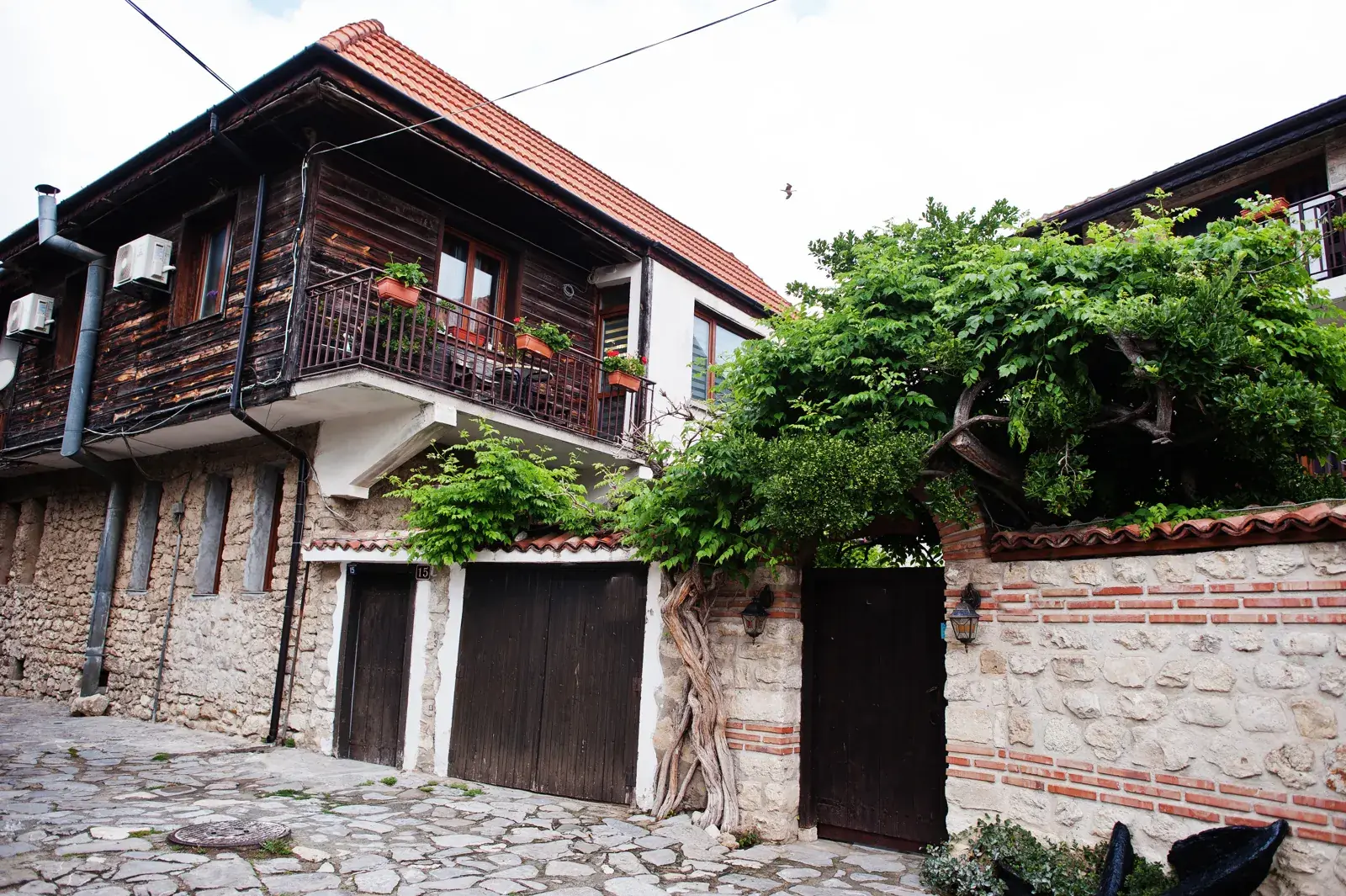
Old houses in the old town of Nessebar, Bulgaria
Sofia
The capital can be seen in two days. The golden-domed Alexander Nevsky Cathedral dominates the center. Around it are the Rotunda of St. George, one of the oldest churches in the city, the Roman remains of Serdica visible right in the city center, and the Central Market Hall. Boyana Church, with its medieval frescoes, is a UNESCO World Heritage Site. The Vitosha massif, south of the city, offers walks right on Sofia’s doorstep.
Rila Monastery and the Seven Lakes
Rila Monastery, deep in the mountains about two hours’ drive from Sofia, is the most famous in the country and a World Heritage Site. Its striped galleries and colorful frescoes make a good day trip. Further north, the Seven Rila Lakes, a staircase of glacial lakes, are one of Bulgaria’s best-known hikes, accessible in summer.
Plovdiv
The country’s second city, Plovdiv is one of the oldest continuously inhabited cities in Europe. Its Roman theater, still used for performances, its ancient stadium and its old town of colorful National Revival houses with overhanging upper floors can all be explored on foot. The pedestrian streets of the Kapana district are full of cafés and galleries. Plovdiv was a European Capital of Culture in 2019.
Veliko Tarnovo
The former capital of the Second Bulgarian Empire, Veliko Tarnovo is tiered above the meanders of the Yantra. Tsarevets Fortress and the craft street of Samovodska Charshia are the main sights. The nearby village of Arbanasi has churches with painted interiors. The town is a good stop between Sofia and the coast.
The Rose Valley and Kazanlak
Between the Balkan Mountains and Sredna Gora, the Rose Valley produces much of Bulgaria’s rose oil. The harvest takes place in late spring. Kazanlak has a Thracian tomb with wall paintings listed as World Heritage; other Thracian tombs can be visited in the valley. The village of Koprivshtitsa, further west, has kept its 19th-century houses.
Nessebar, Sozopol and the Black Sea
On a peninsula linked to the mainland by a causeway, the old town of Nessebar, a World Heritage Site, is lined with medieval churches and wooden houses. It is very busy in summer. Further south, Sozopol has a quieter old town and fine beaches. Varna, a large port city, has an archaeological museum known for its « Varna gold », among the oldest worked gold objects known. The coast also has big resorts, such as Sunny Beach (Slanchev Bryag) and Golden Sands (Zlatni Pyasatsi).
Bansko and Pirin
At the foot of the Pirin massif, a national park listed as World Heritage, Bansko is the country’s main ski resort. In summer, it is a starting point for hikes to lakes and peaks. An hour and a half’s drive south, Melnik, the smallest town in the country, is surrounded by sand pyramids and vineyards. Rozhen Monastery is a few kilometers away.
The Rhodopes and Belogradchik
In the south, the Rhodopes form a wooded massif of villages, gorges and caves, such as Yagodina Cave and the Trigrad Gorge. In the remote northwest, the Belogradchik Rocks, large red sandstone formations, surround a fortress. These regions require a car and time.
Things to do in Bulgaria: experiences not to miss
Visit Rila Monastery and hike to the Seven Rila Lakes (in summer)
Wander through Plovdiv’s old town and see its Roman theater
Climb to Tsarevets Fortress in Veliko Tarnovo
Cross the Rose Valley around Kazanlak
Swim in the Black Sea and visit the old town of Nessebar or Sozopol
Hike in Pirin from Bansko and taste the wines of Melnik
See the Belogradchik Rocks and the villages of the Rhodopes
Itinerary ideas for Bulgaria
7 to 10 days: the essentials of Bulgaria
Days 1 and 2: Sofia and Boyana Church
Day 3: Rila Monastery
Days 4 and 5: Plovdiv
Day 6: the Rose Valley and Kazanlak
Days 7 and 8: Veliko Tarnovo and Arbanasi
Days 9 and 10: Nessebar or Varna, then fly home from Varna or Burgas
2 weeks: mountains, cities and the Black Sea
Days 1 and 2: Sofia
Days 3 and 4: Rila, the monastery and the Seven Lakes (in summer)
Days 5 and 6: Bansko, Melnik and Rozhen Monastery
Days 7 and 8: Plovdiv, then the Rhodopes
Day 9: Koprivshtitsa or the Rose Valley
Days 10 and 11: Veliko Tarnovo
Days 12 to 14: Varna, Nessebar and Sozopol, flying home from Burgas
Flying into Sofia and out of Varna or Burgas saves backtracking. Bulgaria combines well with Romania to the north, Greece to the south or Turkey to the east.
Who is Bulgaria for?
Here is our view by traveler profile, based on the stops, budget and conditions in this Bulgaria guide.
Profile
Our view
Culture and history
✅ Rila Monastery, Plovdiv and its Roman theater, Thracian tombs, Veliko Tarnovo.
Hiking
✅ Seven Rila Lakes, Pirin from Bansko, the Rhodopes, preferably in summer.
Beach
✅ Nearly 400 km (250 mi) of Black Sea coast, from Sozopol to big resorts like Sunny Beach.
Budget travelers
✅ Roughly €45–70 a day; village guesthouses offer good value.
Skiing
✅ Bansko, Borovets and Pamporovo from December to March.
Road trip
⚠️ A car is the most flexible option for Rila and the Rhodopes, but the U.S. Department of State describes driving in Bulgaria as dangerous.
Budget for a trip to Bulgaria
Bulgaria remains an affordable destination, even if prices rise in Sofia and in beach and ski resorts in high season. Indicative amounts per person per day, excluding international flights:
Item
Budget
Comfort
Accommodation (based on a shared double room)
roughly €15–30
roughly €45–80
Meals
roughly €15–25
roughly €30–50
Transport (buses, trains, share of a rental car)
roughly €8–10
roughly €15–25
Activities and sightseeing
roughly €5–10
roughly €10–20
Total per day
roughly €45–70
roughly €100–170
Indicative estimates, varying with the season and the city.
Village guesthouses (Koprivshtitsa, the Rhodopes, Melnik) offer good value and often serve home cooking.
Getting around Bulgaria
Bus: often the most practical way to travel between the main cities (Sofia, Plovdiv, Veliko Tarnovo, Varna, Burgas, Bansko).
Train: Bulgaria has a comprehensive rail network, but the UK FCDO (GOV.UK, updated 11 August 2026) describes the system as very poor by European standards, with trains that can be cancelled at short notice. It can suit some routes, such as Sofia–Plovdiv: check journey times first.
Car: the most flexible option for Rila, the Rhodopes, Melnik and the villages. A digital vignette, bought in advance (online), is required on motorways and main roads outside towns; without it, you will be fined (UK FCDO). Headlights or dipped lights must be on even during the day. Roads are often in poor repair, with potholes, rockslides on mountain roads, livestock and carts, and driving is aggressive: avoid driving at night outside towns (U.S. Department of State, travel.state.gov, last updated December 4, 2025).
Driving licence: a US license is only valid with an International Driving Permit obtained in the United States before travel, and most rental companies now require one (U.S. Department of State). UK drivers must carry their licence, proof of insurance valid in Bulgaria and the original vehicle registration documents (UK FCDO).
Taxis: at Sofia airport, use the official taxi booking office in the arrivals hall, as unlicensed taxis overcharge (UK FCDO).
In Sofia: the metro links the airport with the city center; buses and trams complete the network.
Signs: signs are in Cyrillic, often with Latin script on main roads.
Where to stay in Bulgaria
In Sofia, stay in the center, between Alexander Nevsky Cathedral, Vitosha Boulevard and the Slaveykov Square area, to do everything on foot. In Plovdiv, the old town and Kapana are the most pleasant; in Veliko Tarnovo, choose a hotel overlooking the meanders of the Yantra.
On the coast, Sozopol and the old town of Nessebar suit those looking for charm; big resorts such as Sunny Beach are livelier. In the mountains, Bansko and Borovets have many hotels, in high demand during the winter holidays.
Entry requirements for Bulgaria
Bulgaria is a member of the EU and follows Schengen area rules. Entry requirements checked on 24 October 2026; check them again before you travel.
US citizens
According to the U.S. Department of State (travel.state.gov, last updated December 4, 2025), US citizens on regular tourist passports cannot stay more than a total of 90 days in Bulgaria within a 6-month period; your passport must be valid for at least three months from your expected departure from Bulgaria.
You will need proof of sufficient funds and a return ticket, and visitors must have medical insurance for the duration of their stay, which may be checked on arrival.
Always carry your US passport while in Bulgaria.
UK citizens
According to the UK FCDO (GOV.UK, updated 11 August 2026), you can travel without a visa to the Schengen area, including Bulgaria, for up to 90 days in any 180-day period.
Your passport must have been issued less than 10 years before you arrive and be valid for at least 3 months after you plan to leave the Schengen area. You will be denied entry with a passport reported lost or stolen.
You may need to show a return or onward ticket and enough money for your stay. The EU Entry/Exit System (EES) is being rolled out: you may have to register your fingerprints and photo at the border.
Always carry ID; a printed copy of your passport photo page is acceptable.
Health and safety
Health: UK travelers need a GHIC or EHIC for medically necessary state healthcare, which does not replace travel insurance; health risks include biting insects and ticks (UK FCDO). The State Department strongly recommends supplemental insurance covering medical evacuation.
Crime: watch out for pickpockets and bag thefts in tourist areas, on buses and trains and at transport hubs; tourists are targeted in Sunny Beach, and overcharging has been reported in « gentlemen’s clubs » in Sofia and some resorts (UK FCDO). ATM skimming and card fraud are among the most common problems (U.S. Department of State): never give your PIN to anyone.
Beaches: obey warning signs and flags, and follow lifeguards’ instructions where present (UK FCDO).
Earthquakes: there are earthquakes and small tremors throughout the year, usually without serious consequences (UK FCDO).
Emergencies: 112.
Practical tips for Bulgaria
Money: the euro has been Bulgaria’s currency since 1 January 2026. Major credit and debit cards are accepted in most banks and hotels and most ATMs take international cards; pounds and US dollars are easily exchanged, but only at banks and exchange bureaus. Declare cash of €10,000 or more (UK FCDO). Keep some cash for villages and small shops.
Internet: check your provider’s roaming rates before you leave; an eSIM can be a cheaper option.
Gestures: in Bulgaria, nodding often means « no » and shaking the head « yes ». If in doubt, ask for a verbal confirmation.
Etiquette: in churches and monasteries, clothing covering shoulders and knees is expected.
Language: learning the Cyrillic alphabet helps you read signs and menus. A few words: zdraveyte (hello), blagodarya (thank you).
Not for a short stay if you are a US or British citizen: up to 90 days without a visa (GOV.UK, 11 August 2026; travel.state.gov, December 4, 2025). Your passport must be valid at least three months after you leave, and a passport reported lost or stolen is refused. Checked on 24 October 2026.
Is Bulgaria safe?
Generally yes, with sensible precautions: watch out for pickpockets in tourist areas and on public transport, use ATMs with care (card skimming), take official taxis and be very careful on the roads.
What currency is used in Bulgaria?
The euro, since 1 January 2026. Cards are widely accepted in hotels and banks in town; keep cash for the countryside.
How many days do you need in Bulgaria?
A week to ten days for Sofia, Rila, Plovdiv, Veliko Tarnovo and a stop on the coast. Two weeks to add Pirin, Melnik and the Rhodopes.
What is the best time to visit Bulgaria?
May–June and September for a tour; July–August for the Black Sea and the high mountains; December to March for skiing.
What to see in Bulgaria in a week?
In a week: Sofia, Rila Monastery, Plovdiv and Veliko Tarnovo, passing through the Rose Valley. Add three or four days for the Black Sea (Nessebar, Sozopol) or Pirin.
How much does a week in Bulgaria cost?
Based on our per-person daily estimates (roughly €45–70 on a budget, €100–170 in comfort), a week on the ground comes to roughly €315–490 on a budget and €700–1,190 in comfort, excluding international flights.
Our sources
Entry, health, safety and driving information read on 24 October 2026: U.S. Department of State, Bulgaria country information (travel.state.gov, last updated December 4, 2025), and UK FCDO, foreign travel advice for Bulgaria (GOV.UK, updated 11 August 2026)
World Meteorological Organization, 1991–2020 normals for Sofia, Varna, Burgas, Sandanski and Musala Peak (NOAA NCEI)
Bulgarian National Toll Administration (bgtoll.bg): digital vignette; European Central Bank: Bulgaria’s adoption of the euro on 1 January 2026, read on 6 October 2026
Transparency: this page contains affiliate links, labelled as such. If you book through them we may earn a commission at no extra cost to you; it does not influence our content or recommendations. How we fund the site.