A trip to Turkey is usually built around Istanbul, Cappadocia and the Aegean coast (Ephesus, Pamukkale), with a few days on the Mediterranean coast for the beach: allow 7 to 10 days for the essentials, two weeks to add the Lycian coast, and roughly TRY 2,800–4,450 a day on a budget. This Turkey travel guide covers a country straddling Europe and Asia, with Istanbul and its Byzantine and Ottoman monuments, the volcanic landscapes of Cappadocia, major ancient sites and hundreds of kilometers of coastline. It is easy to combine city, cultural tour and beach. Turkey also opens the road to the Caucasus: see things to do in Georgia if you plan to continue east.
Safety: according to the UK FCDO (GOV.UK, updated 19 October 2026), the FCDO advises against all travel to within 10 km (6 mi) of the border with Syria. The U.S. Department of State (travel.state.gov, last updated June 11, 2026) strongly recommends reconsidering travel to specific areas of eastern and southeastern Turkey and not traveling to areas near the Syrian or Iraqi borders. Istanbul, Cappadocia and the Aegean and Mediterranean coasts are not covered by these warnings. Check the latest advice before you leave.
To locate cities, regions, terrain, national parks and airports, see our map of Turkey.
Turkey at a glance
CapitalAnkara (Istanbul is the largest city)
LanguageTurkish; English is common in tourist areas
The best periods are April to June and September-October: pleasant temperatures in Istanbul and Cappadocia, and the sea is warm enough for swimming on the coasts. July and August are the peak beach season, very hot (close to 35 °C, 95 °F, in Antalya). Winter is cool and rainy in Istanbul, cold and often snowy in Cappadocia. All the details are in our guide best time to visit Turkey, with the climate month by month. Between winter snow and summer heat, the best time to visit Cappadocia is rather the shoulder seasons.
What to see in Turkey: the highlights
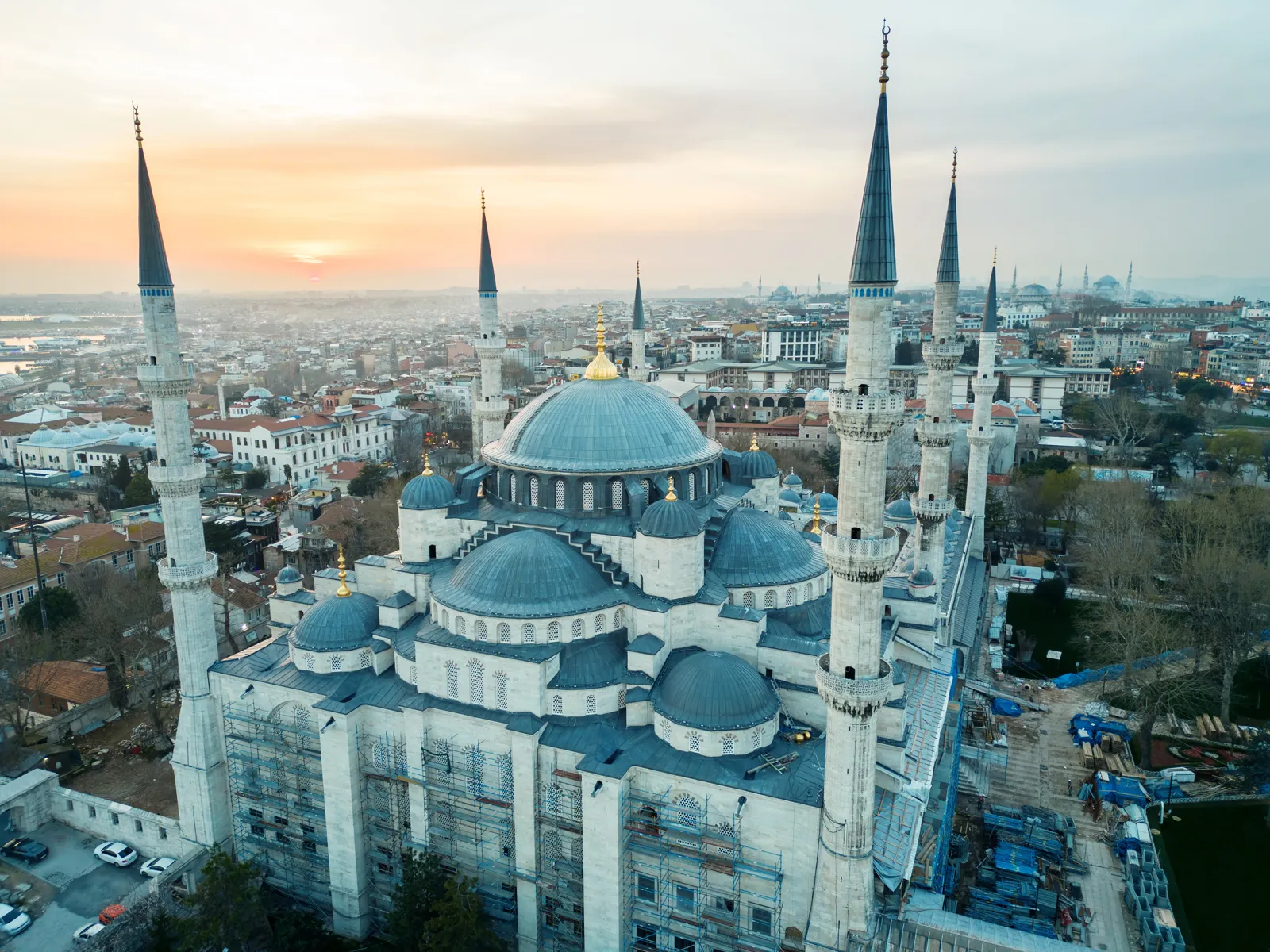
Aerial view of Istanbul’s Blue Mosque at sunset
Istanbul
Allow at least three days for the city. The Sultanahmet district concentrates Hagia Sophia, the Blue Mosque, the Basilica Cistern and Topkapı Palace. The Grand Bazaar and the Spice Bazaar are a few minutes’ walk away. Across the Golden Horn, Beyoğlu and Galata have a more modern feel. A Bosphorus cruise shows the city from the water, and public ferries link the European shore with the Asian shore (Kadıköy, Üsküdar) for little money.
Cappadocia
In the center of the country, Cappadocia is known for its fairy chimneys, rock-cut churches and underground cities. Göreme is the most practical base, with its open-air museum. Allow two or three days to hike in the valleys (Rose Valley, Red Valley), see the Uçhisar rock citadel and visit an underground city such as Derinkuyu or Kaymaklı. A sunrise hot-air balloon flight is the signature activity: the UK FCDO (GOV.UK, updated 19 October 2026) advises using only reputable operators for extreme sports and checking that your insurance covers the activity.
Ephesus and the Aegean coast
Near Selçuk, Ephesus is one of the most complete ancient sites in the Mediterranean, with the Library of Celsus and the Great Theater. Izmir, the country’s third city, is the gateway. Further north, Pergamon and its hilltop ruins are worth the detour.
Pamukkale and Hierapolis
The white travertine terraces of Pamukkale, fed by hot springs, overlook the ruins of the ancient city of Hierapolis. The terraces are walked barefoot. The site combines easily with Ephesus, about three hours away by road.
Antalya and the Lycian coast
Antalya has an old town (Kaleiçi) and a renowned archaeological museum. To the west, the Lycian coast links Kaş, Kalkan, Fethiye and Ölüdeniz, with coves, Lycian tombs carved into the cliffs and the Lycian Way for hiking. To the east, the theater of Aspendos and the ruins of Side round off a beach stay. For the city itself, before the Lycian coast, our Antalya travel guide covers Kaleiçi, beaches and trips to Aspendos.
Bodrum
A resort on the Aegean coast, Bodrum is organized around its Castle of St. Peter and its marina. The peninsula has many beaches and small bays, quieter away from the center.
Konya
On the road between Cappadocia and the Mediterranean coast, Konya is home to the mausoleum of Mevlana, founder of the order of the whirling dervishes, now a museum. It is a more conservative city than the resorts: dress modestly. It is a practical stop to break up the long drive or bus ride.
Troy and the Dardanelles
North of the Aegean coast, the archaeological site of Troy and the town of Çanakkale, on the Dardanelles strait, combine well with Pergamon on a journey between Istanbul and Izmir. The battlefields and memorials of the Gallipoli peninsula are across the strait.
Ankara
The capital is less visited than Istanbul. It deserves a day for Atatürk’s mausoleum (Anıtkabir) and the Museum of Anatolian Civilizations, which traces the region’s history since prehistoric times. The city is linked to Istanbul by high-speed train.
Itinerary ideas for Turkey
7 to 10 days:
Days 1 to 3: Istanbul (Sultanahmet, the bazaars, the Bosphorus)
Days 4 to 6: fly to Cappadocia (Kayseri or Nevşehir), valleys, an underground city, a balloon flight
Days 7 to 9: flight or night bus west, Pamukkale then Ephesus
Day 10: depart from Izmir or Istanbul
2 weeks:
Days 1 to 4: Istanbul, with a day on the Asian shore
Days 5 to 7: Cappadocia
Days 8 and 9: Pamukkale and Hierapolis
Days 10 and 11: Ephesus, Selçuk and the village of Şirince
Days 12 to 14: the Lycian coast (Fethiye, Kaş) or Bodrum, departing from Dalaman, Bodrum or Antalya
Beach variant: for a more relaxing trip, combine three or four days in Istanbul with a week on the coast, for example between Fethiye and Kaş, or in Bodrum. Domestic flights from Istanbul to Antalya, Dalaman or Bodrum make this easy. Don’t try to see everything in a week: the distances between Istanbul, Cappadocia and the coast require at least one domestic flight or a long night bus. Before setting the order of your stops, check Istanbul’s weather month by month: the city is best visited in different seasons from the coast.
Budget for a trip to Turkey
Prices in Turkey change quickly because of inflation. The following amounts are orders of magnitude, per person per day, excluding international flights (converted from our euro estimates at the ECB rate of 23 October 2026, €1 = TRY 55.6715):
Item
Budget
Comfort
Accommodation (double room, per person)
roughly TRY 1,100–1,950
roughly TRY 3,350–6,700
Meals
roughly TRY 850–1,400
roughly TRY 1,950–3,350
Domestic transport
roughly TRY 300–550
roughly TRY 850–1,650
Activities and admissions
roughly TRY 550–1,100
roughly TRY 1,100–2,800
Total per day
roughly TRY 2,800–4,450
roughly TRY 6,700–11,150
Indicative estimates, excluding a hot-air balloon flight (plan a separate budget). Admission to the major sites in Istanbul and Ephesus weighs heavily on the budget.
Getting around Turkey
Distances are long: allow about ten hours by road between Istanbul and Cappadocia. Domestic flights are numerous and often cheap, from both Istanbul airports. The long-distance bus network is dense and comfortable, with night buses on the main routes. High-speed trains link Istanbul, Ankara and Konya. On the coast, renting a car gives the most freedom. In Istanbul, use the tram, metro and ferries with the Istanbulkart transit card; trams and ferries are enough for a stay in Istanbul without a car or taxi.
Driving licence: according to the U.S. Department of State (travel.state.gov, last updated June 11, 2026), a valid US licence, or an IDP with a US licence, is accepted for stays of up to 180 days. UK drivers need a 1968 International Driving Permit or a UK licence notarised in Turkish, bought in the UK before travel, plus a green card for third-party insurance (GOV.UK, updated 19 October 2026).
On the road: drive defensively: drivers routinely ignore traffic rules, and driving at night in rural areas requires extra care. Hand-held phone use is illegal (U.S. Department of State). Approach checkpoints slowly; drink-drivers can lose their licence for 6 months (GOV.UK).
Taxis: avoid unofficial taxis; use registered, metered taxis and note the registration number, or use app-based or pre-booked taxis (GOV.UK).
Where to stay in Turkey
In Istanbul, Sultanahmet is convenient for visiting the great monuments on foot; Beyoğlu and Karaköy are livelier at night; Kadıköy, on the Asian shore, is more residential. In Cappadocia, Göreme and Uçhisar offer cave hotels carved into the rock. On the coast, you will find family guesthouses in Kaş or Selçuk as well as large all-inclusive resorts around Antalya and Bodrum.
Entry requirements for Turkey
US citizens: according to the U.S. Department of State (travel.state.gov, last updated June 11, 2026), ordinary passport holders are exempt from visas for up to 90 days in any 180-day period. Your passport must be valid for six months beyond your entry date, with enough space for entry and exit stamps. Make sure you get entry and exit stamps: you need a Turkish entry stamp to fly domestically.
UK citizens: according to the UK FCDO (GOV.UK foreign travel advice, updated 19 October 2026), British citizen passport holders can visit without a visa for up to 90 days in any 180-day period for tourism or business. Your passport must be valid for at least 150 days after the date you arrive and have at least 1 blank page. At land borders, make sure your passport is stamped and dated.
Validity rules differ: the US source asks for six months of passport validity, the UK source 150 days; if in doubt, check with the Turkish embassy.
Customs: controlled drugs, firearms, flick knives, self-defense sprays and endangered species are prohibited; you cannot take Turkish lira worth more than US$5,000 out of the country (GOV.UK). Buying or exporting antiquities is illegal, with prison sentences of 5 to 12 years: check the status of antique items before buying (GOV.UK; U.S. Department of State). For the return, check your home country’s allowances (e.g. CBP in the US, HMRC in the UK). Entry requirements checked on 24 October 2026; check them again before you travel.
Health and safety in Turkey
Health: the UK FCDO (GOV.UK, updated 19 October 2026) advises checking vaccine recommendations at least 8 weeks before your trip. British prescriptions are not accepted in Turkish pharmacies, some common medicines are controlled, and the GHIC and EHIC are not valid in Turkey: travel insurance covering medical costs and evacuation is essential. The U.S. Department of State advises carrying prescription medication in its original packaging with your prescription.
Methanol: cases of serious illness caused by alcoholic drinks containing methanol have increased in popular destinations around the world; even small amounts can kill (GOV.UK).
Safety: according to the UK FCDO (GOV.UK, updated 19 October 2026), terrorists are likely to try to carry out attacks in Turkey, mostly in the southeast, Ankara and Istanbul. Demonstrations take place regularly in Istanbul and other cities and can turn violent: avoid them. Street robbery and pickpocketing are common in Istanbul’s main tourist areas; be wary of strangers offering to change money or take you to a bar, as drinks may be spiked. The U.S. Department of State warns of restaurants charging extremely high prices: ask for a menu with prices before ordering.
Local laws: carrying photo ID is compulsory: always carry your passport (GOV.UK). Insulting the Turkish nation, the flag, the President or Atatürk is a criminal offense, including online. Drug penalties range from 4 to 24 years in prison. Do not photograph military or official installations. Smoking is banned on public transport and in indoor public places.
Natural hazards: many parts of Turkey regularly experience earthquakes; see the AFAD (Disaster and Emergency Management Authority) website. Wildfires are frequent in summer, and lighting fires or discarding cigarettes in risk areas can lead to a fine or prison (GOV.UK).
Emergencies: 112 (ambulance, fire, police), according to GOV.UK.
Practical tips for Turkey
Money: keep cash for markets and small shops, and check the amount before paying contactless. Our currency converter helps you follow the lira exchange rate.
Internet: Wi-Fi is common in hotels and cafés. An eSIM gives you data as soon as you arrive.
Etiquette: to visit a mosque, cover shoulders and legs and remove your shoes; women cover their heads. Avoid prayer times, especially on Fridays. Be discreet with public displays of affection. During Ramadan (likely between early February and early March in 2027), avoid eating, drinking or smoking in public in the daytime (GOV.UK).
Scams: be wary of overly insistent strangers offering a drink, and watch your belongings in Istanbul’s tourist areas.
Online discretion: according to the U.S. Department of State, insulting the government, the flag, the President or Atatürk on social media is illegal; GOV.UK notes that these laws can apply to posts made anywhere and at any time.
Who is Turkey for?
Culture and history: yes: Hagia Sophia and Topkapı in Istanbul, Ephesus, Pergamon, Hierapolis, Troy, the Museum of Anatolian Civilizations.
Beaches: yes, from June to September: the Lycian coast between Fethiye and Kaş, Bodrum, Antalya, with all-inclusive resorts around Antalya and Bodrum.
Hiking: yes: the valleys of Cappadocia, the Lycian Way on the Mediterranean coast.
Budget travelers: fairly yes: roughly TRY 2,800–4,450 a day, excluding a balloon flight, but prices change quickly with inflation and admission to the major sites adds up.
First tour: yes, in 7 to 10 days for Istanbul, Cappadocia and Ephesus or Pamukkale, with at least one domestic flight or night bus.
Mistakes to avoid on a trip to Turkey
Trying to see everything in a week: about ten hours by road separate Istanbul from Cappadocia; plan a domestic flight or a night bus.
Traveling with a passport close to expiry: the US source requires six months of validity beyond entry, the UK source 150 days after arrival.
Visiting ancient sites in the midday heat: in July and August, see Ephesus and Pamukkale early in the morning.
Choosing the cheapest balloon flight: use only reputable operators and check your insurance covers the activity (GOV.UK).
Buying alcohol anywhere: methanol poisoning is a risk in popular destinations (GOV.UK).
Buying « antiques » without a certificate: exporting antiquities is illegal (GOV.UK).
Entering a mosque without suitable clothing: shoulders and legs covered, shoes off, head covered for women.
Not for a short stay if you are a US or British citizen: both can stay up to 90 days in any 180-day period visa-free (travel.state.gov; GOV.UK). US citizens need a passport valid six months beyond entry; British passports must be valid at least 150 days after arrival, with a blank page. Checked on 24 October 2026.
Is Turkey safe?
The main tourist areas (Istanbul, Cappadocia, the Aegean and Mediterranean coasts) are not covered by the FCDO’s warnings, but the terrorist threat exists and demonstrations can turn violent. The UK FCDO advises against all travel within 10 km of the Syrian border (GOV.UK, updated 19 October 2026). Check the latest advice before you go.
How much does a trip to Turkey cost?
Excluding flights, allow roughly TRY 2,800–4,450 per person per day on a budget, and roughly TRY 6,700–11,150 in comfort. Prices change quickly because of inflation.
How many days do you need in Turkey?
A week to ten days lets you see Istanbul, Cappadocia and Ephesus or Pamukkale. Two weeks leaves time to add the Lycian coast or Bodrum.
What is the best time to visit Turkey?
From April to June and in September-October for a tour; from June to September for the beach.
What is a good 7-day itinerary in Turkey?
Three days in Istanbul, two to three days in Cappadocia (fly to Kayseri or Nevşehir), then Pamukkale or Ephesus, departing from Izmir. For a more relaxing week, combine Istanbul with the coast, in Fethiye, Kaş or Bodrum.
What should you know before going to Turkey?
No visa for up to 90 days for US and UK citizens, but check passport validity rules. Prices change quickly with inflation, carrying photo ID is compulsory, insulting the state or Atatürk is a criminal offense, and the area near the Syrian border is off-limits according to the UK FCDO.
What is the most beautiful region of Turkey?
It depends on your trip: Istanbul for heritage, Cappadocia for landscapes, the Aegean coast for ancient sites (Ephesus, Pergamon), the Lycian coast between Fethiye and Kaş for coves and hiking.
Our sources
Entry, health and safety information read on 24 October 2026: U.S. Department of State, Turkey country information (travel.state.gov, last updated June 11, 2026), and UK FCDO, foreign travel advice for Turkey (GOV.UK, updated 19 October 2026)
Turkish State Meteorological Service (Meteoroloji Genel Müdürlüğü), 1991-2020 climate normals
European Central Bank, euro reference rates of 23 October 2026 (budget conversions)
Transparency: this page contains affiliate links, labelled as such. If you book through them we may earn a commission at no extra cost to you; it does not influence our content or recommendations. How we fund the site.