Georgia, the country in the Caucasus, lies between the Greater Caucasus and the Black Sea. It has a lively capital, Tbilisi, medieval monasteries, mountain villages with defensive towers, a very old winemaking tradition and generous food. This Georgia travel guide gathers the essentials for organizing your trip: what to see, itineraries, budget and transport.
Areas to avoid: according to the UK FCDO (GOV.UK, updated 15 September 2026), the FCDO advises against all travel to the Russian-occupied regions of Abkhazia and South Ossetia, and against all but essential travel to the areas immediately next to their administrative boundary lines, which are generally unmarked. The U.S. Department of State (travel.state.gov, last updated September 17, 2026) reports that attacks, criminal incidents and kidnappings have occurred in and around these areas. Check the latest advice before you leave.
To locate cities, regions, terrain, national parks and airports, see our map of Georgia.
Georgia at a glance
CapitalTbilisi
LanguageGeorgian, with its own alphabetRussian is widely spoken by older people, English by younger people and in tourism
The best periods are mid-May to late June and September to mid-October: it is mild in Tbilisi and Kakheti, and the mountains are accessible in June and September. July and August are the hiking season in the Greater Caucasus and the Black Sea season, but afternoons top 30 °C (86 °F) in Tbilisi. Winter is cold; it is ski season. All the details, region by region and month by month, are in our article best time to visit Georgia.
Where to go in Georgia: the highlights
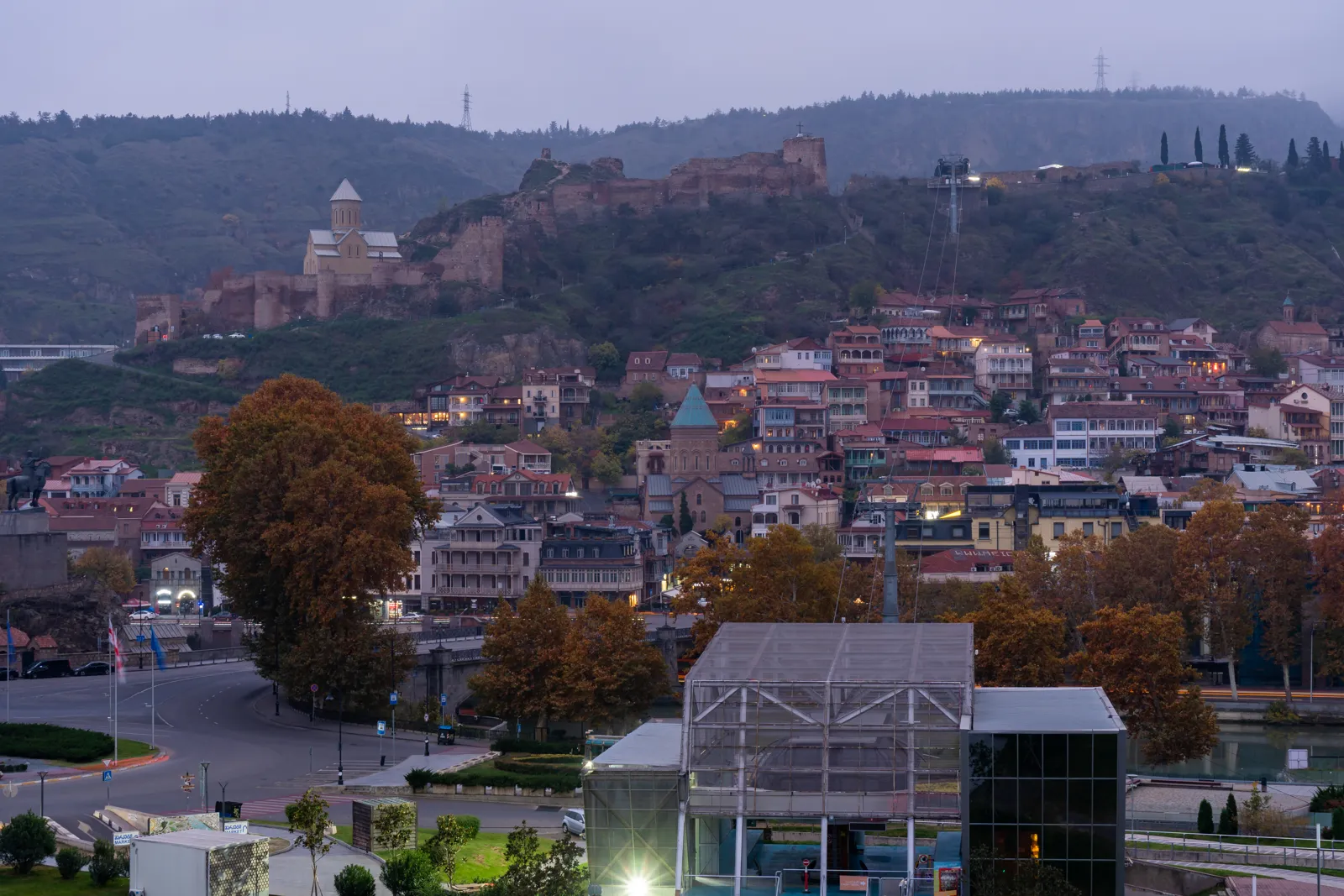
Panorama of the old town of Tbilisi, Georgia
Tbilisi
The capital stretches along the Mtkvari (Kura) River, in a valley framed by hills. The old town mixes houses with wooden balconies, Orthodox churches, a synagogue and a mosque. Below Narikala Fortress, the Abanotubani district is known for its sulfur baths under brick domes. Rustaveli Avenue has museums, theaters and official buildings. Allow three days for the city, its markets, Mtatsminda Park and its many restaurants.
Mtskheta
About thirty minutes by road from Tbilisi, the former capital is the country’s religious heart. Svetitskhoveli Cathedral and Jvari Monastery, perched above the confluence of two rivers, are UNESCO World Heritage Sites. Half a day is enough, and many visitors stop here on the way to Kazbegi.
Kazbegi (Stepantsminda) and the Georgian Military Road
The Georgian Military Road links Tbilisi with the Greater Caucasus via Ananuri fortress, the Gudauri ski resort and the Jvari (Cross) Pass. At the end, the village of Stepantsminda faces Mount Kazbek. Gergeti Trinity Church, on a ridge above the village, is one of the best-known images of the country. The area is good for day hikes, to the Gergeti glacier or in neighboring valleys. This road also leads to the Upper Lars border crossing into Russia: the UK FCDO advises against all travel to Russia. Altitude sickness is a risk around Gudauri and Mount Kazbek (GOV.UK).
Svaneti: Mestia and Ushguli
In the northwest, Svaneti is a high Caucasus valley known for its medieval stone defensive towers. Mestia, the main town, has an airport and an ethnographic museum; Ushguli, one of the highest inhabited villages in Europe, is a World Heritage Site. The region is best explored on foot from July to September, especially on the multi-day trek between Mestia and Ushguli.
Kakheti: Telavi and Sighnaghi
East of Tbilisi, Kakheti is the country’s main wine region. Wine is traditionally made in buried clay jars, qvevri, a method on UNESCO’s Intangible Cultural Heritage list. Visit wineries, monasteries such as Alaverdi and Gremi, and Sighnaghi, a small walled hilltop town overlooking the Alazani Valley and the Caucasus.
Kutaisi and Imereti
Georgia’s second hub, Kutaisi is a practical base for the west. Gelati Monastery, a World Heritage Site, is close by. The surroundings have canyons (Martvili, Okatse), caves (Prometheus) and Katskhi Monastery, set on a rock pillar. Kutaisi airport is served by low-cost airlines.
Batumi and the Black Sea
Batumi, in Adjara, is the country’s main beach resort: seafront, contemporary architecture, botanical garden and pebble beaches. The coast is very busy in July–August. It is also the wettest region of Georgia, especially in autumn. Watch out for pickpockets in crowded places (GOV.UK).
Vardzia and the south
In the south, near the Turkish border, the cave monastery of Vardzia is carved into a cliff above the Mtkvari. Combine it with Rabati fortress in Akhaltsikhe and, in winter, the Bakuriani ski resort. Allow a long day’s drive from Tbilisi, or a night there.
Things to do in Georgia: experiences not to miss
Try the Abanotubani sulfur baths in Tbilisi and climb to Narikala Fortress
Visit Mtskheta, the former capital, and Jvari Monastery
Hike up to Gergeti Trinity Church above Stepantsminda, via the Georgian Military Road
Trek in Svaneti, between Mestia and Ushguli and their defensive towers
Taste qvevri wine in Kakheti, around Telavi and Sighnaghi
Explore the cave city of Vardzia in the south
Sit down to khinkali and the other dishes of Georgian cuisine
Itinerary ideas for Georgia
7 to 10 days: the east and the Greater Caucasus
Days 1 to 3: Tbilisi
Day 4: Mtskheta, then the Georgian Military Road to Kazbegi
Day 5: hike around Stepantsminda, back to Tbilisi
Days 6 and 7: Kakheti (Sighnaghi, Telavi, wineries and monasteries)
Days 8 to 10: Vardzia and Borjomi, or a free day in Tbilisi before departure
2 weeks: from the Black Sea to the Caucasus
Days 1 to 3: Tbilisi and Mtskheta
Days 4 and 5: Kazbegi
Days 6 and 7: Kakheti
Day 8: drive to Kutaisi (Gori or Uplistsikhe on the way)
Days 9 to 11: Svaneti (Mestia, Ushguli), from July to September
Days 12 and 13: Kutaisi and its surroundings, or Batumi in summer
Day 14: depart from Kutaisi or return to Tbilisi
Flying into Tbilisi and out of Kutaisi (or the reverse) saves you from backtracking. For a longer trip in Central Asia or the Caucasus, Uzbekistan shares Georgia’s heritage of historic trade routes, but the two are not easily combined overland.
Who is Georgia for?
Our verdicts by traveler profile, based on the information in this guide:
Profile
Our verdict
Why
Hikers
✅ Ideal
Svaneti between Mestia and Ushguli, Kazbegi and Gergeti Trinity Church; July and August are the Greater Caucasus season.
Culture
✅ Yes
UNESCO-listed Mtskheta and Gelati Monastery, the Vardzia cave monastery, Tbilisi’s old town.
Wine and food
✅ Ideal
Kakheti’s qvevri wines, khinkali and Georgian cuisine.
Budget travelers
✅ Yes
Roughly US$45–80 a day on a budget; mountain guesthouses often include dinner and breakfast.
Families
⚠️ Possible
Tbilisi, Mtskheta and Kakheti are easy to reach; Vardzia and mountain roads mean long days.
Beaches
⚠️ Possible
Batumi has pebble beaches, very busy in July–August, in the country’s wettest region.
Budget for a trip to Georgia
Georgia remains affordable, even though prices have risen in Tbilisi and Batumi. The main costs are accommodation in high season and transport with a driver. Indicative amounts per person per day, excluding international flights (converted from our euro estimates at the ECB rate of 23 October 2026, roughly €1 = US$1.12):
Item
Budget
Comfort
Accommodation (based on a shared double room)
roughly US$17–34 (guesthouses)
roughly US$55–100
Meals
roughly US$13–22
roughly US$34–55
Transport (marshrutkas, trains, taxis)
roughly US$6–11
roughly US$17–34 (driver, rental)
Activities and sightseeing
roughly US$6–11
roughly US$17–34
Total per day
roughly US$45–80
roughly US$110–190
Indicative estimates, varying by season and region. Prices may be quoted in dollars or euros, but payment must be in lari (GOV.UK).
Mountain guesthouses often include dinner and breakfast, which simplifies the budget. Organized tours from Tbilisi cost more than public transport but save time.
Getting around Georgia
Marshrutkas: these minibuses link almost all towns and many villages, cheaply. Schedules are flexible and they often leave when full. The U.S. Department of State (travel.state.gov, last updated September 17, 2026) warns that they are often overcrowded, poorly maintained and lack seat belts.
Train: trains link Tbilisi with Kutaisi, Batumi, Zugdidi (gateway to Svaneti) and Borjomi. They are more comfortable than minibuses over long distances.
Taxi and driver: ride-hailing apps work in Tbilisi and Batumi; GOV.UK advises pre-booking through an app rather than flagging taxis in the street. Hiring a car with driver for the day is common for monasteries and Kakheti.
Rental car: UK drivers can use their UK licence for up to one year, but check whether the rental company requires a 1968 International Driving Permit, to be obtained in the UK before travel (UK FCDO, GOV.UK, updated 15 September 2026). Roads outside cities are often badly lit and in poor condition, stray livestock is a hazard and landslides are common (GOV.UK). There is zero tolerance for drinking and driving (travel.state.gov). Avoid driving at night and on mountain roads in the rain.
Plane: domestic flights sometimes serve Mestia from Tbilisi, depending on the weather: check before relying on them.
In Tbilisi: the metro, buses and the cable car to Narikala make getting around easy.
Where to stay in Georgia
In Tbilisi, the old town and the Sololaki district are the most practical for sightseeing on foot; Vera and Vake, more residential, are a little quieter. Options range from hostels to boutique hotels in old houses. Avoid very steep streets if you travel with heavy luggage.
Outside the capital, family guesthouses are the norm, especially in Kazbegi, Svaneti and Kakheti, where many winemaking families rent rooms. In Batumi, seafront hotels and apartments are in high demand in July–August. In the mountains, book early in high season.
Entry requirements for Georgia
US citizens
According to the U.S. Department of State (travel.state.gov, last updated September 17, 2026), you need a valid passport, and US citizens may enter, reside, work or study in Georgia without a visa for up to 365 days.
Border officials may ask why you are traveling and whether you have enough funds, insurance, hotel reservations and a return ticket, and can deny entry at their discretion. Enter and leave on the same passport.
UK citizens
According to the UK FCDO (GOV.UK foreign travel advice, updated 15 September 2026), you can visit Georgia without a visa for up to one year; your passport should be valid for the duration of your stay.
All visitors must have health and accident insurance covering the full stay (arrival and departure dates included), with coverage of at least 30,000 lari; the airline or immigration may ask for proof.
Georgia has a very strict drugs policy that covers some common medicines: for example, non-prescription medicines containing codeine are illegal. Carry a prescription and the original packaging for any legal medication.
It is illegal under Georgian law to enter Georgia from Russia through South Ossetia or Abkhazia, with heavy fines or up to 4 years in prison (GOV.UK). Taking part in political demonstrations may lead to extra questioning on exit or refusal of re-entry. Entry requirements checked on 24 October 2026; check them again before you travel.
Health and safety
Health: according to the UK FCDO (GOV.UK, updated 15 September 2026), check vaccine recommendations at least 8 weeks before your trip (TravelHealthPro). Risks include rabies (if bitten or scratched by a dog, get medical attention immediately; treatment is available in Tbilisi and major towns), venomous snakes in early summer and varying water quality. Medical facilities are limited outside Tbilisi and most providers only accept cash (travel.state.gov).
Safety: crime levels are low (GOV.UK), but beware of pickpockets, drink spiking and bar scams in which strangers lure visitors into bars with exorbitant bills (travel.state.gov). Protests have taken place in Tbilisi for many months, mainly around Parliament on Rustaveli Avenue: avoid demonstrations.
Natural hazards: small earthquakes are frequent, and heavy rain, flooding and snow can cut mountain roads (GOV.UK).
Mountains: off-piste skiing is very dangerous and avalanche information can be hard to obtain; use specialist guides for extreme sports and check that your insurance covers your activities, including search and rescue.
Emergency number: 112 for police and ambulance (GOV.UK).
Practical tips for Georgia
Money: cards are accepted in cities, but outside major towns you may not find ATMs or be able to pay by card: carry enough lari in cash for marshrutkas, markets and mountain guesthouses (GOV.UK). Check ATMs for skimming devices (travel.state.gov).
Internet: check your carrier’s roaming rates before you go. A local SIM card or an eSIM is the simplest option.
Etiquette: in churches, women cover their hair and wear a skirt (scarves and wraparound skirts are often lent at the entrance), and men avoid shorts. Attitudes are more conservative in rural areas, especially around modest dress in places of worship (GOV.UK).
Meals: the supra, a traditional feast, is led by a tamada who makes successive toasts. Must-try dishes are khachapuri (cheese bread) and khinkali (dumplings).
Language: a few words are appreciated: gamarjoba (hello), madloba (thank you).
For a longer trip along the old trade routes, see our Uzbekistan guide and our page on Central Asia.
Frequently asked questions
Do I need a visa for Georgia?
No for US and British citizens: both can stay visa-free for up to one year (travel.state.gov, GOV.UK). However, health and accident insurance covering your whole stay, with at least 30,000 lari of coverage, is required on entry (GOV.UK). Checked on 24 October 2026; check the latest rules before you leave.
Is Georgia a safe country?
Overall, yes: crime levels are low according to the UK FCDO. However, the FCDO advises against all travel to Abkhazia and South Ossetia and against all but essential travel next to their boundary lines, and demonstrations in Tbilisi should be avoided.
What currency is used in Georgia?
The Georgian lari (GEL). Cards work in cities; keep cash for rural areas, where ATMs can be scarce.
How many days do you need to visit Georgia?
A week lets you see Tbilisi, Mtskheta, Kazbegi and Kakheti. Two weeks are needed to add Svaneti and the west of the country.
What is the best time to visit Georgia?
Mid-May to late June and September to mid-October for a complete trip; July to September for mountain hiking.
What can you see in Georgia in 10 days?
In ten days: Tbilisi and Mtskheta, Kazbegi via the Georgian Military Road, Kakheti (Sighnaghi, Telavi), then Kutaisi and Vardzia. Svaneti needs two to three more days, in season.
What budget do you need for a week in Georgia?
Based on our estimates per person per day (roughly US$45–80 on a budget, US$110–190 in comfort), a week on the ground comes to roughly US$315–560 on a budget and US$780–1,330 in comfort, excluding international flights.
Our sources
Entry, health and safety information read on 24 October 2026: U.S. Department of State, Georgia country information (travel.state.gov, last updated September 17, 2026), and UK FCDO, foreign travel advice for Georgia (GOV.UK, updated 15 September 2026)
Georgian National Tourism Administration, Electricity in Georgia (georgia.travel), read on 24 October 2026
European Central Bank: euro reference rates of 23 October 2026 (budget conversion)
World Meteorological Organization, 1981–2010 normals for Tbilisi airport (NOAA NCEI) and Kutaisi; NOAA NCEI, 1991–2020 normals for Telavi
Transparency: this page contains affiliate links, labelled as such. If you book through them we may earn a commission at no extra cost to you; it does not influence our content or recommendations. How we fund the site.