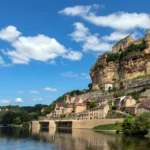
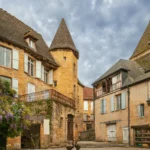
Things to do in the Dordogne: see the paintings of Lascaux IV and the decorated caves of the Vézère valley, wander through Sarlat-la-Canéda, canoe down the Dordogne river below La Roque-Gageac, Beynac and Castelnaud, then visit the gardens of Marqueyssac, Périgueux and Brantôme. To visit the Dordogne, aim for May, June and September: it is mild, the sites are open and there are fewer people than in July-August.
The Dordogne department corresponds almost exactly to the old province of Périgord, which is divided into four « colours »: Green Périgord in the north (Brantôme, Nontron), White in the centre (Périgueux), Purple in the south-west (Bergerac and its vineyards) and Black in the south-east (Sarlat, the Vézère, the Dordogne valley). This guide covers the highlights, two itineraries, the budget, transport, where to stay and the month-by-month climate based on Météo-France’s official normals.

Our travel deals for Dordogne
Affiliate links: we earn a commission, at no extra cost to you.
 FlightsKiwi.comCompare flights and airline combinations to Dordogne.Compare flights

Dordogne at a glance
- Main towns Périgueux (prefecture), Bergerac, Sarlat-la-Canéda
- Currency euro; time zone CET (UTC+1, UTC+2 in summer), one hour ahead of London · currencies
- Airports Bergerac and Brive; Bordeaux further west · detailsTrains to Périgueux, Brive-la-Gaillarde or Bordeaux, then TER
- Entry Schengen rules: US and UK citizens visa-free up to 90 days · details
- Electricity 220 V, 50 Hz, type E sockets; US plugs need an adapter (france.fr, checked 26 October 2026) · plugs
- Car strongly recommended, the sites are spread out
- Suggested length 4 to 5 days for Black Périgord8 to 10 days for the whole department
When to go to the Dordogne
The best months are May, June and September. The climate is a modified oceanic one: cool, damp winters, hot summers (nearly 28 °C, 82 °F, in the afternoon in July-August at Bergerac) and rain spread evenly through the year, with no marked dry season. July and August are the sunniest months, but also the busiest at the caves, the castles and on the river.
| Month | High °C (°F) | Low °C (°F) | Rain mm (in) | Crowds | Prices | Verdict |
|---|---|---|---|---|---|---|
| January | 9.9 (50) | 2.0 (36) | 67.0 (2.6) | Very low | Low | ❌ Cool and grey, many sites closed; truffle markets |
| February | 11.7 (53) | 1.3 (34) | 53.2 (2.1) | Very low | Low | ❌ Cold nights, few tourist services |
| March | 15.7 (60) | 3.7 (39) | 53.7 (2.1) | Low | Low | ⚠️ Sites gradually reopen, changeable weather |
| April | 18.2 (65) | 6.0 (43) | 76.1 (3.0) | Medium (Easter) | Medium | ⚠️ Mild but fairly wet; gardens in bloom |
| May | 22.0 (72) | 9.6 (49) | 77.4 (3.0) | Medium (public holidays) | Medium | ✅ Green, canoeing possible, quiet sites |
| June | 25.5 (78) | 13.1 (56) | 63.2 (2.5) | Medium | Medium | ✅ Long days, pleasant river before the crowds |
| July | 27.7 (82) | 14.6 (58) | 57.0 (2.2) | Very high | High | ⚠️ Good weather but busy caves and river |
| August | 27.9 (82) | 14.3 (58) | 61.5 (2.4) | Very high | High | ⚠️ Hot and lively; book caves and accommodation |
| September | 24.4 (76) | 10.8 (51) | 66.2 (2.6) | Medium | Medium | ✅ Still warm, fewer people, grape harvest at Bergerac |
| October | 19.8 (68) | 8.6 (47) | 65.2 (2.6) | Low | Medium to low | ✅ Autumn colours, ceps and walnuts, shorter hours |
| November | 13.7 (57) | 4.7 (40) | 76.2 (3.0) | Very low | Low | ❌ Wet, many sites closed |
| December | 10.4 (51) | 2.2 (36) | 76.2 (3.0) | Very low | Low | ❌ Quiet; Christmas markets and first truffle markets |
Bergerac totals about 2,020 hours of sunshine a year according to the same data sheet, including more than 250 hours in July and about 80 hours in December. Black Périgord (Sarlat) and Green Périgord, which are hillier, are a little cooler at night.
- Spring (April-June): the countryside is green, the Marqueyssac and Eyrignac gardens are at their best and the river warms up in June. The May public holidays bring crowds to the Dordogne valley.
- Summer (July-August): the season for canoeing, night markets and festivals. It is also when you need to book Lascaux IV and the caves in advance, and when the valley roads are busy.
- Autumn (September-October): the best compromise: still mild, the grape harvest livens up the Bergerac area and the forests turn. Some sites switch to shorter hours from October.
- Winter (November-March): quiet and cheap. This is the season of black truffles and foie gras, but many castles, caves and canoe rental outfits close.
To compare with other seasonal destinations, see our selections of where to go in May and where to go in September.
Things to do in the Dordogne: the highlights
Lascaux IV and the Vézère valley
The original Lascaux cave, discovered in 1940, has been closed to the public since 1963 to protect its paintings. In Montignac, Lascaux IV (the International Centre for Cave Art) presents a full replica, with a guided tour followed by interpretation galleries. The prehistoric sites and decorated caves of the Vézère valley are a UNESCO World Heritage site: in Les Eyzies, the National Museum of Prehistory, the Abri Pataud and the Font-de-Gaume cave, one of the few caves with polychrome paintings still open, with a limited number of visitors each day. Book these visits several days, or even weeks, ahead in summer.
Sarlat-la-Canéda
Sarlat is the capital of Black Périgord. Its medieval and Renaissance centre, built of golden stone, is explored on foot: Saint-Sacerdos cathedral, the Lantern of the Dead, the house of La Boétie, Place de la Liberté. The Saturday morning market is one of the most famous in the region; in winter there is also a truffle market. In summer the town is very busy: come early in the morning or in the evening.
The Dordogne valley: La Roque-Gageac, Beynac, Castelnaud, Domme
Between Sarlat and Siorac, the river flows past spectacular villages and castles. La Roque-Gageac nestles against a cliff; Beynac is crowned by its medieval castle; opposite, Castelnaud castle houses a museum of medieval warfare with siege engines. Domme, a hilltop bastide town, offers one of the best views over the valley. The Château des Milandes recalls Josephine Baker, who lived there.
The gardens of Marqueyssac and Eyrignac
The hanging gardens of Marqueyssac, at Vézac, line up thousands of clipped box trees and a viewpoint above the Dordogne; on some summer evenings they are lit by candles. North of Sarlat, the gardens of the Manoir d’Eyrignac are an immaculate topiary garden.
Canoeing on the Dordogne or the Vézère
Canoeing is the best way to see the valley’s castles. Rental outfits offer trips from a few hours to several days, with a shuttle back; the stretch between Vitrac and Beynac, passing below La Roque-Gageac and Castelnaud, is the classic. The season usually runs from May to September. A life jacket is provided; check the water level and make sure you can swim.
Périgueux
Périgueux has a well-preserved old centre and the cathedral of Saint-Front, with domes and a Greek-cross plan, a World Heritage site as part of the Routes of Santiago de Compostela. The Vesunna museum, designed by Jean Nouvel, protects the remains of a large Gallo-Roman house. On Wednesdays and Saturdays, markets fill the squares in the centre.
Brantôme and Green Périgord
Brantôme, encircled by the Dronne, is nicknamed the « Venice of Périgord ». Its abbey backs onto a cliff riddled with cave dwellings. The nearby Château de Bourdeilles and the Périgord-Limousin regional nature park complete a greener, quieter day than the Dordogne valley.
Bergerac and Purple Périgord
Bergerac has kept an old quarter around the port and Place Pélissière, with its statue of Cyrano. Vineyards surround it: Monbazillac, its château and its sweet wines, Pécharmant, Saussignac. To the east, the Gouffre de Proumeyssac, near Le Bugue, is a large show cave nicknamed the « crystal cathedral ».
On the edge of the Lot: Rocamadour and Padirac
Not far from Sarlat, in the neighbouring Lot department, the pilgrimage town of Rocamadour clings to a cliff, and part of the Gouffre de Padirac is visited by boat on an underground river. Both combine easily with a stay in Black Périgord.
On the Lot side, our guide to visiting the Gouffre de Padirac gives prices, the opening season and booking tips.
Itinerary ideas for the Dordogne
4 to 5 days: Black Périgord
- Day 1: Sarlat-la-Canéda, then the Marqueyssac gardens late in the day
- Day 2: La Roque-Gageac, Domme, Castelnaud and Beynac, with a canoe trip
- Day 3: Lascaux IV in Montignac, then La Roque-Saint-Christophe
- Day 4: Les Eyzies (Museum of Prehistory, Font-de-Gaume) and the Gouffre de Proumeyssac
- Day 5 (optional): Rocamadour and the Gouffre de Padirac
8 to 10 days: all of Périgord
- Days 1 and 2: Périgueux, then Brantôme and Bourdeilles
- Days 3 and 4: the Vézère valley (Montignac, Lascaux IV, Les Eyzies)
- Days 5 to 7: Sarlat and the Dordogne valley, canoeing and castles
- Day 8: Rocamadour and Padirac
- Days 9 and 10: Bergerac, Monbazillac and the vineyards
For another trip in the south of France, see our guide to visiting Provence.
Budget for a stay in the Dordogne
The budget depends mainly on the season and the type of accommodation: campsite, self-catering cottage (gîte) or simple B&B for a tight budget, a boutique hotel for more comfort. Markets and set lunch menus let you eat well for less.
Several sites offer combined tickets or family rates: compare before paying for each entry separately.
Getting around the Dordogne
- Train: Périgueux is served via Limoges; Brive-la-Gaillarde (Corrèze) by Intercités trains on the Paris-Austerlitz – Toulouse line; Bergerac and Sarlat by TER from Bordeaux, which deserves a stop of its own (see things to do in Bordeaux). See our tips for travelling cheaply by train.
- Plane: Bergerac and Brive have regional airports, and Bordeaux-Mérignac is the largest airport in the area; check current routes with the airports.
- Car: almost essential. The valley roads are narrow and busy in summer, and village car parks are often paid. US and UK licence holders should read the driving sections of travel.state.gov and GOV.UK.
- Canoe and bike: a greenway runs from Sarlat towards the Dordogne valley; combined with a canoe, it lets you do without a car on some days.
Where to stay in the Dordogne
Sarlat or a village in the valley (Vitrac, Beynac, La Roque-Gageac, Domme) is the most practical base for Black Périgord. Les Eyzies or Montignac suit prehistory lovers. Périgueux and Brantôme are bases for the north, Bergerac for the south-west. The department has many gîtes, B&Bs and riverside campsites; for July-August, book several months ahead.
Entry requirements, health and safety
- US citizens: France is in the Schengen area, which you may enter for up to 90 days for tourism or business without a visa. Immigration officers may ask for proof of sufficient funds and a return ticket, and France does not recognise the 12-page US emergency passport for visa-free entry (U.S. Department of State, travel.state.gov, last updated August 11, 2025).
- UK citizens: no visa for up to 90 days in any 180-day period as a tourist. Your passport must have been issued less than 10 years before the day you arrive and be valid at least 3 months after the day you plan to leave the Schengen area. The EU Entry/Exit System (EES) may require fingerprints and a photo at your first entry (UK FCDO, GOV.UK, updated 22 October 2026).
- ID: you must be able to prove your identity when asked by the police, or within 4 hours at a police station (GOV.UK, updated 22 October 2026).
- Health and emergencies: UK travellers need a GHIC or a valid EHIC for medically necessary state healthcare, which is not a substitute for travel insurance; the European emergency number is 112 (GOV.UK).
- Canoeing and swimming: wear the life jacket, follow the rental outfits’ instructions and do not swim when the current is strong; take sun cream and water on the river.
- Caves: they are cool all year round: bring a jacket, even in summer.
- Wildfires: they can occur across France in summer, with a higher risk in parts of the south-west in hot, dry weather (GOV.UK, updated 22 October 2026).
For canoeing or hiking, check what your travel insurance covers.
Practical tips for the Dordogne
- Bookings: Lascaux IV, Font-de-Gaume and the most popular caves are booked online; in summer, slots go quickly.
- Markets: Sarlat on Saturdays, Périgueux on Wednesdays and Saturdays; in summer, many villages hold evening farmers’ markets.
- Food: foie gras, duck confit and magret, black truffle, Périgord walnuts, ceps, Périgord strawberries, Bergerac and Monbazillac wines.
- Opening hours: out of season, many sites close or cut their hours; check before you go.
- Internet: some valleys have poor mobile coverage.
Frequently asked questions
What to do in the Dordogne in 3 days?
Base yourself in Sarlat: one day for Sarlat and Marqueyssac, one day for the Dordogne valley (La Roque-Gageac, Beynac, Castelnaud, Domme) with some canoeing, and one day for Lascaux IV and Les Eyzies.
What is the best time to visit the Dordogne?
May, June and September: 22 to 25.5 °C (72 to 78 °F) in the afternoon at Bergerac according to Météo-France’s 1991-2020 normals, sites open and fewer people than in July-August.
Can you visit the real Lascaux cave?
No. The original cave has been closed to the public since 1963. Lascaux IV, in Montignac, presents a full replica. To see original paintings, the Font-de-Gaume cave in Les Eyzies remains open with limited visits.
Dordogne or Périgord: what is the difference?
The Dordogne department corresponds almost exactly to the old province of Périgord. Both names refer to the same destination.
When can you canoe on the Dordogne?
Usually from May to September, when the rental outfits are open and the water warm enough. June and September avoid the summer crowds.
Can you visit the Dordogne without a car?
It is difficult. Trains serve Périgueux, Bergerac and Sarlat, but most caves and castles require a car or an organised tour.
Our sources
- Météo-France: climate data sheet, 1991-2020 statistics, Bergerac-Roumanière station (Dordogne)
- Entry requirements, health and safety checked on 26 October 2026: U.S. Department of State, France country information (last updated August 11, 2025) and UK FCDO, GOV.UK foreign travel advice for France (updated 22 October 2026)
- France tourism board (france.fr), electricity requirements, checked 26 October 2026
- Our methodology
Updated October 2026.
For more ideas, see our France travel guide and our other destinations in Europe.