
Hagia Sophia (Ayasofya) became a mosque again in 2020: you visit it outside prayer times, in covering clothes and, for women, with a headscarf. Since 15 January 2024, foreign visitors have paid an entry fee and follow a separate route. We could not read an official ticketing page: check the price on site.
The 6th-century building dominates Sultanahmet, opposite the Blue Mosque. This page explains what is established and what is not, and offers a figure we calculate: prayer times in Istanbul on the 15th of each month, so you know when to avoid arriving. For the rest of your stay, see our guide to visiting Istanbul. For passports and visas, see entry requirements for Turkey.

Our travel deals for Hagia Sophia
Affiliate links: we earn a commission, at no extra cost to you.
 FlightsKiwi.comCompare flights and airline combinations to Hagia Sophia.Compare flights
- eSIMAiraloData plan to install before you leave (eSIM-compatible phone).See plans


Visiting Hagia Sophia: the essentials
- Status: working mosque (presidential decree of July 2020).
- Price: entry fee for foreign visitors introduced on 15 January 2024 (AFP). No readable official ticketing website on 15 October 2026: we do not publish an amount.
- Booking: no official online booking identified; beware of sites that call themselves « official ».
- Dress: shoulders and knees covered; headscarf for women; shoes removed in the prayer area.
- Time to allow: 45 minutes to 1 hour (estimate).
Tickets: what is official and what is not
The entry fee for foreigners was introduced on 15 January 2024, with separate access to the upper galleries (AFP, Hürriyet Daily News). The ground-floor prayer area remains reserved for worshippers. We found no official page (ministry or mosque) giving the price and the arrangements: the government website ayasofyacamii.gov.tr presents the history and a virtual tour, not ticketing.
Beware: several sites at the top of Google (hagiasophia.com, muze.gen.tr…) have official-sounding names but are private sites or resellers of guided tours. A guided tour can be useful for the history of the site, but it does not replace an official entry ticket.
Prayer times: when to avoid arriving
Hagia Sophia is a mosque: five prayers punctuate the day, and the Friday midday prayer draws the most worshippers. We have no published official rule on visitor access hours; this table is for avoiding arriving at the time of the call to prayer. Destination de Voyage calculation: position of the sun (NOAA algorithm) with the Diyanet angles (dawn 18°, night 17°) and asr at one shadow length, for the 15th of each month 2027, Istanbul time. The Diyanet adds small safety margins: the difference from the official time can reach a few minutes.
| Month | Midday (öğle) | Afternoon (ikindi) | Sunset (akşam) | Night (yatsı) |
|---|---|---|---|---|
| January | 1:14 pm | 3:40 pm | 5:59 pm | 7:31 pm |
| February | 1:19 pm | 4:12 pm | 6:37 pm | 8:04 pm |
| March | 1:14 pm | 4:33 pm | 7:10 pm | 8:36 pm |
| April | 1:05 pm | 4:47 pm | 7:43 pm | 9:15 pm |
| May | 1:01 pm | 4:56 pm | 8:14 pm | 10:00 pm |
| June | 1:05 pm | 5:05 pm | 8:37 pm | 10:35 pm |
| July | 1:11 pm | 5:09 pm | 8:35 pm | 10:27 pm |
| August | 1:09 pm | 4:58 pm | 8:03 pm | 9:40 pm |
| September | 1:00 pm | 4:30 pm | 7:14 pm | 8:42 pm |
| October | 12:50 pm | 3:55 pm | 6:24 pm | 7:50 pm |
| November | 12:49 pm | 3:24 pm | 5:45 pm | 7:15 pm |
| December | 1:00 pm | 3:18 pm | 5:36 pm | 7:10 pm |
- The morning before the midday prayer is the longest slot without interruption.
- On Fridays, avoid late morning and early afternoon.
- In winter, the afternoon and sunset prayers are close together (about 2 h 15 min apart in December): come in the morning instead.
Best time of year
The visit is indoors, but the wait is outside, on the square. In Istanbul, average highs range from 8.8 °C (48 °F) in January to 28.2 °C (83 °F) in August; December is the wettest month (125 mm / 4.9 in), according to the 1991–2020 normals of the Turkish State Meteorological Service (Kireçburnu station) used on our page on the best time to visit Istanbul. April–May and September–October are the most pleasant for walking around Sultanahmet. During Ramadan, religious life intensifies in the evening.
What to see: suggested route
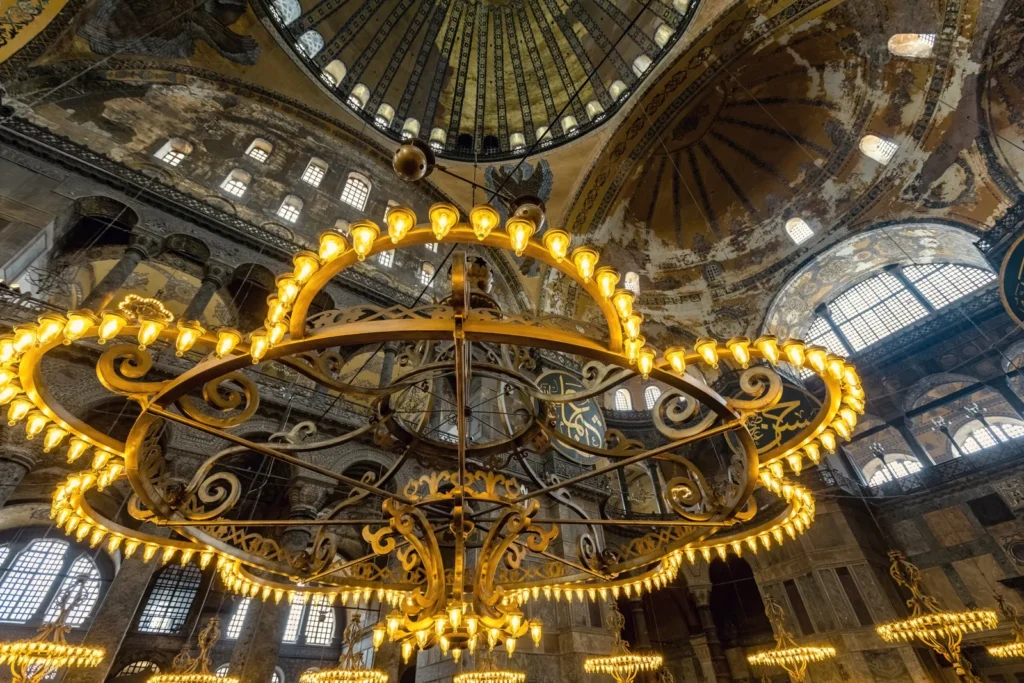
- The dome (about 31 m / 102 ft in diameter) and the windows at its base, which make it seem to rest on light.
- The large calligraphic medallions (Allah, Muhammad, the first four caliphs, Hasan and Hüseyin).
- The Ottoman mihrab and minbar, facing Mecca, hence their slight offset from the Byzantine axis.
- The upper galleries and the Byzantine mosaics (Deësis), where the foreign visitors’ route goes.
- The Imperial Gate and the narthex mosaic.
Getting there
Address: Ayasofya Square (Ayasofya Meydanı), Sultanahmet, Fatih district. The T1 tram serves the Sultanahmet and Gülhane stops, a few minutes’ walk away (check on the Metro İstanbul website).
Dress, accessibility and rules
- Covering clothing (shoulders, knees); headscarf for women. The UK FCDO advises dressing modestly when visiting a mosque (GOV.UK, updated 19 October 2026). Headscarves and cover-ups are offered at the entrance.
- Do not photograph worshippers at prayer; speak quietly.
- Wheelchair access: no official information published that we could read; the galleries are upstairs.
Common mistakes
- Paying for an « official » ticket on a site that is not.
- Arriving just before the midday prayer on a Friday.
- Coming in shorts or with bare shoulders.
- Confusing Hagia Sophia with the Blue Mosque, right opposite (free, different rules).
Hagia Sophia in brief: a little history
Hagia Sophia was built under Emperor Justinian and consecrated in 537. For almost a thousand years, it was the largest church in Christendom and the seat of the Patriarch of Constantinople.
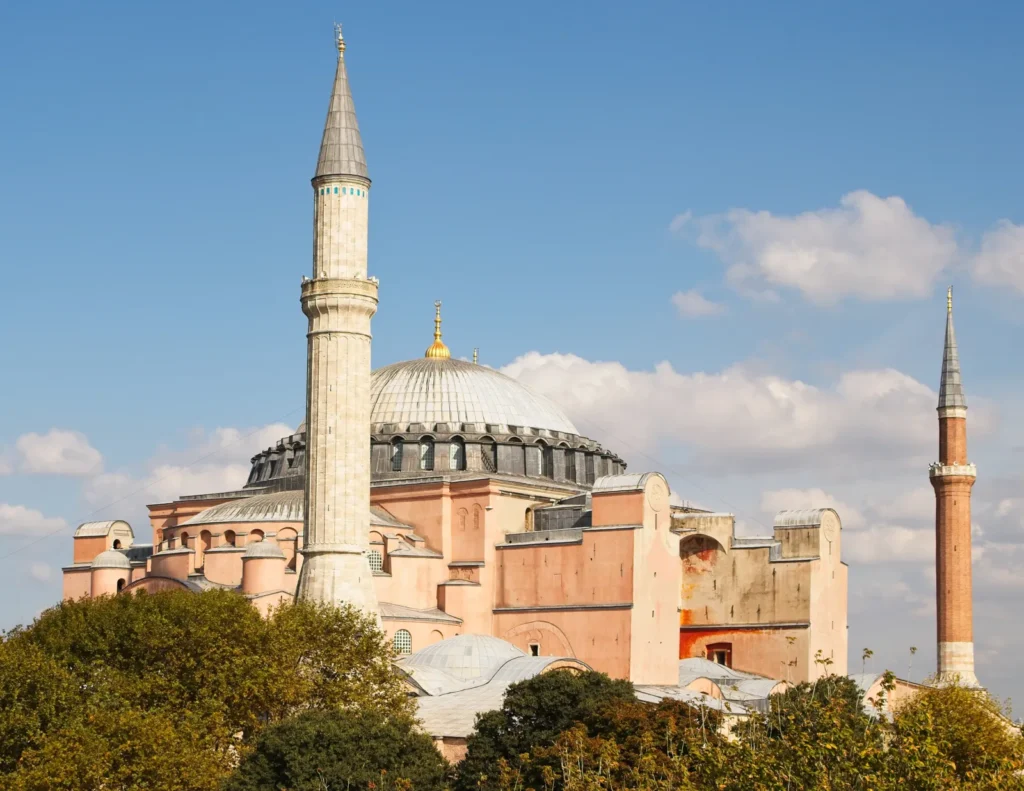
After Mehmed II took the city in 1453, it became a mosque: the minarets, mihrab and minbar were added. In 1934, the Turkish Republic turned it into a museum. In July 2020, a presidential decree returned it to Muslim worship; the first Friday prayer was held there on 24 July 2020.
Some of the Christian mosaics have been preserved; those in the upper galleries, such as the Deësis, are on the visitors’ route.
The monument is part of the Historic Areas of Istanbul, listed as a UNESCO World Heritage Site since 1985, together with the Blue Mosque and Topkapı Palace.
Visiting with children
- The same dress rules apply to teenagers.
- Keep the visit short with young children: the queue is outside, with no shelter from rain or heat.
- Sultanahmet Square, between Hagia Sophia and the Blue Mosque, offers a break before or after.
Checklist before your visit
- Covering clothing (shoulders, knees); headscarf for women.
- Clean socks: you take your shoes off in the prayer area.
- Means of payment for the entry fee (amount to check on site).
- Prayer time for the day checked on the Diyanet website.
- Visit in the morning, especially on Fridays.
Is the visit worth it?
Hagia Sophia is one of the few buildings where you can read fifteen centuries of history at a glance, from Byzantium to the Ottomans. Its status as a mosque imposes constraints (dress, prayers, separate route), but they are not penalising if you plan the visit for the morning. Combined with the Blue Mosque, the Basilica Cistern and Topkapı, it easily fills a day in Sultanahmet; keep Topkapı for the afternoon, when prayer times matter less.
What to see nearby
The Blue Mosque, the Basilica Cistern, Topkapı Palace and the Hippodrome are a few minutes’ walk away. Our Istanbul page details the districts and best time to visit Istanbul the climate month by month.
Frequently asked questions
Is Hagia Sophia free?
No for foreign visitors, since 15 January 2024. With no readable official ticketing page, we do not publish an amount: check on site.
Can you visit Hagia Sophia during prayer?
It is a working mosque: avoid arriving at prayer times. Our table gives times calculated for each month.
What should you wear to visit Hagia Sophia?
Shoulders and knees covered; women cover their hair. Headscarves are offered at the entrance.
Is Hagia Sophia open on Fridays?
Yes, but the Friday midday prayer draws many worshippers: come in the morning or late afternoon.
How long does a visit to Hagia Sophia take?
Allow 45 minutes to an hour on site, plus the wait outside, which varies with the time and season. These durations are estimates: no official data is published.
Do you need to book Hagia Sophia?
We identified no official online booking. Tickets sold online are offered by resellers or agencies.
Our sources
- AFP (15 January 2024) and Hürriyet Daily News: introduction of the entry fee for foreign visitors.
- ayasofyacamii.gov.tr (Turkish presidency communications directorate), consulted on 15 October 2026.
- UK Foreign, Commonwealth & Development Office (FCDO), Turkey travel advice, Safety and security (GOV.UK, updated 19 October 2026; dress at mosques), text downloaded on 26 October 2026.
- Turkish State Meteorological Service (MGM), Kireçburnu 1991–2020 normals, taken from our page on the best time to visit Istanbul.
- Destination de Voyage calculation: prayer times (NOAA algorithm, Diyanet angles).
- Our methodology
Updated November 2026.