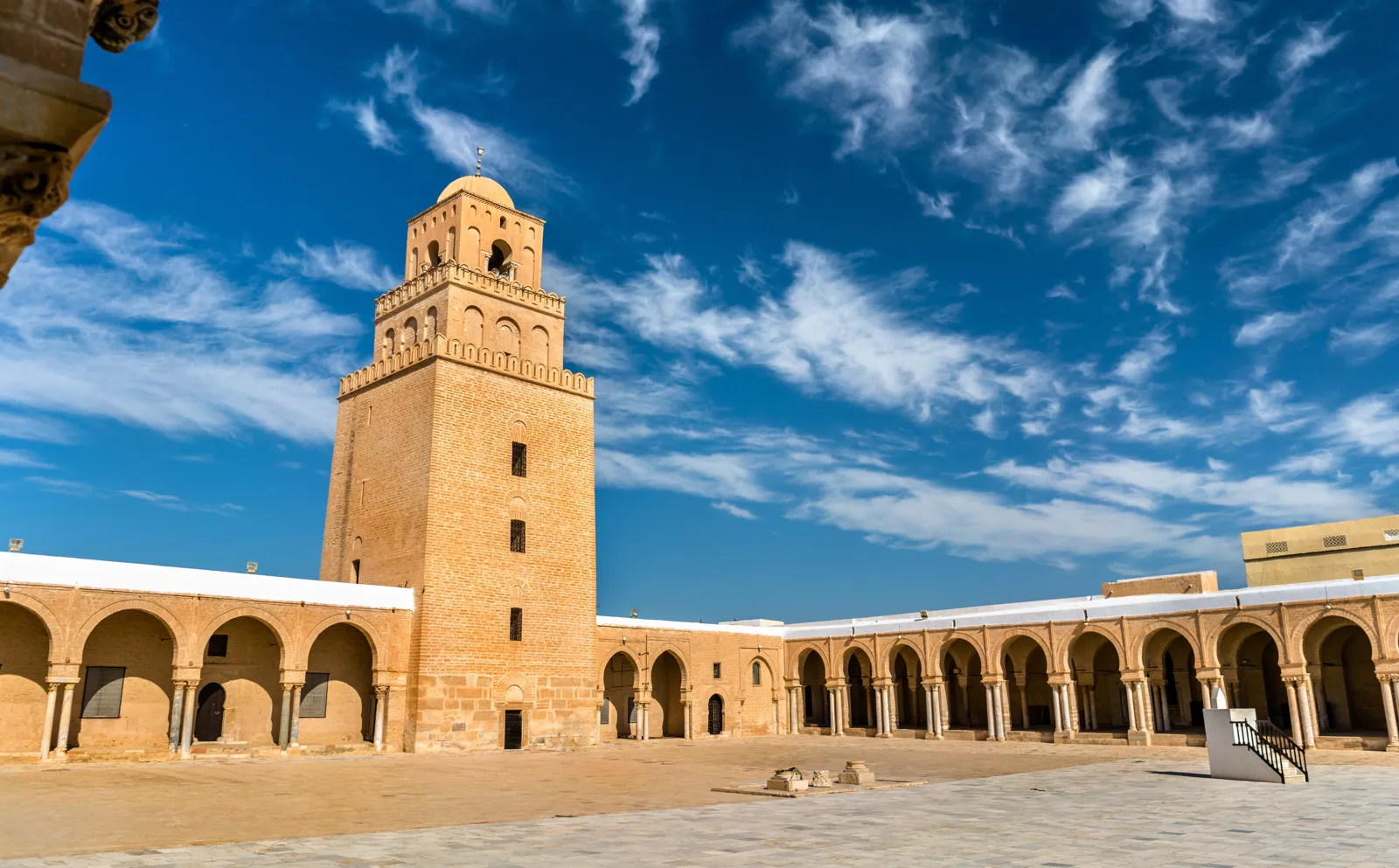
Visiting the Blue Mosque (Sultan Ahmed Mosque) in Istanbul is free and needs no booking, but the visit is organised around the five daily prayers, during which visitors are generally asked not to enter. It is a working mosque: cover up, take your shoes off, and women cover their hair. Since no official visitor hours are published, we calculated the prayer times for each month and, above all, the length of the slots between two prayers: that is what determines when to come.
The mosque faces Hagia Sophia on Sultanahmet Square: the two visits combine well, but they follow different rules. For the rest of your stay, see our guide to visiting Istanbul. For passports and visas, see entry requirements for Turkey.

Our travel deals for Blue Mosque
Affiliate links: we earn a commission, at no extra cost to you.
 FlightsKiwi.comCompare flights and airline combinations to Blue Mosque.Compare flights
- eSIMAiraloData plan to install before you leave (eSIM-compatible phone).See plans


Blue Mosque: the essentials
- Entry: no official ticket office; no ticket is needed to enter. Websites selling « tickets » are resellers of guided tours.
- Opening hours: no official visitor hours that we could read on 15 October 2026; visits are interrupted during prayers (see our calculated table).
- Dress: long clothing, shoes off, women’s heads covered; the UK FCDO advises dressing modestly when visiting a mosque (GOV.UK, updated 19 October 2026)
- Time to allow: no official duration published; add waiting time and interruptions during prayers.
- Getting there: Sultanahmet Square, T1 tram, Sultanahmet stop.
Tickets: why there is nothing to buy
The Blue Mosque is a working place of worship, not a museum: it does not charge an entry fee. Several well-ranked websites have an official-sounding name. One of them, bluemosquetickets.com, states in its own legal notice that it is not the website of the site and that it sells experiences as a partner. A guided tour can provide historical context, but it does not give you a « skip-the-line » pass to a free mosque.
By contrast, Hagia Sophia, just opposite, has charged foreign visitors an entry fee since January 2024: do not confuse the two monuments, or their queues.
Prayer times and visiting slots, month by month
We have no published official rule on visitor access. The table is for planning around the interruptions: it gives the prayer times calculated for the 15th of each month and the length of each slot without prayer. Destination de Voyage calculation: position of the sun (NOAA algorithm) with the Diyanet angles (night 17°) and asr at one shadow length, Istanbul time. The Diyanet adds small margins: the official time may differ by a few minutes, and the mosque stays closed to tourists for a certain time around each call to prayer.
| Month (15th) | Sunrise | Midday (öğle) | Afternoon (ikindi) | Sunset (akşam) | Sunrise → öğle | Öğle → ikindi | İkindi → akşam |
|---|---|---|---|---|---|---|---|
| January | 8:26 am | 1:14 pm | 3:40 pm | 5:59 pm | 4 h 48 min | 2 h 26 min | 2 h 19 min |
| February | 7:58 am | 1:19 pm | 4:12 pm | 6:37 pm | 5 h 21 min | 2 h 53 min | 2 h 26 min |
| March | 7:15 am | 1:14 pm | 4:33 pm | 7:10 pm | 5 h 58 min | 3 h 20 min | 2 h 36 min |
| April | 6:25 am | 1:05 pm | 4:47 pm | 7:43 pm | 6 h 40 min | 3 h 43 min | 2 h 55 min |
| May | 5:46 am | 1:01 pm | 4:56 pm | 8:14 pm | 7 h 15 min | 3 h 55 min | 3 h 18 min |
| June | 5:31 am | 1:05 pm | 5:05 pm | 8:37 pm | 7 h 34 min | 4 h 00 min | 3 h 32 min |
| July | 5:44 am | 1:11 pm | 5:09 pm | 8:35 pm | 7 h 26 min | 3 h 58 min | 3 h 26 min |
| August | 6:13 am | 1:09 pm | 4:58 pm | 8:03 pm | 6 h 56 min | 3 h 49 min | 3 h 05 min |
| September | 6:44 am | 1:00 pm | 4:30 pm | 7:14 pm | 6 h 16 min | 3 h 30 min | 2 h 43 min |
| October | 7:15 am | 12:50 pm | 3:55 pm | 6:24 pm | 5 h 36 min | 3 h 04 min | 2 h 29 min |
| November | 7:51 am | 12:49 pm | 3:24 pm | 5:45 pm | 4 h 58 min | 2 h 35 min | 2 h 21 min |
| December | 8:21 am | 1:00 pm | 3:18 pm | 5:36 pm | 4 h 38 min | 2 h 19 min | 2 h 18 min |
How to read it: the slot between the midday and afternoon prayers lasts from 2 h 19 min in December to 4 h 00 min in June. In winter, it is too short for an unhurried visit once the closures around the calls to prayer are taken off: come in the morning, the longest slot of the day. In summer, the afternoon becomes possible again, but the queue is in full sun.
- On Fridays: the midday prayer is the best attended, so expect longer interruptions around it; we found no official published rule, so check the posted times on the day.
- During Ramadan: religious life intensifies in the evening; check the times for the day.
- To combine with Hagia Sophia: one mosque before the midday prayer, the other in the early afternoon, or Hagia Sophia in the morning and Topkapı in the afternoon.
Best time of year
The visit is indoors, but the wait is outside, on the square. According to the 1991–2020 normals of the Turkish State Meteorological Service (Kireçburnu station) used on our page on the best time to visit Istanbul, highs range from 8.8 °C (48 °F) in January to 28.2 °C (83 °F) in August, and December is the wettest month (125 mm / 4.9 in). April–May and September–October are the most pleasant for walking around Sultanahmet; in winter, morning light is shorter (sunrise around 8:25 am in January according to our calculation).
What to see inside
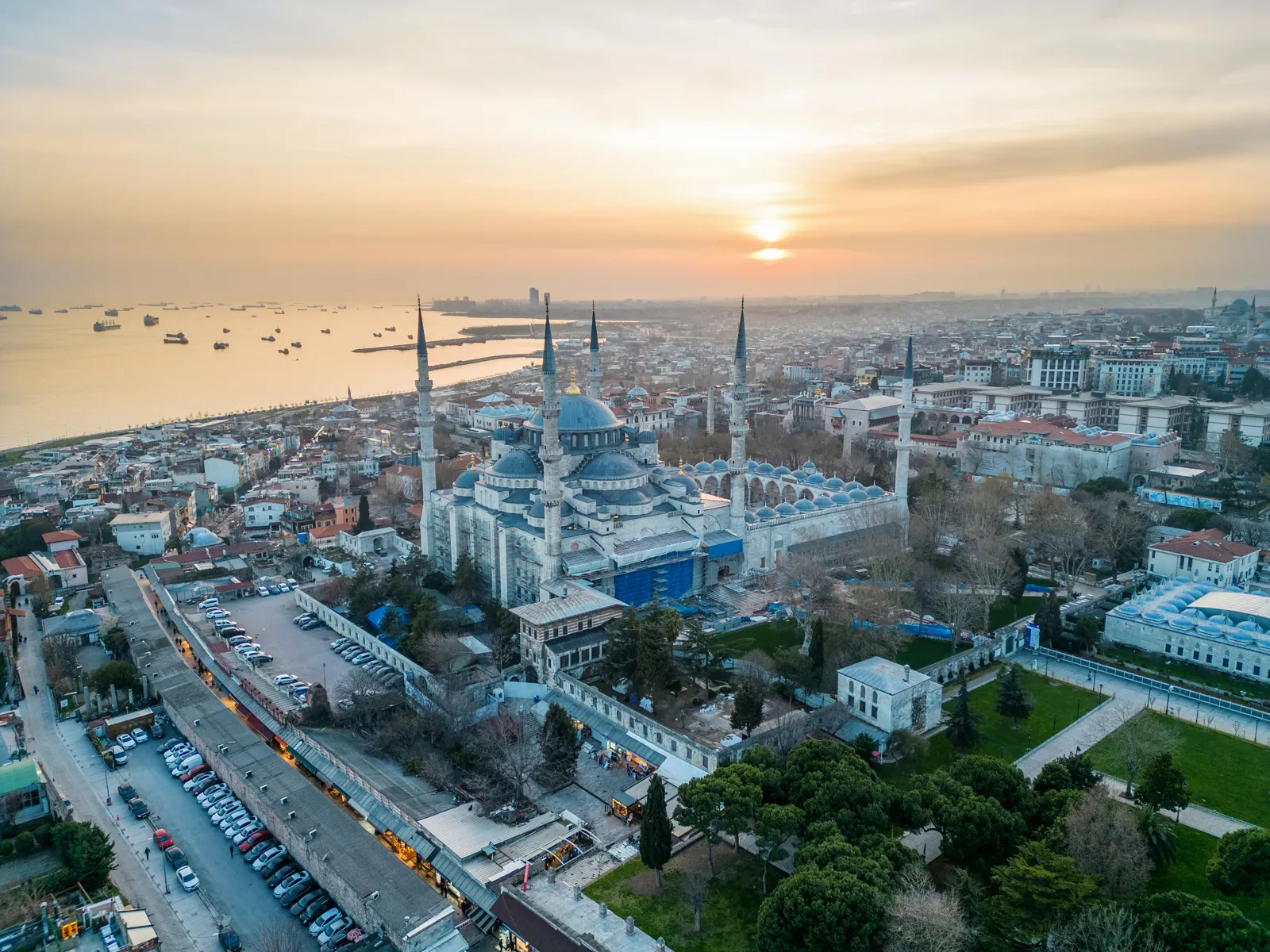
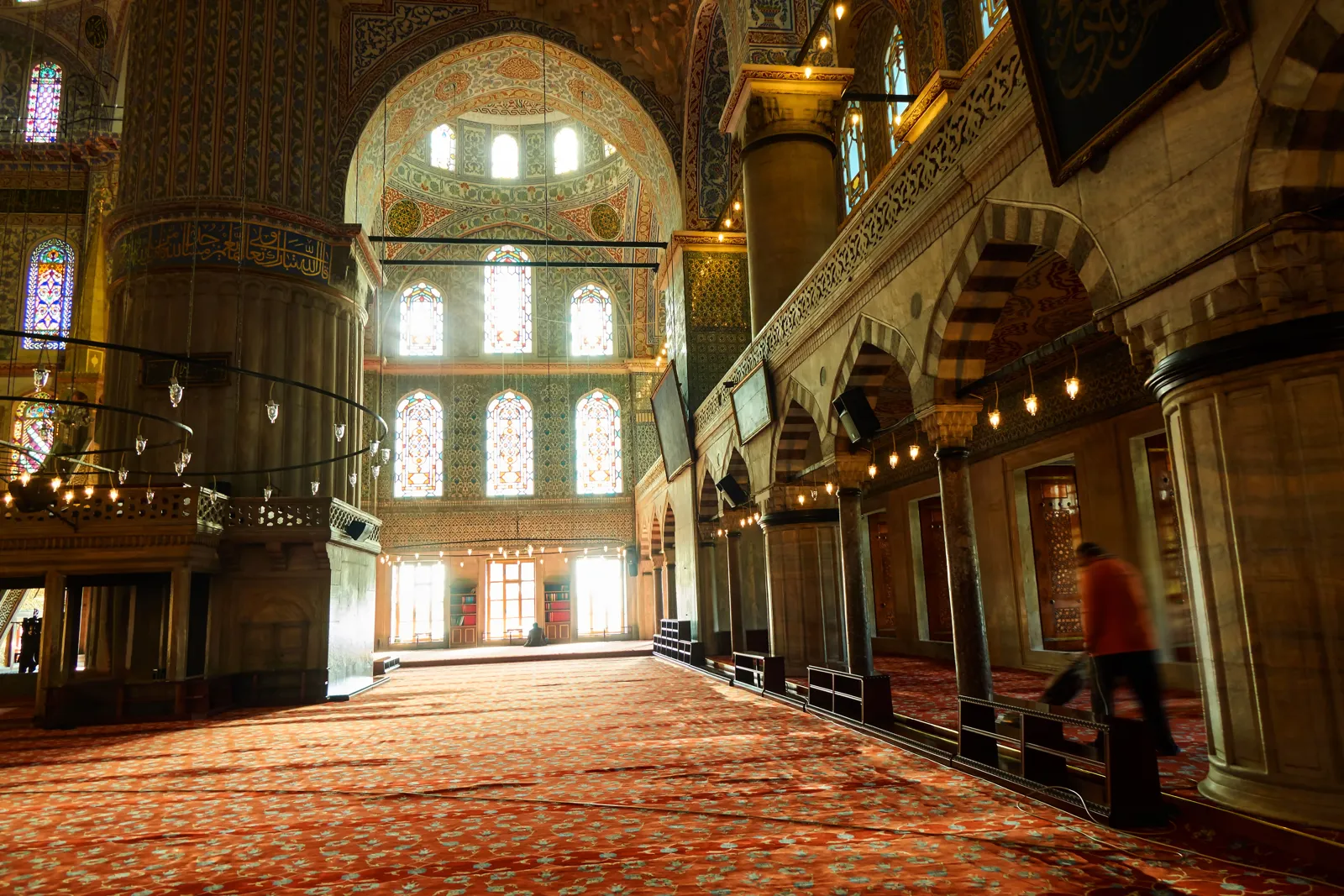
- The prayer hall and the central dome: 23.5 m (77 ft) in diameter and 43 m (141 ft) high, carried by four enormous pillars.
- The Iznik tiles: more than 20,000 ceramic tiles, predominantly blue, which gave the mosque its nickname.
- The stained glass: more than 200 windows, 28 of them in the central dome.
- The mihrab and minbar in carved marble, facing Mecca.
- The courtyard with its arcades and the six minarets, visible from all over the square.
The mosque was built from 1609 to 1616 for Sultan Ahmed I by the architect Sedefkâr Mehmed Ağa, a pupil of Sinan. It is part of the Historic Areas of Istanbul, listed as a UNESCO World Heritage Site in 1985 (figures from the Wikipedia article on the mosque).
Getting there
Sultanahmet Square, in the Fatih district. The T1 tram serves the Sultanahmet stop, a few minutes’ walk away; check the service on the Metro İstanbul website. The visitor entrance is separate from the worshippers’ entrance: follow the signs and the staff’s directions.
Dress, accessibility and rules
- Shoulders and knees covered, long clothing; a headscarf for women. Head coverings and skirts are generally offered at the entrance, but bringing your own saves waiting.
- Shoes removed and carried in a bag: bring clean socks.
- Do not photograph people at prayer, speak quietly, and stay in the area reserved for visitors.
- Wheelchair access: no official information published that we could read; the floor of the hall is flat and carpeted, but the courtyard has steps.
Common mistakes
- Paying for an online « ticket »: entry is not paid.
- Arriving just before the midday prayer, especially on a Friday.
- Coming in shorts, with bare shoulders or without a headscarf.
- Confusing the Blue Mosque and Hagia Sophia, which face each other: different rules, prices and queues.
- Letting your guard down in the crowd: the UK FCDO says street robbery and pickpocketing are common in the major tourist areas of Istanbul, and warns that food and drink offered by strangers could be spiked (GOV.UK, updated 19 October 2026).
Practical tips on site
- Shoes: you take them off at the entrance and keep them with you; a small bag and clean socks make the visit easier.
- Before queueing: check the time of the next prayer (see the table above); if the hall closes, the courtyard remains a good place to wait and photograph the domes.
- Touts: since entry is free, decline offers of a « skip-the-line » pass or an impromptu guide around the square.
- Photos: in the prayer hall, stay behind the area reserved for worshippers and do not photograph people praying.
What to see nearby
Hagia Sophia is right opposite, on the other side of the square. The former Hippodrome, with the Obelisk of Theodosius, runs alongside the mosque; the Basilica Cistern and Topkapı Palace are a few minutes’ walk away. Our guide to visiting Istanbul details these sites and the districts; for the rest of the country, see our Turkey guide.
Frequently asked questions
Why is it called the Blue Mosque?
For the more than 20,000 predominantly blue Iznik ceramic tiles that cover the interior. Its official name is the Sultan Ahmed Mosque, after Sultan Ahmed I, who had it built from 1609 to 1616.
Is the Blue Mosque free?
Yes. It is a working mosque with no ticket office: websites selling tickets offer guided tours, not an entry fee.
What should you wear to visit the Blue Mosque?
Long clothing covering shoulders and knees, shoes removed, and for women, hair covered.
When should you visit the Blue Mosque?
In the morning, between sunrise and the midday prayer: it is the longest slot without prayer all year. Avoid Friday midday.
Can you visit the Blue Mosque during prayer?
Visitors are generally asked not to enter during prayers, although we found no official published rule. Check the day’s times on the Diyanet website or our table calculated for each month.
What is the difference between the Blue Mosque and Hagia Sophia?
The Blue Mosque dates from the 17th century and is free; Hagia Sophia, a 6th-century basilica that became a mosque again in 2020, has charged foreign visitors since 2024.
Our sources
- UK Foreign, Commonwealth & Development Office (FCDO), Turkey travel advice, Safety and security (GOV.UK, updated 19 October 2026; dress at mosques, crime and drink spiking in tourist areas), text downloaded on 26 October 2026
- bluemosquetickets.com: legal notice (reseller site, « not the website of the site »), consulted on 15 October 2026
- Wikipedia, « Blue Mosque » article: construction dates, architect, dome dimensions, tiles, windows, UNESCO listing, consulted on 15 October 2026
- Climate normals: Turkish State Meteorological Service (MGM), Kireçburnu station, 1991–2020, taken from our page on the best time to visit Istanbul
- Prayer times: calculation by Destination de Voyage (NOAA algorithm, Diyanet angles), 15th of each month 2027; official times at namazvakitleri.diyanet.gov.tr
- Our methodology
Updated November 2026.