Kairouan, in central Tunisia, was the first Arab and Muslim city founded in North Africa and is one of the holy cities of Islam. Its medina, mosques and guild-organized souks have been a UNESCO World Heritage Site since 1988. People come for the Great Mosque, the Aghlabid basins, carpets and makrouds. This guide to visiting Kairouan covers what to see, how to plan the visit, the rules for religious sites, entry and safety information for US and UK travelers, and the climate month by month, based on the official normals for the Kairouan station.
To place Kairouan in a trip, see our Tunisia travel guide, the calendar when to go to Tunisia and, on the Sahel coast, our guides to Sousse and Monastir.

Our travel deals for Kairouan
Affiliate links: we earn a commission, at no extra cost to you.
 FlightsKiwi.comCompare flights and airline combinations to Kairouan.Compare flights
- eSIMAiraloData plan to install before you leave (eSIM-compatible phone).See plans


Kairouan at a glance
- Time zone UTC+1 all year (Tunisia does not change its clocks): 1 hour ahead of London in winter, the same time in summer; 5 to 6 hours ahead of New York
- Climate average high of 17.8 °C (64 °F) in January and 38.1 °C (101 °F) in July (1991–2020 normals, INM, Kairouan station)
- Entry visa-free for up to 90 days for US and UK citizens (travel.state.gov, GOV.UK)
- Safety Level 2 « Exercise increased caution » (U.S. Department of State); the areas the FCDO warns against are near the borders and in the western mountains, not around Kairouan
- Highlights Great Mosque, medina and ramparts, Aghlabid basins, Mosque of the Three Doors, Sidi Sahbi mausoleum
What to see in Kairouan: the highlights
The Great Mosque (Sidi Oqba Mosque)
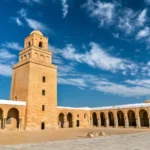
The city’s emblem, the Great Mosque is attributed to Oqba Ibn Nafi, the founder of Kairouan, around 670; it owes most of its present form to the ninth-century enlargements under the Aghlabid dynasty. The vast paved courtyard is dominated by a massive three-story minaret, facing the prayer hall. Inside, the teak minbar, made around 862, is considered the oldest pulpit in the Muslim world. The prayer hall is a place of worship: visitor access is limited, and hours change with prayers and holidays. Check on site.
The medina and its ramparts
The old city is surrounded by ramparts, the first of which date from 762; their present state dates mostly from the eighteenth century. Inside, lanes lined with white houses lead to the souks, organized by trade. This is where you find the carpet shops, a Kairouan specialty since the nineteenth century, and the pastry shops selling makrouds, semolina cakes filled with dates. The medina is explored on foot; in summer, plan for the morning.
The Aghlabid basins
Just north of the medina, these two circular open-air reservoirs were built between 860 and 862 under Emir Abu Ibrahim to supply the city with water. The small basin settled the floodwater of the Merguellil wadi before it passed into the large one, a vast polygonal basin.
The Mosque of the Three Doors
In the medina, between the old wool market and the southern rampart, this small ninth-century mosque is known for its carved facade pierced by three arches and covered in Kufic inscriptions. Its prayer hall is small. It is best admired from the outside.
The Sidi Sahbi mausoleum (the Barber’s mausoleum)
Outside the walls, this large seventeenth-century complex houses the tomb of Abu Zama al-Balawi, a companion of the Prophet. According to tradition, he kept three hairs of the Prophet’s beard, hence the nickname « Barber’s mausoleum ». The courtyards are decorated with ceramic tiles and carved stucco. It is an active place of pilgrimage: covered clothing and discretion are expected.
The Raqqada museum
In President Bourguiba’s former summer residence at Raqqada, on the edge of Kairouan, the national museum of Islamic art displays pieces from the Aghlabid and Zirid periods. The site also holds a collection of ancient manuscripts, including fragments of the « Blue Quran ». Opening hours and visiting conditions: check on site.
Visiting places of worship: the rules to know
Kairouan remains a pilgrimage city, notably during the Mouled, the celebration of the Prophet’s birthday, which draws worshippers from all over Tunisia. A few simple rules avoid unpleasant surprises:
- Wear clothing that covers shoulders and knees; women should keep a scarf at hand. The UK FCDO (GOV.UK) likewise says local custom is to dress modestly at religious sites.
- Respect the areas reserved for prayer: non-Muslims generally stay in the courtyard and at the threshold of the prayer hall.
- Avoid prayer times, especially Friday noon, and find out about hours during Ramadan and religious holidays. During Ramadan, eating, drinking or smoking in public in the daytime may cause offense (FCDO, GOV.UK; next Ramadan starting February 2027).
- Ask before photographing people, and do not photograph government buildings or military sites (FCDO, GOV.UK).
- In the souks, visiting a carpet shop commits you to nothing: take the time to compare.
Kairouan in one or two days
- Morning: Great Mosque at opening time, then the medina, the Mosque of the Three Doors and the souks.
- Afternoon: Sidi Sahbi mausoleum and the Aghlabid basins; a makroud break at the end of the day.
- Second day (optional): Raqqada museum, then back toward the Sahel.
Many travelers visit Kairouan from the coast. If you are staying in Sousse, Monastir, Mahdia or Hammamet, a day trip covers the essentials; sleeping in town lets you see the medina quietly, early in the morning and in the evening.
Where to stay in Kairouan
The choice of accommodation is smaller than on the coast. Places near the medina and the Great Mosque let you do everything on foot; hotels in the new town are more practical with a car. During the Mouled the city fills up: book early if your dates coincide.
Getting to Kairouan and getting around
Kairouan has no international airport: you arrive by road, from Tunis or the Sahel coast cities. Check flight options on the websites of the Tunisian airports and the airlines. The FCDO (GOV.UK, updated 24 July 2026) warns that driving at night can be hazardous outside towns because of unlit roads, vehicles without lights and livestock on the road.
Day trip, transfer or rental car
Three options: an organized excursion from the coast (sometimes combined with El Jem), a private transfer or a rental car. If you drive, UK license holders can drive in Tunisia for up to one year with a 1968 International Driving Permit and their UK license (the permit must be bought in the UK before travel) and must carry a green card as proof of minimum insurance cover (FCDO, GOV.UK). Before booking, compare the official provider with resellers: what is included (guide, entry fees), cancellation terms, and insurance and excess for a rental. To stay connected, see our Tunisia eSIM guide.
When to go to Kairouan: climate month by month
Kairouan is inland, without the moderating effect of the sea: summers are noticeably hotter than on the coast and winter nights are cool. The table combines the official normals with our calculations.
| Month | Avg. max | Avg. min | Rain | Rainy days | Day/night gap | Sunrise / sunset on the 15th | Day length |
|---|---|---|---|---|---|---|---|
| January | 17.8 °C (64 °F) | 7.4 °C (45 °F) | 24 mm (0.9 in) | 3.4 | 10.4 °C (19 °F) | 7:28 am / 5:29 pm | 10 h 00 min |
| February | 18.6 °C (65 °F) | 7.8 °C (46 °F) | 20 mm (0.8 in) | 3.4 | 10.8 °C (19 °F) | 7:06 am / 6:01 pm | 10 h 54 min |
| March | 21.7 °C (71 °F) | 9.9 °C (50 °F) | 33 mm (1.3 in) | 4.4 | 11.8 °C (21 °F) | 6:30 am / 6:26 pm | 11 h 56 min |
| April | 24.9 °C (77 °F) | 12.4 °C (54 °F) | 27 mm (1.1 in) | 4.3 | 12.5 °C (22 °F) | 5:47 am / 6:52 pm | 13 h 05 min |
| May | 29.7 °C (85 °F) | 16.0 °C (61 °F) | 25 mm (1.0 in) | 3.4 | 13.7 °C (25 °F) | 5:14 am / 7:17 pm | 14 h 03 min |
| June | 34.7 °C (94 °F) | 20.0 °C (68 °F) | 12 mm (0.5 in) | 1.9 | 14.7 °C (26 °F) | 5:03 am / 7:36 pm | 14 h 34 min |
| July | 38.1 °C (101 °F) | 22.9 °C (73 °F) | 5 mm (0.2 in) | 0.6 | 15.2 °C (27 °F) | 5:15 am / 7:35 pm | 14 h 21 min |
| August | 37.9 °C (100 °F) | 23.5 °C (74 °F) | 16 mm (0.6 in) | 2.2 | 14.4 °C (26 °F) | 5:38 am / 7:09 pm | 13 h 31 min |
| September | 32.6 °C (91 °F) | 21.0 °C (70 °F) | 56 mm (2.2 in) | 5.0 | 11.6 °C (21 °F) | 6:01 am / 6:27 pm | 12 h 25 min |
| October | 28.2 °C (83 °F) | 17.3 °C (63 °F) | 41 mm (1.6 in) | 3.7 | 10.9 °C (20 °F) | 6:25 am / 5:44 pm | 11 h 19 min |
| November | 22.8 °C (73 °F) | 12.2 °C (54 °F) | 25 mm (1.0 in) | 3.1 | 10.6 °C (19 °F) | 6:54 am / 5:12 pm | 10 h 18 min |
| December | 18.8 °C (66 °F) | 8.8 °C (48 °F) | 28 mm (1.1 in) | 3.3 | 10.0 °C (18 °F) | 7:21 am / 5:07 pm | 9 h 46 min |
Reading the table: in July and August the average high exceeds 37 °C (99 °F) (38.1 and 37.9 °C, or 101 and 100 °F): visit at opening time and at the end of the day. March–April (21.7 and 24.9 °C, or 71 and 77 °F) and October–November (28.2 and 22.8 °C, or 83 and 73 °F) are the most comfortable for walking. September is the wettest month (56 mm (2.2 in) over 5.0 rainy days on average). In January nights drop to 7.4 °C (45 °F): bring a sweater.
Note: our page when to go to Tunisia does not give normals for Kairouan (it uses Tunis-Carthage, Monastir, Tozeur and Djerba). The figures above come from the same agency (INM) and the same reference period (1991–2020).
Entry requirements, health and safety
- US citizens: according to the U.S. Department of State (travel.state.gov, Tunisia page last updated June 04, 2026), a valid passport is required and US passport holders do not need a visa for stays of up to 90 days; a residence permit is needed for longer stays. The Department rates Tunisia Level 2, « Exercise increased caution », because of terrorism, crime and unrest (advisory updated May 20, 2026), and notes a country-wide state of emergency.
- UK citizens: according to the UK FCDO (GOV.UK, updated 24 July 2026), you can visit Tunisia without a visa for up to 90 days, and your passport should be valid for the duration of your stay. Border officials can ask for your contact details, your onward or return ticket and proof of accommodation, and will stamp your passport on arrival: keep the stamp, because overstaying the 90 days without a valid reason means a fine.
- Neither source gives a minimum passport validity beyond the length of your stay: confirm the current rules with your airline and the Tunisian embassy before you travel.
- Hotel tax: the FCDO (GOV.UK, updated 24 July 2026) says you pay a tourist hotel tax on arrival: 8 Tunisian dinars per person per night in 3-star hotels and 12 dinars in 4- and 5-star hotels, for a maximum of ten nights.
- Safety: The FCDO (GOV.UK, updated 24 July 2026) advises against all travel to the Chaambi Mountains National Park and the military operations zones of Mount Salloum, Mount Sammamma and Mount Mghila, against all but essential travel to a number of areas along the Algerian border and in Kasserine Governorate, and against all travel to the militarised zone south of El Borma and Dhehiba, to Ben Guerdane and to the border strip with Libya. The U.S. Department of State advises against travel within 16 km (10 mi) of the Algerian and Libyan borders (with exceptions for Tabarka and Ain Draham), to the same mountain areas, to Mount Orbata and to the desert south of Remada. None of the places in this guide is named in either list; check the maps before any trip toward the south or west.
- The FCDO adds that terrorists are likely to try to carry out attacks in Tunisia, and that you may be at higher risk around religious sites, tourist sites and festivals, public transport and crowded places; a formal state of emergency has been in place since 2015 and security forces are visible in many places.
- The most common crime is theft; avoid displaying expensive items and carry a copy of the photo page of your passport, because security officials may ask for ID at any time (FCDO, GOV.UK).
- See our travel formalities guide.
If you… then…
| If you… | Then… |
|---|---|
| Have only one day | Great Mosque early, medina and Three Doors, then the Aghlabid basins |
| Dislike the heat | Avoid June–August; aim for March–April or October–November |
| Want to see inside the mosques | Come outside prayer times, in covered clothing, and accept staying in the areas open to visitors |
| Want to buy a carpet | Compare several shops, ask about the material (wool, cotton) and the type of knot |
| Are staying on the coast | A day trip is enough; leave early to arrive before the heat |
| Travel during the Mouled | Expect large crowds and book accommodation early |
Frequently asked questions
What can you see in Kairouan in one day?
The Great Mosque, the medina with the Mosque of the Three Doors and the souks, the Sidi Sahbi mausoleum and the Aghlabid basins.
Can you go inside the Great Mosque of Kairouan?
Non-Muslim visitors generally have access to the courtyard and see the prayer hall from the threshold, outside prayer times and in covered clothing. Hours vary: check on site.
What is the best time to visit Kairouan?
March–April and October–November: highs of 21 to 28 °C (70 to 83 °F) (1991–2020 normals, INM). July and August average highs exceed 37 °C (99 °F).
Why is Kairouan a holy city?
Founded by Oqba Ibn Nafi, it was the first Arab city in North Africa and a major center for the spread of Islam; it is often called the fourth holy city of Islam.
Do you need a visa for Kairouan and Tunisia?
No visa is needed for US or UK citizens for stays of up to 90 days; you need a valid passport (U.S. Department of State, last updated June 04, 2026; UK FCDO, GOV.UK, updated 24 July 2026).
Is Kairouan safe?
Neither the FCDO nor the U.S. Department of State names Kairouan among the areas it advises against; both advise against the border areas and western mountains. The State Department rates Tunisia Level 2 and a state of emergency is in force country-wide.
Our sources
- U.S. Department of State, Tunisia country information (travel.state.gov, last updated June 04, 2026) and Tunisia travel advisory (Level 2, updated May 20, 2026), read on 26 October 2026
- UK FCDO, foreign travel advice for Tunisia (GOV.UK, updated 24 July 2026), read on 26 October 2026
- World Meteorological Organization, 1991–2020 climate normals, Kairouan station (60735), Institut National de la Météorologie (NOAA/NCEI archive)
- Wikipedia article « Kairouan » (history, monuments, crafts)
- UNESCO World Heritage List: Kairouan (1988)
- Astronomical calculations: NOAA solar algorithm, applied by Destination de Voyage to the coordinates of Kairouan (15th of each month, year 2027)
- Our methodology
Updated October 2026.