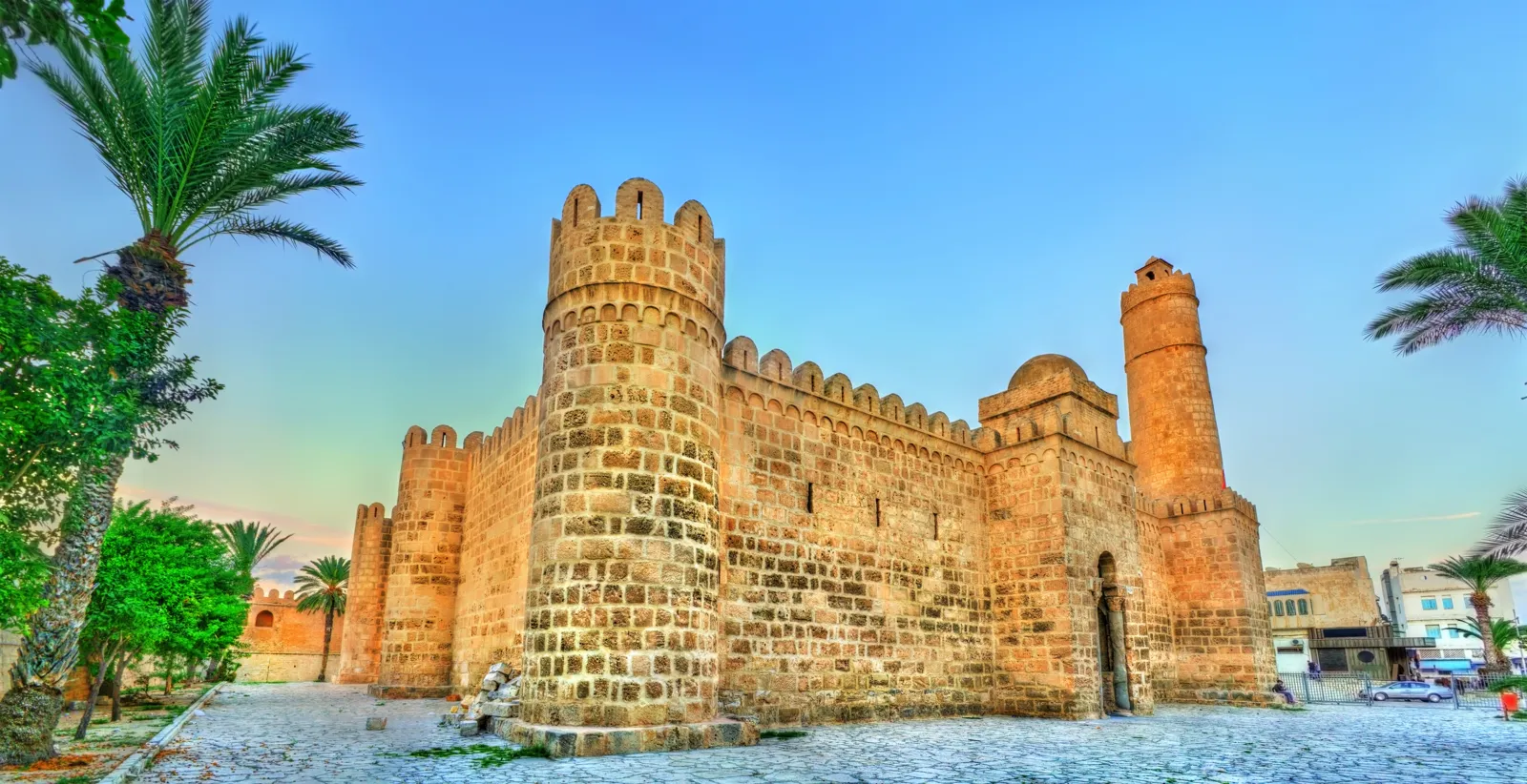
Mahdia is a town on Tunisia’s east coast, built on a narrow peninsula jutting into the sea: a medina founded in 916 by the first Fatimid caliph, an active fishing port and, to the north, a long sandy beach lined with hotels. Quieter than its Sahel neighbors Sousse and Monastir, it appeals to travelers who want to combine beach and heritage. This guide to visiting Mahdia covers what to see, how to get there, where to stay, the weather month by month (official normals for the Mahdia station) and what the US and UK governments say about entry and safety.
To place Mahdia: our Tunisia travel guide, the calendar when to go to Tunisia, and our pages on the neighboring towns, Monastir and Sousse.

Our travel deals for Mahdia
Affiliate links: we earn a commission, at no extra cost to you.
 Learn the languageTargumiLearn a few words of Tunisian Arabic before you go — 30% off via our link.See the course
- FlightsKiwi.comCompare flights and airline combinations to Mahdia.Compare flights
- eSIMAiraloData plan to install before you leave (eSIM-compatible phone).See plans



Mahdia at a glance
- Time zone UTC+1 all year (Tunisia does not change its clocks): 1 hour ahead of London in winter, the same time in summer; 5 to 6 hours ahead of New York
- Location east coast of the Sahel; capital of Mahdia Governorate
- Climate afternoon highs of 31.3 °C (88 °F) in August and 16.8 °C (62 °F) in January; fewer than one rainy day a month in June and July (WMO 1991–2020 normals)
- Entry visa-free for up to 90 days for US and UK citizens (travel.state.gov, GOV.UK)
- Highlights Skifa el Kahla, medina, Great Mosque, Borj el Kebir, Cape Africa and its seaside cemetery, museum, port, beaches
What to see in Mahdia: the highlights
The Skifa el Kahla, gateway to the medina
You enter the old town through the Skifa el Kahla, also called Bab Zouila: a fortified gate built between 916 and 921 and restored in the sixteenth century, one of the few remains of the wall that closed off the peninsula. Its long vaulted passage opens onto the main street of the medina, busy with shops and workshops.
The medina and its weavers
The medina occupies the peninsula: lime-washed lanes, small squares and cafes. Mahdia is known for silk and wool weaving, still practiced in workshops; a craft village opened in 2019. It is the place to look for fabrics and foutas, comparing prices between several shops.
The Great Mosque
Founded in 916, at the same time as the city, the Great Mosque is unusual in having no minaret. It was rebuilt between 1961 and 1965 following the tenth-century plan. As in most active Tunisian mosques, access to the prayer hall is generally reserved for Muslims: ask on site and respect prayer times.
The Borj el Kebir and Cape Africa
Built in 1595, the Borj el Kebir is the fortress that overlooks the peninsula and Cape Africa. From its ramparts the view stretches over the medina, the sea and, at the tip, the seaside cemetery: its white tombs lined up facing the sea are the best-known image of Mahdia. The cemetery borders a former harbor basin cut into the rock in Phoenician times, the cothon.
The Mahdia museum
Opened in 1997, the museum displays Punic and Roman ceramics, mosaics and Byzantine gold coins, evidence of the long history of the site, a Phoenician then Punic trading post before becoming Aphrodisium in Roman times. The ancient shipwreck discovered around 1907 about six kilometers (4 mi) off Mahdia, loaded with Athenian works of art of the first century BC, made the town’s name known in the world of archaeology.
The port and the beaches
The fishing port animates the lower part of the peninsula: fishing and canneries matter to the town’s economy, along with tourism and olive oil. To the north, the tourist zone runs along a long sandy beach, opposite the Hiboun district: this is where most of the beach hotels are.
Around Mahdia: the Sahel
Mahdia combines easily with the other towns of the Tunisian Sahel: Monastir and its ribat, Sousse and its World Heritage medina. Farther south, the Roman amphitheater of El Jem, also a UNESCO World Heritage Site, is the classic excursion from the coast. To go further south, see our page on Djerba.
Mahdia in two or three days
- Day 1: Skifa el Kahla, medina and weaving workshops, Great Mosque (from the outside), Borj el Kebir and Cape Africa at sunset.
- Day 2: museum in the morning, fishing port, then beach in the afternoon.
- Day 3: excursion to El Jem, or a day in Monastir and Sousse on the Sahel Metro.
Where to stay in Mahdia
Two main options: the tourist zone north of the town, along the beach, where the beach hotels are concentrated, often all-inclusive; or the medina and its surroundings, for a few guesthouses and a stay more focused on the town. In July and August, the busiest period on the coast, book early.
Getting to Mahdia and getting around
Mahdia has no airport. The nearest is Monastir; Tunis-Carthage is the other gateway. Check routes on the airport and airline websites. The Sahel Metro, a regional rail line, links Mahdia with Monastir and Sousse; trains also link Sousse and Sfax. We do not give journey times: they depend on timetables and service, to be checked with SNCFT, the national railway.
In town, the medina is explored on foot; taxis and louages (shared taxis) link the tourist zone, the center and the neighboring towns. The FCDO (GOV.UK, updated 24 July 2026) says rail travel is generally safe, with a risk of petty crime on trains, and that driving at night can be hazardous outside towns.
Airport transfer: train, taxi or private transfer?
From Monastir, the Sahel Metro is the cheapest option if your times match; a taxi or private transfer is simpler with luggage or a night arrival. Before booking, compare cancellation terms and check whether the price is per vehicle or per person. For a rental car, check the local driving rules and the insurance offered: UK license holders can drive in Tunisia for up to one year with a 1968 International Driving Permit (bought in the UK before travel) plus their UK license, and need a green card as proof of minimum insurance (FCDO, GOV.UK).
When to go to Mahdia: climate month by month
Mahdia has a semi-arid Mediterranean climate: mild winters, hot and very dry summers, and rain concentrated from September to January. The table combines the official normals with our calculations: day/night gap, sunrise and sunset, day length.
| Month | Avg. max | Avg. min | Rain | Rainy days (at least 1 mm) | Day/night gap | Sunrise / sunset on the 15th | Day length |
|---|---|---|---|---|---|---|---|
| January | 16.8 °C (62 °F) | 8.8 °C (48 °F) | 38 mm (1.5 in) | 4.6 | 8.0 °C (14 °F) | 7:24 am / 5:25 pm | 10 h 01 min |
| February | 16.9 °C (62 °F) | 9.0 °C (48 °F) | 34 mm (1.3 in) | 4.1 | 7.9 °C (14 °F) | 7:02 am / 5:57 pm | 10 h 55 min |
| March | 18.6 °C (65 °F) | 11.0 °C (52 °F) | 33 mm (1.3 in) | 3.8 | 7.6 °C (14 °F) | 6:27 am / 6:22 pm | 11 h 56 min |
| April | 20.6 °C (69 °F) | 13.5 °C (56 °F) | 18 mm (0.7 in) | 3.4 | 7.1 °C (13 °F) | 5:43 am / 6:48 pm | 13 h 05 min |
| May | 23.7 °C (75 °F) | 16.6 °C (62 °F) | 20 mm (0.8 in) | 2.6 | 7.1 °C (13 °F) | 5:11 am / 7:13 pm | 14 h 02 min |
| June | 27.5 °C (82 °F) | 20.2 °C (68 °F) | 5 mm (0.2 in) | 0.8 | 7.3 °C (13 °F) | 4:59 am / 7:32 pm | 14 h 33 min |
| July | 30.5 °C (87 °F) | 23.0 °C (73 °F) | 2 mm (0.1 in) | 0.2 | 7.5 °C (14 °F) | 5:11 am / 7:31 pm | 14 h 20 min |
| August | 31.3 °C (88 °F) | 24.0 °C (75 °F) | 9 mm (0.4 in) | 1.2 | 7.3 °C (13 °F) | 5:34 am / 7:05 pm | 13 h 31 min |
| September | 28.9 °C (84 °F) | 22.3 °C (72 °F) | 67 mm (2.6 in) | 4.8 | 6.6 °C (12 °F) | 5:58 am / 6:23 pm | 12 h 25 min |
| October | 26.0 °C (79 °F) | 19.2 °C (67 °F) | 44 mm (1.7 in) | 4.1 | 6.8 °C (12 °F) | 6:21 am / 5:40 pm | 11 h 19 min |
| November | 21.8 °C (71 °F) | 13.8 °C (57 °F) | 41 mm (1.6 in) | 3.8 | 8.0 °C (14 °F) | 6:50 am / 5:09 pm | 10 h 19 min |
| December | 18.2 °C (65 °F) | 10.0 °C (50 °F) | 47 mm (1.9 in) | 4.8 | 8.2 °C (15 °F) | 7:17 am / 5:04 pm | 9 h 47 min |
Reading the table: from June to August it almost never rains (fewer than one day of precipitation a month) and the high reaches 31.3 °C (88 °F) in August, with nights at 24.0 °C (75 °F): this is the beach season. September stays warm (28.9 °C (84 °F)) but is the wettest month (67 mm (2.6 in)), often in the form of thunderstorms. April–May and October are the best windows to combine sightseeing and the beach (20 to 26 °C (68 to 79 °F) in the afternoon). The day/night gap stays small all year, between 6.5 and 8.5 °C (12 to 15 °F), an effect of the sea (calculation). In December the sun sets around 5 pm (calculation).
To compare with Tunis, Djerba or the desert, see when to go to Tunisia.
Safety
Neither the UK FCDO (GOV.UK, updated 24 July 2026) nor the U.S. Department of State (travel advisory updated May 20, 2026) names Mahdia in its warnings. The FCDO (GOV.UK, updated 24 July 2026) advises against all travel to the Chaambi Mountains National Park and the military operations zones of Mount Salloum, Mount Sammamma and Mount Mghila, against all but essential travel to a number of areas along the Algerian border and in Kasserine Governorate, and against all travel to the militarised zone south of El Borma and Dhehiba, to Ben Guerdane and to the border strip with Libya. The U.S. Department of State advises against travel within 16 km (10 mi) of the Algerian and Libyan borders (with exceptions for Tabarka and Ain Draham), to the same mountain areas, to Mount Orbata and to the desert south of Remada. The warned areas are far from Mahdia, in the Saharan south and the western mountains near the Libyan and Algerian borders. Key points:
- State of emergency: in place since a terrorist attack on a police bus in 2015, with security forces visibly present in many parts of the country (FCDO, GOV.UK). The State Department also notes a country-wide state of emergency and rates Tunisia Level 2, « Exercise increased caution ».
- Terrorism: The FCDO adds that terrorists are likely to try to carry out attacks in Tunisia, and that you may be at higher risk around religious sites, tourist sites and festivals, public transport and crowded places; a formal state of emergency has been in place since 2015 and security forces are visible in many places.
- After dark: the State Department says violent crime is more common after dark and advises against walking or driving at night; the most common crime against visitors is theft (FCDO, GOV.UK).
- Excursions: before a trip to the south, check the FCDO and State Department maps of the warned areas.
Entry requirements
- US citizens: according to the U.S. Department of State (travel.state.gov, Tunisia page last updated June 04, 2026), a valid passport is required and US passport holders do not need a visa for stays of up to 90 days; a residence permit is needed for longer stays. The Department rates Tunisia Level 2, « Exercise increased caution », because of terrorism, crime and unrest (advisory updated May 20, 2026), and notes a country-wide state of emergency.
- UK citizens: according to the UK FCDO (GOV.UK, updated 24 July 2026), you can visit Tunisia without a visa for up to 90 days, and your passport should be valid for the duration of your stay. Border officials can ask for your contact details, your onward or return ticket and proof of accommodation, and will stamp your passport on arrival: keep the stamp, because overstaying the 90 days without a valid reason means a fine.
- Neither source gives a minimum passport validity beyond the length of your stay: confirm the current rules with your airline and the Tunisian embassy before you travel.
- Hotel tax: the FCDO (GOV.UK, updated 24 July 2026) says you pay a tourist hotel tax on arrival: 8 Tunisian dinars per person per night in 3-star hotels and 12 dinars in 4- and 5-star hotels, for a maximum of ten nights.
- See our travel formalities guide.
Staying connected
Tunisia is outside the European Union, so the roaming terms of your home plan may not apply and data can be expensive. An eSIM installed before departure is often simpler: see our Tunisia eSIM page and the travel eSIM guide. Locals appreciate the effort: learn a few words of Tunisian Arabic before you go with Targumi, with 30% off via our link.
If you… then…
| If you… | Then… |
|---|---|
| Come for the beach | June to September: 27 to 31 °C (81 to 88 °F) in the afternoon, almost no rain from June to August |
| Want to sightsee without the heat | April–May or October: 20 to 26 °C (68 to 79 °F) in the afternoon |
| Travel in September | Expect thunderstorms: it is the wettest month |
| Have no car | Sahel Metro to Monastir and Sousse |
| Like crafts | Medina weaving workshops and the craft village |
| Have only half a day | Skifa el Kahla, medina, Borj el Kebir and Cape Africa |
Frequently asked questions
What can you see in Mahdia?
The Skifa el Kahla, the medina and its weavers, the Great Mosque (916), the Borj el Kebir (1595), Cape Africa and its seaside cemetery, the museum and the fishing port.
Is Mahdia a safe destination?
Neither the FCDO nor the U.S. Department of State names Mahdia among the areas it advises against (read 26 October 2026). A state of emergency is in force across the country, and the State Department rates Tunisia Level 2, « Exercise increased caution ».
Which airport for Mahdia?
Monastir airport is the nearest; Tunis-Carthage is the other option. Mahdia has no airport.
What is the best time to go to Mahdia?
June to September for the beach (31.3 °C (88 °F) in August, WMO 1991–2020 normals), April–May and October to combine sightseeing and swimming.
Can you go from Mahdia to Sousse by train?
Yes, on the Sahel Metro, which links Mahdia with Monastir and Sousse. Check timetables with SNCFT.
Do you need a visa for Tunisia?
No visa is needed for US or UK citizens for stays of up to 90 days (U.S. Department of State, last updated June 04, 2026; UK FCDO, GOV.UK, updated 24 July 2026).
Our sources
- U.S. Department of State, Tunisia country information (travel.state.gov, last updated June 04, 2026) and Tunisia travel advisory (Level 2, updated May 20, 2026), read on 26 October 2026
- UK FCDO, foreign travel advice for Tunisia (GOV.UK, updated 24 July 2026), read on 26 October 2026
- World Meteorological Organization, 1991–2020 climate normals, Mahdia station (60742), Institut National de la Météorologie (NOAA/NCEI archive)
- Wikipedia article « Mahdia » (FR)
- Astronomical calculations: NOAA solar algorithm, applied by Destination de Voyage to the coordinates of Mahdia (15th of each month, year 2027)
- Our methodology
Updated October 2026.