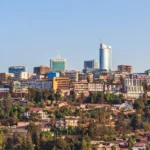
Kigali, the capital of Rwanda, spreads over several hills at about 1,500 m (4,900 ft). Often cited as a model of cleanliness, it is the starting point for almost every trip in the country. The first of the things to do in Kigali is a visit to the Kigali Genocide Memorial at Gisozi; then come the Kandt House Museum, the Inema art scene, the markets and the Nyamirambo district, before heading off to the gorillas of Volcanoes National Park or the savanna of Akagera.
This guide covers what to see, how to get around, the best season based on official normals, US and UK government advice, and exclusive calculations: rainy days over a stay, hot days, and daylight near the equator.

Our travel deals for Kigali
Affiliate links: we earn a commission, at no extra cost to you.
 FlightsKiwi.comCompare flights and airline combinations to Kigali.Compare flights
- Airport transferKiwitaxiPrivate driver booked in advance at a fixed price.Book a transfer
- eSIMAiraloData plan to install before you leave (eSIM-compatible phone).See plans



Kigali at a glance
- Population 1,745,555 at the census of 22 August 2022 (Wikipedia)
- Altitude about 1,500 m (4,900 ft), hence moderate temperatures all year
- Time zone UTC+2, no daylight saving; 2 h ahead of London and 7 h ahead of New York in winter
- Airports Kigali International Airport (KGL), at Kanombe, east of the city
- Entry US: visa on arrival ($50 single entry); UK: free 30-day visa on arrival; passport valid 6 months after arrival (travel.state.gov · GOV.UK)
- Currency Rwandan franc
- As the crow flies Musanze (Volcanoes National Park) about 69 km (43 mi), Lake Kivu at Gisenyi 93 km (58 mi) (Destination de Voyage calculation)
- Best time June to August (long dry season); December to February more variable
Safety: the U.S. Department of State rates Rwanda Level 3: Reconsider Travel due to crime, unrest and health risks (travel advisory updated June 3, 2026), citing the Ebola outbreak in neighbouring DRC and Uganda, and advises against travel within 10 km (6 mi) of the border with the Democratic Republic of the Congo. The UK FCDO (GOV.UK, updated 4 September 2026) advises against all but essential travel to the parts of Rusizi District within 10 km of the DRC border. Kigali is not in these areas.
Things to do in Kigali: the highlights
The Kigali Genocide Memorial (Gisozi)
Located in the Gisozi district, the memorial commemorates the 1994 genocide against the Tutsi. More than 250,000 victims are buried there. It includes a visitor centre and exhibition halls that explain the events that led to the genocide; it is run by the Aegis Trust. Allow plenty of time, dress respectfully and keep a reflective attitude: this is the most important visit in Kigali.
The Kandt House Museum
In 1907, the German administrator Richard Kandt set up the colonial administration’s headquarters on Nyarugenge hill. The building constructed in 1908, the only historic building from that period still standing, was renovated in 2004 and turned into a natural history museum. Since 17 December 2017 it has been called the Kandt House Museum and also presents the history of Rwanda before and during German colonisation.
Nyamirambo
Southwest of the centre, on Nyarugenge hill, the Nyamirambo district was built in the 1920s by the Belgian colonial administration to house civil servants and Swahili traders, mostly Muslim: it is often called the « Muslim quarter ». Its mosque dates from the 1930s. Its lively streets, workshops and small restaurants are best explored on foot, ideally with a local guide.
Inema Arts Center and the art scene
Founded in 2012 by six painter brothers, the Inema Arts Center is both an art centre and a gallery. It shows contemporary Rwandan artists and serves as a platform for young talent. Other galleries and studios are dotted around the city.
Markets and neighbourhood life
Kimironko market, in Gasabo District, is the one most often recommended by guides for fresh produce, fabrics and crafts. Elsewhere, the Kiyovu and Kimihurura districts, home to the Kigali Convention Centre, have cafés and restaurants. According to GOV.UK, the last Saturday of each month is Umuganda, a national day of community service, when most normal services close from 7 a.m. to 11 a.m.; Kigali also has a car-free morning from 7 a.m. to 10 a.m. on the first and third Sunday of the month.
A plastic bag–free city
Rwanda bans plastic bags for environmental reasons: any you bring will be confiscated on arrival (GOV.UK, travel.state.gov). Leave them out of your luggage and bring cloth bags.
Day trips: Volcanoes, Akagera, Lake Kivu
Kigali is the gateway to the major parks. Volcanoes National Park, in the northwest near Musanze (Ruhengeri), is home to mountain gorillas: permits are limited and must be booked well in advance (the U.S. Department of State reminds you to obtain permits before entering national parks). Akagera National Park, 1,122 km² (433 sq mi) in the east near the Tanzanian border and created in 1934, is the country’s savanna park. To the west, Lake Kivu is reached at Gisenyi (Rubavu). If your trek takes you close to the DRC border, the UK FCDO advises checking the advice for that border region and discussing your itinerary with your tour operator. More ideas in our Rwanda travel guide.
Itinerary: Kigali in 2 days
| Day | Plan | Tip |
|---|---|---|
| 1 | Gisozi memorial in the morning, Kandt House Museum, city centre | Keep the afternoon light after the memorial |
| 2 | Kimironko market, Inema Arts Center, Nyamirambo late in the day | Use licensed taxis rather than motorcycle taxis |
When to go to Kigali
From June to August, during the long dry season: 20 mm (0.8 in) in June, 10 mm (0.4 in) in July and 30 mm (1.2 in) in August, according to WMO 1991–2020 normals for the Kigali airport station. Thanks to the altitude, temperatures vary little: 26.3 to 28.2 °C (79 to 83 °F) in the afternoon and about 15.4 to 16.6 °C (60 to 62 °F) at night, all year round. Kigali has two rainy seasons: March to May (April is the wettest, 136 mm, 5.4 in) and October to December (121 mm, 4.8 in, in November). January–February form a short, drier season, but it still rains on about eight days a month.
| Month | High °C (°F) | Low °C (°F) | Rain mm (in) | Rainy days | Days ≥ 10 mm | Days ≥ 30 °C | Verdict |
|---|---|---|---|---|---|---|---|
| January | 27.5 (82) | 16.2 (61) | 84 (3.3) | 8.5 | 3.0 | 4.9 | ⚠️ Short dry season, showers |
| February | 27.8 (82) | 16.3 (61) | 84 (3.3) | 7.8 | 2.7 | 5.7 | ⚠️ Short dry season, showers |
| March | 27.1 (81) | 16.2 (61) | 129 (5.1) | 12.9 | 4.5 | 3.1 | ❌ Rainy season |
| April | 26.4 (80) | 16.5 (62) | 136 (5.4) | 14.4 | 4.7 | 0.6 | ❌ The wettest |
| May | 26.3 (79) | 16.6 (62) | 89 (3.5) | 9.8 | 3.0 | 0.3 | ⚠️ End of the rains |
| June | 26.7 (80) | 16.0 (61) | 20 (0.8) | 2.3 | 0.7 | 0.2 | ✅ Dry season |
| July | 27.4 (81) | 15.4 (60) | 10 (0.4) | 0.9 | 0.2 | 1.2 | ✅ The driest |
| August | 28.2 (83) | 16.4 (62) | 30 (1.2) | 3.6 | 1.0 | 5.0 | ✅ Dry, the warmest |
| September | 28.2 (83) | 16.4 (62) | 65 (2.6) | 7.9 | 2.2 | 5.9 | ⚠️ Rains return |
| October | 27.4 (81) | 16.3 (61) | 109 (4.3) | 12.5 | 3.7 | 3.0 | ❌ Rainy season |
| November | 26.3 (79) | 16.1 (61) | 121 (4.8) | 13.6 | 4.1 | 0.2 | ❌ Rainy season |
| December | 26.8 (80) | 16.2 (61) | 76 (3.0) | 9.9 | 2.5 | 1.4 | ⚠️ Rains easing |
These values match our page on when to go to Rwanda.
Rain over a 4-day stay and daylight
Over four days, you can expect on average 0.1 rainy days in July, against 1.9 in April. Days above 30 °C (86 °F) are rare (32 a year), mostly in August–September and February. Just south of the equator, day length barely changes: between 12 h 01 and 12 h 14 depending on the month. On the 15th of each month, the sun sets between 17:50 and 18:19 local time: plan your excursions accordingly.
| Month | Rainy days over 4 days | Sunrise (15th) | Sunset (15th) |
|---|---|---|---|
| January | 1.1 | 06:02 | 18:15 |
| February | 1.1 | 06:08 | 18:19 |
| March | 1.7 | 06:05 | 18:12 |
| April | 1.9 | 05:57 | 18:01 |
| May | 1.3 | 05:55 | 17:56 |
| June | 0.3 | 05:59 | 18:00 |
| July | 0.1 | 06:05 | 18:06 |
| August | 0.5 | 06:02 | 18:05 |
| September | 1.1 | 05:52 | 17:57 |
| October | 1.6 | 05:40 | 17:50 |
| November | 1.8 | 05:38 | 17:50 |
| December | 1.3 | 05:47 | 18:01 |
To compare with other destinations, see where to go in July and our Uganda and Kenya pages.
Getting there and getting around Kigali
- By air: Kigali International Airport (KGL), the hub of RwandAir, is at Kanombe, east of the city. Routes may be nonstop or involve a connection depending on the airline and season: check current schedules with the airlines. GOV.UK reports health screening at the airport in response to the Ebola outbreak in DRC.
- Taxis: the U.S. Department of State advises using only official Kigali city buses and licensed taxis (orange-striped) and confirming the fare before departure; US Embassy staff are not permitted to use motorcycle taxis or minibus taxis, considered unsafe. GOV.UK also notes that shared taxis and motorbike taxis are very vulnerable to accidents.
- Road: roads from Kigali to the main towns are in good condition but can be damaged by landslides in the rainy season; after dark, many roads outside the larger towns are unlit and driving standards are poor (GOV.UK). An international driving permit and third-party insurance are required (travel.state.gov); UK drivers need the 1949 IDP and their UK licence (GOV.UK).
Airport transfer and car rental
A transfer booked through your accommodation makes arrival easier. For the parks, a car with a driver-guide saves you driving yourself; if you rent a vehicle, check the insurance, the excess, the vehicle’s condition and permission to enter the parks, and avoid driving at night.
Where to stay in Kigali
The Kiyovu, Kimihurura and Remera districts have most of the hotels and restaurants; Remera is handy for the airport. Choose according to your day trips: northwest toward Volcanoes or east toward Akagera.
If you… then…: choosing your trip
| If you… | Then… |
|---|---|
| only have one day | the Gisozi memorial, the Kandt House Museum, the city centre |
| want to understand the country | the memorial on the first day, before any excursion |
| love art and city life | Inema Arts Center, Kimironko, Nyamirambo |
| dream of gorillas | Volcanoes National Park, with a permit booked well in advance |
| prefer the savanna | Akagera, preferably in the dry season (June–August) |
Entry requirements, health and safety
- US citizens: according to the U.S. Department of State (travel.state.gov, last updated May 14, 2026), your passport must be valid for six months after the date of entry. You can get a 30-day tourist visa on arrival for $50 (single entry) or $70 (multiple entry); cards are generally accepted at Kigali airport, but bring enough cash in US dollars in case card payment is not possible. Visas of 30 days, 90 days or 10 years can also be obtained through the Rwandan Embassy in Washington, D.C.
- UK citizens: according to the UK FCDO (GOV.UK, updated 4 September 2026), you must have a visa, and as a Commonwealth citizen you can get a free 30-day visa on arrival. Your passport must have an expiry date at least 6 months after the date you arrive and at least one blank page.
- Yellow fever: a yellow fever vaccination certificate is required if you arrive from a country listed as a transmission risk (GOV.UK, travel.state.gov).
- Health: the U.S. Department of State lists malaria among health risks; see a doctor about prevention before you leave. GOV.UK reports health screening at Kigali airport and border restrictions with DRC linked to the Ebola outbreak. Hospitals often require payment up front, and appropriate treatment is typically available only near major cities: insurance covering medical evacuation is strongly recommended (travel.state.gov). Emergencies: 112 (ambulance, GOV.UK).
- Crime: crime levels are relatively low, but there are cases of burglary, theft, bag-snatching and mugging in Kigali; some off-limits military zones in Kigali may not be well lit or signposted (GOV.UK). Do not display cash and valuables (travel.state.gov).
- Local laws: photographing military sites, government buildings, airports and public monuments is prohibited; drones must be declared on arrival and require a permit (travel.state.gov).
- Borders: crossings with DRC at Gisenyi–Goma and Cyangugu–Bukavu have varying opening hours and can close at short notice; Burundi closed its border with Rwanda in January 2024 (GOV.UK).
- See also our guides to travel documents and travel insurance.
Practical tips: internet and money
The currency is the Rwandan franc. For mobile internet, a local SIM card or an eSIM limits roaming charges: check your phone’s compatibility (our travel eSIM guide) and follow exchange rates with our currency converter.
Frequently asked questions
What can you see in Kigali in one day?
The Kigali Genocide Memorial at Gisozi, the Kandt House Museum and the city centre; if time allows, Kimironko market or the Inema Arts Center.
Is Kigali safe?
The U.S. Department of State rates Rwanda Level 3: Reconsider Travel (crime, unrest, health) and advises against areas within 10 km of the DRC border. In Kigali, GOV.UK describes crime as relatively low but reports theft, bag-snatching and mugging. Check both sources before you go.
Do you need a visa for Rwanda?
Yes, but it is available on arrival: US citizens pay $50 for a 30-day single-entry visa (travel.state.gov), and UK citizens get a free 30-day visa (GOV.UK). Your passport must be valid six months after arrival.
What is the best time to visit Kigali?
June to August, during the long dry season (10 mm, 0.4 in, in July according to WMO 1991–2020 normals). Temperatures vary little all year thanks to the altitude.
Can you bring plastic bags to Rwanda?
No: plastic bags are banned and will be confiscated on arrival (GOV.UK, travel.state.gov). Bring cloth bags.
Our sources
- WMO 1991–2020 normals, Kigali airport station (WMO 64387), NOAA/NCEI file downloaded on 24 October 2026
- Entry, health and safety information read on 26 October 2026: U.S. Department of State, Rwanda country information (travel.state.gov, last updated May 14, 2026) and Rwanda travel advisory (June 3, 2026); UK FCDO, foreign travel advice for Rwanda (GOV.UK, updated 4 September 2026)
- Wikipedia: « Kigali », « Kigali Genocide Memorial », « Volcanoes National Park », « Akagera National Park », « Kandt House Museum », « Inema Arts Center », « Gasabo District », « Kigali International Airport », consulted on 24 October 2026
- Destination de Voyage calculations: rain over 4 days, sunrise and sunset (NOAA algorithm), day length, straight-line distances
- Our methodology
Updated October 2026.
To extend your trip, see our Rwanda travel guide, the page when to go to Rwanda, our Uganda and Tanzania pages and our destinations in Africa.