When is the best time to visit Bhutan? Autumn (October–November), then spring (March–April): skies are often clear over the Himalaya, trails are passable and days are mild in the Paro, Thimphu and Punakha valleys. From June to September, the monsoon brings almost daily rain, low cloud and roads that are sometimes cut. To picture the Paro, Thimphu and Punakha valleys, open the map of Bhutan.
Bhutan rises from the tropical hills of the south, at about 200 m (656 ft) in altitude, to peaks of more than 7,000 m (22,966 ft) on the northern border. Most travelers visit the central valleys, between 1,200 and 2,500 m (3,937 and 8,202 ft). The right time therefore also depends on your plans: cultural visits, religious festivals (tsechus), high-altitude trekking or watching black-necked cranes. Here is how to choose, based on the official normals of the Bhutanese meteorological service.

Our travel deals for Bhutan
Affiliate links: we earn a commission, at no extra cost to you.
 FlightsKiwi.comCompare flights and airline combinations to Bhutan.Compare flights
- eSIMAiraloData plan to install before you leave (eSIM-compatible phone).See plans


When to go to Bhutan at a glance
- Best overall period October and November, just after the monsoon
- Second best period March and April, with rhododendrons in bloom at altitude
- Monsoon roughly June to September; 19 rainy days on average in July in Thimphu
- Winter (December–February) dry and bright, but night frosts in Thimphu and Paro (average minimum of −2.2 °C (28 °F) in January in Thimphu)
- For high-altitude trekking preferably October–November, or April–May
- For festivals the Paro Tsechu in spring and the Thimphu Tsechu in autumn, on dates that change every year
- Good to know the cost of a stay depends little on the season, because the Sustainable Development Fee (SDF) of USD 100 per person per night applies all year (Department of Tourism, rate to run until 2027; check before booking)
When to go to Bhutan by priority
- Best weather: October–November, just after the monsoon (0.3 rainy days in November in Thimphu), then March–April
- Cheapest: costs vary little: the SDF of USD 100 per person per night applies all year; accommodation is a little cheaper in winter and during the monsoon
- Fewest crowds: December to February, dry and bright but cold at night; June to August, in the middle of the monsoon
- Events: Paro Tsechu in March or April, Thimphu Tsechu in September or October, black-necked crane festival usually in November; lunar dates to check every year
Bhutan: the calendar at a glance
✅ Best months: March, April, October, November, December
❌ Period to avoid: June, July, August
Climate in Bhutan month by month
The table below gives the normals for Thimphu (Simtokha station, 2,310 m or 7,579 ft above sea level), the capital, which is almost always visited together with Paro, home to the country’s only international airport. The Bhutanese meteorological service publishes the number of rainy days, which gives a good idea of how often showers occur. Punakha and Bumthang are detailed below.
| Month | Avg. max | Avg. min | Rainy days | Crowds | Prices | Verdict |
|---|---|---|---|---|---|---|
| January | 14.8 °C (59 °F) | −2.2 °C (28 °F) | 1.1 | Low | Moderate | ⚠️ Dry and sunny, freezing nights |
| February | 16.6 °C (62 °F) | 0.3 °C (33 °F) | 1.2 | Low | Moderate | ⚠️ Dry, still cold in the evening |
| March | 19.3 °C (67 °F) | 3.8 °C (39 °F) | 3.8 | High | High | ✅ Mild, start of the spring high season |
| April | 22.4 °C (72 °F) | 7.9 °C (46 °F) | 6.2 | High | High | ✅ Rhododendrons, a few showers |
| May | 24.8 °C (77 °F) | 11.6 °C (53 °F) | 8.7 | Moderate | High | ⚠️ More frequent showers, haze |
| June | 26.7 °C (80 °F) | 15.3 °C (60 °F) | 14.2 | Low | Moderate | ❌ Arrival of the monsoon |
| July | 27.0 °C (81 °F) | 16.5 °C (62 °F) | 19.0 | Low | Moderate | ❌ Wettest month |
| August | 27.3 °C (81 °F) | 16.1 °C (61 °F) | 16.7 | Low | Moderate | ❌ Monsoon, roads sometimes cut |
| September | 26.0 °C (79 °F) | 14.6 °C (58 °F) | 11.7 | Moderate | High | ⚠️ End of the monsoon, Thimphu festival possible |
| October | 23.7 °C (75 °F) | 9.0 °C (48 °F) | 4.7 | Very high | High | ✅ Clear skies, the most requested month |
| November | 19.7 °C (67 °F) | 3.2 °C (38 °F) | 0.3 | High | High | ✅ Almost no rain, Himalayan views |
| December | 16.6 °C (62 °F) | −0.8 °C (31 °F) | 0.7 | Moderate | Moderate | ✅ Dry and quiet, cold nights |
Two figures sum up Thimphu’s climate: 0.3 rainy days on average in November, against 19 in July. Temperatures vary mostly with altitude and time of day. Afternoons remain pleasant almost all year in the valleys, but nights are cool from October to April and fall below freezing in the heart of winter. Mid-range accommodation is rarely heated throughout: pack warm layers.
The seasons in Bhutan: pros and cons
As in neighboring Nepal, there are four periods: the post-monsoon autumn (October–November), the dry winter (December–February), spring (March–May) and the summer monsoon (June–September). The contrast between the dry and rainy seasons is sharp: from November to February, it almost never rains in the central valleys.
Autumn (October–November): the high season
This is the most sought-after period. The monsoon has washed the atmosphere, visibility over the snow-capped peaks is excellent, notably from the Dochula pass, and trails are dry. In Thimphu there are fewer than 5 rainy days in October and almost none in November. Highs fall from 24 °C (75 °F) to 20 °C (68 °F) over the season.
- Pros: the best visibility of the year, ideal trekking conditions, golden rice terraces around Punakha early in the season, Thimphu festival in some years
- Cons: hotels and flight seats in high demand, notably around festivals; cold nights at altitude from November
- Our tip: November often offers the same skies as October, with slightly fewer people
Winter (December to February): dry, quiet and cold
Winter is the driest and often the brightest season. Days remain mild in Thimphu (15 to 17 °C (59 to 63 °F)), but average minimums are below zero in December and January. Lower valleys such as Punakha (1,236 m or 4,055 ft) are markedly milder: an average minimum of 5.8 °C (42 °F) in January. At altitude, snow can temporarily close some mountain passes on the roads.
- Pros: few visitors, clear skies, black-necked cranes in the Phobjikha valley, pleasant climate in Punakha
- Cons: freezing nights in Thimphu, Paro and Bumthang, high-altitude treks impassable, mountain roads sometimes snowed over
- Who is it for? Cultural trips and birdwatchers
Spring (March to May): the second high season
Temperatures rise, rhododendrons bloom at altitude and the Paro Tsechu, one of the most visited festivals in the country, usually takes place in this season. March and April are very good months. In May, showers become more frequent (nearly 9 rainy days in Thimphu) and haze more often veils the peaks.
- Pros: flowering forests, pleasant temperatures, Paro festival, a good trekking season
- Cons: less sharp visibility than in autumn, crowds around the Paro festival
- Who is it for? Nature and festival lovers, trekkers
Monsoon (June to September): the green season
The monsoon brings frequent rain, mostly in the afternoon and at night: 14 to 19 rainy days a month in Thimphu, and up to 21.7 days in July in Jakar, in Bumthang. Clouds often hide the peaks, trails become muddy and landslides can cut mountain roads. Flights to Paro, which land in a narrow valley, are sensitive to the weather.
- Pros: very green landscapes, few tourists, mild temperatures
- Cons: obstructed views, slower roads, unpleasant trekking, leeches in the forest
- Who is it for? Culture-focused travelers, ready to adapt their program
When to go to Bhutan by region
In Bhutan, altitude matters more than distance. The table compares four stations representative of the most visited valleys: Paro (airport and Taktsang monastery), Thimphu (the capital), Punakha (low, warm valley) and Jakar (Bumthang district, in the center of the country).
| Month | Paro (2,406 m / 7,894 ft) | Thimphu (2,310 m / 7,579 ft) | Punakha (1,236 m / 4,055 ft) | Jakar / Bumthang (2,470 m / 8,104 ft) |
|---|---|---|---|---|
| January | 13.2 °C (56 °F) / −0.9 °C (30 °F) | 14.8 °C (59 °F) / −2.2 °C (28 °F) | 18.8 °C (66 °F) / 5.8 °C (42 °F) | 11.4 °C (53 °F) / −3.9 °C (25 °F) |
| February | 15.0 °C (59 °F) / 1.3 °C (34 °F) | 16.6 °C (62 °F) / 0.3 °C (33 °F) | 20.7 °C (69 °F) / 7.9 °C (46 °F) | 13.0 °C (55 °F) / −1.1 °C (30 °F) |
| March | 17.9 °C (64 °F) / 4.3 °C (40 °F) | 19.3 °C (67 °F) / 3.8 °C (39 °F) | 23.9 °C (75 °F) / 11.2 °C (52 °F) | 15.3 °C (60 °F) / 2.1 °C (36 °F) |
| April | 20.6 °C (69 °F) / 7.8 °C (46 °F) | 22.4 °C (72 °F) / 7.9 °C (46 °F) | 26.8 °C (80 °F) / 14.4 °C (58 °F) | 17.5 °C (64 °F) / 5.9 °C (43 °F) |
| May | 22.7 °C (73 °F) / 11.2 °C (52 °F) | 24.8 °C (77 °F) / 11.6 °C (53 °F) | 28.8 °C (84 °F) / 17.3 °C (63 °F) | 19.7 °C (67 °F) / 9.5 °C (49 °F) |
| June | 24.6 °C (76 °F) / 14.5 °C (58 °F) | 26.7 °C (80 °F) / 15.3 °C (60 °F) | 30.5 °C (87 °F) / 19.9 °C (68 °F) | 21.9 °C (71 °F) / 13.0 °C (55 °F) |
| July | 25.0 °C (77 °F) / 16.1 °C (61 °F) | 27.0 °C (81 °F) / 16.5 °C (62 °F) | 30.7 °C (87 °F) / 20.8 °C (69 °F) | 22.7 °C (73 °F) / 14.4 °C (58 °F) |
| August | 24.9 °C (77 °F) / 15.7 °C (60 °F) | 27.3 °C (81 °F) / 16.1 °C (61 °F) | 30.4 °C (87 °F) / 20.6 °C (69 °F) | 22.7 °C (73 °F) / 14.2 °C (58 °F) |
| September | 23.3 °C (74 °F) / 14.2 °C (58 °F) | 26.0 °C (79 °F) / 14.6 °C (58 °F) | 29.3 °C (85 °F) / 19.4 °C (67 °F) | 21.6 °C (71 °F) / 12.5 °C (54 °F) |
| October | 20.7 °C (69 °F) / 9.3 °C (49 °F) | 23.7 °C (75 °F) / 9.0 °C (48 °F) | 27.4 °C (81 °F) / 16.6 °C (62 °F) | 18.8 °C (66 °F) / 7.0 °C (45 °F) |
| November | 16.9 °C (62 °F) / 4.7 °C (40 °F) | 19.7 °C (67 °F) / 3.2 °C (38 °F) | 23.9 °C (75 °F) / 11.4 °C (53 °F) | 15.5 °C (60 °F) / 1.3 °C (34 °F) |
| December | 14.6 °C (58 °F) / 0.5 °C (33 °F) | 16.6 °C (62 °F) / −0.8 °C (31 °F) | 20.2 °C (68 °F) / 7.3 °C (45 °F) | 12.9 °C (55 °F) / −2.9 °C (27 °F) |
Paro and Thimphu
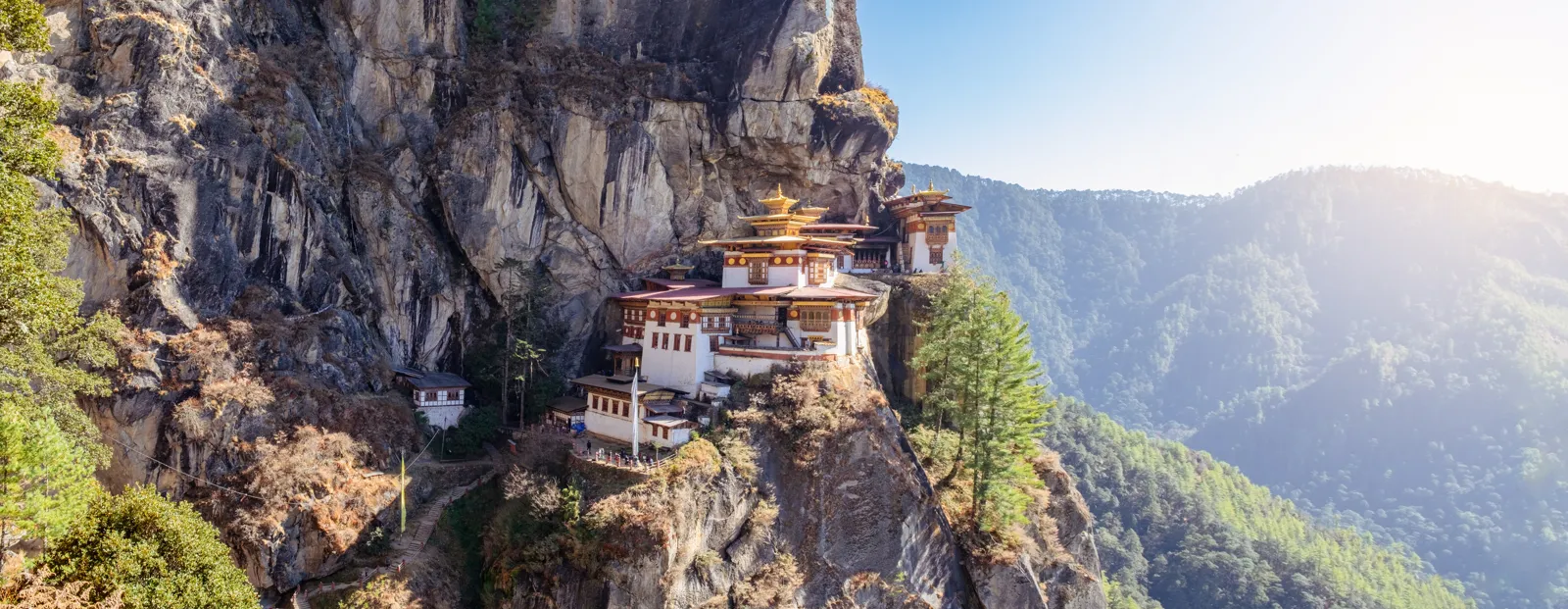
The two valleys, at about 2,300–2,400 m (7,546–7,874 ft), have a very similar climate. The ideal period is March to May and October to November. The climb to Taktsang monastery, perched at about 3,100 m (10,171 ft), is more pleasant in dry weather; in winter, set out early but dress warmly, as it often freezes at night. During the monsoon, the trail becomes slippery and the monastery is often in cloud.
Punakha and the Wangdue valley
About 1,000 m (3,281 ft) lower, the Punakha valley is the mildest on the classic circuit: 18 to 21 °C (64 to 70 °F) in the afternoon from December to February, with nights above 5 °C (41 °F). It is the right stop on a winter trip. In summer it becomes hot and humid, with highs above 30 °C (86 °F) from June to August.
Bumthang and the center of the country
Bumthang, in the heart of the country, is colder and wetter than the west: in Jakar, average minimums stay below zero from December to February, and there are more than 15 rainy days a month from May to August. The best window is mid-September to November, then March to April. The road from Punakha crosses several passes, which are slower to cross in winter and during the monsoon.
The Phobjikha valley
This glacial valley, at about 3,000 m (9,843 ft) in altitude, is known for hosting black-necked cranes in winter, which migrate from the Tibetan plateau. They are generally present from late autumn to late winter. A festival is dedicated to them at Gangtey monastery, usually in November: check the date for the year with the Department of Tourism or your tour operator.
Region-by-region summary: the right month by valley or type of trip (NCHM normals cited above).
| Month | Paro and Thimphu | Punakha (low valley) | Bumthang (center) | High-altitude trek |
|---|---|---|---|---|
| January | ⚠️ Dry, freezing nights | ✅ Mild (19 °C (66 °F)) | ⚠️ Very cold at night | ❌ Impassable |
| February | ⚠️ Dry, still cold | ✅ Mild | ⚠️ Cold at night | ❌ Impassable |
| March | ✅ Mild | ✅ Pleasant | ✅ Spring | ⚠️ Start of the season |
| April | ✅ Rhododendrons | ✅ Pleasant | ✅ Spring | ✅ Good season |
| May | ⚠️ More showers | ⚠️ Hot | ⚠️ Frequent showers | ✅ Good season |
| June | ❌ Monsoon | ❌ Hot and humid | ❌ Monsoon | ❌ Monsoon |
| July | ❌ Heart of the monsoon | ❌ Hot and humid | ❌ Monsoon | ❌ Monsoon |
| August | ❌ Monsoon | ❌ Hot and humid | ❌ Monsoon | ❌ Monsoon |
| September | ⚠️ End of the monsoon | ⚠️ End of the monsoon | ⚠️ Better late in the month | ⚠️ End of the monsoon |
| October | ✅ Clear skies | ✅ Pleasant | ✅ Good window | ✅ Ideal |
| November | ✅ Driest | ✅ Pleasant | ✅ Good window | ✅ Ideal |
| December | ✅ Dry, cold nights | ✅ Mild (20 °C (68 °F)) | ⚠️ Cold at night | ❌ Impassable |
✅ favorable conditions, ⚠️ possible with reservations, ❌ to avoid. Summary based on the normals cited on this page and the regional advice above.
When to go to Bhutan by trip type
| Trip | Best time | Where? |
|---|---|---|
| First cultural trip | October–November, March–April | Paro, Thimphu, Punakha |
| Multi-day trek | October–November, April–May | Druk Path (Paro–Thimphu), Haa valley |
| High-altitude trek | October, then April–May depending on the route | Jomolhari region |
| Religious festivals (tsechus) | March–April, September–October | Paro, Thimphu, Bumthang |
| Black-necked cranes | Late autumn and winter | Phobjikha valley |
| Quiet trip | December–February | Paro, Thimphu, Punakha |
| Mountain photography | October to December | Dochula pass, Chele La |
Major events to plan your trip around
| Date | Event | Location |
|---|---|---|
| Spring, usually March or April (lunar calendar) | Paro Tsechu: masked dances and the unfurling of a giant thangka at dawn on the last day | Rinpung Dzong, Paro |
| Autumn, usually September or October (lunar calendar) | Thimphu Tsechu, one of the largest festivals in the country | Tashichho Dzong, Thimphu |
| Usually November | Black-necked crane festival | Gangtey monastery, Phobjikha valley |
| Winter, usually December (lunar calendar) | Punakha Drubchen and Tsechu | Punakha Dzong |
| All year, depending on the monasteries | Local tsechus in many districts | Bumthang, Trongsa, Wangdue… |
During the major Paro and Thimphu festivals, hotels in both valleys fill up long in advance. Tsechus are above all religious ceremonies: appropriate dress, discretion and respect for photography rules are expected.
Bhutan weather month by month
Bhutan in January: The coldest month: an average minimum of −2.2 °C (28 °F) in Thimphu, but a very often blue sky. A good month for Punakha and the Phobjikha cranes, with very few visitors.
Bhutan in February: Still dry (1.2 rainy days in Thimphu), nights still cool. Losar, the Bhutanese new year, often falls between late January and March depending on the lunar calendar.
Bhutan in March: Start of the spring season: 19 °C (66 °F) in the afternoon in Thimphu, first rhododendrons. The Paro Tsechu is often held in March or April.
Bhutan in April: One of the best months: mild weather, flowering forests, about 6 rainy days in Thimphu. A very good month for the Druk Path.
Bhutan in May: Warmer, more showers (nearly 9 rainy days in Thimphu), visibility sometimes reduced. Still fine for the valleys.
Bhutan in June: Arrival of the monsoon, frequent afternoon rain. Few tourists, very green landscapes.
Bhutan in July: The heart of the monsoon: 19 rainy days in Thimphu, nearly 22 in Jakar. Slower roads, hidden peaks. Best reserved for cultural trips.
Bhutan in August: Conditions close to July. Flights to Paro can be delayed by the weather: keep some margin.
Bhutan in September: The rains recede late in the month. The Thimphu Tsechu falls in September in some years, in October in others.
Bhutan in October: The reference month: clear skies, fewer than 5 rainy days in Thimphu, trekking in good conditions. Maximum crowds.
Bhutan in November: The driest month (0.3 rainy days in Thimphu) and one of the clearest. Cold nights, arrival of the cranes in Phobjikha.
Bhutan in December: Dry and quiet, night frost in Paro and Thimphu, relative mildness in Punakha. Beautiful views from the Dochula pass in clear weather.
When to book your trip to Bhutan
For October–November or the dates of the major festivals, contact a licensed tour operator 4 to 6 months ahead: hotels and flight seats to Paro are limited. For winter and summer, 1 to 3 months is generally enough. Paro has the country’s only international airport, and flights into its narrow valley are sensitive to weather, so allow a margin of a day around your onward connections.
Planning your trip to Bhutan
- Entry requirements: see our country guide for the entry requirements for Bhutan.
- Time difference: Bhutan is on UTC+6 all year: 6 hours ahead of London in winter (5 in summer) and 11 hours ahead of New York in winter (10 in summer).
- Currency: the ngultrum (BTN), at par with the Indian rupee. Use our currency converter to estimate your budget.
To go further, see our complete Bhutan travel guide. Hesitating with a neighboring Himalayan destination? See also when to go to Nepal.
Frequently asked questions
What is the best month to visit Bhutan?
October and November are the most favorable months: the monsoon is over, skies are clear and trails are dry. November is the driest month in Thimphu, with 0.3 rainy days on average. March and April make up the second best period.
Can you visit Bhutan during the monsoon?
Yes, if your trip is mostly cultural. From June to September it rains on a large share of days (19 rainy days in July in Thimphu), peaks are often in cloud and mountain roads can be slowed by landslides.
Is Bhutan cold in winter?
Days remain mild in the valleys (15 to 17 °C (59 to 63 °F) in Thimphu), but nights are cold: an average minimum of −2.2 °C (28 °F) in January in Thimphu and −3.9 °C (25 °F) in Jakar. Punakha, at a lower altitude, is markedly milder.
When are the festivals in Bhutan?
Tsechus follow the lunar calendar. The Paro Tsechu is usually held in spring (March or April) and the Thimphu Tsechu in autumn (September or October). Check the dates for the year on Bhutan.travel before booking.
Is Bhutan cheaper in the low season?
Only a little. The Sustainable Development Fee of USD 100 per person per night applies all year (Department of Tourism; check bhutan.travel for the current rate before booking). Hotels and flights can be slightly more accessible in winter and during the monsoon, depending on tour operators’ quotes.
When can you see black-necked cranes in Bhutan?
They winter in the Phobjikha valley, generally from late autumn to late winter. A festival is dedicated to them at Gangtey monastery, usually in November.
What is the driest month in Bhutan?
November: 0.3 rainy days on average in Thimphu according to the NCHM normals, with 19.7 °C (67 °F) in the afternoon and 3.2 °C (38 °F) at night. December to February remain very dry, but colder at night.
Our sources
- National Center for Hydrology and Meteorology (NCHM) of Bhutan, Climate Data Book of Bhutan (2018): 1996–2017 normals for Thimphu-Simtokha, Paro and Jakar, and 1990–2017 for Punakha
- Department of Tourism, Royal Government of Bhutan (bhutan.travel): Sustainable Development Fee of USD 100 per person per night, in force from 1 September 2023 and announced for four years, checked 11 November 2026
- Our methodology
Looking for another destination for autumn? See our ideas for where to go in October and where to go in November.
Updated November 2026.